

Master Seoul’s Shared E-Scooter Parking Laws: How to Handle Fines, Towing, and Korean Civic Etiquette
Phase 1: Empathy (Immersive Story Opening)
안녕하세요! 매일한글 에디터입니다. (Hello! This is your Daily Hangul editor.)
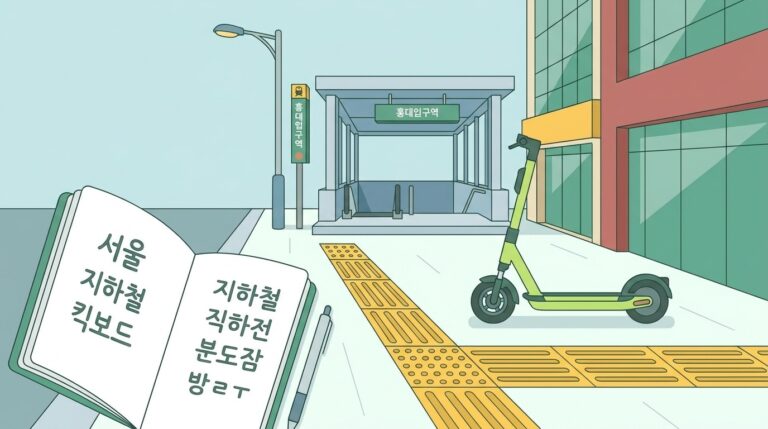
Picture this: You are rushing through the bustling alleys of Seongsu-dong after finishing a chic pop-up store crawl. To catch your KTX at Seoul Station, you grab a shared electric scooter (전동 킥보드), zip past traffic, and casually park it near a subway exit right next to the tactile paving. You feel like a savvy local embracing Korea’s cutting-edge smart-mobility sharing economy. But as you step back, a district towing officer (견인 단속반) steps forward with a clipboard and camera, sternly pointing out that your ride is obstructing the path of pedestrians and is subject to immediate towing (즉각 견인).
If you have ever felt a spike of adrenaline trying to navigate administrative confrontation in a foreign language, you are not alone. In urban Korea, where civic space is governed by meticulous standards of public consideration (배려 and 보행권), improper micro-mobility parking has triggered stringent regulations: instant 40,000 KRW towing fees plus storage penalties. At the C2 level, you do not just need survival words; you need nuanced legal diplomacy, articulate deference, and persuasive discourse markers to resolve civil disputes with district officials and towing operators. This guide is crafted from real case studies of international professionals and advanced learners living in Seoul.
Phase 2: Core Expressions Deep Dive (3 Selected Nuances)
1. 견인 조치 (Gyeon-in jo-chi)
- Pronunciation: [Gyeon-in jo-chi] (Think of ‘Gyeon’ like the start of ‘Beyond’ with a G, and ‘jo-chi’ sounding like an energetic ‘Joe-cheetah’ without the ‘tah’)
- Meaning: Literal: Towing action / Nuance: Regulatory towing enforcement due to illegal parking or urban obstruction.
- K-Culture Moment: Commonly heard in modern urban K-dramas when a character’s vehicle or scooter parked illegally outside a district office is hooked up to a tow truck amidst high drama.
- Editor’s Insight: 조치 (measure/action) carries authoritative administrative weight. When an officer mentions 견인 조치 예정입니다, it signals that legal enforcement is already underway, requiring immediate and polite intervention rather than casual dismissal.
- Situation Spectrum: Casual 🚫 | Semi-formal ⚠️ | Formal ✅
- 🤔 Think About It: Why does Korean bureaucracy frame administrative enforcement as ‘measures’ (조치) rather than personal penalties? How does this institutional phrasing shift conversational accountability?
2. 통행 방해 (Tong-haeng bang-hae)
- Pronunciation: [Tong-haeng bang-hae] (Sounds like ‘Tongue-hang bahng-hay’)
- Meaning: Literal: Passing interference / Nuance: Obstruction of pedestrian or vehicular traffic right-of-way.
- K-Culture Moment: Seen on Seoul Metropolitan public campaign posters emphasizing the civic right to unobstructed sidewalks (보행권 확보).
- Editor’s Insight: In Korean municipal law, parking within 5 meters of a subway exit or on tactile paving (점자블록) is legally categorized as 통행 방해, stripping the rider of typical grace periods.
- Situation Spectrum: Casual ⚠️ | Semi-formal ✅ | Formal ✅
- 🤔 Think About It: How does the societal concept of 민폐 (causing public inconvenience) transform a simple parking mistake into an ethical civic dilemma in Korean culture?
3. 과태료 부과 (Gwa-tae-ryo bu-gwa)
- Pronunciation: [Gwa-tae-ryo bu-gwa] (Imagine ‘Gwah-teh-ryo boo-gwah’)
- Meaning: Literal: Negligence fine imposition / Nuance: Levying an administrative non-criminal fine for regulatory violations.
- K-Culture Moment: Used when characters deal with civil fines—distinct from criminal penalties (벌금)—often seen in real estate or neighborhood dispute storylines.
- Editor’s Insight: C2 learners must distinguish between 과태료 (administrative fine for civic breach) and 벌금 (criminal fine). Misidentifying them during a dispute can alter your legal posture.
- Situation Spectrum: Casual 🚫 | Semi-formal ⚠️ | Formal ✅
- 🤔 Think About It: In your native culture, do administrative infractions carry social stigma, or are they viewed purely as transactional fees? How does Korea’s system bridge both?
Phase 3: Textbook Korean vs. Real Native Korean
Situation A: Explaining immediate relocation to prevent towing
- 📖 Textbook Korean: 킥보드를 여기에 두면 안 됩니다. 제가 지금 옮기겠습니다. (Kik-bo-deu-reul yeo-gi-e du-myeon an doem-ni-da. Je-ga ji-geum olm-gi-get-seum-ni-da.)
- 🗣️ Real Native Korean: 지금 즉시 전용 주차구역으로 이동 조치할 테니, 견인 처리는 잠시만 재고해 주실 수 있을까요? (Ji-geum jeuk-si jeon-yong ju-cha-gu-yeog-eu-ro i-dong jo-chi-hal te-ni, gyeon-in cheo-ri-neun jam-si-man jae-go-hae ju-sil su iss-eul-kka-yo?)
- 💡 Why is it different?: C2 discourse employs sophisticated administrative terms (이동 조치, 재고) with honorific softening (-해 주실 수 있을까요) to show legal comprehension and respect, substantially increasing the officer’s willingness to grant leniency.
Situation B: Inquiring about fine appeal procedures
- 📖 Textbook Korean: 벌금이 너무 비쌉니다. 어떻게 취소합니까? (Beol-geum-i neo-mu bi-ssam-ni-da. Eot-teoh-ge chwi-so-ham-ni-ka?)
- 🗣️ Real Native Korean: 해당 구역이 즉각 견인 대상 구역인지 인지하지 못했는데, 소명 절차를 밟을 수 있는 창구가 마련되어 있습니까? (Hae-dang gu-yeog-i jeuk-gak gyeon-in dae-sang gu-yeog-in-ji in-ji-ha-ji mot-haet-neun-de, so-myeong jeol-cha-reul balb-eul su iss-neun chang-gu-ga ma-ryeon-doe-eo iss-seum-ni-ka?)
- 💡 Why is it different?: Native speakers do not argue emotional unfairness; they cite formal objection mechanisms (소명 절차) with bureaucratic precision.
Phase 4: K-Culture Deep Dive & Non-Verbal Manners
4-1. Nunchi & Dispute Etiquette
When dealing with district towing teams (견인 단속 공무원 및 대행 기사), overt anger or aggressive body language (such as crossing arms, pointing, or voice-raising) will immediately terminate any informal grace window. Korean public officials adhere strictly to regulatory manuals to avoid favoritism accusations.
* Posture: Maintain a neutral, upright posture with hands gathered in front (공손한 자세).
* Eye Contact & Nodding: Alternate between attentive eye contact and slight respectful head nods (목례) while they cite the ordinance.
* De-escalation Tone: Use low, steady, deferential intonation with -시지요 or -하겠습니까 endings to convey high cultural literacy.
4-2. Cultural Code: The Balancing Act of Smart Mobility and Civic Space
Korea’s hyper-dense metropolitan infrastructure prioritizes vulnerable pedestrians—particularly the elderly and visually impaired. Tactical infrastructure like yellow tactile paving (점자블록) is legally sacred. Micro-mobility brands (지쿠, 빔, 씽씽) transformed Seoul’s last-mile transit, but public backlash against 킥라니 (a satirical portmanteau of ‘Kickboard’ + 고라니 / wild water deer leaping into traffic) led the Seoul Metropolitan Government to establish zero-tolerance towing zones. Understanding this civic context shifts your perspective from seeing enforcement as personal harassment to viewing it as urban maintenance.
Phase 5: Real-World C2 Roleplay Scenario
Setting: Subway Line 2, Seongsu Station Exit 3. You return to unlock your parked scooter, only to find a district-contracted towing technician affixing a yellow violation tag.
Characters:
* 민우 (Min-woo): District enforcement officer / towing contractor.
* You: Advanced expatriate professional resolving the violation.
— Dialogue Start —
- 민우: (단말기에 사진을 전송하며) 여기 지하철역 진입로 바로 앞은 5미터 이내 즉각 견인 구역입니다. 이미 전산 등록 마쳤습니다.
(Yeo-gi ji-ha-cheol-yeok jin-im-no ba-ro ap-eun o-mi-teo i-nae jeuk-gak gyeon-in gu-yeok-im-ni-da. I-mi jeon-san deung-nok ma-chyeot-seum-ni-da.)
🎭 Scanning the QR code and securing the wheel lock.
“This area within 5 meters of the subway entrance is an immediate towing zone. It is already registered in the system.” -
You: (정중하게 다가가며) 단속 중이신데 실례하겠습니다. 제가 잠시 정차 구역을 오인하여 보행에 불편을 끼쳐드렸군요.
(Dan-sok jung-i-sin-de sil-lye-ha-get-seum-ni-da. Je-ga jam-si jeong-cha gu-yeog-eul o-in-ha-yeo bo-haeng-e bul-pyeon-eul kki-chyeo-deu-ryeot-gun-yo.)
🎭 Bowing slightly and showing genuine awareness of the fault.
“Excuse me during your duty, officer. It seems I misjudged the designated parking perimeter and caused pedestrian inconvenience.” -
민우: 원칙대로라면 견인차에 결박해서 구청 보관소로 넘겨야 합니다. 기본 견인료 4만 원에 보관료까지 청구돼요.
(Won-chik-dae-ro-ra-myeon gyeon-in-cha-e gyeol-bak-hae-seo gu-cheong bo-gwan-so-ro neom-gyeo-ya ham-ni-da. Gi-bon gyeon-in-ryo sa-man won-e bo-gwan-ryo-kka-ji cheong-gu-dwae-yo.)
🎭 Checking the paperwork on his tablet with an unyielding expression.
“By protocol, this must be hitched to the tow truck and transferred to the district storage facility. You will be billed a 40,000 KRW base towing fee plus storage.” -
You: 네, 규정은 충분히 이해합니다. 다만 기사님께서 견인차에 결박하시기 직전 시점인데, 현장에서 즉시 이동 조치하는 조건으로 행정 처리를 유예해 주실 여지는 없으신지요?
(Ne, gyu-jeong-eun chung-bun-hi i-hae-ham-ni-da. Da-man gi-sa-nim-kke-seo gyeon-in-cha-e gyeol-bak-ha-si-gi jik-jeon si-jeom-in-de, hyeon-jang-e-seo jeuk-si i-dong jo-chi-ha-neun jo-geon-eu-ro haeng-jeong cheo-ri-reul yu-ye-hae ju-sil yeo-ji-neun eop-seu-sin-ji-yo?)
🎭 Maintaining a composed, respectful demeanor with hands clasped together.
“Yes, I fully respect the regulations. However, since this is right before physical hitching, would there be any room to defer towing on the condition that I immediately relocate it to a lawful zone on the spot?” -
민우: (잠시 고민하듯 단말기를 확인하며) 원칙상 전산 업로드 후에는 취소가 까다롭긴 합니다만… 현장 자진 이동 의사가 명확하시니 취소 사유를 적어볼 수는 있습니다.
(Won-chik-sang jeon-san eop-ro-deu hu-e-neun chwi-so-ga kka-da-rop-gin ham-ni-da-man… Hyeon-jang ja-jin i-dong ui-sa-ga myeong-hwak-ha-si-ni chwi-so sa-yu-reul jeok-eo-bol su-neun iss-seum-ni-da.)
🎭 Pausing and looking up, acknowledging the speaker’s polite Korean proficiency.
“Officially, cancellation after system upload is complex… but since you clearly express intent for immediate voluntary relocation, I could log a cancellation rationale.” -
You: 배려해 주셔서 대단히 감사합니다. 바로 50미터 전방에 위치한 지정 거치대로 즉각 입고시키겠습니다.
(Bae-ryeo-hae ju-syeo-seo dae-dan-hi gam-sa-ham-ni-da. Ba-ro o-sip-mi-teo jeon-bang-e wi-chi-han ji-jeong geo-chi-dae-ro jeuk-gak ip-go-si-ki-get-seum-ni-da.)
🎭 Unlocking the scooter via smartphone app swiftly.
“I deeply appreciate your consideration. I will immediately park it in the designated rack located 50 meters ahead.” -
민우: 다음부터는 점자블록이나 횡단보도 진입로는 무조건 피하세요. 보행자 안전 단속이 대폭 강화되었습니다.
(Dae-eum-bu-teo-neun jeom-ja-beul-lok-i-na hoeng-dan-bo-do jin-im-no-neun mu-jo-geon pi-ha-se-yo. Bo-haeng-ja an-jeon dan-sok-i dae-pok gang-hwa-doe-eoss-seum-ni-da.)
🎭 Releasing the manual clamp with a nod.
“Next time, make sure to avoid tactile blocks or pedestrian crossing paths unconditionally. Sidewalk safety enforcement has intensified significantly.” -
You: 명심하겠습니다. 수고하십시오!
(Myeong-sim-ha-get-seum-ni-da. Su-go-ha-sip-si-o!)
🎭 Nodding with a professional 45-degree bow before smoothly wheeling the scooter away.
“I will keep that strictly in mind. Keep up the good work!”
— Dialogue End —
🔀 Interactive Decision Branch
What would you do if the officer says the digital upload is finalized and cannot be cancelled on-site?
* Choice A: Firmly demand to see their identification badge and state that you will file a formal complaint with the city hall immediately.
* Feedback (Bad): Triggering an aggressive confrontation will result in immediate towing, potential obstruction of justice inquiries, and zero room for fine waivers.
* Choice B: Ask for the official receipt and inquire politely about the formal objection submission process (소명 절차) at the district office.
* Feedback (Best): Demonstrates elite civic composure. Officers will provide accurate paperwork, making your formal online appeal via the Seoul E-Complaint portal far more credible.
* Choice C: Abandon the scooter and walk away quickly so your name isn’t recorded on the spot.
* Feedback (Risk): The rental mobility platform will automatically link your user account to the impound notice, deducting both the 40,000 KRW towing fee and accrued daily storage fees directly from your registered credit card.
Phase 6: 10-Second Emotion Shadowing Drill
- [Formal Deference & Apology]
보행에 / 불편을 끼쳐드린 점 / 깊이 사과드립니다.
(Bo-haeng-e / bul-pyeon-eul kki-chyeo-deu-rin jeom / gip-i sa-gwa-deu-rim-ni-da.)
I sincerely apologize for causing inconvenience to pedestrian traffic. -
[Persuasive Negotiation]
현장에서 / 즉각 이동 조치할 테니 / 행정 처리를 / 유예해 주실 수 있겠습니까?
(Hyeon-jang-e-seo / jeuk-gak i-dong jo-chi-hal te-ni / haeng-jeong cheo-ri-reul / yu-ye-hae ju-sil su iss-get-seum-ni-ka?)
Since I will relocate it on the spot immediately, would you be able to defer administrative towing? -
[Administrative Precision]
부당한 견인 조치에 대해 / 정식으로 소명 절차를 / 밟고자 합니다.
(Bu-dang-han gyeon-in jo-chi-e dae-hae / jeong-sik-eu-ro so-myeong jeol-cha-reul / balb-go-ja ham-ni-da.)
I would like to undergo formal appeal procedures regarding this unwarranted towing measure.
Phase 7: K-Culture Mini Dictionary
- 무단 방치 (Mu-dan bang-chi) | Unauthorized Abandonment
Refers to leaving personal mobility devices or trash in unauthorized public spaces without prior municipal consent. Legally invokes instant impoundment. - 점자블록 (Jeom-ja-beul-lok) | Tactile Paving / Braille Blocks
Yellow textured ground indicators designed for the visually impaired. Obstructing these is treated as an egregious municipal safety violation in Korea. - 소명 절차 (So-myeong jeol-cha) | Formal Justification / Appeal Procedure
The legal right of a citizen to provide evidentiary justification (such as app server malfunction or emergency circumstances) against an administrative penalty. - 즉각 견인 구역 (Jeuk-gak gyeon-in gu-yeok) | Immediate Towing Zone
Five designated high-risk zones across Seoul (subway entrances, bus stops, tactile paving, crosswalk ramps, and fire hydrants) exempt from the standard 1-hour grace notice.
Phase 8: Survival Kit for Urban Navigators
Top 3 Survival Phrases
- 지정 주차구역이 어디인가요? (Ji-jeong ju-cha-gu-yeog-i eo-di-in-ga-yo? / Where is the designated parking zone?)
Pro Tip: Look for white scooter-drawn rectangular painted boxes on the sidewalk near bike racks. - 견인 보관소 위치와 반환 절차를 안내해 주십시오. (Gyeon-in bo-gwan-so wi-chi-wa ban-hwan jeol-cha-reul an-nae-hae ju-sip-si-o. / Please guide me on the towing impound location and retrieval procedure.)
Pro Tip: Towing impounds require personal ID verification and app session proof. - 주차 인증 사진을 다시 확인해 주시겠습니까? (Ju-cha in-jeung sa-jin-eul da-si hwak-in-hae ju-si-get-seum-ni-ka? / Could you re-verify my parking confirmation photo?)
Pro Tip: Always take a clear wide-angle photo when ending your ride on the app as legal defense evidence.
Editor’s Travel Note
- Essential Digital Utility: Download the Seoul Smart Complaint App (서울스마트불편신고) to check real-time mobility regulations and verify designated parking clusters near major transit hubs.
- Transit Reality: Never park within 5 meters of a subway station exit or inside bus station shelter perimeters—these are camera-monitored high-enforcement hotspots.
Phase 9: “한 발 더 깊이” (Think Deeper Essay)
In many Western urban centers, micro-mobility disputes center largely on private property rights and corporate liability. In South Korea, however, shared e-scooter governance is deeply intertwined with the ethical philosophy of Gongdongche Uisik (공동체 의식 / Collective Community Consciousness). Sidewalks are fundamentally perceived as a shared public sanctuary where the vulnerability of pedestrians precedes individual convenience. When an e-scooter blocks a yellow tactile paving slab (점자블록), society views it not merely as a parking technicality, but as an infringement on communal empathy and civic solidarity. Mastering the language of Korean municipal etiquette requires understanding this collective equilibrium: your fluency is expressed not through winning a debate, but through restoring harmonious public order.
💬 Your Turn: Have you ever encountered a clash between shared micro-mobility and pedestrian rights in your home city? How would you articulate the balance between technological convenience and public consideration in Korean? Share your perspective in the comments below!
Phase 10: FAQ & Common Mistakes
Q: Can shared mobility companies pay the towing fine on my behalf?
A: No. While the mobility rental company initially pays the municipal impound fee to recover their hardware, their terms of service mandate that the full 40,000 KRW towing fee plus hourly storage surcharges are automatically charged to your registered credit card.
Q: Is there a grace period before a scooter is towed in Seoul?
A: Standard sidewalk obstructions generally receive a 1-hour grace period via the municipal alert system. However, the 5 Immediate Towing Zones (subway exits, bus stops, crosswalk ramps, tactile paving, and fire hydrants) are towed immediately without prior notice.
Q: What should I do if my scooter was moved into an illegal zone by someone else after I parked lawfully?
A: Always capture an in-app termination photo showcasing the scooter parked against a fixed background reference. You can submit this photographic proof during the official appeal process (소명 절차) via the district office website to get the fine dismissed.
🚨 Common Mistakes
- Mistake: Arguing that you “only parked for 2 minutes to grab coffee.”
- Correct Action: Acknowledge the obstruction instantly with 즉시 이동하겠습니다 (I will move it immediately) rather than making temporal excuses, which carry zero legal validity.
- Mistake: Using informal or blunt imperative verbs like 견인하지 마세요 (Don’t tow it).
- Correct Action: Employ deferential honorifics: 견인 처리를 잠시만 재고해 주실 수 있겠습니까? (Could you please reconsider towing processing for a moment?).
- Mistake: Leaving the scooter parked diagonally across tactile paving.
- Correct Action: Ensure the scooter is aligned parallel to the curb, at least 1 meter away from tactile paving and building entrances.
Phase 11: Action Missions & Community Challenge
- 🥉 Bronze Mission (Solo Practice): Record yourself reading Phase 6 Shadowing Drill #2 with steady, professional intonation until you achieve natural rhythm under 5 seconds.
- 🥈 Silver Mission (Social Application): Next time you spot an electric scooter blocking a sidewalk, identify whether it sits in an 즉각 견인 구역 (Immediate Towing Zone) and write a 2-sentence summary in Korean about why it violates municipal rules.
- 🥇 Gold Mission (Real-World Mastery): Open your preferred Korean mobility app (e.g., Kakao T, Swing, Beam) and locate the 반납 불가 구역 (No-Return Zone) settings in Korean UI, interpreting the legal disclaimer entirely in Korean.
- 🎮 K-Culture Mission: Watch an episode of an urban-themed K-Drama and spot how characters react to parking enforcement or municipal notices. Note down the honorific endings used.
Phase 12: Interactive Quiz Challenge
1. Contextual Judgement
You parked your shared scooter right next to a tactile block near Gangnam Station Exit 11. An enforcement officer begins photographing it. What is the most legally sound and culturally effective response?
* A) “여기 잠깐 둔 건데 왜 사진을 찍으세요?” (I only left it for a second, why are you taking photos?)
* B) “보행에 방해가 된 점 사과드립니다. 지금 즉시 전용 거치대로 이동 조치하겠습니다.” (I apologize for obstructing pedestrians. I will immediately relocate it to a designated rack.)
* C) “어차피 공유 킥보드 회사에서 돈 낼 거니까 그냥 견인하세요.” (The scooter company will pay anyway, so just tow it.)
🔍 Click to view Answer & Explanation
Correct Answer: B
Explanation: B combines immediate admission of civic impact (보행에 방해가 된 점), sincere apology, and proactive relocation terminology (이동 조치), which maximizes the officer’s administrative discretion to halt the towing process.
2. Fill-in-the-Blank
횡단보도 진입로나 점자블록 위에 킥보드를 방치할 경우, 유예 시간 없이 ________ ________ 대상이 됩니다.
(If you leave a scooter on crosswalk ramps or tactile blocks, it becomes subject to ________ ________ without a grace period.)
🔍 Click to view Answer & Explanation
Correct Answer: 즉각 견인 (Jeuk-gak gyeon-in / Immediate Towing)
Explanation: High-risk pedestrian areas are designated as immediate towing zones (즉각 견인 구역) across Seoul municipalities.
3. True or False Cultural Quiz
Statement: In Seoul, if you receive a towing fine for a shared scooter, you can completely ignore it if you are a foreign tourist leaving Korea within 48 hours. (True / False)
🔍 Click to view Answer & Explanation
Correct Answer: False
Explanation: Shared mobility platforms retain your credit card pre-authorization and will automatically charge the 40,000 KRW municipal towing fee plus compound daily storage penalties regardless of your physical location or residency status.







