

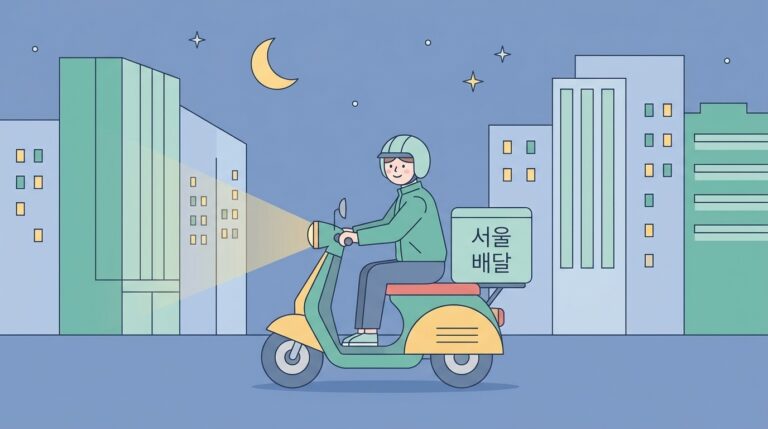
Master Korean Delivery Culture: Delivery Fees, Rider Etiquette, and Survival Phrases
Phase 1: Empathy & K-Culture Storytelling Opening
안녕하세요! 매일한글 (Daily Hangul) editor here!
Picture this: It is 11:30 PM on a brisk Friday evening in Hongdae. You are snuggled in your cozy apartment binge-watching the latest K-drama, and suddenly, the craving strikes—golden, crispy Korean fried chicken with pickled radish. You proudly whip out your phone, open a food delivery app, and assemble your dream midnight snack. But just as you reach the checkout screen, your eyes widen in disbelief: the base food is 18,000 KRW, but the “배달비” (delivery fee) adds an unexpected 5,000 KRW!
Wait, doesn’t South Korea have a strict zero-tipping culture? Is this a tip, a service surcharge, or a weather penalty? And when the doorbell finally rings, do you tip the rider in cash, or should you just shout through the intercom?
Navigating Korea’s lightning-fast delivery ecosystem can feel like a linguistic obstacle course for intermediate learners. In this comprehensive guide, curated from hundreds of real learner experiences and local cultural insights, we will demystify delivery fee tiering, teach you natural rider communications, and equip you with B2-level spoken phrases so you can order like a true Seoulite!
Phase 2: Core 3 Expressions Breakdown
1. 배달팁이 너무 비싸서 포장해 올게요. (한글)
- Pronunciation: [Bae-dal-ti-bi neo-mu bi-ssa-seo po-jang-hae ol-ge-yo] (Sounds like: bay-dahl-tee-bee nuh-moo bee-ssah-suh poh-jahng-hay ohl-geh-yo)
- Meaning: Literal: “Because the delivery tip is too expensive, I will package and bring it.” / Actual Nuance: “Delivery fees are crazy right now, so I’m just going to do takeout / pick it up myself.”
- K-Culture Moment: Heard constantly in Korean university dorms or one-room studios when roommates split the decision between paying a steep fee or walking five minutes to the local tteokbokki spot.
- Editor’s Insight: Notice the word 배달팁 (baedaltip). Even though tipping culture does not traditionally exist in Korean restaurants, apps coined this term to represent platform delivery surcharges.
- Situation Spectrum: Casual ✅ | Semi-formal ✅ | Formal ⚠️
- 🤔 Think About It: How does your home country differentiate between a “service charge,” a “courier fee,” and a personal “tip”?
2. 문 앞에 두고 벨 한 번만 눌러주세요. (한글)
- Pronunciation: [Mun a-pe du-go bel han beon-man nul-leo-ju-se-yo] (Sounds like: moon ah-peh doo-goh bell hahn buhn-mahn nool-luh-joo-seh-yo)
- Meaning: Literal: “Leave it in front of the door and press the bell just once.” / Actual Nuance: “Please leave the order at my doorstep and ring the bell once (contactless delivery).”
- K-Culture Moment: The quintessential request written into the “요청사항” (rider request box) in modern Korean apartments to maintain privacy and silence.
- Editor’s Insight: Using 한 번만 (just once) softens the imperative request politely, ensuring the rider doesn’t spam your doorbell while your pet or roommate is sleeping.
- Situation Spectrum: Casual ⚠️ | Semi-formal ✅ | Formal ✅
- 🤔 Think About It: Why has contactless convenience (비대면) become the default social etiquette in high-density Korean apartment buildings?
3. 기사님, 빗길인데 조심히 안전 운전하세요! (한글)
- Pronunciation: [Gi-sa-nim, bit-gi-rin-de jo-sim-hi an-jeon un-jeon-ha-se-yo!] (Sounds like: gee-sah-neem, beet-gheel-een-deh joh-sheem-hee ahn-jeon oon-jeon-hah-seh-yoh!)
- Meaning: Literal: “Driver-nim, it is a rainy road, so drive carefully and safely!” / Actual Nuance: “Rider, the roads are wet tonight, please drive safe and take your time!”
- K-Culture Moment: Left as a warm memo during monsoon season or heavy snowstorms, showing deep empathy (정, Jeong) toward motorcycle delivery workers.
- Editor’s Insight: Addressing delivery professionals respectfully as 기사님 (gisanim) or 라이더님 (ra-i-deo-nim) builds instant goodwill and community warmth.
- Situation Spectrum: Casual 🚫 | Semi-formal ✅ | Formal ✅
- 🤔 Think About It: In an age of gig-economy transactions, how do small linguistic touches preserve human warmth?
Phase 3: Textbook Korean vs Real Native Korean
- Situation A: Deciding to pick up food to save on delivery surcharges
- 📖 교과서 한국어: 배달료가 과다하므로 직접 매장에 가서 수령하겠습니다. (Because the delivery charge is excessive, I will go receive it in person.)
- 🗣️ 진짜 한국어: 배달비 너무 아까운데 그냥 포장 할인 받고 픽업해 올까? (Delivery fees feel like a waste; should we just get a takeout discount and pick it up?)
- 💡 왜 다를까? Koreans rarely use formal business terms like “수령하다” (to receive) in casual chats. Instead, 포장 (takeout) or 픽업 (pickup) paired with emotional markers like 아깝다 (to feel like a waste of money) sounds far more natural.
- Situation B: Choosing delivery speed options on apps
- 📖 교과서 한국어: 음식을 빠른 단독 배달로 주문해 주십시오. (Please order the food via expedited individual delivery.)
- 🗣️ 진짜 한국어: 배고파 죽겠는데 그냥 돈 더 내고 한집배달로 쏘자! (I’m starving to death, let’s just pay a little extra and shoot for direct single delivery!)
- 💡 왜 다를까? Native speakers use dynamic slang verbs like 쏘다 (to shoot/treat) or choose specific platform terms like 한집배달 (single-house delivery) versus 알뜰배달 (bundled saver delivery).
Phase 4: K-Culture Deep Dive & Non-Verbal Manners
4-1. 눈치 (Nunchi) & Gestures
- The 1-Second Bow: If you happen to meet the rider at your door, do not stand stiffly or offer a handshake. A swift 15-degree bow with both hands gently tucked near your waist, accompanied by “감사합니다, 수고하세요!” is the gold standard.
- App Status Awareness: Korean delivery apps track the rider’s GPS in real time. Nunchi means opening your door after the rider has placed the food down and started walking toward the elevator, preserving seamless contactless privacy for both parties.
- Zero Cash Tipping: Never attempt to hand cash tips directly to riders unless it was explicitly specified as cash-on-delivery. It can cause confusion or awkwardness since delivery fees are already settled digitally.
4-2. Cultural Code Analysis: The Evolution of “Baedal” Logistics
South Korea’s delivery landscape is among the densest in the world. Historically, restaurants hired their own dedicated delivery staff (철가방 metal briefcase era) with zero delivery fees. With the rise of mega-platforms like Baemin (배달의민족) and Coupang Eats, third-party logistics transformed delivery into an independent gig economy.
Today, delivery fees scale dynamically based on distance, late-night hours, and inclement weather (rain/snow surge fees). Consequently, the tension between delivery costs and rider safety remains a major topic of social dialogue across Korean media and variety shows.
Phase 5: Real-World Roleplay Scenario
- Background: Alex and his Korean flatmate Minjun are debating what to order for dinner during a torrential downpour in Mapo-gu.
- Characters:
- Alex (B2 Intermediate Korean Learner)
- Minjun (Korean Native Flatmate)
- [Turn 1] Minjun: 민준: 비도 오는데 오늘 저녁은 그냥 치킨 배달 시켜 먹을까?
- (Bi-do o-neun-de o-neul jeo-nyeog-eun geu-nyang chi-kin bae-dal si-kyeo meog-eul-kka?)
- “It’s raining outside, should we just order chicken delivery for dinner?”
🎭 Action: Looking out the window at the rain while scrolling his phone.
- [Turn 2] Alex: 알렉스: 좋아! 배민 켜볼게. 어? 근데 오늘 배달팁이 6,000원이네?
- (Jo-a! Bae-min kyeo-bol-ge. Eo? Geun-de o-neul bae-dal-ti-bi yuk-cheon-wo-ni-ne?)
- “Sounds great! Let me open Baemin. Huh? But delivery fee is 6,000 KRW today?”
🎭 Action: Tapping the screen in mild shock.
- [Turn 3] Minjun: 민준: 우천 할증 붙었나 보다. 알뜰배달로 하면 얼마 나와?
- (U-cheon hal-jeung bu-teon-na bo-da. Al-tteul-bae-dal-ro ha-myeon eol-ma na-wa?)
- “Looks like a rainy weather surcharge was added. How much is it if we select Saver Delivery?”
🎭 Action: Leaning over Alex's shoulder.
- [Turn 4] Alex: 알렉스: 알뜰배달은 3,000원인데, 40분 정도 더 걸린대.
- (Al-tteul-bae-da-reun sam-cheon-wo-nin-de, sa-sip-bun jeong-do deo geol-lin-dae.)
- “Saver delivery is 3,000 KRW, but it says it takes about 40 minutes longer.”
🎭 Action: Checking the estimated delivery time widget.
- [Turn 5] Minjun: 민준: 난 괜찮은데 너 많이 배고파? 요청사항에는 뭐라고 적을래?
- (Nan gwaen-chan-eun-de neo man-i bae-go-pa? Yo-cheong-sa-hang-e-neun mwo-ra-go jeog-eul-lae?)
- “I’m fine with that, but are you starving? What do you want to write in the delivery request note?”
🎭 Action: Handing a drink to Alex.
- [Turn 6] Alex: 알렉스: 비 오니까 기사님께 안전하게 와달라고 적을게.
- (Bi o-ni-kka gi-sa-nim-kke an-jeon-ha-ge wa-dal-la-go jeog-eul-ge.)
- “Since it’s raining, I’ll write a note asking the rider to come safely.”
🎭 Action: Typing rapidly into the app memo section.
- [Turn 7] Minjun: 민준: 오, 센스 있네! 문 앞에 두고 벨 눌러달라고도 써줘.
- (O, sen-seu ing-ne! Mun a-pe du-go bel nul-leo-dal-ra-go-do sseo-jwo.)
- “Oh, thoughtful! Also add to leave it at the door and ring the bell.”
🎭 Action: Giving a thumbs-up.
- [Turn 8] Alex: 알렉스: 응, 입력 완료! 결제는 내가 N분의 1로 요청 보낼게.
- (Eung, im-ryeok wan-ryo! Gyeol-je-neun nae-ga en-bu-nui il-ro yo-cheong bo-nael-ge.)
- “Done! I will send you a split-bill request for 1/N on KakaoPay.”
🎭 Action: Completing the checkout with a grin.
🔀 Interactive Decision Point
When the rider arrives at the apartment building gate and calls via intercom saying they cannot access the keycode:
* Choice A: “기사님, 1층 공동현관 비밀번호 누르고 올라오시면 됩니다!” (Rider-nim, press the 1st-floor lobby passcode and come up!)
* Choice B: “왜 못 올라오세요? 그냥 빨리 올라와 주세요.” (Why can’t you come up? Just hurry up and come up.)
* Choice C: “제가 1층으로 지금 내려갈 테니 로비에 놔주세요!” (I will come down to the 1st floor now, so please leave it in the lobby!)
Feedback:
* Choice A (Best): Clear, polite, and provides the immediate solution so the rider can drop the food at your door.
* Choice B (Bad): Impolite and aggressive; ignores the reality of security-locked apartment doors in Korea.
* Choice C (Risk/Alternative): Helpful if the intercom is broken, though Choice A is standard if the passcode works.
Phase 6: 10-Second Emotion Shadowing Drill
[😤 약간 답답하고 결단력 있게]
배달비가 / 음식값 절반이라 / 그냥 제가 픽업하러 갈게요!
(Bae-dal-bi-ga / eum-sik-gap jeol-ban-i-ra / geu-nyang je-ga pi-keop-ha-reo gal-ge-yo!)
“Since the delivery fee is half the food cost, I will just go pick it up!”-
[🙏 다정하고 배려 넘치게]
기사님, / 비가 많이 오는데 / 천천히 조심히 오세요!
(Gi-sa-nim, / bi-ga man-i o-neun-de / cheon-cheon-hi jo-sim-hi o-se-yo!)
“Rider, it’s raining hard, so please take your time and come safely!” -
[🤫 차분하고 깔끔하게]
아기가 자고 있어서 / 노크 말고 / 문 앞에 두고 문자 주세요.
(A-gi-ga ja-go it-seo-seo / no-keu mal-go / mun a-pe du-go mun-ja ju-se-yo.)
“The baby is sleeping, so please don’t knock; leave it at the door and text me.”
Phase 7: K-Culture Mini Dictionary
- 배달팁 (Baedaltip) | Delivery Surcharge / App Delivery Fee
- Despite the word “tip”, this is a non-negotiable platform logistics charge calculated by distance, peak hours, or weather.
- 한집배달 vs 알뜰배달 (Hanjip-baedal vs Alddeul-baedal) | Direct Single Delivery vs Saver Bundled Delivery
- Core app delivery models: “한집배달” goes directly from restaurant to you (faster, higher fee), while “알뜰배달” bundles multiple orders along optimal routes (cheaper, slightly slower).
- 공동현관 비밀번호 (Gong-dong-hyeon-gwan bi-mil-beon-ho) | Main Lobby Keycode
- Crucial instruction field in Korean apartment apps ensuring delivery riders can enter the secure main building gate.
- 포장할인 (Pojang-harin) | Takeout Discount
- A promotional discount (usually 1,000 ~ 3,000 KRW) offered by eateries when customers pick up the meal directly.
Phase 8: Traveler’s Survival Kit
-
Top 3 Survival Expressions:
- 문 앞에 두고 가시면 됩니다. (Mun a-pe du-go ga-si-myeon doem-ni-da. – “You can just leave it in front of the door.”) -> Pro Tip: Perfect when responding to a delivery phone call.
- 수고 많으십니다, 감사합니다! (Su-go ma-neu-sim-ni-da, gam-sa-ham-ni-da! – “Thank you for your hard work!”) -> Pro Tip: Universal polite greeting when receiving items directly.
- 비밀번호는 샵(#) 누르고 1234입니다. (Bi-mil-beon-ho-neun syap nool-leu-go il-i-sam-sa-im-ni-da. – “The lobby passcode is # then 1234.”) -> Pro Tip: Always clarify prefix symbols like
#or*for building entry.
- Editor’s Travel Note:
- If you do not possess a domestic Korean credit card or ARC (Alien Registration Card), standard apps like Baemin can be tricky. Use tourist-friendly alternatives like Coupang Eats English version app download or Shuttle Delivery foreign card service which support international cards.
Phase 9: “A Step Deeper” (Reflective Mini-Essay)
For decades, Korea took immense cultural pride in “무료 배달” (free delivery)—a standard enabled by mom-and-pop restaurants absorbing logistics costs. The advent of platform apps and surge delivery pricing has spurred a fascinating nationwide discourse on labor value, gig-economy fair wages, and consumer burden. When you write a polite note or choose between direct and bundled routes, you aren’t just buying food; you are actively participating in the evolving social contract of urban Korean society.
💬 Your Turn: What is the food delivery tipping culture like in your country compared to Korea’s fixed digital delivery fee model? Share your thoughts below!
Phase 10: FAQ & Common Mistakes
Q: Do I need to give cash tips to Korean delivery riders upon arrival?
A: No, absolutely not! In Korea, all delivery fees are calculated and charged digitally at checkout. Giving cash tips is unexpected and can cause confusion.
Q: What is the difference between ‘배달비’ and ‘배달팁’?
A: They are virtually synonymous. “배달비” is the traditional term for delivery fee, while “배달팁” is modern app branding adopted by platform companies.
Q: Why did the rider leave the food on the floor outside my apartment door?
A: Contactless doorstep delivery (문 앞 배송) is standard practice in Korea for speed and personal privacy. It is considered courteous, not rude.
🚨 Common Mistakes Alert
- Mistake: Forgetting to input the lobby security passcode (공동현관 비번).
- Correct Action: Always specify the entrance code format (e.g.,
#1234호 호출or비번: 종1234*).
- Correct Action: Always specify the entrance code format (e.g.,
- Mistake: Asking riders to do personal errands in the “요청사항” (e.g., “편의점에서 담배 사다 주세요”).
- Correct Action: Keep delivery requests strictly related to drop-off placement and safety.
- Mistake: Using aggressive honorifics or blunt imperative commands.
- Correct Action: Use polite softeners like “~해 주세요” or “부탁드립니다”.
Phase 11: Action Mission & Engagement
- 🥉 Bronze Level: Practice reading the 3 Emotion Shadowing sentences aloud until you can speak without pausing.
- 🥈 Silver Level: Next time you order food in Korea, type “기사님 안전 운전하세요! 문 앞에 부탁드립니다.” into the app rider request box.
- 🥇 Gold Level: Successfully do a 포장 (takeout) order in person or via app using the phrase “포장 할인 적용되나요?”.
- 🎮 K-Culture Mission: Watch an episode of a modern K-drama (like Hospital Playlist or Business Proposal) and spot a scene where characters order late-night delivery (야식).
Phase 12: Interactive Quiz Challenge
1. Situational Judgment: You want the rider to leave the food outside because you are in an online business meeting. What is the most natural message to write?
* A) 음식 두고 도망가세요.
* B) 문 앞에 두고 벨 한 번만 눌러주세요.
* C) 회의 중이니까 절대 소리 내지 말고 서 계세요.
2. Fill-in-the-Blank: 비가 많이 와서 배달료에 우천 __________이 붙었어요. (It is raining heavily, so a rain surcharge was added to the delivery fee.)
* A) 할인 (Discount)
* B) 할증 (Surcharge)
* C) 환불 (Refund)
3. True or False: In Korea, you are socially expected to hand a 10% to 15% cash tip to the scooter driver.
* (True / False)
👉 Click here to reveal Answers & Explanations!
- Answer: B | “문 앞에 두고 벨 한 번만 눌러주세요” is polite, standard, and crystal clear.
- Answer: B | 할증 (hal-jeung) means an extra surcharge or premium fee added due to peak conditions.
- Answer: False | Korea does not have a cash tipping culture; all delivery charges are finalized digitally upon app checkout.







