

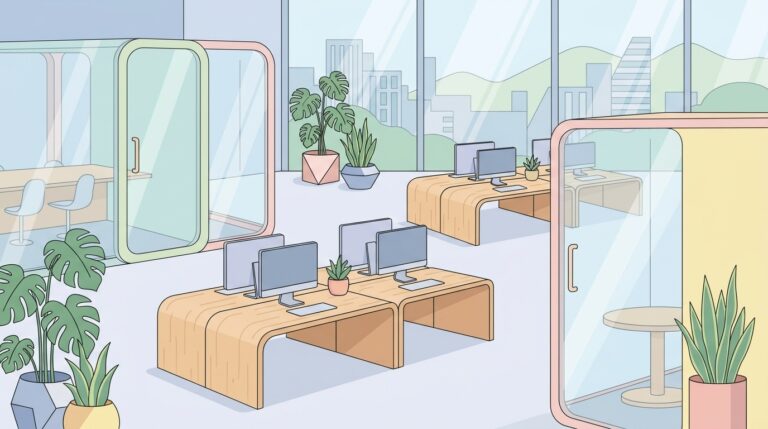
Mastering Korean Smart Office Architecture: Designing Collaboration in K-Workplaces
Phase 1: Empathy & The Modern K-Office Reality
안녕하세요! 매일한글 에디터입니다. (Hello! This is your Daily Hangul editor.)
If you have watched K-dramas like Start-Up or Search: WWW, you have probably noticed how Korean office environments have shifted drastically from rigid cubicle rows to sleek, cutting-edge agile hubs. Yet, when foreign professionals join tech companies in Pangyo Techno Valley or Gangnam, they often hit a wall trying to articulate nuanced spatial strategies. Describing zone acoustic segregation, hot-desking ergonomics, or spatial traffic flow requires sophisticated C1-level business Korean that goes far beyond standard textbook vocabulary. This guide blends real-world corporate field feedback with actionable linguistic frameworks so you can lead workspace optimization discussions with confidence.
Phase 2: Top 3 Advanced Workspace Expressions
1. 자율좌석제 운영 방식을 개편하다 (Jayuljwaseokje un-yeong bangsik-eul gae-pyeonhada)
- Pronunciation: [Ja-yul-jwa-seok-je un-yeong bang-sik-eul gae-pyeon-ha-da] (Think of ‘Jayul’ like ‘Jai-rule’ without the ‘r’, and ‘jwaseok’ like ‘jwah-suk’.)
- Meaning: Literal: “Reorganize the autonomous seating management method.” | Nuance: Overhauling hot-desking policies to boost cross-functional agility.
- K-Culture Moment: A team lead pitching a hybrid remote-office rotation model in a Pangyo tech boardroom.
- Editor’s Insight: ‘개편하다’ carries executive authority—it implies structural refinement rather than a simple change (‘바꾸다’).
- Situation Spectrum: Casual 🚫 | Semi-formal ⚠️ | Formal ✅
- 🤔 Think About It: In hierarchical cultures, does unassigned seating democratize communication or introduce subtle new social tensions?
2. 집중 업무 구역과 협업 라운지를 분리하다 (Jipjung eomu guyeok-gwa hyeobeop raunji-reul bunrihada)
- Pronunciation: [Jip-jung eom-mu gu-yeok-gwa hyeo-beop ra-un-ji-reul bul-li-ha-da] (Note the nasal assimilation: ‘eom-mu’ and liquid assimilation ‘bul-li’.)
- Meaning: Literal: “Separate deep focus work zones and collaboration lounges.” | Nuance: Establishing acoustic and functional zoning for varied cognitive tasks.
- K-Culture Moment: Facilities managers designing open-plan offices equipped with private phone booths and brainstorm hubs.
- Editor’s Insight: Using ‘분리하다’ (deliberate separation) emphasizes intentional spatial partitioning over passive isolation.
- Situation Spectrum: Casual ⚠️ | Semi-formal ✅ | Formal ✅
- 🤔 Think About It: How does your native workplace balance privacy with spontaneous interaction compared to open Korean smart offices?
3. 동선과 소음 차단을 고려해 공간을 재배치하다 (Dongseon-gwa so-eum chadan-eul goryeohae gonggan-eul jaebaejihada)
- Pronunciation: [Dong-seon-gwa so-eum cha-dan-eul go-ryeo-hae gong-gan-eul jae-bae-chi-ha-da]
- Meaning: Literal: “Relayout space considering movement pathways and noise blocking.” | Nuance: Optimizing floorplans to balance acoustic comfort and foot-traffic ergonomics.
- K-Culture Moment: An architectural review meeting discussing acoustic baffles and hallway flow.
- Editor’s Insight: ‘동선’ (movement line/pathway) is an essential architectural term used constantly in contemporary Korean product design and interior planning.
- Situation Spectrum: Casual ⚠️ | Semi-formal ✅ | Formal ✅
- 🤔 Think About It: Why is ‘동선’ considered one of the most critical factors in Korean commercial real estate?
Phase 3: Textbook Korean vs. Real Native Korean
Situation A: Proposing a Hot-Desking Policy
- 📖 Textbook: 우리는 매일 다른 자리에 앉는 시스템을 쓰는 것이 좋습니다. (Uri-neun maeil dareun jari-e anneun siseutem-eul sseuneun geos-i jotseumnida. – It is good for us to use a system where we sit in different seats every day.)
- 🗣️ Real Native: 업무 몰입도와 유연성을 높이기 위해 자율좌석제를 전면 도입하는 방안을 검토 중입니다. (Eomu moripdo-wa yuyeonseong-eul nop-igi wihae jayuljwaseokje-reul jeonmyeon doiphaneun bang-an-eul geomto jung-imnida. – We are reviewing full-scale adoption of hot-desking to enhance work immersion and agility.)
- 💡 Why It Differs: High-level Korean corporate discourse replaces descriptive verb phrases with sophisticated Sino-Korean nouns (몰입도, 유연성, 전면 도입).
Situation B: Requesting Quiet Booths
- 📖 Textbook: 사무실이 시끄러우니 조용한 방을 더 만들어 주세요. (Samusir-i sikkeureouni joyonghan bang-eul deo mandeureo juseyo. – The office is noisy so please make more quiet rooms.)
- 🗣️ Real Native: 집중도 향상을 위해 포커스존과 폰부스 증설이 시급한 상황입니다. (Jipjungdo hyangsang-eul wihae pokeseujon-gwa ponbuseu jeungseor-i sigeuphan sanghwang-imnida. – Expanding focus zones and phone booths is urgent to improve cognitive concentration.)
- 💡 Why It Differs: C1 business Korean frames personal inconvenience as an objective corporate productivity metric.
Phase 4: K-Culture Deep Dive & Non-Verbal Manners
4-1. Smart Office Nunchi (눈치) & Spatial Etiquette
In open smart offices in Korea, unassigned seating brings subtle non-verbal rules:
1. The Clean Desk Rule (클린데스크): Leaving personal items to ‘reserve’ a hot desk overnight is seen as a breach of communal trust.
2. Visual Availability Cues: Wearing over-ear noise-cancelling headphones signals ‘Focus Mode’ (집중 모드)—interrupting someone without sending a quick Slack/KakaoWork ping first is considered poor etiquette.
4-2. The Rise of Pangyo-Style Agile Ecosystems
Leading Korean enterprises (such as Kakao, Naver, and Coupang) have abandoned the traditional hierarchical desk layout where the team leader (팀장) sits at the head of the room overseeing subordinates. Instead, they embrace modular collaboration lounges, agora-style amphitheaters for town halls, and private acoustic pods, reflecting a cultural pivot toward decentralized innovation.
Phase 5: Live Roleplay Simulation
Setting: Conference Room A at a Pangyo tech startup. Project Lead Min-jun (민준) and Spatial Strategy Lead Alex (알렉스) are finalizing the new office redesign.
- Turn 1 (Min-jun): 🎭 Reviewing architectural blueprints 이번 거점 오피스 개편안에서 가장 중점을 둔 공간적 변화는 무엇인가요? (Ibeon geojeom opiseu gaepyeon-an-eseo gajang jungjeom-eul dun gongganjeok byeonhwa-neun mueot-ingayo? – What is the focal spatial change in this satellite office reorganization plan?)
- Turn 2 (Alex): 🎭 Pointing at the central lounge diagram 구성원 간의 유기적 협업을 유도할 수 있도록 라운지 공간을 중앙에 배치했습니다. (Guseongwon gan-ui yugijeok hyeobeop-eul yudohal su itdorok raunji gonggan-eul jung-ang-e baechihaetseumnida. – We placed the collaboration lounge in the center to induce organic collaboration among team members.)
- Turn 3 (Min-jun): 🎭 Frowning slightly in thought 개방형 라운지가 중앙에 있으면 소음 이슈로 인해 집중 업무 구역에 방해가 되지 않을까요? (Gaebanghyeong raunji-ga jung-ang-e isseumyeon so-eum isyu-ro inhae jipjung eomu guyeok-e banghae-ga doeji aneulkkayo? – If an open lounge is at the center, won’t noise issues interfere with the deep-work focus zone?)
- Turn 4 (Alex): 🎭 Presenting acoustic zoning layer 그래서 동선 분리와 흡음 파티션 설계를 통해 소음 전달을 최소화하도록 보완했습니다. (Geuraeseo dongseon bunri-wa heubeum patisyeon seolgye-reul tonghae so-eum jeondal-eul choesohwahadorok bowanhaetseumnida. – That is why we complemented it by segregating foot-traffic pathways and installing acoustic baffles to minimize sound propagation.)
- Turn 5 (Min-jun): 🎭 Nodding approvingly 자율좌석제 도입에 따른 좌석 점유율 변동 데이터는 반영되었나요? (Jayuljwaseokje doip-e ddareun jwaseok jeomyuyul byeondong deiteo-neun banyeongdoe-eotnayo? – Have fluctuations in desk occupancy data resulting from hot-desking been reflected?)
- Turn 6 (Alex): 🎭 Displaying analytics chart 네, 피크 시간대 점유율을 85%로 상정하여 유연하게 모듈형 데스크를 구성했습니다. (Ne, pikeu sigandae jeomyuyur-eul palsibo peosenteu-ro sangjeonghayeo yuyeonhage modyulhyeong deseukeu-reul guseonghaetseumnida. – Yes, assuming an 85% peak occupancy rate, we configured flexible modular desks.)
- Turn 7 (Min-jun): 🎭 Smiling with satisfaction 훌륭합니다. 포커스존 예약 시스템과의 연동 방안만 최종 확정하면 되겠군요. (Hullyunghamnida. Pokeuseujon yeyak siseutem-gwa-ui yeondong bang-an-man choejong hwakjeonghamyeon doegessgunyo. – Excellent. We just need to finalize the integration with the focus zone reservation system.)
- Turn 8 (Alex): 🎭 Closing presentation tablet 네, 유관 부서와 즉각 조율하여 금주 내로 최종 기안을 올리겠습니다. (Ne, yugwan buseo-wa jeukgak joyulhayeo geumju naero choejong gian-eul olligessseumnida. – Understood, I will coordinate with relevant departments immediately and submit the formal proposal this week.)
🔀 Interactive Decision Point
How should Alex address budget cuts regarding acoustic partition installations?
* Option A: 돈이 없으니 파티션은 그냥 취소하죠. (Don-i eopseuni patisyeon-eun geunyang chwisohajo. – We have no money so let’s just cancel the partitions.)
* Feedback [Bad]: Unprofessional and blunt for corporate environments.
* Option B: 예산 제약을 감안하여 흡음 패널 대신 친환경 식재 플랜테리어로 소음을 완충하는 대안을 제안합니다. (Yesan je-yag-eul gamanhayeo heubeum paeneol daesin chinehwangyeong sikjae peullanteorieo-ro so-eum-eul wanchunghaneun dae-an-eul je-anhamnida.)
* Feedback [Best]: Sophisticated problem-solving demonstrating budget awareness and creative spatial planning.
* Option C: 소음 문제는 직원들이 조용히 떠들면 해결됩니다. (So-eum munje-neun jikwondeur-i joyonghi tteodeulmyeon haegyeoldoemnida.)
* Feedback [Risk]: Unrealistic and dismisses workspace ergonomics.
Phase 6: 10-Second Emotional Shadowing Drill
[💼 Confident & Strategic]
동선과 소음 차단을 / 철저히 고려하여 / 공간 효율성을 / 극대화했습니다.
(Dongseon-gwa so-eum chadan-eul / cheoljeohi goryeohayeo / gonggan hyoyulseong-eul / geukdaehwahaetseumnida.)-
[🤝 Persuasive & Collaborative]
집중 구역과 협업 공간의 분리가 / 팀의 업무 몰입도를 / 한 단계 끌어올릴 것입니다.
(Jipjung guyeok-gwa hyeobeop gonggan-ui bunri-ga / tim-ui eomu moripdo-reul / han dangye kkeureo-ollil geos-imnida.)
Phase 7: K-Culture Mini Dictionary
- 거점 오피스 (Geojeom Opiseu): Satellite office deployed in suburban transport hubs to minimize employee commute times.
- 모듈형 가구 (Modyulhyeong Gagu): Modular furniture that can be instantly rearranged for agile project standups.
- 플랜테리어 (Peullanteorieo): Portmanteau of ‘Plant’ and ‘Interior’ used widely in modern Korean offices to create natural acoustic barriers.
- 코어 타임 (Koeo Taim): Mandatory core working hours when all flexible/remote team members must be synchronously reachable.
Phase 8: Expat & Business Traveler Survival Kit
-
Top 3 Survival Expressions:
- 여기 빈 좌석인지 확인해 주시겠어요? (Yeogi bin jwaseok-inji hwag-inhae jusigess-eoyo? – Could you confirm if this desk is unoccupied?)
- 회의실 예약 시스템에 오류가 발생했습니다. (Hoe-uisil yeyak siseutem-e oryuga balsoeanghaetseumnida. – An error occurred in the meeting room reservation system.)
- 폰부스는 최대 몇 시간까지 이용 가능한가요? (Ponbuseu-neun choedae myeot sigan-kkaji iyong ganeunghangayo? – What is the maximum duration for using phone booths?)
- Editor’s Logistics Note: Download the 네이버 지도 앱 다운로드 to search for shared coworking hubs like FastFive or Sparkplus across Seoul.
Phase 9: A Step Deeper: Individual Autonomy vs. Collective Synergy
Korean workplaces are redefining the balance between individual deep focus and collective team cohesion. While Western smart offices often prioritize personal privacy, Korean agile layouts focus on balancing ‘집중’ (deep focus) with ‘눈치 기반의 유연한 협업’ (tactful, high-context collaboration). Modern spatial design in Seoul is not just about aesthetics; it embodies the cultural transition toward trust-based, output-oriented professionalism.
💬 Your Turn: How does your organization structure its physical floorplan to encourage cross-functional alignment? Share your thoughts below!
Phase 10: FAQ & Common Pitfalls
Q: Can ‘자율좌석제’ be used in small startups?
A: Yes, it is widely used in organizations of any size that use flexible, unassigned seating.
Q: What is the difference between ‘재배치’ and ‘리모델링’?
A: ‘재배치’ (jaebaechi) refers specifically to rearranging furniture, seating, and traffic flow, whereas ‘리모델링’ (rimodelling) implies structural architectural renovation.
Q: How do I formally ask a colleague to lower their voice in an open agile zone?
A: Say: “죄송하지만, 포커스존 구역이라 통화는 폰부스를 이용해 주시면 감사하겠습니다.” (Pardon me, but this is a focus zone, so we would appreciate it if you could use the phone booth for calls.)
🚨 Common Mistakes
- ❌ Using ‘자유 자리’ instead of ‘자율좌석제’ -> Correct: Always use the formal term 자율좌석제 in presentations.
- ❌ Translating ‘Foot traffic’ literally as ‘발 교통’ -> Correct: Use the professional term 동선 (Dongseon).
- ❌ Confusing ‘방음’ (soundproofing) with ‘흡음’ (acoustic absorption/baffling) -> Correct: Use 흡음 파티션 for modular dividers.
Phase 11: Action Missions
- 🥉 Bronze: Practice pronouncing ‘동선과 소음 차단’ 5 times using the shadowing guide.
- 🥈 Silver: Draft a 2-sentence Slack message suggesting a new office floorplan idea in Korean.
- 🥇 Gold: Lead a mock 5-minute spatial redesign pitch using at least two C1 terms from Phase 2.
- 🎮 K-Culture Mission: Watch an episode of a recent workplace K-drama (like Agency or Start-Up) and identify the spatial layout of their office!
Phase 12: Interactive Quiz Challenge
1. Fill in the blank: 우리 팀은 업무 집중도를 높이기 위해 (______ )을 설치하여 소음을 차단하기로 했다.
Click to view Answer & Explanation
Correct Answer: 흡음 파티션 (또는 포커스존 / 폰부스)
Explanation: Absorbing partitions (흡음 파티션) or quiet booths are the exact spatial solutions for mitigating ambient office noise.
2. True or False: In a Korean smart office with a ‘클린데스크’ policy, leaving your laptop bag to reserve a desk overnight is encouraged.
Click to view Answer & Explanation
Correct Answer: False
Explanation: Clean desk rules require all personal items to be removed at the end of the workday to maintain true hot-desking autonomy.







