

Mastering Executive Korean: Managing Foreign Exchange Risk in Korean Boardrooms
Phase 1: Empathy (Story-Immersive Opening)
안녕하세요! 매일한글 (Daily Hangul) editor here!
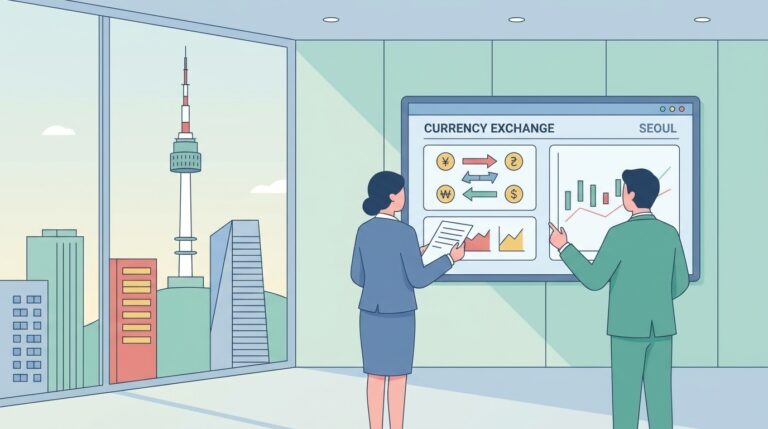
Imagine this: You are sitting in an executive boardroom on the 32nd floor of a sleek tower in Yeouido, Seoul’s financial district. The KRW/USD exchange rate has just spiked past 1,380 KRW, triggering urgent risk warnings across Korean business dailies like Maeil Business Newspaper and The Korea Economic Daily. Your Chief Financial Officer turns toward you and asks, “이번 분기 환율 급등에 따른 외환 리스크 관리 방안은 어떻게 마련되고 있습니까?” (How is our foreign exchange risk management plan shaping up against this quarter’s FX spike?).
If you have ever felt your heart drop in a Korean corporate setting because standard intermediate textbook expressions (“환율이 올라서 걱정돼요”) sound too simplistic for executive decision-making, you are not alone! C2-level proficiency in Korean requires not just grammatical accuracy, but the ability to convey strategic foresight, analytical precision, and institutional diplomacy. This guide draws upon real-world insights from foreign executives and senior financial analysts working in Korea, giving you the high-stakes vocabulary and nuanced corporate phrasing required to lead macroeconomic discussions with absolute authority.
Phase 2: Core Expressions Deep Dive
1. 환율 변동성에 따른 환차손을 최소화하기 위해 선제적인 헤징 전략을 수립해야 합니다.
- Pronunciation: [Hwan-yul byeon-dong-seong-e tta-reun hwan-cha-so-neul choe-so-hwa-ha-gi wi-hae seon-je-jeok-in he-jing jeol-lyak-eul su-rip-hae-ya ham-ni-da] (Pronounce ‘hwan-cha-son’ crisp like ‘Hwan-cha-sohn’ with an assertive cadence)
- Meaning: Literal: We must establish a preemptive hedging strategy to minimize foreign exchange losses resulting from exchange rate volatility. / Nuance: Confident, executive-level recommendation urging immediate financial hedging without sounding alarmist.
- K-Culture Moment: Seen in boardroom showdown scenes in hit corporate dramas like Reborn Rich (재벌집 막내아들) or Queen of Tears (눈물의 여왕) when corporate strategists brief the group chairman on impending macroeconomic shocks.
- Editor’s Insight: Using “선제적” (preemptive) signals proactivity and strategic foresight—two leadership virtues highly prized in Korean corporate governance.
- Situation Spectrum: Casual: 🚫 | Semi-formal: ⚠️ | Formal: ✅
- 🤔 Think About It: In your native language, do corporate speakers prefer active hedging metaphors (e.g., “locking in hedges”) over structural declarations (“수립해야 합니다”)?
2. 통화 스왑 및 선물환 계약을 통해 외화 유동성 리스크를 완충할 필요가 있습니다.
- Pronunciation: [Tong-hwa seu-wap mit seon-mul-hwan gye-yak-eul tong-hae oe-hwa yu-dong-seong ri-seu-keu-reul wan-chung-hal pil-yo-ga it-seum-ni-da] (Flow smoothly over ‘wan-chung-hal’, mimicking the damping motion of a shock absorber)
- Meaning: Literal: There is a need to buffer foreign currency liquidity risk through currency swaps and forward exchange contracts. / Nuance: A seasoned treasury proposal balancing risk mitigation tools with measured corporate prudence.
- K-Culture Moment: Echoes classic scenes from the film Default (국가부도의 날), where treasury teams dissect FX liquidity mechanisms during systemic market transitions.
- Editor’s Insight: The verb “완충하다” (to cushion/buffer) sounds far more sophisticated than “막다” (to block) or “줄이다” (to reduce) in formal macroeconomic briefings.
- Situation Spectrum: Casual: 🚫 | Semi-formal: ⚠️ | Formal: ✅
- 🤔 Think About It: Notice how Korean finance adopts loanwords like ‘스왑’ (Swap) and ‘리스크’ (Risk) while pairing them strictly with Sino-Korean verbs.
3. 대외 불확실성에 대비해 보수적인 시나리오별 스트레스 테스트를 병행해야 합니다.
- Pronunciation: [Dae-oe bul-hwak-sil-seong-e dae-bi-hae bo-su-jeok-in si-na-ri-o-byeol seu-teu-re-seu te-seu-teu-reul byeong-haeng-hae-ya ham-ni-da] (Keep the vowel transitions in ‘dae-oe’ clean and distinct)
- Meaning: Literal: We must concurrently conduct conservative, scenario-based stress tests against external uncertainties. / Nuance: Demonstrates risk aversion and analytical rigor to institutional stakeholders.
- K-Culture Moment: Frequently heard during year-end strategic planning meetings (경영전략회의) across Top 10 Korean conglomerates (Chaebols).
- Editor’s Insight: “병행하다” (to conduct simultaneously/in parallel) highlights multi-track competence without overburdening resource allocation.
- Situation Spectrum: Casual: 🚫 | Semi-formal: ⚠️ | Formal: ✅
- 🤔 Think About It: Why does Korean corporate communication place heavy emphasis on anticipating “대외 불확실성” (external uncertainties)?
Phase 3: Textbook Korean vs. Real-World Corporate Korean
Situation 1: Suggesting currency hedging to the executive committee
- 📖 Textbook Korean: “환율이 오르면 손해가 나니까 보험을 들어야 합니다.” (Because exchange rates go up and cause losses, we should buy insurance.)
- 🗣️ Real-World Korean (C2): “환율 변동성 확대에 따른 익스포저(Exposure)를 통제하기 위해 파생상품을 활용한 헤지 비율을 상향 조정해야 합니다.” (To control exposure from widening FX volatility, we must upwardly adjust our hedge ratio using derivatives.)
- 💡 Why the Difference? C2 corporate Korean relies on domain-specific financial nomenclature (익스포저, 헤지 비율, 파생상품) rather than colloquial metaphors like “보험” (insurance).
Situation 2: Reporting high FX sensitivity during an earnings review
- 📖 Textbook Korean: “우리 회사는 달러 가격에 영향을 많이 받습니다.” (Our company is heavily affected by the price of the dollar.)
- 🗣️ Real-World Korean (C2): “당사는 원자재 수입 비중이 높아 원/달러 환율 상승 시 영업이익률 훼손 압력이 가중되는 구조입니다.” (Given our heavy reliance on raw material imports, our operational margin faces intensified downward pressure whenever the KRW/USD exchange rate rises.)
- 💡 Why the Difference? Real corporate reporting clearly identifies root causes (원자재 수입 비중), mechanisms (구조), and precise metrics (영업이익률 훼손 압력).
Phase 4: K-Culture Deep Dive & Non-verbal Manners
4-1. Executive 눈치 (Nunchi) & Boardroom Manners
When presenting financial risk analysis in Korea:
* Data-First Neutrality: Maintain a steady, neutral pitch. Korean executive culture associates excessive emotional fluctuations during financial presentations with a lack of institutional composure.
* Two-Handed Laser Pointer / Tablet Grip: When referencing critical exchange rate inflection points on presentation screens, hold your clicker or pointer with both hands or support your right forearm slightly with your left hand.
* Deference to Macro Climate: Always acknowledge broad macroeconomic headwinds before proposing internal corrective measures, validating the leadership’s broader worldview.
4-2. Cultural Code: The Chaebol Risk Mindset
Korean enterprises operate with a profound institutional memory of systemic liquidity crises, notably the 1997 Asian Financial Crisis (IMF 외환위기). As portrayed in award-winning Korean cinema and business dramas, treasury management in Korea is never just about optimization; it is deeply tied to existential corporate resilience (생존 전략). Framing FX risk mitigation around “안정성 확보” (securing stability) resonates much deeper than aggressive arbitrage.
Phase 5: Real-World Roleplay Scenario
Setting: Yeouido Financial Tower, Strategic Planning Boardroom.
Characters:
* Director Park (박 전무): Veteran CFO with sharp analytical instincts.
* Learner (본인 – Risk Strategy Lead): Senior strategist presenting FX countermeasures.
- Turn 1 (박 전무): “이번 미 연준(Fed)의 금리 결정 이후 환율 변동성이 심상치 않은데, 외환 익스포저 점검 결과는 어떻습니까?” (🎭 Adjusting his glasses while studying the monthly balance sheet)
- Turn 2 (Learner): “네, 전무님. 원/달러 환율 변동 폭 확대에 따라 단기 결제 통화 기준 환차손 압박이 가시화되고 있습니다.” (🎭 Delivering the briefing with calm, measured articulation)
- Turn 3 (박 전무): “환차손 발생 시 연간 영업이익 목표치 달성에 상당한 차질이 예상되는군요. 구체적인 대응 카드가 있습니까?” (🎭 Leaning forward, resting his hands together on the desk)
- Turn 4 (Learner): “선물환 매도 계약을 통해 결제 대금의 70% 수준을 선제 헤징하고, 잔여 익스포저는 통화 스왑으로 커버하는 방안을 제안합니다.” (🎭 Pointing calmly to the risk-matrix slide)
- Turn 5 (박 전무): “헤지 비율을 70%까지 올릴 경우 수수료 부담과 환율 하락 시의 기회비용은 검토했습니까?” (🎭 Probing critically with a discerning gaze)
- Turn 6 (Learner): “보수적 시나리오 분석 결과, 기회비용 대비 현금 흐름의 가시성을 확보하는 실익이 훨씬 큰 것으로 나타났습니다.” (🎭 Responding with confidence and empirical backing)
- Turn 7 (박 전무): “좋습니다. 재무팀과 협의하여 주간 단위 스트레스 테스트 보고서를 즉시 정례화하세요.” (🎭 Nodding subtly in approval)
- Turn 8 (Learner): “명심하겠습니다. 시나리오별 비상 계획(Contingency Plan)을 수립하여 내일 오전 중으로 보고드리겠습니다.” (🎭 Standing slightly and nodding respectfully)
🔀 Interactive Branching Moment
How do you handle Director Park’s sudden question in Turn 5 about hedging fees?
* Option A: “수수료가 좀 들더라도 환율이 어떻게 될지 모르니 일단 다 막아야 합니다.”
* Feedback (Bad): Too casual and colloquial. Lacks numerical analysis and strategic reasoning.
* Option B: “보수적 시나리오 분석 결과, 수수료 부담 대비 다운사이드 리스크 방어 실익이 지배적입니다.”
* Feedback (Best): Perfect C2 level. Demonstrates decisive quantitative grounding and advanced financial lexicon.
* Option C: “전무님 말씀대로 수수료가 아까우니 헤지 비율을 30%로 낮추겠습니다.”
* Feedback (Risk): Displays lack of analytical conviction and exposes the enterprise to extreme volatility.
Phase 6: 10-Second Emotion Shadowing Drill
- [🧐 Analytical & Decisive]
“환율 급변동에 따른 / 환차손을 선제적으로 차단하기 위해 / 파생상품 포지션을 재조정해야 합니다.”
(Hwan-yul geup-byeon-dong-e tta-reun / hwan-cha-so-neul seon-je-jeok-eu-ro cha-dan-ha-gi wi-hae / pa-saeng-sang-pum po-ji-syeon-eul jae-jo-jeong-hae-ya ham-ni-da.) -
[🏛️ Prudent & Executive]
“거시경제적 불확실성이 지속되는 만큼 / 외화 유동성 버퍼를 / 보수적으로 확충할 방침입니다.”
(Geo-si-gyeong-je-jeok bul-hwak-sil-seong-i ji-sok-doe-neun man-keum / oe-hwa yu-dong-seong beo-peo-reul / bo-su-jeok-eu-ro hwak-chung-hal bang-chim-im-ni-da.)
Phase 7: K-Culture Mini Dictionary
- 환리스크 (Hwan-ri-seu-keu) | Foreign Exchange Risk | Used in all Korean financial and economic analyses when discussing corporate vulnerabilities to currency fluctuations.
- 선물환 계약 (Seon-mul-hwan Gye-yak) | Forward Exchange Contract | The core instrument cited in Korean corporate treasury protocols for hedging forward exposures.
- 환차손익 (Hwan-cha-so-nik) | Foreign Exchange Gains and Losses | Standard balance sheet accounting term used during quarterly investor relation (IR) sessions.
- 거시경제 지표 (Geo-si-gyeong-je Ji-pyo) | Macroeconomic Indicators | Vital terminology when leading macroeconomic outlook presentations in Seoul.
Phase 8: Professional & Traveler Survival Kit
-
Top 3 High-End Financial Inquiries:
- “원/달러 환율 급등 시 당사 수지타산에 미치는 영향 분석표가 있습니까?” (Do you have a breakdown of how the KRW/USD surge impacts our bottom line?)
- “외환은행 및 주요 주거래 은행과의 환율 우대 협의는 완료되었습니까?” (Have our preferential FX rate terms with lead commercial banks been finalized?)
- “비상 외화 조달 라인이 가동 가능한 상태인지 확인 바랍니다.” (Please verify whether our contingency FX credit lines are operable.)
- Editor’s Professional Note: When conducting high-level research in Korea, download and bookmark the Bank of Korea ECOS Economic Statistics System Portal and the Maeil Business Newspaper Mobile Edition for authoritative real-time FX statistics.
Phase 9: “One Step Deeper” (Reflective Humanities Essay)
In Korean corporate linguistic culture, the phrase “선제적 대응” (preemptive response) carries an emotional weight far beyond standard risk governance. Born out of rapid industrialization and the collective scar of past foreign exchange shortages, Korean business culture holds that anticipating market volatility is not merely technical acumen—it is a moral responsibility to protect the organization and its employees. When you articulate FX strategies with deep respect for this stability-centric mindset, Korean executives will view you not just as a foreign partner, but as an authentic insider who understands the soul of Korean enterprise.
💬 Your Turn: How does corporate culture in your home country discuss currency and macroeconomic volatility? Let us know in the comments below!
Phase 10: FAQ & Common Mistakes
Q: Can I use the English word “Hedging” directly in Korean business meetings?
A: Yes! However, you must conjugate it naturally with Korean verbal endings—for example, “헤징하다” (to hedge) or “헤지 전략을 구사하다” (to employ a hedging strategy).
Q: What is the difference between 환차손 and 외환평가손실?
A: 환차손 refers to realized losses from completed FX transactions, whereas 외환평가손실 refers to unrealized mark-to-market translation losses on financial statements at closing.
Q: How formal should I be when discussing financial risk with peers?
A: Even among peers, use polite formal speech (하십시오체 / 해요체 with professional terminology) during strategic meetings to maintain executive credibility.
🚨 Common Mistakes Alert
- Mistake: Saying “환율이 비싸요” (The exchange rate is expensive).
- Correct Action: Say “환율이 상승했습니다/급등했습니다” (The exchange rate has risen/surged).
- Mistake: Using “돈을 지키다” (protect money) in board meetings.
- Correct Action: Use “자본 보존 및 유동성 리스크 완화” (Capital preservation and liquidity risk mitigation).
- Mistake: Direct translation of “We bet against the dollar.”
- Correct Action: State “달러 약세 포지션을 취하다” or “달러 인버스 포트폴리오를 구성하다”.
Phase 11: Action Missions
- 🥉 Bronze Mission (Solo Mastery): Record yourself reading the Phase 6 Shadowing Drill three times, ensuring smooth rhythm and confident intonation.
- 🥈 Silver Mission (Social Learning): Share your favorite C2 business vocabulary word from this guide on LinkedIn or Instagram with the hashtag
#DailyHangulBusiness. - 🥇 Gold Mission (Real-World Application): Write a 3-sentence simulated executive memo in Korean recommending a hedge strategy for a multinational company facing KRW volatility.
- 🎮 K-Culture Media Mission: Watch an episode of a Korean corporate drama and identify at least two macroeconomic or financial terms mentioned in the boardroom scenes!
Phase 12: Interactive Quiz Challenge
1. Situational Judgment: Which phrase is most appropriate during an executive briefing?
* A) 환율 떨어질 때까지 그냥 기다려 보시죠.
* B) 환율 변동성 확대에 따른 외환 리스크 관리 가이드라인을 수립해야 합니다.
* C) 달러가 너무 비싸서 아무것도 못 하겠습니다.
2. Fill-in-the-Blank: “외화 유동성 위기에 대비해 금융기관과의 통화 ________ 체결을 검토 중입니다.”
* Hint: Financial mechanism for exchanging currency flows.
3. True or False: In formal Korean finance presentations, using “헤지 비율을 조정하다” is considered poor form compared to purely native Korean words.
🔍 Click to Reveal Answers & Explanations
- Correct Answer: B | Explanation: Option B employs polished C2 executive phrasing (외환 리스크 관리 가이드라인 수립).
- Correct Answer: 스왑 (Swap) | Explanation: 통화 스왑 (Currency Swap) is the standard terminology.
- Correct Answer: False | Explanation: Loanword financial terms paired with Sino-Korean verbs are standard and expected in elite corporate Korean!






