

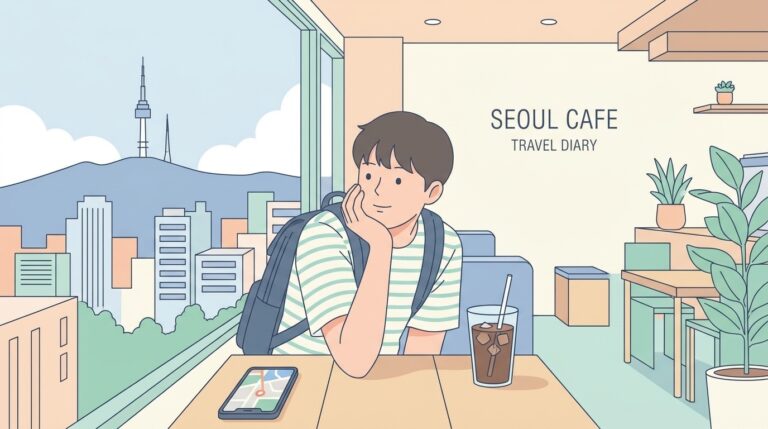
Phase 1: Empathy & Story Opening
안녕하세요! 매일한글 에디터입니다. (Hello! I’m your Daily Hangul editor.) Have you ever found yourself sitting in a long subway ride across Seoul, or waiting endlessly for a friend at a trendy Hongdae café, thinking, “I am so bored!”? Many beginner learners immediately try to translate “I am bored” word-for-word and end up mixing up words like jiruhaeyo and simsimhaeyo. Saying the wrong one in front of a Korean friend might accidentally insult their storytelling or sound a bit awkward!
Today, we are diving into essential negative emotion expressions to help you talk about boredom naturally. Based on real feedback from hundreds of beginner students at Daily Hangul, this guide will show you exactly how real locals express boredom without offending anyone. Let’s make sure you never sound like a robotic textbook again!
Phase 2: 3 Core Expressions Deep Dive
1. 지루해요 (Jiruhaeyo)
- Pronunciation: [Ji-ru-hae-yo] (Sounds like “Jee-roo-hae-yo”)
- Meaning: “It is tedious / It drags on” (Expresses that a situation, event, or speech is lengthy and dull)
- K-Culture Moment: In K-Dramas, when a student sits through a monotone lecture or a character attends a stiff company dinner, they might whisper to their best friend: “너무 지루해요…”
- Editor’s Insight: Use this when a specific activity or object is dragging on too long (like a 3-hour movie).
- Situation Spectrum: Casual (⚠️ with close friends) | Semi-formal (✅ “지루해요”) | Formal (✅ “지루합니다”)
- 🤔 Think About It: In English, “I am bored” covers everything. Why do you think Korean separates “having nothing to do” from “something dragging on”?
2. 심심해요 (Simsimhaeyo)
- Pronunciation: [Sim-sim-hae-yo] (Sounds like “Seem-seem-hae-yo”)
- Meaning: “I have nothing to do / I’m idle-bored”
- K-Culture Moment: Seen in variety shows when an idol is alone in their dorm on a day off, rolling on the sofa and texting: “심심해! 놀아줘!” (I’m bored! Play with me!).
- Editor’s Insight: This is purely about personal free time with no stimulus. Never say this to your boss during work hours!
- Situation Spectrum: Casual (✅ “심심해”) | Semi-formal (✅ “심심해요”) | Formal (🚫 Avoid in professional meetings)
- 🤔 Think About It: How often do you text friends just because you’re bored? In Korea, saying “심심해요” is often an open invitation to hang out.
3. 재미없어요 (Jaemieopseoyo)
- Pronunciation: [Jae-mi-eop-seo-yo] (Sounds like “Jae-mee-up-suh-yo”)
- Meaning: Literal: “There is no fun” / Nuance: “It’s uninteresting / lame”
- K-Culture Moment: Watching a comedy show that doesn’t make anyone laugh, prompting a flat reaction: “솔직히 재미없어요.” (Honestly, it’s not fun.)
- Editor’s Insight: 재미 (Jaemi) means “fun” and 없어요 (eopseoyo) means “do not have.” It is a direct and honest review of content or events.
- Situation Spectrum: Casual (✅ “재미없어”) | Semi-formal (✅ “재미없어요”) | Formal (✅ “재미없습니다”)
- 🤔 Think About It: Would you tell a host their party is “not fun” in your culture? In Korea, softening this with “조금” (a little) is essential for politeness.
Phase 3: Textbook Korean vs. Real Korean
Situation 1: Waiting at a bus stop with nothing to do
- 📖 교과서 한국어 (Textbook): 저는 지금 무료합니다. (Jeoneun jigeum muryohamnida. – I am idle/bored.)
- 🗣️ 진짜 한국어 (Real-Life): 아, 진짜 심심하다… (A, jinjja simsimhada… – Ah, I’m seriously so bored…)
- 💡 왜 다를까? (Why different?): 무료하다 is extremely formal Hanja (Sino-Korean). Real native speakers casually say 심심하다 or 심심해요 in daily speech.
Situation 2: Reacting to a boring movie
- 📖 교과서 한국어 (Textbook): 그 영화는 흥미가 없습니다. (Geu yeonghwaneun heungmiga eopseumnida. – That movie lacks interest.)
- 🗣️ 진짜 한국어 (Real-Life): 영화가 좀 지루해요. (Yeonghwaga jom jiruhaeyo. – The movie is a bit boring.)
- 💡 왜 다를까? (Why different?): Koreans rarely say “it lacks interest” in conversation; adding 좀 (jom – a bit) before 지루해요 makes the critique polite and natural.
Phase 4: K-Culture Deep Dive & Non-Verbal Etiquette
4-1. 눈치 (Nunchi) & Gestures
When you feel bored in Korea, displaying it outwardly can be considered impolite depending on who you are with.
* Body Language: Resting your chin on your palm (턱 괴기) or checking your phone repeatedly while someone is speaking signals extreme boredom. If you must express boredom playfully to a close friend, Koreans often puff out their cheeks or tap their fingers lightly while whining “심심해~” in a cute tone.
* Eye Contact: Avoid heavy sighing (한숨) around seniors or elders, as it carries a strong negative vibe of dissatisfaction.
4-2. Cultural Code: The Culture of “Nojam” (노잼)
In Korean youth culture and internet variety shows, boredom has its own humorous slang: 노잼 (No-jaem), a blend of English “No” and Korean Jaemi (fun). If a friend tells a terrible dad joke (아재개그), calling them “완전 노잼!” (Totally unfunny!) is an affectionate tease rather than a harsh insult.
Phase 5: Real-Life Roleplay Scenario
Setting: A quiet Sunday afternoon at a cozy café in Yeonnam-dong. Minho (민호) and Sophie (the learner) have finished their coffee and are looking at their phones.
- 민호 (Minho): 소피 씨, 오늘 카페에 사람 진짜 없네요. (Sophie-ssi, oneul kape-e saram jinjja eomneyo. / “Sophie, there’s really nobody at the café today.”)
🎭 looking around slowly - Sophie: 네, 맞아요. 조용해요. (Ne, majayo. Joyonghaeyo. / “Yes, that’s right. It’s quiet.”)
🎭 sipping iced water - 민호 (Minho): 우리 이제 뭐 할까요? (Uri ije mwo halkkayo? / “What should we do now?”)
🎭 tapping fingers on the table - Sophie: 음… 솔직히 조금 심심해요! (Eum… soljiki jogeum simsimhaeyo! / “Um… honestly, I’m a little bored!”)
🎭 smiling lightly - 민호 (Minho): 하하, 저도요. 근처 보드게임 카페 갈래요? (Haha, jeodoyo. Geuncheo bodeu-geim kape gallaeyo? / “Haha, me too. Do you want to go to a board game café nearby?”)
🎭 brightening up - Sophie: 좋아요! 영화는 지루할 것 같아요. (Joayo! Yeonghwaneun jiruhal geot gatayo. / “Sounds good! I think a movie might be boring.”)
🎭 nodding in agreement - 민호 (Minho): 그래요, 가서 신나게 놀아요! (Geuraeyo, gaseo sinnage norayo! / “Great, let’s go have fun!”)
🎭 standing up with energy - Sophie: 네, 빨리 가요! (Ne, ppalli gayo! / “Yes, let’s go quickly!”)
🎭 packing bag happily
🔀 Interactive Branching Point
If Minho asks you: “지금 하는 게임 어때요?” (How do you like this game?), how would you reply?
* Option A: “조금 지루해요. 다른 거 해요!” (It’s a bit boring. Let’s do something else!) 👉 [Best] Honest, polite with 조금, and offers a fun alternative.
* Option B: “완전 재미없어요. 그만해요.” (It’s completely unfunny. Stop it.) 👉 [Bad] Too blunt and harsh for casual friendly conversation.
* Option C: “심심해요.” (I have nothing to do.) 👉 [Risk] Grammatically mismatched since you are currently doing an activity!
Phase 6: 10-Second Emotion Shadowing Drill
Practice matching your pitch and pauses with these emotion milestones:
[🥺 Cute & Whiny]아, / 진짜 / 심심해요~ (A, / jinjja / simsimhaeyo~)[🥱 Tired & Dragging]이 수업은 / 너무 / 지루해요. (I sueobeun / neomu / jiruhaeyo.)[😅 Playful & Light]그 영화는 / 조금 / 재미없었어요. (Geu yeonghwaneun / jogeum / jaemieopseosseoyo.)
Phase 7: K-Culture Mini Dictionary
- 심심풀이 (Simsimpuri) | Time-killer / light snack or game | Refers to small snacks (like roasted peanuts) or casual mobile games played just to pass the time when idle.
- 노잼 (No-jam) | Not fun / Boring person or thing | A widely used slang word combining “No” + “재미 (Fun)”. Frequently used in internet comments and K-Pop lives.
- 킬링타임 (Killing Time) | Passing time lightly | Konglish expression referring to easy-to-watch dramas, webtoons, or YouTube shorts.
- 멍때리기 (Meong-ttaerigi) | Spacing out / zoning out | The act of doing nothing and letting your mind go completely blank; Korea even holds annual “Space-Out Competitions” by the Han River!
Phase 8: Survival Kit for Travelers
Top 3 Survival Phrases
- “여기 와이파이 있어요?” (Yeogi waipai isseoyo?) – Is there Wi-Fi here? (Pro Tip: Essential when you’re bored waiting in a cafe!)
- “다른 것 추천해 주세요.” (Dareun geot chucheonhae juseyo.) – Please recommend something else. (Pro Tip: Great when an attraction or menu looks uninteresting.)
- “조금 심심한데 어디 갈까요?” (Jogeum simsimhande eodi galkkayo?) – I’m a little bored, where should we go? (Pro Tip: Perfect prompt for your Korean travel buddy.)
Editor’s Travel Note
When you find yourself bored during long train rides or waiting times in Seoul, make sure to explore 네이버 지도 앱 다운로드 to find hidden nearby photo booths (인생네컷) or coin karaoke rooms (코인노래방). They are Korea’s favorite quick antidotes to boredom!
Phase 9: Think Deeper (한 발 더 깊이)
In Korean culture, emotions are heavily context-dependent and tied to community harmony. When you say “심심해요” (I have free time with no stimulus), it is often viewed as a social invitation meaning “Let’s do something together!” In contrast, saying an activity is “지루해요” directly critiques the passage of time or the host’s effort. Understanding this fine distinction helps you navigate Korean social dynamics with warmth and emotional intelligence.
💬 Your Turn: When was the last time you felt truly 심심해요? What is your favorite way to kill time when traveling in Korea? Let us know in the comments below!
Phase 10: FAQ & Common Mistakes
Q: Can I say “심심해요” to a teacher or boss?
A: It is best to avoid it! Saying 심심해요 implies you have nothing to do and are idling around. In a professional setting, ask for tasks instead: “제가 더 도와드릴 일이 있을까요?” (Is there anything more I can help with?).
Q: What is the exact difference between “지루해요” and “재미없어요”?
A: 지루해요 focuses on time dragging on tediously (e.g., a 2-hour speech), while 재미없어요 simply means it lacks entertainment value (e.g., a joke that fell flat).
Q: How do I say “I’m bored to death” in Korean?
A: You can playfully say “심심해서 죽겠어요!” (Simsimhaeseo jukgesseoyo!).
🚨 Common Mistakes Board
- Mistake 1: Saying “영화가 심심해요” (❌) ➔ Correction: “영화가 지루해요” or “재미없어요” (✅). (Movies cannot feel idle; they are tedious or uninteresting!)
- Mistake 2: Using “지루해요” when sitting alone on your couch with nothing to do (❌) ➔ Correction: “심심해요” (✅).
- Mistake 3: Forgetting to add “좀” (a bit) when giving honest feedback to a friend (❌) ➔ Correction: “조금 지루해요” (✅).
Phase 11: Action Missions
- 🥉 Bronze Mission (Solo Practice): Stand in front of a mirror and recite “아, 진짜 심심해요!” with a dramatic, cute sigh 3 times.
- 🥈 Silver Mission (Social Sharing): Post a photo of your relaxing weekend or coffee cup on Instagram with the caption: “주말인데 심심해요~”.
- 🥇 Gold Mission (Real Life): Next time a Korean drama scene or YouTube video feels slow, comment or tell a friend: “조금 지루해요!”.
- 🎮 K-Culture Mission: Watch an episode of a Korean variety show (like Running Man) and spot whether the cast uses 노잼 or 심심해!
Phase 12: Interactive Quiz Challenge
1. Multiple Choice: You are home alone on a rainy Saturday with zero plans. Which phrase should you say?
* A) 너무 지루해요
* B) 너무 심심해요
* C) 너무 재미없어요
2. Fill in the Blank: “이 책은 너무 길어서 조금 ______.” (This book is so long that it’s a bit tedious.)
3. True or False: Calling your friend’s joke “노잼 (No-jam)” is an extreme formal insult in Korean business meetings.
🔍 Click here to reveal the answers and explanations!
- Answer: B (너무 심심해요) – You have free time and lack activity, so 심심해요 is correct!
- Answer: 지루해요 (Jiruhaeyo) – Long duration that drags on makes something 지루해요.
- Answer: False (with nuance) – While it is NOT an extreme formal insult, it is slang! However, you should never use it in business meetings anyway; keep it for close friends!







