

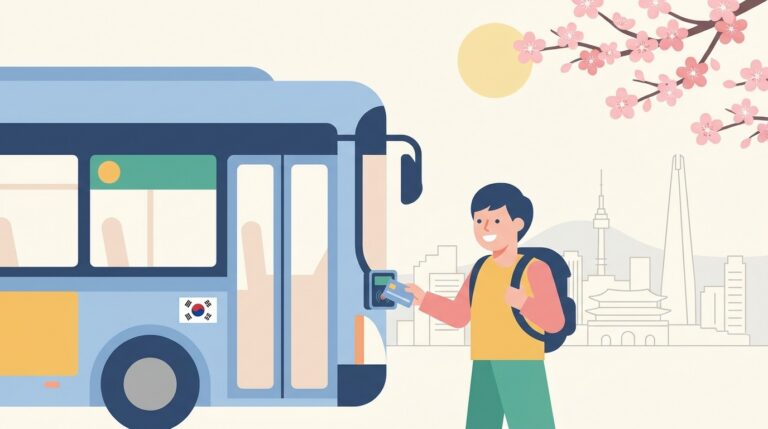
Phase 1: Morning Panic at the Seoul Bus Stop
안녕하세요! 매일한글 에디터입니다. (Annyeonghaseyo! Hello, this is your Daily Hangul editor!)
Imagine this: It is 8:00 AM in Seoul. Just like the heroine in your favorite K-Drama, you rush out the door, iced Americano in hand, chasing a bright blue city bus down the street. You hop on, tap your card, and suddenly freeze. Does this bus even go to your university? And how do you politely squeeze past ten sleepy commuters when your stop finally arrives?
If Korean morning bus rides make your heart race, you are not alone! Based on real feedback from our beginner students studying in Korea, these exact moments cause the biggest morning panic. Mastering just three friendly phrases will turn your stressful school commute into a confident, local K-Culture adventure.
Phase 2: Top 3 Core Expressions Deep Dive
1. 버스를 타고 학교에 가요 (Beoseureul tago hakgyoe gayo)
- Pronunciation: Beo-seu-reul ta-go hak-gyo-e ga-yo (Say “buh-suh-reul” like bus with a soft uh, “ta-go” like taco with a g, “hak-gyo-e” like hock-gyo-eh, and “ga-yo” like guy-oh.)
- Meaning: Literally “I ride a bus and to school go.” Naturally means “I take the bus to school.”
- K-Culture Moment: Picture the opening morning montage in hit school dramas like True Beauty or Lovely Runner, where students put in their earphones and hop onto the morning bus to start their day.
- Editor’s Insight: In Korean, you use 타고 (tago)—meaning “ride and then”—to connect two actions smoothly. Instead of saying “by bus,” Koreans describe the physical action of riding first, then going!
- Situation Spectrum: Casual ⚠️ (Drop “요 (yo)” for close friends) | Semi-formal ✅ (Perfect for daily life!) | Formal ⚠️ (Use “갑니다 (gamnida)” in speeches)
- 🤔 Think About It: In English, you “take” a bus as if grabbing an object. In Korean, you 타고 가요 (tago gayo — ride and go), painting a step-by-step movie scene of your movement. How does your native language describe getting on transport?
2. 이 버스 학교에 가요? (I beoseu hakgyoe gayo?)
- Pronunciation: I beo-seu hak-gyo-e ga-yo? (Say “ee” like bee, “buh-suh” for bus, “hock-gyo-eh”, and raise your voice at the end on “guy-oh?”)
- Meaning: Literally “This bus to school goes?” Naturally means “Does this bus go to the school?”
- K-Culture Moment: Just like a newly arrived exchange student in a Seoul vlog hesitating on the bus steps before tapping their card, looking up at the driver for confirmation.
- Editor’s Insight: Notice there is no “Does” or question word here! Simply lifting your pitch on the last syllable 가요? (gayo?) turns a statement into an instant polite question. You can even swap 학교 (hakgyo) for your specific university name like 연세대 (Yeonsedae)!
- Situation Spectrum: Casual ⚠️ | Semi-formal ✅ (Friendly and clear for bus drivers) | Formal ⚠️
- 🤔 Think About It: Korean relies heavily on rising intonation rather than rearranging word order for yes/no questions. Does that feel easier or trickier when you are speaking fast in the morning?
3. 잠시만요, 내릴게요! (Jamsimanyo, naerilgeyo!)
- Pronunciation: Jam-si-man-yo, nae-ril-ge-yo! (Say “jahm-shee-mahn-yo”, then “neh-reel-geh-yo” like nail-get-yo without the t.)
- Meaning: Literally “Just a moment, I will get off!” Naturally means “Excuse me, coming through—I’m getting off!”
- K-Culture Moment: Every packed rush-hour scene in Korean variety shows like I Live Alone, where commuters politely weave through a crowded bus aisle to reach the back door.
- Editor’s Insight: Saying 내릴게요 (naerilgeyo) expresses your immediate intention warmly, while 잠시만요 (jamsimanyo) acts as a magic cushion so people gladly step aside without feeling pushed.
- Situation Spectrum: Casual 🚫 | Semi-formal ✅ (Essential everyday survival!) | Formal ✅
- 🤔 Think About It: In crowded spaces, Korean prefers stating what you are about to do rather than telling others to “move.” Why do you think this indirect approach keeps the morning atmosphere peaceful?
Phase 3: Textbook Korean vs. Real Korean
Situation 1: Checking the bus route with the driver
- 📖 교과서 한국어 (Textbook Korean): 기사님, 이 버스가 대학교 정문에 갑니까? (Gisanim, i beoseuga daehakgyo jeongmune gamnikka? — Driver, does this bus go to the main gate of the university?)
- 🗣️ 진짜 한국어 (Real Korean): 저기요, 이거 학교 가요? (Jeogiyo, igeo hakgyo gayo? — Excuse me, does this one go to the school?)
- 💡 왜 다를까? (Why is it different?): During busy morning traffic, drivers appreciate short, quick questions. Locals naturally replace full nouns with 이거 (igeo — this one) and drop extra grammar particles.
Situation 2: Squeezing out of a crowded bus
- 📖 교과서 한국어 (Textbook Korean): 실례지만 제가 내려야 하니 비켜 주십시오. (Sillyejiman jega naeryeoya hani bikyeo jusipsio. — Excuse me, I must get off, so please step aside.)
- 🗣️ 진짜 한국어 (Real Korean): 잠시만요! 저 내릴게요~ (Jamsimanyo! Jeo naerilgeyo~ — Just a sec! I’m getting off~)
- 💡 왜 다를까? (Why is it different?): Directly asking people to “step aside” (비켜 주세요 — bikyeo juseyo) can sound stiff or blunt. Simply announcing that you are getting off lets people move naturally with good 눈치 (nunchi — social awareness).
Phase 4: K-Culture Deep Dive & Non-Verbal Manners
4-1. 눈치 (Nunchi) & Bus Gestures
- Tap On AND Tap Off: Always tap your 교통카드 (gyotongkadeu — transit card) at the front door when boarding AND at the back door when getting off! If you forget to tap off, you miss your transfer discount and pay extra next time.
- The Red Stop Button: Press the 하차벨 (hachabel — stop button) right after the announcement for your stop finishes, then stand up carefully before the bus fully halts. Korean bus drivers are famously speedy!
- Backpack Etiquette: If the bus is crowded, swing your backpack to your front or hold it near your knees. It shows great 배려 (baeryeo — consideration) for others.
4-2. Culture Code: K-Drama & K-Travel
In Seoul, buses are color-coded like a rainbow! 파란 버스 (Paran beoseu — Blue buses) travel long distances across districts, while 초록 버스 (Chorok beoseu — Green buses) connect subway stations to neighborhoods and university campuses. Just like in K-Dramas, sitting in the back window seat watching Seoul wake up with your playlist on is a beloved morning ritual.
Phase 5: Real-Life Roleplay Scenario
Setting: It is 8:15 AM at a bustling bus stop near Sinchon. Cool morning air, coffee shops just opening, and a blue city bus pulls up with a soft hiss of its doors.
Characters: You (a Level 1 student heading to Korean class) & 버스 기사님 (Beoseu gisanim — the Bus Driver), a warm, brisk middle-aged driver wearing neat sunglasses.
- You: 🎭 (Stepping onto the bus stairs, holding your transit card) 저기요, 이 버스 학교에 가요? (Jeogiyo, i beoseu hakgyoe gayo? — Excuse me, does this bus go to the school?)
- Driver: 🎭 (Glancing quickly at the mirror with a friendly nod) 네, 가요! 카드 찍으세요. (Ne, gayo! Kadeu jjigeuseyo. — Yes, it goes! Tap your card.)
- You: 🎭 (Tapping your card—”Beep!”—and smiling) 감사합니다! (Gamsahamnida! — Thank you!)
- Driver: 🎭 (Closing the doors and pulling smoothly into traffic) 얼른 앉으세요! (Eolleun anjeuseyo! — Sit down quickly!)
- Narrator: 🎭 (10 minutes later, the bus speaker announces your university stop. You press the red stop button—”Ding-dong!”—and stand up near the crowded back door.)
- You: 🎭 (Speaking politely to the commuters standing by the exit) 잠시만요! 저 내릴게요. (Jamsimanyo! Jeo naerilgeyo. — Just a moment! I’m getting off.)
- Commuter: 🎭 (Stepping back smoothly to clear the path) 네, 지나가세요. (Ne, jinagaseyo. — Yes, go ahead.)
- You: 🎭 (Tapping your card at the back door sensor and stepping onto the sidewalk) 감사합니다! (Gamsahamnida! — Thank you!)
🔀 Interactive Branching Point: What do you do when your card beeps with an error (잔액 부족 — Janaek bujok / Low balance)?
- Option A: Say “잠시만요! (Jamsimanyo! — Just a moment!)” and pay with small cash bills or check your spare card.
- Feedback (🌟 Best!): Staying calm and using 잠시만요 (jamsimanyo) buys you time politely without blocking the line behind you. Drivers appreciate quick, calm problem-solving!
- Option B: Panic silently and walk straight to the back seat without paying.
- Feedback (🚫 Bad!): Walking past without paying causes a misunderstanding with the driver, who will call out to stop you. Always communicate!
- Option C: Hand the driver a huge 50,000 KRW bill.
- Feedback (⚠️ Risky!): Most buses today are cashless or lack change for big bills. It is much safer to top up at a convenience store beforehand!
Phase 6: 10-Second Emotion Shadowing Drill
Read these out loud! Pause at the / marks and match the emotion in brackets.
- [😊 Cheerful & Bright] 아침에 / 버스를 타고 / 학교에 가요! (Achime / beoseureul tago / hakgyoe gayo! — In the morning, I take the bus to school!)
- [😟 Curious & Urgent] 저기요! / 이 버스 / 학교에 가요? (Jeogiyo! / I beoseu / hakgyoe gayo? — Excuse me! Does this bus go to the school?)
- [🙏 Polite & Relieved] 잠시만요, / 저 이번 역에서 / 내릴게요! (Jamsimanyo, / jeo ibeon yeogeseo / naerilgeyo! — Just a moment, I’m getting off at this stop!)
Phase 7: K-Culture Mini Dictionary
- 교통카드 (Gyotongkadeu) | Transit Card (e.g., T-money) | Your essential rechargeable card for buses, subways, and even convenience store snacks.
- 하차벨 (Hachabel) | Stop Bell / Button | The red or yellow button on bus poles that you press to signal the driver before your stop.
- 환승 (Hwanseung) | Transfer | Switching from bus to subway (or another bus) within 30 minutes for free or at a tiny discount.
- 등굣길 (Deunggyotgil) | Way to School | A poetic everyday word for your morning journey to school, often used in K-Pop lyrics and youth dramas.
Phase 8: Traveler’s Survival Kit
Top 3 Bus Survival Phrases
- 카드 안 찍혀요 (Kadeu an jjikhyeoyo) — My card isn’t scanning! (Pro Tip: Hold your card flat for 1 full second against the sensor.)
- 문 열어 주세요! (Mun yeoreo juseyo!) — Please open the door! (Pro Tip: Shout this warmly if the back door closes before you step out.)
- 다음 정류장에서 내려요 (Daeum jeongnyujangeseo naeryeoyo) — I’m getting off at the next stop. (Pro Tip: Useful to tell seatmates so they know to let you out.)
Editor’s Travel Note
Do not rely on Google Maps for Korean public transit! Before you step out the door, Download the Naver Map App for Real-Time Korean Bus Tracking or Install KakaoMap to Check Exact Bus Stop Locations. Both support English and show how crowded the approaching bus is! Also, grab a 기후동행카드 (Gihudonghaengkadeu — Climate Card) at any convenience store if you plan to take Seoul buses unlimited times during your stay.
Phase 9: One Step Deeper
Have you noticed how Korea’s famous 빨리빨리 (ppalli-ppalli — hurry-hurry) culture blends with deep social 배려 (baeryeo — consideration) on morning buses? Everyone wants to get to school or work on time, so passengers move swiftly and press the bell early. Yet, you will also see pink 임산부 배려석 (imsanbu baeryeoseok — priority seats for pregnant women) left empty even when the bus is full, and young students instantly standing up for elders. Riding a Korean bus teaches you more than grammar—it lets you feel the heartbeat of Korean community spirit every morning.
💬 Your Turn: What is the most surprising or different thing about taking public buses in your home country compared to Korea? Share your morning commute story in the comments!
Phase 10: FAQ & Common Mistakes
Q: Can I bring my iced coffee onto a Korean city bus?
A: Usually, no! Since 2018, Seoul city buses ban open cups of takeout beverages to prevent spills on other passengers. Sealed bottles or tumblers with tight lids are totally fine, so finish your cup or pack a tumbler!
Q: How do I know which bus goes to my school without asking?
A: Check the electronic arrival board at the bus stop—it shows the bus number and minutes remaining. You can also match the school name written on the side window of the bus or check Naver Map!
Q: What if I forget to tap my card when getting off the bus?
A: No need to panic! You will simply miss the transfer discount and pay a small penalty (around 700 KRW) the next time you tap your card. Just make it a habit to tap at the back door every time.
🚨 Common Mistakes TOP 3
- Using “안녕히 가세요 (Annyeonghi gaseyo)” to people on the bus when exiting: Wait—that means “Goodbye (go well)” to someone leaving! ✅ Correct Action: Just say 감사합니다 (Gamsahamnida — Thank you) to the driver or 수고하세요 (Sugohaseyo — Keep up the good work) as you step off.
- Standing silently behind people blocking the exit door: Koreans often wear earphones and may not notice you want to get off. ✅ Correct Action: Speak up gently with 잠시만요, 내릴게요! (Jamsimanyo, naerilgeyo!).
- Forgetting to flag down the bus at quiet stops: At smaller stops, drivers might zoom past if nobody looks ready to board. ✅ Correct Action: Step toward the curb and make eye contact or raise a hand slightly as your bus approaches!
Phase 11: Action Mission & Engagement
- 🥉 Bronze Mission: Stand in front of your mirror before leaving home and say 버스를 타고 학교에 가요 (Beoseureul tago hakgyoe gayo) three times with a cheerful smile!
- 🥈 Silver Mission: Record a 10-second voice note or Reel practicing the Phase 6 shadowing drill and tag
#DailyHangulon social media. - 🥇 Gold Mission: Next time you ride a bus in Korea (or meet a Korean friend), use 잠시만요, 내릴게요! (Jamsimanyo, naerilgeyo!) or 이 버스 학교에 가요? (I beoseu hakgyoe gayo?) in real life!
- 🎮 K-Culture Mission: Watch the first 10 minutes of any high-school or college K-Drama today and spot how characters tap their 교통카드 (gyotongkadeu) or press the 하차벨 (hachabel)!
Phase 12: Interactive Quiz Challenge
1. [Situational] Your bus is packed, and your school stop is coming up! Which phrase is the most natural and polite to use?
* A) 비켜 주세요! (Bikyeo juseyo!) — Step aside!
* B) 잠시만요, 내릴게요! (Jamsimanyo, naerilgeyo!) — Just a moment, I’m getting off!
* C) 버스를 타요! (Beoseureul tayo!) — I ride the bus!
Check Answer & Explanation
Answer: B) 잠시만요, 내릴게요! (Jamsimanyo, naerilgeyo!)
Saying “step aside” (A) sounds too blunt in daily life, and “I ride the bus” (C) makes no sense when exiting. Option B is polite, clear, and super natural!
2. [Fill-in-the-Blank] Complete the sentence: “I take the bus and go to school.” -> 버스를 ( _____ ) 학교에 가요. (Beoseureul _____ hakgyoe gayo.)
* A) 먹고 (meokgo)
* B) 타고 (tago)
* C) 자고 (jago)
Check Answer & Explanation
Answer: B) 타고 (tago)
타고 (tago) comes from the verb 타다 (tada — to ride) and means “ride and then.” (Fun fact: meokgo means eat and jago means sleep!)
3. [True/False Culture Quiz] In Seoul, you only need to tap your transit card when getting ON the bus, not when getting OFF.
Check Answer & Explanation
Answer: False!
Always tap your 교통카드 (gyotongkadeu) at the front door when boarding AND at the back door when exiting so you get your free transfer (환승 — hwanseung) benefits and avoid extra charges!
🎬 Watch Our Daily Videos! (Daily Hangul Official Instagram)
Review the expressions you learned in this article with our fun daily short videos! Check out native pronunciation and real-life nuances in action.
- Instagram @dailyhangul_en







