

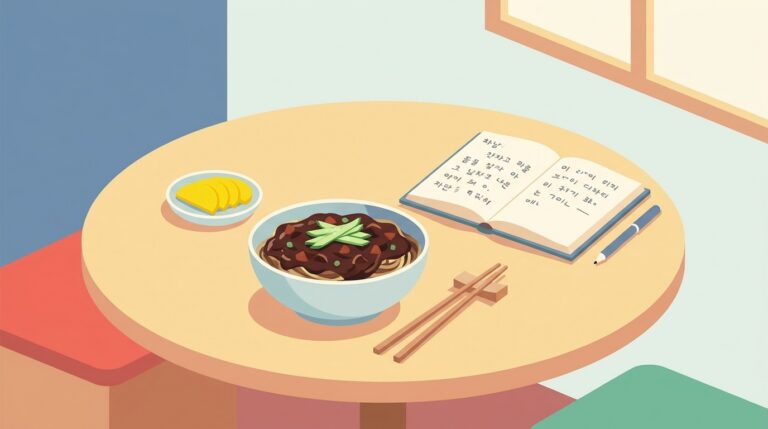
Phase 1: Why Korean Delivery Notes Matter
안녕하세요! 매일한글 에디터입니다. (Hello, this is your Daily Hangul Editor!) Picture this: you are curled up in your Seoul Airbnb watching a cozy K-Drama, and a craving for hot jajangmyeon hits. You open a delivery app, place your order, and thirty minutes later, your food arrives—along with four plastic spoons and three extra packs of yellow pickled radish (danmuji) you didn’t want! Or worse, you open the box and see the wrong dish. Many Daily Hangul learners told us they feel stressed typing delivery notes or calling restaurants in Korean. Don’t worry! Today’s real-world guide gives you natural, beginner-friendly phrases to save the planet and fix wrong orders without panic.
Phase 2: Top 3 Essential Expressions Deep Dive
1. 단무지랑 일회용 수저는 안 주셔도 괜찮아요 (Danmuji-rang ilhoeyong sujeo-neun an jusyeodo gwaenchanayo)
- Pronunciation: Dan-mu-ji-rang il-hoe-yong su-jeo-neun an ju-syeo-do gwaen-cha-na-yo (Think of gwaen-cha-na-yo as starting with ‘Gwen’ like Gwen Stefani, followed by ‘chah-nah-yo’!)
- Meaning: Literal: “Even if you don’t give pickled radish and disposable spoon/chopsticks, it’s okay.” / Real Nuance: “You don’t need to include pickled radish or disposable utensils.”
- K-Culture Moment: On Korean reality shows like I Live Alone (나 혼자 산다), stars ordering late-night tteokbokki often leave sweet notes asking owners to skip the extra plastic cutlery so their kitchen drawers don’t overflow.
- Editor’s Insight: Two super handy beginner hacks here! First,
수저(sujeo) is a magic combo word for both숟가락(sutgarak – spoon) and젓가락(jeotgarak – chopsticks). Second, adding-아/어도 괜찮아요(it’s okay even if…) makes your refusal sound warm and polite rather than bossy.- Situation Spectrum: Casual ⚠️ | Semi-formal ✅ | Formal ✅
- 🤔 Think About It: In English, we often just say “No cutlery, please.” Why do Koreans prefer saying “It is okay even if you don’t give it to me”? How does acknowledging the restaurant owner’s effort reflect Korean jeong (affection and consideration)?
2. 문 앞에 두고 벨 눌러 주세요 (Mun ape dugo bel nulleo juseyo)
- Pronunciation: Mun a-pe du-go bel nul-leo ju-se-yo (Say mun like ‘moon’, a-pe like ‘ah-peh’, and bel just like the English word ‘bell’!)
- Meaning: Literal: “Put it in front of the door and please press the bell.” / Real Nuance: “Please leave it at the door and ring the bell.”
- K-Culture Moment: Think of that classic K-Drama scene where a tired office worker in cozy pajamas peeks through the peephole, waits for the delivery rider’s footsteps to fade, and happily scoops up their chimaek (fried chicken and beer).
- Editor’s Insight: This is the number one requested phrase in Korean delivery apps! If your roommate is asleep or your dog barks loudly, simply swap the end to
벨 누르지 마세요(Bel nureuji maseyo – Please don’t ring the bell).- Situation Spectrum: Casual 🚫 | Semi-formal ✅ | Formal ✅
- 🤔 Think About It: Contactless delivery in Korea works smoothly because people trust leaving food outside apartment doors. How does delivery etiquette in your home country compare?
3. 죄송한데, 주문한 거랑 다른 음식이 왔어요 (Joesonghande, jumunhan georang dareun eumsigi wasseoyo)
- Pronunciation: Joe-song-han-de, ju-mun-han geo-rang da-reun eum-si-gi wa-sseo-yo (Joe-song sounds like ‘jweh-song’, and wa-sseo-yo sounds like ‘wah-ssuh-yo’.)
- Meaning: Literal: “I’m sorry, but food different from what I ordered came.” / Real Nuance: “Excuse me, I received the wrong order.”
- K-Culture Moment: Just like in slice-of-life dramas when someone excitedly peels open the plastic wrap only to discover spicy jjamppong instead of the sweet jajangmyeon they dreamed about all day.
- Editor’s Insight: Beginners are often surprised that Koreans say
죄송한데(Joesonghande – I’m sorry, but…) when the restaurant made the mistake! You aren’t taking the blame—it’s simply a polite conversational cushion meaning “Excuse me for bothering you.”- Situation Spectrum: Casual 🚫 | Semi-formal ✅ | Formal ✅
- 🤔 Think About It: Why do Koreans cushion complaints with “I’m sorry”? How does your native language balance politeness and directness when something goes wrong?
Phase 3: Textbook Korean vs. Real Korean
Situation 1: Saying no to disposable utensils
- 📖 Textbook Korean:
일회용 숟가락과 젓가락을 주지 마십시오.(Ilhoeyong sutgarakgwa jeotgarageul juji masipsio.) - 🗣️ Real Korean:
수저는 빼 주세요~(Sujeo-neun ppae juseyo~) or일회용품 안 주셔도 돼요!(Ilhoeyongpum an jusyeodo dwaeyo!) - 💡 Why the difference? Using
-지 마십시오sounds like a strict military commander! In real delivery apps, adding빼 주세요(please leave it out) or a soft tilde (~) keeps the vibe friendly for busy kitchen staff.
Situation 2: Telling the shop something is missing
- 📖 Textbook Korean:
제가 주문한 콜라가 배달되지 않았습니다.(Jega jumunhan kollaga baedaldoeji anasseumnida.) - 🗣️ Real Korean:
저기요, 콜라가 빠져서 왔어요.(Jeogiyo, kollaga ppajyeoseo wasseoyo.) - 💡 Why the difference? Instead of a stiff passive sentence, locals say the item “arrived missing” (
빠져서 왔어요), which sounds gentle, natural, and easy to understand over the phone.
Phase 4: K-Culture Deep Dive & Non-Verbal Manners
4-1. Nunchi (눈치) & Delivery Etiquette
Even when typing in a delivery app, good Korean nunchi (social awareness) shines through! Always add 감사합니다 (Gamsahamnida – Thank you) at the end of your request note—restaurant owners genuinely read them and sometimes even sneak in an extra dumpling as a thank-you! Also, remember that tipping is not part of Korean delivery culture. If you call a restaurant about a wrong order, keep your voice calm and warm rather than raised; owners are usually super eager to send the right dish right away.
4-2. Cultural Code: Korea’s Eco-Friendly Baedal Revolution
Korea’s baedal (배달 – delivery) culture is legendary—you can order sizzling stews, iced coffee, or fried chicken right to a picnic mat by the Han River! However, because Korea enforces strict recycling and food-waste sorting rules (분리수거 – bunli-sugeo), piles of unused plastic forks and tiny yellow danmuji packets became a huge headache. Today, Korean delivery apps include an eco-friendly toggle asking if you want disposable cutlery, and locals proudly leave custom notes like 단무지 빼 주세요 (Leave out the pickled radish) to avoid waste!
Phase 5: Real-Life Roleplay Scenario
Setting: It’s a rainy Friday night in Hongdae. You ordered crispy yangnyeom chicken and danmuji via a delivery app, and you wrote 문 앞에 두고 벨 눌러 주세요 (Mun ape dugo bel nulleo juseyo). When you open the bag, wait—you got spicy garlic chicken instead! You call the friendly owner, Sajangnim Min-su.
- Sajangnim: 여보세요, 행복치킨입니다! (Yeoboseyo, Haengbok Chicken-imnida!) – Hello, this is Haengbok Chicken! (🎭 Speaks cheerfully over sizzling fryer sounds)
- You: 안녕하세요. 저 방금 배달 받았는데요. (Annyeonghaseyo. Jeo banggeum baedal badanneundeyo.) – Hello. I just received my delivery. (🎭 Holds the warm chicken box, speaking politely)
- Sajangnim: 네, 손님! 무슨 일 있으세요? (Ne, sonnim! Museun il isseuseyo?) – Yes, customer! Is something wrong? (🎭 Pauses, attentive and ready to help)
- You: 죄송한데, 주문한 거랑 다른 음식이 왔어요. (Joesonghande, jumunhan georang dareun eumsigi wasseoyo.) – I’m sorry, but a different dish from what I ordered arrived. (🎭 Checks the receipt on the bag to be sure)
- Sajangnim: 어머, 정말요? 양념치킨 주문하시지 않으셨어요? (Eomeo, jeongmallyo? Yangnyeom chicken jumunhasiji aneuseyeossoyo?) – Oh my, really? Didn’t you order seasoned chicken? (🎭 Sounds genuinely surprised and checks the order screen)
- You: 네, 맞아요. 그런데 마늘치킨이 왔어요. (Ne, majayo. Geureonde maneul chicken-i wasseoyo.) – Yes, that’s right. But garlic chicken arrived. (🎭 Points at the label on the box)
- Sajangnim: 아이고, 죄송합니다! 지금 바로 다시 보내 드릴게요! (Aigo, joesonghamnida! Jigeum baro dasi bonae deurilgeyo!) – Oh dear, I’m so sorry! I will send it again right away! (🎭 Apologizes sincerely and starts packing a fresh order)
- You: 아, 단무지랑 일회용 수저는 안 주셔도 괜찮아요. 감사합니다! (A, danmuji-rang ilhoeyong sujeo-neun an jusyeodo gwaenchanayo. Gamsahamnida!) – Oh, you don’t need to include pickled radish or disposable utensils. Thank you! (🎭 Smiles warmly, glad to avoid extra waste)
🔀 Interactive Branching Point
Before hanging up, Sajangnim asks: “혹시 지금 온 마늘치킨은 어떻게 할까요?” (Hoksi jigeum on maneul chicken-eun eotteoke halkkayo? – What should we do about the garlic chicken you have now?) What do you say?
- A:
문 앞에 내놓을게요. 가져가셔도 돼요.(Mun ape naenoeulgeyo. Gajyeogasyeodo dwaeyo.) – “I’ll leave it outside the door. You can take it back.”- 👉 Feedback (Best!): Super polite and practical! Usually the rider swaps the bags at the door, or the owner might even tell you to keep it as a bonus service!
- B:
그냥 제가 먹을게요. 공짜로 주세요.(Geunyang jeoga meogeulgeyo. Gongjjaro juseyo.) – “I’ll just eat it. Give it to me for free.”- 👉 Feedback (Bad!): Demanding
공짜(free) sounds quite rude in Korean culture. Wait for the owner to offer it first!
- 👉 Feedback (Bad!): Demanding
- C:
몰라요! 빨리 바꿔 주세요!(Mollayo! Ppalli bakkwo juseyo!) – “I don’t know! Hurry up and exchange it!”- 👉 Feedback (Risk!): Using
몰라요(I don’t know) and빨리(hurry up) sounds harsh and stressful. Keep it gentle for faster, friendlier service!
- 👉 Feedback (Risk!): Using
Phase 6: 10-Second Emotion Shadowing Drill
Read aloud using / for quick pauses and match the emotion!
- [😊 Warm & Eco-friendly] 단무지랑 / 일회용 수저는 / 안 주셔도 괜찮아요. (Danmuji-rang / ilhoeyong sujeo-neun / an jusyeodo gwaenchanayo.)
- [🏠 Relaxed & Clear] 문 앞에 두고 / 벨 눌러 주세요. / 감사합니다! (Mun ape dugo / bel nulleo juseyo. / Gamsahamnida!)
- [🥺 Polite & Gentle] 죄송한데, / 주문한 거랑 / 다른 음식이 왔어요. (Joesonghande, / jumunhan georang / dareun eumsigi wasseoyo.)
Phase 7: K-Culture Mini Dictionary
- 배달 (baedal) | Delivery | Used everywhere from restaurant apps to ordering groceries in 30 minutes (
배달의 민족literally means “Nation of Delivery”). - 요청사항 (yocheongsahang) | Special requests | The text box in Korean delivery apps where you write notes for the kitchen or rider.
- 단무지 (danmuji) | Yellow pickled radish | A sweet-and-tangy crunchy side dish that almost always comes free with jajangmyeon, kimbap, or tteokbokki.
- 오배달 (obaedal) | Wrong delivery | The official term used in customer support chats when your order goes to the wrong door or the wrong food arrives.
Phase 8: Survival Kit for Travelers
Top 3 Survival Phrases
- 일회용품 빼 주세요 (Ilhoeyongpum ppae juseyo) — Pro Tip: Shorter than saying spoon and chopsticks! Covers plastic forks, napkins, and bags all at once.
- 벨 누르지 마세요 (Bel nureuji maseyo) — Pro Tip: Essential for late-night snacking if you are staying in a quiet guesthouse or sleeping baby’s home.
- 음식이 안 왔어요 (Eumsigi an wasseoyo) — Pro Tip: Easy emergency phrase meaning “The food hasn’t arrived” if the app says delivered but your doorstep is empty.
Editor’s Travel Note
- Must-Have Apps: If you have a Korean phone number and card, try the Baedal Minjok Korean delivery app download for the biggest menu selection. Traveling short-term with a foreign credit card? Use the Shuttle Delivery English service guide so you can order seamlessly in English!
- Building Code Tip: Korean apartments usually have a locked main lobby door (
공동현관– gongdong hyeongwan). In the app’s요청사항, remember to write your building door passcode (for example:#1234*) so the rider doesn’t get stuck downstairs!
Phase 9: One Step Deeper
In Korea’s hyper-fast delivery world, speed is important—but warmth (정 – jeong) still keeps everything running smoothly. Adding a simple 안 주셔도 괜찮아요 (you don’t have to give it) or starting a mix-up call with 죄송한데 shows that you see the person behind the screen, not just a faceless service. Even small business owners (소상공인 – sosanggongin) often write handwritten sticky notes on takeout boxes wishing customers a good meal! Language isn’t just about getting your food right; it’s about sharing a tiny moment of kindness.
💬 Your Turn: What is the first Korean food you want to order by delivery, or what special request (like “no cilantro” or “less spicy”) would you love to learn in Korean? Tell us in the comments!
Phase 10: FAQ & Common Mistakes
Q: Can I just write “단무지 X, 수저 X” in the delivery app?
A: Yes! Writing 단무지 X, 수저 X (Danmuji X, sujeo X) is super common and quick for busy cooks to read, though adding 안 주셔도 돼요~ feels extra polite.
Q: What if I’m too shy to call the restaurant about a wrong order?
A: Don’t panic! Major apps like Baedal Minjok and Coupang Eats have a 1:1 customer chat (고객센터 – gogaek senteo) where you can just upload a photo of the wrong food and paste 주문한 거랑 다른 음식이 왔어요.
Q: Does “수저” (sujeo) include napkins too?
A: Usually 수저 only refers to the spoon and chopsticks. If you want to skip napkins and wet wipes as well, use 일회용품 (ilhoeyongpum – disposable items).
🚨 Common Mistakes TOP 3
- Mistake: Saying
주지 마세요(Juji maseyo – Don’t give it to me) abruptly over the phone. -> Correct Action: Use안 주셔도 괜찮아요(An jusyeodo gwaenchanayo) so it sounds grateful rather than commanding. - Mistake: Confusing
배달(baedal – delivery) with포장(pojang – takeout/pickup) in the app. -> Correct Action: Double-check that배달is selected before paying so you don’t accidentally have to walk to the restaurant! - Mistake: Forgetting your building lobby password (
공동현관 비밀번호) in the request box. -> Correct Action: Always check if your Airbnb has a lobby code and type it neatly into요청사항.
Phase 11: Action Mission & Engagement
- 🥉 Bronze Mission: Stand in front of the mirror and say
단무지랑 일회용 수저는 안 주셔도 괜찮아요three times smoothly without looking at the Romanization! - 🥈 Silver Mission: Screenshot your favorite phrase from Phase 2 and share it on your Instagram Story or study group chat with your dream Korean midnight snack.
- 🥇 Gold Mission: Next time you order Korean takeout or delivery (even at a local Korean restaurant in your city!), politely tell the staff
일회용 수저는 안 주셔도 괜찮아요!. - 🎮 K-Culture Mission: Watch a Korean Mukbang or I Live Alone clip on YouTube and try to spot how the host opens their delivery bag—listen closely for
문 앞에or수저!
Phase 12: Interactive Quiz Challenge
Test your skills before your next midnight craving!
1. [Situational Judgment] You ordered tteokbokki online, and you want the rider to leave it outside without waking up your sleeping roommate. Which note should you type?
* A) 문 앞에 두고 벨 눌러 주세요.
* B) 문 앞에 두고 벨 누르지 마세요.
* C) 죄송한데, 다른 음식이 왔어요.
Check Answer & Explanation (Q1)
Answer: B!
If you choose A, the rider will ring the doorbell and wake up your roommate! Changing 눌러 주세요 (please press) to 누르지 마세요 (please don’t press) keeps the house quiet. Option C is for reporting a wrong order.
2. [Fill in the Blank] Complete the polite request to skip pickled radish and disposable utensils:
단무지랑 일회용 ______ 안 주셔도 괜찮아요. (Hint: It combines spoon and chopsticks!)
Check Answer & Explanation (Q2)
Answer: 수저는 (sujeo-neun)수저 (sujeo) is the everyday Korean word combining 숟가락 (spoon) and 젓가락 (chopsticks)! Adding the topic particle -는 makes the sentence flow naturally.
3. [True / False Cultural Quiz] In Korea, if a restaurant sends the wrong food (오배달), you shouldn’t say 죄송한데 (I’m sorry, but…) because it means you are admitting the mistake was your fault.
Check Answer & Explanation (Q3)
Answer: False!
In Korean, starting a phone call or request with 죄송한데 is a polite social cushion meaning “Excuse me for troubling you.” It actually makes the owner much happier to help you fix the order quickly!
🎬 Watch Our Daily Videos! (Daily Hangul Official Instagram)
Review the expressions you learned in this article with our fun daily short videos! Check out native pronunciation and real-life nuances in action.
- Instagram @dailyhangul_en







