

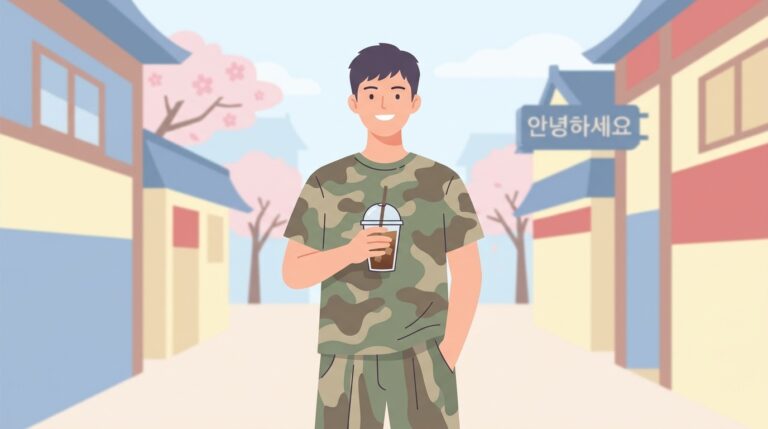
Phase 1: 공감 (Story-driven Empathy Opening)
안녕하세요! 매일한글 (Daily Hangul) editor here! Have you ever walked through the bustling streets of Seoul or hopped onto Line 2 on a Tuesday morning and suddenly spotted someone wearing a full camouflage military uniform, slouching comfortably in a subway seat or grabbing an iced Americano at a café? If your first thought was, “Wait, is there an active emergency?!”—don’t panic at all! You’ve just witnessed one of Korea’s most fascinating cultural phenomena: 예비군 훈련 (Yebigun Hullyeon – Reserve Forces Training).
In South Korea, almost all able-bodied men complete mandatory active military service (현역), but the journey doesn’t completely end upon discharge (전역). For several years afterward, every Korean man is called back annually for a few days of refresher training. The running cultural joke across K-Dramas and webtoons is that the moment a charismatic, sharp Korean man puts on his loose reserve uniform, his posture relaxes, his walking pace slows down by half, and he looks endlessly sleepy. Understanding this cultural quirk will not only enrich your understanding of K-Dramas like D.P. or casual everyday conversations with Korean friends, but it also gives you essential phrases to comfortably ask your Korean male friends about their training days without sounding awkward or intrusive. Let’s dive into this unique, warm slice of Korean life!
Phase 2: 핵심 표현 3선 심층 분석 (Top 3 Essential Expressions)
1. 오늘 예비군 훈련 가요. (Oneul yebigun hullyeon gayo.)
- Pronunciation: [Oh-neul yeh-bee-goon hool-lyeon gah-yo] (Sounds like saying “Yeah-bee-goon” softly while exhaling)
- Meaning: Literal: “Today I go to reserve army training.” / Actual: “I have reserve military training today (so I’m off work/school).”
- K-Culture Moment: Seen frequently in everyday sitcoms and office K-Dramas when a male colleague wears a military cap to the office early in the morning before heading to the base.
- Editor’s Insight: At level A2, this simple declarative sentence with the Polite ending -아요/어요 is your go-to sentence. It explains why someone might be absent from university classes or group chats.
- Situation Spectrum: Casual ✅ | Semi-formal ✅ | Formal ✅
- 🤔 Think About It: In many countries, military service is voluntary and rarely part of everyday office talk. How does talking openly about reserve training reflect Korea’s shared collective experience?
2. 훈련 잘 다녀오세요! (Hullyeon jal danyeo-oseyo!)
- Pronunciation: [Hool-lyeon jahl dah-nyeo-oh-seh-yoh] (Think of “dahn-yeo” flowing smoothly together)
- Meaning: Literal: “Go and return well from training!” / Actual: “Have a safe and smooth training session!”
- K-Culture Moment: Friends and coworkers warmly waving goodbye to a friend heading out early in the morning with their combat boots tied.
- Editor’s Insight: 다녀오다 means “to go and come back.” Adding the polite imperative -세요 turns this into the kindest, most natural supportive cheer for someone going anywhere temporary, especially military training.
- Situation Spectrum: Casual ⚠️ (Use ‘잘 다녀와!’ with close friends) | Semi-formal ✅ | Formal ✅
- 🤔 Think About It: Why does Korean have a dedicated single verb for “going and safely returning” rather than just saying “have a good day”?
3. 군복 입으니까 어색해요. (Gunbok ibeunikka eosaekhaeyo.)
- Pronunciation: [Goon-bok ee-beu-nee-kka uh-saek-hae-yo] (Sharp double-k sound on “k-ka”)
- Meaning: Literal: “Because I wore my military uniform, it is awkward.” / Actual: “It feels so weird and funny wearing this uniform again after so long.”
- K-Culture Moment: Classic Instagram selfie caption uploaded by Korean actors or idols returning to their reserve duty drills.
- Editor’s Insight: The grammar pattern -(으)니까 expresses reason (“because/since”), and 어색하다 means to feel awkward or out of place. It perfectly captures the relatable feeling of putting on an old uniform.
- Situation Spectrum: Casual ✅ | Semi-formal ✅ | Formal 🚫
- 🤔 Think About It: Sharing minor personal awkwardness builds instant rapport in Korean communication. How does expressing vulnerability bridge friendships?
Phase 3: 교과서 한국어 vs 진짜 한국어 (Textbook vs. Real Korean)
Situation 1: Asking if training is finally over for the day
- 📖 교과서 한국어: “예비군 훈련이 종료되었습니까?” (Did the reserve training conclude?)
- 🗣️ 진짜 한국어: “오늘 훈련 끝났어요?” (Are you done with training today?)
- 💡 왜 다를까?: Textbook Korean often uses rigid Sino-Korean vocabulary like 종료 (conclusion), whereas real native speakers rely on the friendly, warm verb 끝나다 (to finish/end).
Situation 2: Sympathizing with a tired friend after drill
- 📖 교과서 한국어: “훈련을 받느라 대단히 수고하셨습니다.” (You exerted tremendous effort undergoing drill.)
- 🗣️ 진짜 한국어: “오늘 고생 많았어요! 맛있는 거 먹어요.” (You worked so hard today! Let’s get some tasty food.)
- 💡 왜 다를까?: Rather than solemn formal congratulations, real friends acknowledge physical tiredness with 고생했어요 (you went through hardship) followed by an offer of food.
Phase 4: K-Culture 딥다이브 & 비언어적 매너 (Deep Dive & Non-Verbal Manners)
4-1. 눈치 (Nunchi) & Polite Etiquette
- The “P.X. Request” Culture: If your close Korean friend mentions they are at 예비군 training, never ask them to do heavy military tasks, but you can playfully ask: “PX에서 달팽이 크림 사다 줘!” (Buy me snail cream at the PX!). The military PX (Post Exchange) is famous for selling luxury skincare and snacks at extreme discounts!
- Body Language & Mood: Reserve soldiers look visibly tired because waking up at 6:00 AM for roll call is exhausting. Give them space, avoid staring at their uniforms on the subway, and greet them with a gentle smile.
4-2. Cultural Code Analysis: The PX Snail Cream Phenomenon
In K-Dramas and reality variety shows like Real Men (진짜 사나이), you often see Korean men returning from reserve service carrying plastic bags filled with cosmetics and frozen dumplings (냉동식품). This creates a unique bonding bridge between young men and their families or girlfriends, turning a tiring obligation into a gift-giving ritual.
Phase 5: 실전 롤플레이 시나리오 (Interactive Roleplay)
Setting: You meet your university classmate/colleague Minho (민호) at a café near Gangnam Station. He is wearing military fatigues and holding a cup of iced coffee looking exhausted.
- 민호: “어, 사라 씨! 여기서 만나네요!” (Oh, Sarah! Fancy meeting you here!)
🎭 [Waving with a tired smile, adjusting his military cap] - 사라: “민호 씨! 오늘 군복 입으셨네요?” (Minho! You’re wearing a military uniform today?)
🎭 [Looking curious and pointing politely] - 민호: “네, 오늘 예비군 훈련 다녀왔어요.” *(Yes, I came back from reserve military training today.)
🎭 [Sighing playfully and slumping into the chair]` - 사라: “아, 진짜요? 오늘 날씨 더운데 훈련 잘 다녀오셨어요?” (Ah, really? The weather was hot today, did your drill go well?)
🎭 [Offering a supportive nod] - 민호: “더워서 조금 힘들었지만 무사히 끝났어요.” *(It was a bit tough because of the heat, but it finished safely.)
🎭 [Wiping his brow with a laugh]` - 사라: “정말 고생 많으셨어요!” (You really worked hard today!)
🎭 [Clapping hands gently in sympathy] - 민호: “고마워요. 혹시 PX 달팽이 크림 필요해요? 제가 하나 샀어요.” *(Thank you. By any chance, do you need PX snail cream? I bought one.)
🎭 [Reaching into his bag to pull out a green box]` - 사라: “우와, 정말요? 민호 씨 최고예요!” (Wow, really? Minho, you are the best!)
🎭 [Beaming brightly with both hands on the gift]
🔀 인터랙티브 분기점 (Interactive Choice Branch)
If Minho says he just finished training and feels hungry, how do you respond?
* Option A: “오늘 고생했으니까 제가 시원한 커피 살게요!” (Since you worked hard today, I’ll buy cool coffee!)
* Option B: “왜 군대에 다시 가셨어요? 잘못했어요?” (Why did you go to the army again? Did you do something wrong?)
* Option C: “군복이 안 어울려요. 빨리 갈아입으세요.” (The uniform doesn’t suit you. Change quickly.)
Feedback:
* Option A [BEST]: 100 points! Showing empathy and offering a small treat is the peak of Korean social etiquette.
* Option B [RISK]: 30 points. It implies reserve training is a punishment, which might cause awkward misunderstanding!
* Option C [BAD]: 0 points. Too blunt and dismissive of their tiring day.
Phase 6: 10초 감정 섀도잉 드릴 (10-Second Emotion Shadowing Drill)
Practice reading these out loud with natural pauses marked by /:
[😊 따뜻하고 다정하게 - Warm & Encouraging]
“오늘 / 훈련 / 잘 다녀오세요!”[😮 반갑고 신기해하며 - Curious & Surprised]
“군복 입으니까 / 분위기가 / 완전 달라요!”[🥺 깊이 공감하며 - Deeply Sympathetic]
“날씨도 더운데 / 오늘 진짜 / 고생 많았어요.”
Phase 7: K-Culture 미니 사전 (Mini Dictionary)
- 예비군 (Yebigun): Reserve Forces / Men who have completed active military service and are on standby status.
- PX (Pi-eks): Post Exchange / On-base military convenience store known for extreme tax-free discounts.
- 군복 (Gunbok): Military uniform / Camouflage combat attire.
- 수고하셨습니다 (Sugohasyeotseumnida): “Thank you for your hard work” / The quintessential polite phrase used when finishing any task.
Phase 8: 여행자를 위한 생존 키트 (Traveler’s Survival Kit)
- Survival Phrase 1: 군복 입은 사람 왜 많아요? (Gunbok ibeun saram wae manayo? – Why are there so many people in uniform?) -> Pro Tip: Use this to ask local friends when you see groups of soldiers.
- Survival Phrase 2: PX에서 샀어요? (PX-eseo sasseoyo? – Did you buy this at the PX?) -> Pro Tip: Great conversation starter when a Korean friend shows unique snacks or cosmetics.
- Survival Phrase 3: 조심히 들어가세요! (Josimhi deureogaseyo! – Get home safely!) -> Pro Tip: Perfect farewell for someone heading home tired after training.
-
Editor’s Travel Note: Reserve training centers are usually located on the outskirts of cities. If you ever need to meet someone near a subway terminal station like Gupabal or Moran in the morning, check bus routes on the Naver Map application to avoid morning transit crowds around military shuttle stops.
Phase 9: “한 발 더 깊이” (Cultural Reflection Essay)
In South Korea, military duty is a universal shared rite of passage for most men, creating an unspoken bond of empathy that cuts across generations. When Koreans see a reserve soldier walking down the road in loose boots, they do not see an intimidating soldier; they see someone’s son, brother, or friend sacrificing a workday for collective community defense. This shared solidarity explains why strangers often offer a polite nod or gentle understanding to men in uniform on public transit.
💬 Your Turn: In your home country, do civilians have shared public obligations like jury duty or national service? How do people talk about them with friends? Share your thoughts below!
Phase 10: FAQ & 오해 방지 (FAQ & Common Mistakes)
Q: Why do Korean men look so tired when wearing their reserve uniform?
A: Reserve training starts extremely early with strict roll calls, physical drills, and weapon refresher courses after months or years of comfortable civilian desk life. Putting on heavy combat boots naturally exhausts anyone!
Q: Is it rude to ask a Korean friend about their military service?
A: Not at all! Most Korean men are actually proud and happy to share funny military stories (군대 이야기), provided you ask with genuine curiosity and friendliness.
Q: Can women serve in the reserve forces in Korea?
A: Yes! Female officers and non-commissioned officers who completed active service also participate in reserve training alongside male soldiers.
🚨 흔한 실수 (Common Mistakes) Caution Board
- Mistake 1: Calling reserve soldiers “active soldiers” (현역).
- Correct Action: Refer to them casually as 예비군 (Yebigun).
- Mistake 2: Assuming military camouflage on the subway indicates a national crisis.
- Correct Action: Stay calm—it is 99.9% just a standard annual reserve training session.
- Mistake 3: Forgetting to say 고생했어요 when your friend finishes their day.
- Correct Action: Always validate their fatigue with a warm supportive remark!
Phase 11: 액션 미션 & 참여 유도 (Action Missions)
- 🥉 Bronze Mission: Practice pronouncing “훈련 잘 다녀오세요!” out loud 3 times in front of a mirror.
- 🥈 Silver Mission: Leave a comment below using the grammar pattern -(으)니까 (e.g., 군복 입으니까 멋있어요!).
- 🥇 Gold Mission: Next time a Korean celebrity or friend posts a photo in military fatigues, comment: “오늘 고생 많으셨어요!”
- 🎮 K-Culture Mission: Watch an episode of a Korean drama featuring workplace banter and spot if someone mentions going to 예비군!
Phase 12: 인터랙티브 퀴즈 챌린지 (Interactive Quiz Challenge)
1. Situation Quiz: What is the most polite and natural phrase to say to your colleague who is leaving early for reserve training?
* (A) 군대에 다시 가세요!
* (B) 훈련 잘 다녀오세요!
* (C) 왜 군복을 입어요?
2. Fill-in-the-blank Quiz: Complete the sentence with the polite reason ending:
“군복을 ______ 어색해요.” (I wore uniform -> it feels awkward.)
* (A) 입으니까
* (B) 먹으니까
* (C) 가니까
3. True or False: Korean military PX stores are famous for selling affordable skincare products like snail cream.
* (A) True
* (B) False
👉 Click here to check answers and explanations!
- Answer: (B) – 훈련 잘 다녀오세요! is the ideal polite blessing wishing someone a safe drill.
- Answer: (A) – 입으니까 comes from the verb 입다 (to wear clothes).
- Answer: (A) True – PX cosmetics are legendary among Korean families and friends for their affordability!







