Phase 1: Empathy & Storytelling Opening
안녕하세요! 매일한글 에디터입니다. Have you ever experienced that warm, heart-stopping moment in Korea where a kind stranger went completely out of their way to help you? Picture this: you are standing at the top of a steep subway staircase in Seoul with a heavy 25kg suitcase, feeling completely stranded. Suddenly, a passerby rushes over, grabs the handle without hesitation, carries it all the way down, and smiles. In that moment, a flat, robotic “감사합니다 (Gamsahamnida)” just doesn’t feel like enough to capture the overwhelming gratitude rushing through your chest.
You want to convey genuine, deep appreciation and perhaps offer a small token of reciprocity—the Korean way. In our 10 years of mentoring Korean language learners at Daily Hangul, the number one frustration B1 intermediate learners share is sounding emotionally detached when expressing true gratitude. In this guide, you will master how to transform textbook politeness into heartfelt, authentic Korean gratitude that warms anyone’s heart.
Phase 2: Top 3 Core Expressions in Depth
1. 도와주셔서 진심으로 감사드립니다 (한글)
- Pronunciation: Do-wa-ju-syeo-seo jin-sim-eu-ro gam-sa-deu-rim-ni-da (Sounds like: doh-wah-joo-shuh-suh jeen-sheem-oo-roh gahm-sah-deu-reem-nee-dah)
- Meaning: Literal: “Because you helped, I sincerely offer thanks.” | Real Nuance: “Thank you from the bottom of my heart for your generous help.”
- K-Culture Moment: Heard constantly in K-Dramas when a protagonist overcomes a major crisis thanks to a mentor’s unexpected intervention.
- Editor’s Insight: Using 진심으로 (with sincerity / from the heart) elevates your gratitude instantly. Adding 감사드립니다 instead of 감사합니다 demonstrates deep humility and respect.
- Situation Spectrum: Casual 🚫 | Semi-formal ✅ | Formal ✅
- 🤔 Think About It: In English, we often say “I appreciate it,” but Korean focuses on the specific action done for you (도와주셔서) combined with your inner state (진심).
2. 덕분에 살았어요 / 덕분에 큰 도움이 되었어요 (한글)
- Pronunciation: Deok-bu-ne sar-as-seo-yo / Deok-bu-ne keun do-um-i doe-eoss-eo-yo (Sounds like: duck-boo-neh sah-rahs-sui-yoh / duck-boo-neh koon doh-oom-ee dway-uss-sui-yoh)
- Meaning: Literal: “Thanks to you, I lived / It was a huge help.” | Real Nuance: “You literally saved my day / You were a lifesaver!”
- K-Culture Moment: When a coworker covers an urgent deadline for you right before the boss checks the report.
- Editor’s Insight: 덕분에 (thanks to you / by your grace) places credit entirely on the other person. Saying 살았어요 (I survived) adds vivid warmth without being dramatic.
- Situation Spectrum: Casual ✅ | Semi-formal ✅ | Formal ⚠️
- 🤔 Think About It: Notice how Korean creates closeness by acknowledging interdependence through the magic prefix word 덕분에.
3. 작지만 제 마음이에요 (한글)
- Pronunciation: Jak-ji-man je ma-eum-i-e-yo (Sounds like: jahk-jee-mahn jeh mah-oom-ee-eh-yoh)
- Meaning: Literal: “It’s small, but it is my heart/mind.” | Real Nuance: “It’s just a small token of my appreciation (please accept it).”
- K-Culture Moment: Handing a warm canned coffee or a bakery treat to someone who just helped you with directions or a task.
- Editor’s Insight: Korean culture values modesty. Never boast about what you give; framing it as “just my sincere feeling” (제 마음) makes the recipient feel honored without burden.
- Situation Spectrum: Casual ✅ | Semi-formal ✅ | Formal ✅
- 🤔 Think About It: Why does Korean etiquette frame gifts as “humble feelings” rather than focusing on the item’s material value?
Phase 3: Textbook Korean vs. Real Native Korean
- Situation 1: Thanking a colleague or stranger for unexpected assistance
- 📖 교과서 한국어 (Textbook): 도움을 주셔서 대단히 감사합니다. (Do-um-eul ju-syeo-seo dae-dan-hi gam-sa-deu-rim-ni-da. – “Thank you very much for giving help.”)
- 🗣️ 진짜 한국어 (Real Native): 진짜 너무 감사해요! 덕분에 한숨 돌렸어요. (Jin-jja neo-mu gam-sa-hae-yo! Deok-bu-ne han-sum dol-lyeoss-eo-yo. – “Thank you so, so much! Thanks to you, I can finally catch my breath.”)
- 💡 왜 다를까?: “대단히” sounds like a public announcement or a prepared speech. Real Koreans use vivid emotional idioms like “한숨 돌리다” (catch one’s breath) to convey practical relief.
- Situation 2: Promising to repay a favor or treat someone
- 📖 교과서 한국어 (Textbook): 다음 기회에 은혜를 갚겠습니다. (Da-eum gi-hoe-e eun-hye-reul gap-get-seum-ni-da. – “I shall repay this grace on the next occasion.”)
- 🗣️ 진짜 한국어 (Real Native): 제가 다음에 맛있는 밥 꼭 살게요! (Je-ga da-eum-e mas-it-neun bap kkok sal-ge-yo! – “I am definitely treating you to a delicious meal next time!”)
- 💡 왜 다를까?: Promising to “repay grace (은혜)” sounds like a historical period drama. Modern Koreans bond over food, so offering to buy a meal (밥 사다) is the ultimate natural sign of gratitude.
Phase 4: K-Culture Deep Dive & Non-Verbal Manners
4-1. Nunchi & Non-Verbal Etiquette
When expressing heartfelt thanks in Korea, your physical posture carries 50% of the emotional weight:
* The Two-Handed Hold (두 손 사용): When handing over a small token of thanks (like a drink, snack, or gift), always hold it with both hands or support your right wrist/forearm with your left hand.
* The 30-Degree Grateful Bow: Pair your sentence with a smooth, 30 to 45-degree bow. Maintain eye contact right before bending, lower your gaze during the bow, and reconnect with a warm smile as you rise.
* Receiving Refusals Gracefully: In Korea, when you offer a small gift, the receiver might say “에이, 뭘 이런 걸 다! (Oh, you really didn’t have to!)” once or twice out of politeness. Don’t retract the gift immediately; gently insist with “제 마음이니까 편하게 받아주세요” (It’s my sincere gesture, please accept it comfortably).
4-2. Cultural Code: The Culture of Jeong (정) and Reciprocity
In Korean society, receiving help creates an invisible, warm social bond known as 정 (Jeong). Leaving gratitude at a verbal level can sometimes feel incomplete when someone made a noticeable effort for you. This is why small “repayment rituals” thrive—from handing over a vitamin drink (like Bacchus) at a convenience store counter to buying coffee after a collaborative project. It signals: “I see your effort, and our connection matters to me.”
Phase 5: Real-Life Roleplay Scenario
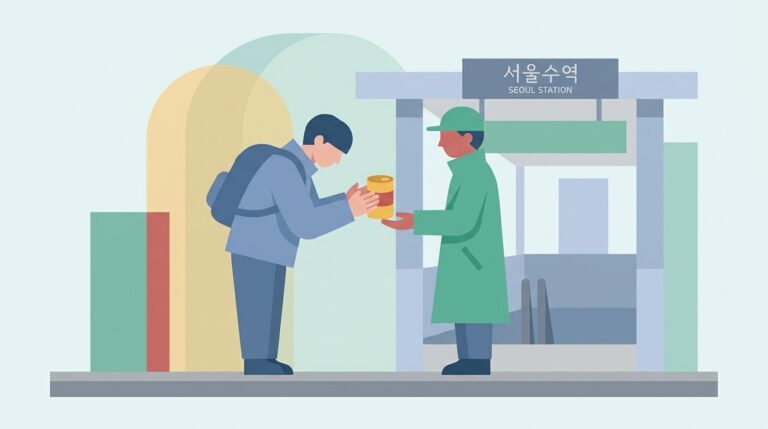
Setting: Alex (an exchange student in Seoul) accidentally drops his documents and metro card near the turnstile. Minji, an office worker nearby, helps retrieve everything and assists Alex in resolving a card error at the ticket kiosk.
- Turn 1 (Alex): 저기요, 제 카드가 개찰구 밑으로 들어갔는데 도와주실 수 있나요? (Excuse me, my card slipped under the gate, could you help me?)
🎭 당황하며 손가락으로 가리킨다 (Points panickingly) - Turn 2 (Minji): 어머, 괜찮아요! 역무원 벨 제가 눌러서 같이 말씀드릴게요. (Oh my, it’s okay! I’ll press the station staff bell and speak with them for you.)
🎭 미소를 지으며 역무실 호출 벨을 누른다 (Smiles and presses the assistance bell) - Turn 3 (Alex): 와, 직접 설명까지 해주시고 정말 다행이에요. (Wow, you even explained it directly, what a relief.)
🎭 안도하며 가슴을 쓸어내린다 (Sighs in visible relief) - Turn 4 (Minji): 카드 잘 나왔네요! 지하철 타러 가시면 돼요. (Your card came back safely! You can head on to catch your train.)
🎭 카드를 건네주며 따뜻하게 말한다 (Hands the card back with a warm smile) - Turn 5 (Alex): 바쁘신 텐데 도와주셔서 진심으로 감사드립니다. (Thank you from the bottom of my heart for helping even though you’re busy.)
🎭 두 손을 모으고 정중하게 허리를 숙여 인사한다 (Bows politely with hands joined) - Turn 6 (Alex): 덕분에 약속 시간에 안 늦고 살았어요! (Thanks to you, I saved my day and won’t be late for my appointment!)
🎭 활짝 웃으며 진심 어린 눈빛을 보낸다 (Smiles brightly with sincere eyes) - Turn 7 (Minji): 별말씀을요! 한국 여행 즐겁게 하세요. (Don’t mention it! Enjoy your time in Korea.)
🎭 손을 가볍게 내저으며 기분 좋게 웃는다 (Waves hand modestly and laughs gently) - Turn 8 (Alex): 잠시만요! 편의점에서 산 건데, 작지만 제 마음이에요. 드세요! (Wait a moment! I bought this at the convenience store—it’s small, but it’s a token of my thanks. Please have it!)
🎭 따뜻한 캔커피를 두 손으로 건넨다 (Hands over a warm canned coffee using two hands)
🔀 Interactive Branching Choice
What should Alex say after Minji finishes helping him at the gate?
* Option A: “땡큐! 다음엔 제가 밥 사줄게요.” (Thanks! I’ll buy you a meal next time.)
* ⚠️ Risk: Too casual for a complete stranger. Asking a stranger out for a meal unexpectedly might trigger awkwardness.
* Option B: “도와주셔서 진심으로 감사드립니다. 덕분에 큰 도움 되었어요!” (Thank you sincerely for your help. You were a tremendous help!)
* ✅ Best: Perfect balance of polite honorifics, sincere emotion, and clear gratitude.
* Option C: “네, 고마워요. 잘 가세요.” (Yeah, thanks. Good bye.)
* 🚫 Bad: Sounds abrupt, cold, and borderline dismissive after receiving dedicated help.
Phase 6: 10-Second Emotion Shadowing Drill
Master natural intonation by matching your breath and emotional state to these pauses (/ marks a brief micro-pause):
[🥺 Deeply touched & sincere]
도와주셔서 / 진심으로 / 감사드립니다.
(Do-wa-ju-syeo-seo / jin-sim-eu-ro / gam-sa-deu-rim-ni-da.)-
[😊 Relieved & full of energy]
진짜 / 덕분에 살았어요! / 너무 감사해요!
(Jin-jja / deok-bu-ne sar-as-seo-yo! / neo-mu gam-sa-hae-yo!) -
[🎁 Modest & warm-hearted]
작지만 / 제 작은 마음이에요 / 맛있게 드세요.
(Jak-ji-man / je ja-geun ma-eum-i-e-yo / mas-it-ge deu-se-yo.)
Phase 7: K-Culture Mini Dictionary
- 은혜 (Eun-hye) | Grace / Deep benevolence
- Meaning: A profound, life-altering favor or kindness bestowed by someone (e.g., parents, mentors, or life-savers). Used in phrases like 은혜를 잊지 않겠습니다 (I will never forget your grace).
- 정 (Jeong) | Warm communal bonding & affection
- Meaning: The uniquely Korean feeling of sticky, emotional connection cultivated through shared time, mutual vulnerability, and acts of kindness.
- 한턱내다 (Han-teok-nae-da) | To treat / To pick up the tab
- Meaning: The customary act of paying for someone’s meal or drinks to celebrate good news or express gratitude for their assistance.
- 신세 (Sin-se) | Indebtedness / Obligation for help received
- Meaning: Used when someone goes out of their way for you. Common polite expression: 신세 많이 졌습니다 (I have become greatly indebted to your kindness).
Phase 8: Survival Kit for Travelers
Survival Expressions TOP 3
- 덕분에 문제 해결됐어요! (Deok-bu-ne mun-je hae-gyeol-dwaess-eo-yo! – “Thanks to you, the problem is completely solved!”)
- Pro Tip: Use this when a hotel receptionist or shop staff fixes a tricky issue for you.
- 신경 써주셔서 감사합니다. (Sin-gyeong sseo-ju-syeo-seo gam-sa-ham-ni-da. – “Thank you for your thoughtful attention/care.”)
- Pro Tip: Perfect when someone pays extra care to your dietary requests or luggage handling.
- 이거 약소하지만 받아주세요. (I-geo yak-so-ha-ji-man bad-a-ju-se-yo. – “This is modest, but please accept it.”)
- Pro Tip: Use this when offering a small gift or treat to a tour guide or host.
Editor’s Travel Note
- App Navigation: If you lose your way in complex subway transfer stations, prepare your route beforehand with the Naver Map Navigation Application. It displays accurate exit numbers and elevator locations.
- Expressing Gratitude at Restaurants: Don’t just leave quietly after a memorable meal. Handing your card with both hands while saying “정말 맛있게 잘 먹었습니다, 감사합니다!” (I ate so wonderfully, thank you!) will bring the warmest smile to any restaurant owner’s face.
Phase 9: Think Deeper
In many Western contexts, saying “thank you” is often seen as closing a transaction—balancing the ledger so that both parties are even. In Korean culture, however, expressing gratitude through “덕분에” and reciprocating with modest treats is seen as opening or deepening an emotional relationship (관계). Gratitude is less about settling a score and more about affirming human connection in an interconnected community.
💬 Your Turn: Have you ever received kindness from a stranger while traveling or studying? How did you show your appreciation? Share your story in the comments below!
Phase 10: FAQ & Common Mistakes
Q: What is the exact difference between 감사합니다 (Gamsahamnida) and 감사드립니다 (Gamsadeurimnida)?
A: Both mean “thank you,” but 감사드립니다 uses the humble auxiliary verb 드리다 (to offer/give respectfully). It implies you are offering your gratitude upward to someone of higher status, older age, or to a stranger who provided major assistance.
Q: Can I use “고마워요 (Gomawoyo)” with strangers or service workers?
A: “고마워요” is informal-polite (해요체). While it is polite, using it with unfamiliar adults, elders, or service staff can sound slightly patronizing or overly casual. Stick to 감사합니다 or 감사드립니다 for proper etiquette.
Q: Is it rude if someone refuses my gift of gratitude twice?
A: Not at all! In Korean manners, refusing once or twice (거절의 예의) prevents looking greedy. Simply offer it one more time warmly with both hands, saying “제 성의니까 편하게 받아주세요 (It’s my sincere intention, please enjoy it)”.
🚨 Common Mistakes Warning Board
- Mistake: Saying “당신 덕분에 살았어요” to a stranger or senior.
- Why: The word 당신 (Dangsin) can sound confrontational in spoken Korean.
- Correct Action: Drop the pronoun completely and just say “도와주신 덕분에 살았어요!”
- Mistake: Offering cash as a casual thank-you gift for personal help.
- Why: Handing cash to a friendly helper can feel transactional or insulting.
- Correct Action: Buy a coffee, beverage, or small snack instead.
- Mistake: Handing a gift or shaking hands using only one hand with limp posture.
- Why: It signals indifference or superiority.
- Correct Action: Support your elbow or forearm with your left hand and bow slightly.
Phase 11: Action Mission & Engagement
- 🥉 Bronze Mission (Solo Practice): Stand in front of a mirror. Practice the phrase “도와주셔서 진심으로 감사드립니다” while executing a smooth 30-degree bow and two-handed gesture 5 times.
- 🥈 Silver Mission (Social Connection): Leave a comment on a Korean creator’s video or an Instagram post you love: “좋은 콘텐츠 만들어주셔서 진심으로 감사드려요! 덕분에 한국어 많이 늘었어요!”
- 🥇 Gold Mission (Real-Life Application): The next time you visit a Korean café or receive assistance, present your payment card with both hands and say “친절하게 도와주셔서 감사합니다!”
- 🎮 K-Culture Mission: Watch an episode of your favorite K-Drama. Spot a scene where a character offers canned coffee or a snack while expressing gratitude. Notice their body posture and the exact phrase they use!
Phase 12: Interactive Quiz Challenge
1. Situation Decision: You lost your passport and a kind Korean civilian escorted you all the way to the police box. What is the most culturally fitting way to thank them?
* A) 땡큐! 바이바이!
* B) 도와주셔서 진심으로 감사드립니다. 덕분에 살았어요!
* C) 은혜를 갚아야 하니 지금 10만 원 받으세요.
2. Fill-in-the-Blank: Complete the phrase meaning “It’s a small token, but it’s my sincere feeling.”
* “(__________) 제 마음이에요. 편하게 받아주세요.”
3. True or False: In Korea, it is polite to accept a gratitude gift instantly without any hesitation on the first try.
* (True / False)
🔍 Click here to view Quiz Answers & Explanations
- Answer: B | 도와주셔서 진심으로 감사드립니다. 덕분에 살았어요! is the ideal mix of respectful gratitude and genuine emotion. Option A is too casual; Option C offering cash to a stranger is culturally inappropriate.
- Answer: 작지만 (Jak-ji-man) | “작지만 제 마음이에요” (It’s small, but it’s my sincere heart) is the quintessential phrase for modest gift-giving.
- Answer: False | Most Koreans will politely decline once (“아니에요, 괜찮아요!”) out of modesty before accepting your kind gesture with two hands.