

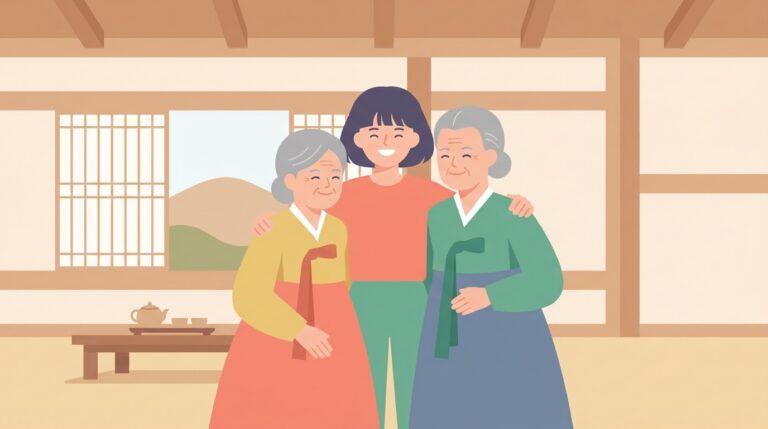
Phase 1: Why Talking About Grandparents Matters in Korea
Hello! This is your Daily Hangul editor. Have you ever watched a heartwarming K-Drama like Reply 1988, seen a grandchild hug their elders, and wished you could express that same warmth in Korean? Many beginners tell us they know Mom and Dad, but freeze up when introducing their grandparents or greeting a Korean friend’s elders. That ends today! Built on real feedback from hundreds of beginner learners, this guide teaches you the exact phrases and cultural manners to honor and show love to your grandfather and grandmother naturally.
Phase 2: Deep Dive into Top 3 Key Expressions
1. 할아버지 (Harabeoji)
- Pronunciation: [Harabeoji] — Sounds like ha-rah-buh-jee (make the “buh” soft, like “but” without the t).
- Meaning: Literal: Grandfather / Real Nuance: A warm, respectful title for your own grandpa or even a friendly elderly man in the neighborhood.
- K-Culture Moment: In Korean weekend family dramas, grandchildren always shout 할아버지! (Harabeoji!) brightly the second they walk through the front door.
- Editor’s Insight: Unlike English, where calling a stranger “Grandpa” might sound weird, Koreans use 할아버지 (Harabeoji) warmly with elderly men they meet at markets or parks!
- Situation Spectrum: Casual ✅ / Semi-formal ✅ / Formal ⚠️ (Use 할아버님 [Harabeonim] when speaking formally about someone else’s grandfather.)
- 🤔 Think About It: In English, you usually call an older stranger “Sir.” Korean extends family titles to the whole community. How does that change how people treat elders?
2. 할머니 (Halmeoni)
- Pronunciation: [Halmeoni] — Sounds like hahl-muh-nee (think “hall” + “muh” + “knee”).
- Meaning: Literal: Grandmother / Real Nuance: The ultimate symbol of unconditional love, warm hugs, and endless delicious food in Korea.
- K-Culture Moment: Think of the beloved Gam-ri Halmeoni from Hometown Cha-Cha-Cha or the iconic grandmother in Minari—always looking out for everyone!
- Editor’s Insight: Say it with a gentle smile. If a Korean grandma hears a foreigner call her 할머니 (Halmeoni) politely, don’t be surprised if she hands you extra snacks!
- Situation Spectrum: Casual ✅ / Semi-formal ✅ / Formal ⚠️ (Use 할머님 [Halmeonim] in very formal settings for someone else’s grandma.)
- 🤔 Think About It: In Western stories, grandmas often bake cookies. In Korea, a 할머니 (Halmeoni) shows love by making sure your plate is never empty. How do your grandparents show love?
3. 사랑해요 (Saranghaeyo)
- Pronunciation: [Saranghaeyo] — Sounds like sah-rahng-hae-yo (keep the “ng” soft, like in “song”).
- Meaning: Literal: I love you (polite) / Real Nuance: Sweet, sincere affection used for family, close elders, and K-Pop idols—not just romance!
- K-Culture Moment: Every May on Korean Parents’ Day, grandkids pin red carnations on their grandparents, make a big heart with their arms over their heads, and shout 사랑해요! (Saranghaeyo!).
- Editor’s Insight: Adding 정말 (jeongmal — really) makes it extra touching: 정말 사랑해요 (jeongmal saranghaeyo) meaning “I really love you.” Older Koreans can be shy about hearing it, so watch for a happy blush!
- Situation Spectrum: Casual ⚠️ (Use 사랑해 [Saranghae] with peers or younger kids) / Semi-formal ✅ / Formal ✅ (Or 사랑합니다 [Saranghamnida] in formal speeches).
- 🤔 Think About It: Many traditional Korean elders rarely say “I love you” out loud, preferring quiet actions instead. Is it easy or awkward to say “I love you” to elders in your family?
Phase 3: Textbook Korean vs. Real Korean
Situation 1: Expressing love to your grandparents directly
- 📖 Textbook Korean: 저는 할아버지와 할머니를 사랑합니다. (Jeoneun harabeojiwa halmeonireul saranghamnida. — I love my grandfather and grandmother.)
- 🗣️ Real Korean: 할아버지, 할머니 사랑해요! (Harabeoji, halmeoni saranghaeyo! — Grandpa, Grandma, I love you!)
- 💡 Why the difference? Textbooks love full sentences with “I” (저는 [jeoneun]) and formal endings (-합니다 [-hamnida]), which can sound like a news report. Dropping “I” and using -해요 (-haeyo) feels warm and natural.
Situation 2: Bragging about how awesome your grandma is
- 📖 Textbook Korean: 할머니가 매우 좋습니다. (Halmeoniga maeu joseumnida. — Grandmother is very good.)
- 🗣️ Real Korean: 우리 할머니 최고예요! (Uri halmeoni choegoyeyo! — Our/My grandma is the best!)
- 💡 Why the difference? Koreans use 우리 (uri — our) instead of “my” for family to show closeness, and 최고예요 (choegoyeyo — the best) is the go-to real-life compliment!
Phase 4: K-Culture Deep Dive & Non-Verbal Manners
4-1. Nunchi & Gestures: Respect in Your Hands
Words are only half the story in Korea! When you greet your 할아버지 (Harabeoji) or 할머니 (Halmeoni), or hand them a gift or cup of tea, always use two hands (두 손 [du son]). If you pass something with one hand, lightly support your right forearm with your left hand. Pair this with a gentle 15-to-30-degree bow and warm eye contact. Want bonus points for a cute family photo? Put both hands above your head to form a big heart—grandparents adore it!
4-2. Cultural Code: K-Food & K-Drama Family Love
In K-Food and K-Drama culture, food equals affection. You will often hear Korean grandparents ask 밥 먹었어? (Bap meogeosseo? — Did you eat?) instead of “How are you?” Refusing food completely can hurt their feelings, while eating happily and saying 맛있어요! (Masisseoyo! — It’s delicious!) is one of the best ways to say “I love you” in Korean culture.
Phase 5: Real-Life Roleplay Scenario
Setting: A cozy living room in Jeonju during Chuseok (Korean Thanksgiving). The warm smell of roasted chestnuts fills the air. Halmeoni is wearing a cozy floral padded vest (김장 조끼 [gimjang jokki]), and Harabeoji is smiling brightly on the floor cushion.
- You: 할아버지, 할머니! 안녕하세요! (Harabeoji, halmeoni! Annyeonghaseyo! — Grandpa, Grandma! Hello!) 🎭 You bow politely with a big smile.
- Harabeoji: 어서 와! 잘 지냈어? (Eoseo wa! Jal jinaesseo? — Welcome! Have you been well?) 🎭 He waves you over warmly.
- You: 네, 잘 지냈어요! 이거 선물이에요. (Ne, jal jinaesseoyo! Igeo seonmurieyo. — Yes, I’ve been well! This is a gift.) 🎭 You hand over a box of fruit using both hands.
- Halmeoni: 아이고, 고마워라! 배고프지? (Aigo, gomawora! Baegopeuji? — Oh my, thank you! You’re hungry, right?) 🎭 She immediately puts sliced Korean pears in front of you.
- You: 우와, 정말 맛있어요! (Uwa, jeongmal masisseoyo! — Wow, it’s really delicious!) 🎭 You take a happy bite and give a thumbs-up.
- Halmeoni: 우리 손주 최고네! 더 먹어! (Uri sonju choegone! Deo meogeo! — Our grandchild is the best! Eat more!) 🎭 She laughs and pushes the plate closer.
- You: 할아버지, 할머니, 정말 사랑해요! (Harabeoji, halmeoni, jeongmal saranghaeyo! — Grandpa, Grandma, I really love you!) 🎭 You make a big heart with your arms over your head.
- Harabeoji: 나도 사랑해! (Nado saranghae! — I love you too!) 🎭 He chuckles shyly and pats your shoulder.
🔀 Interactive Branching Point: Halmeoni tries to give you a third huge plate of fruit, even though you are super full! What do you say?
- A) “배불러요. 이제 그만 주세요!” (Baebulleoyo. Ije geuman juseyo! — I’m full. Stop giving me food now!) -> Bad: A bit too blunt! Even though it’s grammatically okay, saying “stop” directly to an elder sounds abrupt.
- B) “너무 맛있어서 배가 터질 것 같아요! 정말 감사해요!” (Neomu masisseoseo baega teojil geot gatayo! Jeongmal gamsahaeyo! — It’s so delicious my stomach might burst! Thank you so much!) -> Best: Warm, playful, and appreciative! You compliment her cooking while gently saying you’re full.
- C) “안 먹어요.” (An meogeoyo. — I’m not eating.) -> Risk: Very risky! Saying a flat “no” without a smile or thank you can make a Korean grandma worry you didn’t like her food.
Phase 6: 10-Second Emotion Shadowing Drill
Read these lines out loud! Pause briefly at each / and match the mood.
[😊 Cheerfully and warmly]
할아버지, / 할머니! / 안녕하세요! (Harabeoji, / halmeoni! / Annyeonghaseyo! — Grandpa, / Grandma! / Hello!)[🥰 Sweetly with a big smile]
우리 할머니 / 최고예요! (Uri halmeoni / choegoyeyo! — My grandma / is the best!)[🥺 Sincerely and lovingly]
할아버지, / 할머니, / 정말 사랑해요! (Harabeoji, / halmeoni, / jeongmal saranghaeyo! — Grandpa, / Grandma, / I really love you!)
Phase 7: K-Culture Mini Dictionary
- 우리 (Uri) | Our / My | Koreans use “our” before family words like 우리 할머니 (uri halmeoni) to express shared warmth and belonging.
- 효도 (Hyodo) | Filial piety | Showing deep respect, care, and gratitude to your parents and grandparents.
- 어버이날 (Eobeoinal) | Parents’ Day (May 8) | A special Korean holiday where people gift carnations and say 사랑해요 (saranghaeyo) to parents and grandparents.
- 손주 (Sonju) | Grandchild | A gender-neutral, affectionate word Korean grandparents love using when introducing their grandkids.
Phase 8: Traveler’s Survival Kit
Top 3 Elder-Friendly Survival Phrases
- 안녕하세요! (Annyeonghaseyo!) — Hello! Pro Tip: Add a slight bow whenever you greet older Koreans at shops or traditional markets.
- 감사합니다! (Gamsahamnida!) — Thank you! Pro Tip: Use this formal thank-you when an elder holds a door or gives you directions.
- 맛있어요! (Masisseoyo!) — It’s delicious! Pro Tip: Say this with a big smile at neighborhood restaurants run by Korean grandmas—it makes their whole day!
Editor’s Travel Note
Getting around Korea to visit traditional neighborhoods like Bukchon or Jeonju is easy when you prepare! Before your trip, download the Naver Map app since global map apps don’t offer full walking directions in Korea, and install the Papago translator app for quick voice translations with friendly locals. Also, grab a T-money card at any convenience store for subways and buses—and remember to keep the pink or light-blue priority seats (노약자석 [noyakjaseok]) open for 할아버지 (Harabeoji) and 할머니 (Halmeoni)!
Phase 9: One Step Deeper
In Korean society, language reflects how deeply generations are connected. Respecting elders (공경 [gonggyeong]) isn’t just about using polite endings like -요 (-yo); it’s about recognizing that our grandparents paved the way for us. That is why calling someone 우리 할머니 (uri halmeoni — our grandma) feels like wrapping them in a warm blanket of community. When you learn these simple family words, you aren’t just memorizing vocabulary—you are stepping right into the heart of Korean warmth.
💬 Your Turn: What affectionate nickname do you use for your grandparents in your language? Share it in the comments below!
Phase 10: FAQ & Myth-Busting
Q: Can I call a stranger “Harabeoji” or “Halmeoni” in Korea?
A: Yes! In casual, friendly settings like traditional markets or neighborhood restaurants, calling an elderly man 할아버지 (Harabeoji) or an elderly woman 할머니 (Halmeoni) with a warm smile is considered affectionate and respectful.
Q: Should I say “Saranghae” or “Saranghaeyo” to my grandparents?
A: Always use 사랑해요 (Saranghaeyo)! Dropping the -요 (-yo) to say 사랑해 (Saranghae) is casual speech meant for friends or younger kids, so adding -요 (-yo) keeps it polite and loving for elders.
Q: Is there a difference between mom’s parents and dad’s parents in Korean?
A: Yes! Your dad’s parents are 할아버지 (Harabeoji) and 할머니 (Halmeoni), while your mom’s parents are 외할아버지 (Oeharabeoji) and 외할머니 (Oehalmeoni). However, when speaking to them directly, most Koreans simply call both sets 할아버지 and 할머니!
🚨 Common Mistakes TOP 3
- Mistake: Saying “내 할머니 (Nae halmeoni — My grandma).” -> Correct Action: Use 우리 할머니 (Uri halmeoni — Our grandma) to sound natural!
- Mistake: Handing a gift with one hand while saying thank you. -> Correct Action: Always use both hands (두 손 [du son]) with elders.
- Mistake: Saying 사랑해 (Saranghae) without -요 (-yo) to grandparents. -> Correct Action: Keep the polite -요 (-yo) ending: 사랑해요 (Saranghaeyo)!
Phase 11: Action Mission & Engagement
- 🥉 Bronze Mission: Look in the mirror and practice saying “할아버지, 할머니, 사랑해요! (Harabeoji, halmeoni, saranghaeyo!)” three times with a big smile and a polite bow.
- 🥈 Silver Mission: Write 할아버지 (Harabeoji) and 할머니 (Halmeoni) in Hangul on a sticky note and share a photo of your handwriting on social media with
#DailyHangul. - 🥇 Gold Mission: Actually send a voice message or call your grandparents (or an older family member) today and teach them how to say 사랑해요 (Saranghaeyo)!
- 🎮 K-Culture Mission: Watch one episode of a family K-Drama (like Reply 1988 or Hometown Cha-Cha-Cha) this week and count how many times you hear 할머니 (Halmeoni) or 할아버지 (Harabeoji)!
Phase 12: Interactive Quiz Challenge
Quiz 1 (Situation Judgment): You are visiting your Korean friend’s grandmother, and she hands you a cup of warm tea. What is the best action and phrase?
* A) Take it with one hand and say “사랑해 (Saranghae).”
* B) Take it with two hands and say “감사합니다, 할머니! (Gamsahamnida, halmeoni!)”
* C) Take it silently and walk away.
Check Answer & Explanation
Answer: B! Using both hands shows deep respect, and saying 감사합니다, 할머니! (Gamsahamnida, halmeoni! — Thank you, Grandma!) is warm and polite.
Quiz 2 (Fill in the Blank): Complete the natural Korean way to say “My/Our grandma is the best!”:
____ 할머니 최고예요! (____ halmeoni choegoyeyo!)
Check Answer & Explanation
Answer: 우리 (Uri)! Koreans say 우리 할머니 (uri halmeoni) instead of “my grandma” to show warm family closeness.
Quiz 3 (True or False): It is rude to say “사랑해요 (Saranghaeyo)” to your grandparents because that phrase is only for romantic partners.
Check Answer & Explanation
Answer: False! 사랑해요 (Saranghaeyo) is warmly used for parents, grandparents, friends, and even K-Pop idols!
🎬 Watch Our Daily Videos! (Daily Hangul Official Instagram)
Review the expressions you learned in this article with our fun daily short videos! Check out native pronunciation and real-life nuances in action.
- Instagram @dailyhangul_en







