

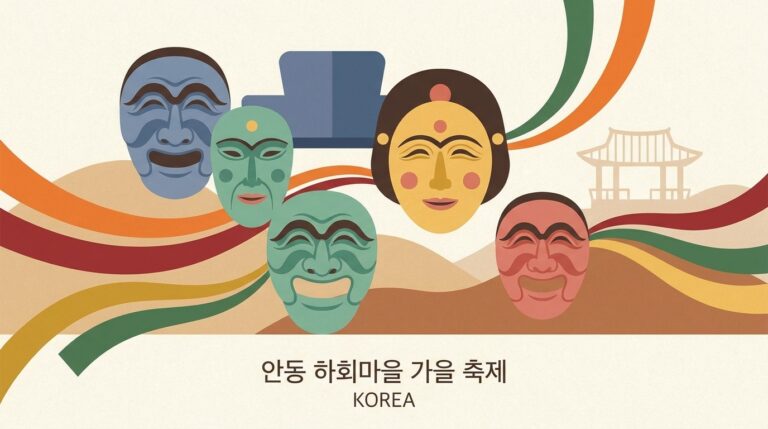
Mastering the Andong Mask Dance Festival Like a Local Insider
안녕하세요! 매일한글 에디터입니다. (Hello! It’s your Daily Hangul editor.)
Picture this: crisp autumn breeze, the hypnotic beat of traditional kkwaenggwari (gongs) echoing across the riverbanks, and vibrant performers wearing iconic wooden Hahoe masks swirling before your eyes. You find yourself right in the heart of the world-famous Andong International Mask Dance Festival (안동 국제 탈춤 페스티벌). Everyone around you is clapping to the rhythm, shouting exhilarating festival chants, and having the time of their lives.
Then, an enthusiastic performer points at you to join the grand finale dance circle, shouting something in fast, dialect-tinged Korean. Suddenly, your mind blanks out. You want to ask how to sign up for the mask-making workshop, compliment the master artisan on their performance, and shout along with the crowd without sounding like a robotic textbook. Over the past decade guiding Korean language learners through regional heritage trips, I’ve seen so many intermediate learners freeze in these spontaneous cultural moments. This guide is curated precisely from real field feedback to give you the vocabulary, cultural instincts, and confidence to own the festival stage like a true local.
Phase 2: Core Expressions Deep Dive (핵심 표현 3선)
1. 흥이 절로 나네요! (Heung-i jeol-lo na-ne-yo!)
- Pronunciation: Heung-ee jul-loh nah-neh-yo! (Think of ‘heung’ as a joyful hum starting deep from your chest, and ‘jul-lo’ flowing smoothly like ‘jello’ with a light ‘o’).
- Meaning: Literal: Excitement/joy arises automatically! | Real Nuance: The festive energy is completely contagious! / I can’t help but get into the groove!
- K-Culture Moment: Seen frequently on variety shows like 2 Days & 1 Night or travel vlogs whenever cast members step into a bustling traditional market or festival and immediately start bopping to the rhythm.
- Editor’s Insight: 흥 (Heung) is an untranslatable Korean socio-emotional concept representing innate, collective joy and spontaneous rhythm. Saying “흥이 절로 나요” proves to Koreans that you don’t just speak the language—you feel the culture.
- Situation Spectrum: Casual: ✅ (흥이 절로 나!) | Semi-formal: ✅ (흥이 절로 나네요!) | Formal: ⚠️ (흥이 절로 납니다)
- 🤔 Think About It: Does your native language have a specific word for joy that is collective rather than individual? How does expressing shared energy change your relationship with strangers?
2. 탈춤 체험 프로그램은 어디서 신청해요? (Talchum cheheom peurogeuraemeun eodiseo sincheonghaeyo?)
- Pronunciation: Tahl-choom cheh-hum poo-roh-goo-rahm-eun uh-dee-suh shin-chung-hae-yo?
- Meaning: Literal: Where do I apply for the mask dance experience program? | Real Nuance: Excuse me, where can I register for the hands-on mask dance workshop?
- K-Culture Moment: A classic line when navigating interactive cultural festival booths, cultural heritage centers, or tourist info desks across Korea.
- Editor’s Insight: The word 체험 (cheheom – hands-on experience) is the magic festival keyword in Korea. Pairing it with 신청하다 (sincheonghada – to register/apply) unlocks countless interactive workshops from mask crafting to folk dance tutorials.
- Situation Spectrum: Casual: 🚫 | Semi-formal: ✅ (신청해요?) | Formal: ✅ (신청하면 됩니까?)
- 🤔 Think About It: In Korea, festivals heavily prioritize participatory experiential learning (체험) over passive watching. Why do you think immersive participation is so central to Korean festival culture?
3. 어깨춤이 덩실덩실 춰져요. (Eokkaechumi deongsil-deongsil chwojyeoyo.)
- Pronunciation: Uh-kkae-choom-ee dung-shil-dung-shil chwuh-jyuh-yo. (Pronounce ‘deongsil-deongsil’ playfully with a bounce in your pitch).
- Meaning: Literal: My shoulder dance is dancing buoyantly. | Real Nuance: My shoulders are bouncing to the beat all on their own!
- K-Culture Moment: Widely heard in K-dramas when characters enjoy street music, celebrate good food, or join a joyful community gathering.
- Editor’s Insight: 덩실덩실 (deongsil-deongsil) is an onomatopoeia/mimetic word depicting the buoyant, graceful up-and-down movement of the body and shoulders in traditional Korean dance.
- Situation Spectrum: Casual: ✅ (어깨춤이 절로 춰져!) | Semi-formal: ✅ (어깨춤이 덩실덩실 춰져요) | Formal: ⚠️ (Too playful for strictly formal settings)
- 🤔 Think About It: Mimetic words (의태어) bring Korean speech alive. How does describing the physical motion of dancing make the sentiment more vivid than just saying “It’s fun”?
Phase 3: Textbook Korean vs. Real Korean (교과서 vs. 진짜 한국어)
Situation 1: Expressing excitement about the festival atmosphere
- 📖 교과서 한국어: “축제가 매우 재미있고 흥미롭습니다.” (The festival is very interesting and enjoyable.)
- 🗣️ 진짜 한국어: “축제 분위기 완전 대박이에요! 흥이 제대로 올랐어요.” (The festival vibe is incredible! The energy is at an absolute peak!)
- 💡 왜 다를까?: Textbook Korean relies on static descriptive adjectives like 재미있다 and 흥미롭다. Native speakers at B2 level use dynamic expressions like 분위기 완전 대박이다 and 흥이 오르다 (the energy/groove is rising) to convey genuine, sensory hype.
Situation 2: Asking a booth staff member to try on a traditional mask
- 📖 교과서 한국어: “제가 이 탈을 착용해 봐도 괜찮습니까?” (Is it acceptable if I wear this mask?)
- 🗣️ 진짜 한국어: “이 탈 잠깐 써봐도 돼요? 사진 한 장만 찍고 싶어서요!” (Can I try this mask on for a second? I’d love to snap a quick photo!)
- 💡 왜 다를까?: 착용하다 is overly bureaucratic and clinical for a lively festival booth. Native speakers use the everyday verb 쓰다 (to put on/wear on head/face) combined with a soft reason clause (-아서/어서요).
Phase 4: K-Culture Deep Dive & Non-Verbal Etiquette (K-컬처 딥다이브)
4-1. Nunchi & Festival Etiquette: The Art of “Chuimsae” (추임새)
At the Andong Mask Dance Festival, you are not meant to sit in quiet contemplation! Traditional Korean performance relies on reciprocal audience reactions called 추임새 (chuimsae – vocal encouragements).
* The Magic Words: When a dancer pulls off an impressive spin or a witty satirical punchline, shout “얼쑤!” (Eol-ssu!) or “좋다!” (Joh-da!).
* Body Language & Nunchi: Do not stand stiffly with arms crossed. Keep your arms relaxed, nod to the 3-beat folk rhythm (gutgeori rhythm: Dung-gi-dak-kung-deorereo), and let your shoulders gently bounce. If an actor makes eye contact and motions toward you, smile, clap, and give a hearty “얼쑤!”
4-2. Cultural Code: The Satirical Heart of Talchum (탈춤)
Talchum was historically the common people’s therapeutic outlet during the Joseon Dynasty. Behind the anonymity of masks like Yangban (the arrogant aristocrat), Choraengi (the meddling servant), or Bune (the flirtatious maiden), commoners satirized elite hypocrisy and resolved communal grievances (Hahn, 한) through shared laughter and catharsis (Heung, 흥). When in Andong, remember you are participating in a 600-year-old tradition of social liberation and unity!
Phase 5: Real-life Roleplay Scenario (실전 롤플레이)
Setting: A sunlit artisan booth inside the Andong Mask Dance Festival grounds near the Nakdong River.
Characters: Alex (You), an enthusiastic cultural traveler; Master Kim (김 장인), a warm veteran mask maker and folk performer in traditional linen hanbok.
- Alex: 안녕하세요! 탈들이 다 표정이 살아있네요. 이 탈 잠깐 써봐도 돼요? 🎭 (Drawn to a beautifully carved wooden mask, pointing politely with both palms open)
(Annyeohaseyo! Taldeuri da pyojeongi sara-inneeyo. I tal jamkkan sseobwado dwaeyo?)
Hello! These masks all look so expressive and alive. May I try this mask on for a second? - Master Kim: 그럼요! 편하게 써보세요. 그 탈은 ‘양반탈’인데, 웃을 때 고개를 뒤로 젖히면 탈도 함께 호탕하게 웃는답니다. 🎭 (Hands over the mask with a proud, welcoming smile)
(Geureomyo! Pyeonhage sseoboseyo. Geu tareun ‘Yangbantal’-inde, useul ttae gogaereul dwiro jeochimyeon taldo hamkke hotanghage unneundabnida.)
Of course! Feel free to put it on. That’s the ‘Yangban mask’—if you tilt your head back when you laugh, the mask laughs heartily along with you. - Alex: 와, 진짜 신기하네요! 직접 만들어보는 탈춤 체험 프로그램은 어디서 신청해요? 🎭 (Gently touching the chin of the mask in admiration)
(Wa, jinjja singihaneeyo! Jikjeop mandeureoboneun talchum cheheom peurogeuraemeun eodiseo sincheonghaeyo?)
Wow, that’s fascinating! Where can I sign up for the hands-on mask-making workshop? - Master Kim: 저쪽 3번 부스로 가면 바로 접수할 수 있어요. 오늘 오후 4시에 대동놀이도 있는데 꼭 와요! 🎭 (Points toward the central lawn with a wooden carving chisel)
(Jeojjok sambeon buseuro gamyeon baro jeopsuhal su isseoyo. Oneul ohu nesie Daedongnorido inneunde kkok wayo!)
Head over to Booth 3 right over there to register immediately. We also have the grand Daedongnori circle dance at 4 PM today—you must come! - Alex: 대동놀이요? 저처럼 춤을 잘 못 추는 외국인도 참여할 수 있나요? 🎭 (Tilting head slightly with curious, slightly hesitant eyes)
(Daedongnoriyo? Jeocheoreom chumeul jal mot chuneun oeguk-indo chamyeohal su innayo?)
Daedongnori? Can foreigners who aren’t great dancers like me participate too? - Master Kim: 하하! 탈춤은 잘 추고 못 추고가 없어요. 음악에 맞춰 어깨만 덩실덩실 흔들면 그게 바로 탈춤이지! 🎭 (Heartily chuckling and demonstrating a shoulder bounce)
(Haha! Talchumeun jal chugo mot chugoga eopseoyo. Eumage matchwo eokkaeman deongsil-deongsil heundeulmyeon geuge baro talchum-iji!)
Haha! In Talchum, there’s no such thing as good or bad dancing. As long as your shoulders bounce to the beat, that is genuine Talchum! - Alex: 듣기만 해도 벌써 흥이 절로 나네요! 꼭 갈게요, 얼쑤! 🎭 (Clapping hands in rhythm and playfully striking a dance pose)
(Deutgiman haedo beolsseo heung-i jeol-lo na-ne-yo! Kkok galgeyo, eol-ssu!)
Just hearing about it gets my excitement rising! I’ll definitely be there, Eol-ssu! - Master Kim: 아이고, 추임새 제대로네! 4시에 마당에서 신나게 한판 놉시다! 🎭 (Giving a delighted two-thumbs-up gesture)
(Aigo, chuimsae jedaerone! Nesie madang-eseo sinnage hanpan popsida!)
Oh my, your Chuimsae rhythm is on point! Let’s party joyfully on the festival grounds at 4!
🔀 Interactive Choice Point
At 4:00 PM, the master dancer in the center of the arena waves his fan toward you during the finale. What do you do?
* Option A: Stand up, give an energetic shout of “얼쑤! 좋다!”, and step into the circle while bouncing your shoulders.
* Option B: Sit perfectly still, maintain complete silence out of respect, and nod without making eye contact.
* Option C: Grab your camera, jump in front of the master performer to take a close-up selfie, and shout “Kimchi!”
Feedback & Cultural Assessment:
* Option A (Best Choice): Perfect! You understood the true spirit of Daedongnori (communal unity). The crowd and performers will cheer for you.
* Option B (Risk / Suboptimal): While polite, extreme reserve at a Korean folk festival dampens the collective Heung. You’ll miss out on the magic of active participation.
* Option C (Bad / Cultural Faux Pas): Disrupts the sacred performance flow and breaks the communal atmosphere. Respect performer boundaries first.
Phase 6: 10-Second Emotion Shadowing Drill (10초 감정 섀도잉 드릴)
Practice reading these out loud, matching the emotional tone and natural rhythm markers (/ = brief pause):
[😆 Excited & Contagiously Cheerful]
“와, / 장구 소리 들으니까 / 흥이 절로 나네요! / 얼쑤!”
(Wa, / janggu sori deureunikka / heung-i jeol-lo na-ne-yo! / Eol-ssu!)-
[🤔 Curious & Polite Inquiry]
“저기요, / 탈 만들기 체험 프로그램은 / 어디서 신청하면 돼요?”
(Jeogiyo, / tal mandeulgi cheheom peurogeuraemeun / eodiseo sincheonghamyeon dwaeyo?) -
[🥳 Carefree, Playful & Vibrant]
“축제 분위기 완전 최고예요! / 어깨춤이 / 덩실덩실 춰져요!”
(Chukje bunwigi wanjeon choegoyeyo! / Eokkaechumi / deongsil-deongsil chwojyeoyo!)
Phase 7: K-Culture Mini Dictionary (핵심 어휘 4선)
- 흥 (Heung) | Innate joy / communal groove
Usage: Refers to that spontaneous high energy and rhythmic passion that Koreans tap into during music, dance, and celebrations. - 추임새 (Chuimsae) | Vocal interjections / encouraging callouts
Usage: Exclamations like “얼쑤!”, “지화자!”, or “좋다!” used to energize performers and maintain rapport between stage and audience. - 대동놀이 (Daedongnori) | Grand communal finale celebration
Usage: Traditional festival climax where social status, age, and nationality dissolve as everyone joins hands in a giant circle dance. - 뒤풀이 (Dwipuri) | Post-event celebration / after-party
Usage: Gathering for food, drinks, and recap talks after an event, festival, or performance (e.g., heading for Andong Jjimdak and local craft soju!).
Phase 8: Traveler’s Survival Kit (여행자 생존 키트)
Top 3 Survival Phrases for Andong Festival
- 1. 안동찜닭 골목이 여기서 멀어요? (Andong-jjimdak golmogi yeogiseo meoreoyo?)
Is the Andong Braised Chicken alley far from here?
💡 Pro Tip: Combine festival grounds with the famous Andong Old Market Jjimdak Alley for the ultimate culinary experience. - 2. 셔틀버스 정류장이 어디예요? (Syeoteul-beoseu jeongnyujangi eodiyeyo?)
Where is the festival shuttle bus stop?
💡 Pro Tip: Free festival shuttles run frequently between Andong Station, downtown, and the Maskdance Park. - 3. 계좌이체나 카드 결제도 되나요? (Gyejwai-chena kadeu gyeoljedo doenayo?)
Can I pay by bank transfer or credit card?
💡 Pro Tip: Most artisan and food stalls take cards, but having small cash or Korean bank transfer ready is super helpful at craft booths.
Editor’s Travel Note
- Transportation: Take the high-speed KTX-Eum from Seoul Cheongnyangni Station directly to Andong Station (approx. 2 hours). Book train tickets in advance via the official Korail reservation system.
- Local Navigation: Google Maps has limited walking accuracy in Korea. Download and navigate using the Naver Map application to check live bus schedules and food alley reviews.
- Gourmet Pairing: Do not leave without trying 안동 간고등어 (Salted Mackerel), 안동찜닭 (Braised Chicken), and traditional 안동소주 (Andong Soju)!
Phase 9: Thinking Deeper (한 발 더 깊이)
In Western performance traditions, the fourth wall strictly separates the audience from the stage. In contrast, traditional Korean folk performances like Andong Talchum dismantle this barrier entirely. The audience’s active vocal participation (Chuimsae) is not an interruption; it is literally half of the performance. Talchum transforms personal sorrow and daily stress into shared joy through collective satire. When we put on a mask, we paradoxically become our truest, most authentic selves within the community.
💬 Your Turn: Have you ever experienced a festival where the boundary between audience and performer disappeared? What kind of traditional performance in your culture resembles the satirical spirit of Talchum? Let me know in the comments below!
Phase 10: FAQ & Common Mistakes (자주 묻는 질문 & 실수 교정)
Q: Can foreign tourists easily join the mask dance workshops without speaking fluent Korean?
A: Absolutely! The festival operates dedicated international guide booths with multilingual staff, and the physical steps of Talchum are taught visually with energetic demonstrations. A few key phrases like “체험 신청하고 싶어요” will make your experience seamless.
Q: What is the best time of year to attend the festival and what should I wear?
A: The festival takes place annually in late September to early October during beautiful Korean autumn weather. Wear comfortable sneakers for dancing and layered clothing, as daytime can be warm while river breezes turn chilly at night.
Q: Is the festival suitable for solo travelers?
A: It is one of the friendliest festivals in Korea for solo travelers! Because of communal events like Daedongnori and shared workshop tables, making friends with locals and other global travelers happens naturally.
🚨 Common Mistakes (흔한 실수 TOP 3)
- Mistake: Sitting silently with zero reaction during performances.
Correct Action: Give occasional rhythmic claps and shout energetic “얼쑤!” callouts. - Mistake: Trying to use honorifics to refer to your own actions (e.g., saying “제가 춤을 추셨어요” ❌).
Correct Action: Keep honorific suffix -시- for others: “제가 춤을 췄어요” / “선생님께서 춤을 추셨어요” ✅. - Mistake: Touching antique performance masks on display without asking.
Correct Action: Always ask politely first: “이 탈 만져봐도 될까요?” ✅.
Phase 11: Action Missions (액션 미션)
- 🥉 Bronze Mission (Solo Practice): Practice the shadowing drill in Phase 6 three times while mimicking the shoulder bounce (어깨춤) in front of a mirror.
- 🥈 Silver Mission (Social Connection): Leave a comment below using the word “흥 (Heung)” in a creative original Korean sentence.
- 🥇 Gold Mission (Real Field Application): Next time you attend a live concert, performance, or festival in Korea, shout “얼쑤!” or use “흥이 절로 나네요!” when talking to a local friend or performer.
- 🎮 K-Culture Bonus Mission: Search for a clip of the Andong International Mask Dance Festival on YouTube or watch an episode of a Korean variety show set in Andong, and spot at least two Chuimsae interjections from the audience!
Phase 12: Interactive Quiz Challenge (퀴즈 타임)
Test your intermediate cultural fluency! Solve the questions below:
- Situational Check: You want to express that the rhythmic Korean music is making your shoulders bounce naturally with joy. Which expression is most natural?
- (A) 어깨가 매우 아픕니다.
- (B) 어깨춤이 덩실덩실 춰져요.
- (C) 춤을 즉시 중단하십시오.
- Fill in the Blank:
“공연 볼 때 관객이 ‘얼쑤!’, ‘좋다!’ 하고 외쳐주는 것을 ( )(이)라고 해요.” -
True or False: In traditional Korean Talchum, audiences are strictly forbidden from shouting or dancing until the entire show is completely finished. (True / False)
👉 Click to reveal answers & explanations! (정답 및 해설 확인)
- Answer: (B)
Explanation: “어깨춤이 덩실덩실 춰져요” is the authentic mimetic idiom for shoulder dancing along to festive music. (A means “My shoulders hurt”, and C is an abrupt command to stop dancing!). - Answer: 추임새 (Chuimsae)
Explanation: Chuimsae is the essential traditional art of vocal interjection and audience encouragement. - Answer: False
Explanation: Talchum thrives on interactive audience participation! Spectators are encouraged to react and join the grand finale Daedongnori.







