

Phase 1: Why Safe Trading Korean Is Your Best Concert Armor
안녕하세요! 매일한글 에디터입니다. (Annyeonghaseyo! Hello, this is your Daily Hangul Editor!) Imagine this: you lost the brutal “ticketing war” for your favorite K-Pop group’s Seoul concert, and your heart sinks. Suddenly, you spot a ticket transfer post online. Your fingers hover over the banking app—wait! Ghosting scams after upfront payment happen constantly in Korea. Even our intermediate learners have shared heartbreaking stories of losing hard-earned cash to fake sellers. Today, I’m sharing real, street-smart Korean expressions for safe escrow payments and in-person trades so you can snag that dream ticket without getting scammed!
Phase 2: Deep Dive Into 3 Essential Expressions
1. 직거래 가능할까요? (Jikgeorae ganeunghalkkayo?)
- Pronunciation: [jik-geo-rae ga-neung-hal-kka-yo] (Think of “jeek-guh-reh” + “ga-neung-hal-kka-yo,” giving that double “k” a crisp little pop like snapping a physical ticket stub.)
- Meaning: Literal: “Is a direct transaction possible?” | Nuance: “Can we meet in person to inspect the item and trade face-to-face?”
- K-Culture Moment: Picture dozens of fans outside Hongdae Station Exit 9 or Olympic Park holding lightsticks, swapping rare photocards or concert wristbands in broad daylight.
- Editor’s Insight: On Korean platforms like Karrot (당근) or Bungaejangter (번개장터), leading with 직거래 (in-person trade) instantly tells a seller you are street-smart. Scammers hunting for easy 입금 후 잠적 (ghosting after bank transfer) targets will usually vanish the moment you mention meeting face-to-face—saving you from a disaster!
- Situation Spectrum:
- Casual (to a friend/peer): 직거래 돼요? (Jikgeorae dwaeyo?) ✅
- Semi-formal (chatting with a seller): 직거래 가능할까요? (Jikgeorae ganeunghalkkayo?) ✅
- Formal (polite business/older seller): 직거래로 진행 가능하신가요? (Jikgeoraero jinhaeng ganeunghasingayo?) ✅
- 🤔 Think About It: In many Western countries, meeting a stranger from an online marketplace can feel risky, so buyers often prefer shipping with online buyer protection. Why do Korean K-Pop fans actually feel safer meeting face-to-face at a busy subway station?
2. 안전결제로 부탁드려요 (Anjeongyeoljero butakdeuryeoyo)
- Pronunciation: [an-jeon-gyeol-je-ro bu-tak-deu-ryeo-yo] (Sounds like “ahn-jun-gyul-jeh-ro” + “boo-tak-deu-ryuh-yo,” with a soft, quick tap on the “r” sound.)
- Meaning: Literal: “I ask a favor of you by safe payment.” | Nuance: “Let’s please pay through the platform’s escrow service.”
- K-Culture Moment: You finally find a sold-out K-Drama limited-edition OST vinyl on Bungaejangter. Before clicking buy, you message the seller to confirm using 번개페이 (BungaePay escrow) instead of sending money directly to their bank account.
- Editor’s Insight: Adding 부탁드려요 (please / I kindly request) softens a firm financial boundary so you don’t sound accusatory. Pro tip from my own rookie mistakes: if a seller refuses 안전결제 (escrow) and begs for a direct transfer claiming “my app has an error,” run! It’s a classic red flag.
- Situation Spectrum:
- Casual: 안전결제 해줘 (Anjeongyeolje haejwo) 🚫 (Too blunt for strangers!)
- Semi-formal: 안전결제로 부탁드려요 (Anjeongyeoljero butakdeuryeoyo) ✅
- Formal: 안전결제로 진행 부탁드립니다 (Anjeongyeoljero jinhaeng butakdeurimnida) ✅
- 🤔 Think About It: Notice how Korean uses 부탁드려요 (asking a favor) even when you are simply asserting a basic safety right as a buyer. How does that compare to how you protect yourself financially in your native language?
3. 먹튀 당할까 봐 걱정돼요 (Meoktwi danghalkka bwa geokjeongdwaeyo)
- Pronunciation: [meok-twi dang-hal-kka bwa geok-jeong-dwae-yo] (“Meok-twi” sounds like “muk-twee”—like “mug” without the g + “tweet” without the final t.)
- Meaning: Literal: “I’m worried I’ll suffer an eat-and-run.” | Nuance: “I’m scared I’ll pay and the seller will take my money and ghost me.”
- K-Culture Moment: Two besties sitting at a cafe near KSPO Dome before a SEVENTEEN concert, nervously refreshing their X (Twitter) DMs while checking a seller’s past trade history.
- Editor’s Insight: This combines the super-useful B1 grammar -(으)ㄹ까 봐 (worried that something might happen) with 당하다 (to suffer an unpleasant action). 먹튀 (short for 먹고 튀다, eat and bolt) is wildly common slang among Koreans, though you should switch to 사기 (fraud) if you ever talk to the police!
- Situation Spectrum:
- Casual (to a friend): 먹튀 당할까 봐 걱정돼 (Meoktwi danghalkka bwa geokjeongdwae) ✅
- Semi-formal (to an acquaintance): 먹튀 당할까 봐 걱정돼요 (Meoktwi danghalkka bwa geokjeongdwaeyo) ⚠️
- Formal (police report / official inquiry): 사기 피해를 입을까 봐 우려됩니다 (Sagi pihaereul ibeulkka bwa uryeodoemnida) 🚫 (Avoid slang here!)
- 🤔 Think About It: Korean turns a dine-and-dash image (먹고 튀다) into a verb for online ghosting scams. What colorful idioms does your language use when someone takes your money and vanishes?
Phase 3: Textbook Korean vs. Real Korean
Situation 1: Checking if a transferred concert ticket is real before paying in person
- 📖 Textbook Korean: 이 티켓이 진짜인지 먼저 확인하고 싶습니다. (I tikesi jinjainji meonjeo hwaginhago sipseumnida. – I want to check if this ticket is real first.)
- 🗣️ Real Korean: 현장에서 인증 먼저 확인하고 입금해도 될까요? (Hyeonjangeseo injeung meonjeo hwaginhago ipgeumhaedo doelkkayo? – Could I check the verification on-site first and then transfer the money?)
- 💡 Why the difference? In K-Pop ticket culture, nobody just says “real or fake”—the magic word is 인증 (verification), meaning opening the official Interpark or Melon Ticket app live (never a screenshot!). Using 현장에서 (on-site) plus -아/어도 될까요? sounds smooth, experienced, and totally natural.
Situation 2: Politely rejecting a sketchy seller who demands an upfront deposit
- 📖 Textbook Korean: 돈을 미리 보내는 것은 위험해서 싫습니다. (Doneul miri bonaeneun geoseun wiheomhaeseo silseumnida. – I don’t like sending money in advance because it is dangerous.)
- 🗣️ Real Korean: 선입금은 조금 부담스러워서 직거래로만 진행할게요. (Seonipgeumeun jogeum budamseureowoseo jikgeoraeroman jinhaenghalgeyo. – An upfront deposit feels a bit uncomfortable for me, so I’ll only proceed via in-person trade.)
- 💡 Why the difference? Saying 싫습니다 (I dislike it) directly can escalate conflict. Saying 부담스럽다 (to feel burdened/uncomfortable) is the ultimate Korean social cushion—polite on the surface, yet rock-solid with -로만 (exclusively by).
Phase 4: K-Culture Deep Dive & Non-Verbal Manners
4-1. Nunchi (눈치) & Body Language at an In-Person Trade
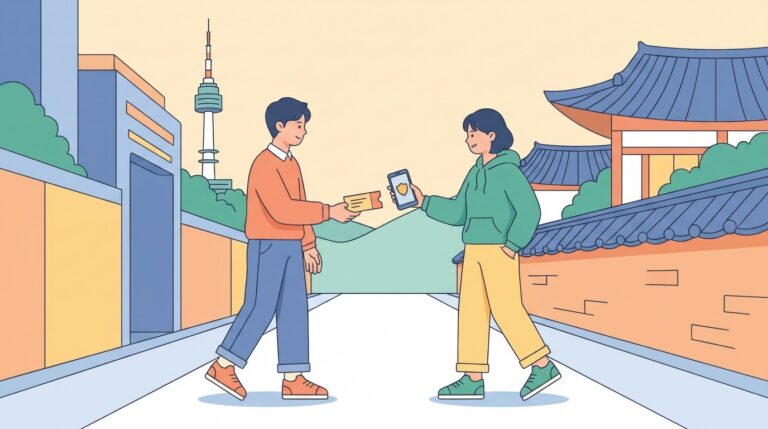
When meeting for a 직거래 (in-person trade), Koreans value efficiency, safety, and respectful distance. Always pick a bright, crowded spot—typically right inside a subway station near the ticket gates or directly under a CCTV camera outside a convenience store. Keep a polite half-arm’s distance, give a quick light nod (목례) instead of a handshake or hug, and hold your smartphone screen slightly angled so both of you can calmly verify the ticket app and the bank transfer confirmation (이체 확인증) without awkward hovering.
4-2. Cultural Code: The “Picketting” Economy & TheCheat
Because K-Pop concert ticketing in Korea is famously called 피켓팅 (bloody ticketing), a huge fan-to-fan 양도 (transfer) market thrives on X (Twitter) and apps like 번개장터 (Bungaejangter). To survive without getting burned, locals rely on two habits: never buying digital screenshots, and running the seller’s phone number or bank account through 더치트 (TheCheat), Korea’s go-to fraud lookup database, before ever tapping “send.”
Phase 5: Real-Life Roleplay Scenario
Setting: Outside Exit 3 of Olympic Park Station in Seoul, 90 minutes before a sold-out K-Pop encore concert. Fans are rushing past with glowing lightsticks, and street vendors are selling unofficial slogans under the crisp evening air.
Characters: Minji (a friendly but busy fan seller wearing a tour hoodie) and You (an eager fan hoping to buy her spare floor ticket).
- Minji: 저기, 방금 연락 주신 분 맞으시죠? (Jeogi, banggeum yeollak jusin bun majeusijyo?) — “Excuse me, you’re the person who just messaged me, right?” 🎭 (Checks her phone while glancing up and waving slightly)
- You: 네, 맞아요! 시간 맞춰 나와 주셔서 감사해요. (Ne, majayo! Sigan matchwo nawa jusyeoseo gamsahaeyo.) — “Yes, that’s me! Thank you for coming out on time.” 🎭 (Gives a polite nod and steps into the well-lit area near the station map)
- Minji: 아니에요, 저도 빨리 들어가야 해서요. 바로 거래할까요? (Anieyo, jeodo ppalli deureogaya haeseyo. Baro georaehalkkayo?) — “No problem, I need to get inside soon too. Shall we trade right away?” 🎭 (Reaches into her tote bag for her concert pouch)
- You: 네! 죄송하지만 현장에서 예매 내역 인증 먼저 확인해도 될까요? (Ne! Joesonghajiman hyeonjangeseo yemae naeyeok injeung meonjeo hwaginhaedo doelkkayo?) — “Yes! Sorry to ask, but could I check your live booking verification first on-site?” 🎭 (Smiles politely while keeping both hands visible)
- Minji: 아, 그럼요! 요즘 먹튀 사기가 워낙 많잖아요. 여기 앱 화면 보세요. (A, geureomyo! Yojeum meoktwi sagiga wonak manchanayo. Yeogi aep hwamyeon boseyo.) — “Oh, of course! There are so many ghosting scams these days. Look at the app screen here.” 🎭 (Unlocks her phone and refreshes the official ticketing app live)
- You: 확인했어요! 그럼 지금 계좌이체로 보내 드릴까요, 아니면 안전결제로 할까요? (Hwaginhaesseoyo! Geureom jigeum gyejwaichero bonae deurilkkayo, animyeon anjeongyeoljero halkkayo?) — “Got it, verified! Should I send it via bank transfer right now, or use safe escrow?” 🎭 (Opens banking app while standing beside Minji)
- Minji: 현장에서 바로 확인하셨으니까 계좌이체로 해 주셔도 괜찮아요. (Hyeonjangeseo baro hwaginhashyeosseunikka gyejwaichero hae jusyeodo gwaenchanayo.) — “Since you verified it right here in person, a direct bank transfer is totally fine.” 🎭 (Hands over the physical ticket envelope as soon as the chime rings)
- You: 네, 입금 완료했어요! 확인해 보세요. 좋은 관람 되세요! (Ne, ipgeum wallyohaesseoyo! Hwaginhae boseyo. Joeun gwallam doeseyo!) — “Done, transfer complete! Please check. Enjoy the show!” 🎭 (Holds the ticket carefully with both hands and bows slightly)
🔀 Interactive Branching Point: What If Things Got Sketchy?
Imagine in Turn 5, Minji refuses to open the app live, holds up a blurry screenshot instead, and says: “My data isn’t working! Just send half as a deposit now and I’ll walk you to the gate!” What do you say?
* A) 아, 데이터가 안 터지시는군요. 알겠어요, 지금 바로 선입금 보낼게요! (A, deiteoga an teojisineungunyo. Algesseoyo, jigeum baro seonipgeum bonaelgeyo! – “Oh, your data isn’t working. Okay, I’ll send the deposit right now!”) -> [❌ Bad Choice] Classic scam trap! “No signal” or “battery dying” right at the venue is a huge red flag. Never send an upfront deposit without live app verification.
* B) 데이터 안 되시면 와이파이 잡히는 편의점 앞에서 확인하고 거래할게요. 아니면 죄송하지만 거래 취소할게요. (Deiteo an doesimyeon waipai japineun pyeonuijeom apeseo hwaginhago georaehalgeyo. Animyeon joesonghajiman georae chwisohalgeyo. – “If your data isn’t working, let’s check near a convenience store with Wi-Fi. Otherwise, sorry, I’ll cancel the trade.”) -> [🌟 Best Choice] Brilliant! Polite, calm, and completely shuts down the scammer’s excuse while offering a fair solution for an honest seller.
* C) 사기꾼 아니에요? 왜 화면을 안 보여 주세요! (Sagikkun anieyo? Wae hwamyeoneul an boyeo juseyo! – “Aren’t you a scammer? Why won’t you show me the screen!”) -> [⚠️ Risk Choice] While your instinct is right, accusing someone directly in public can cause an unnecessary scene if their phone genuinely froze. Use Option B’s cool-headed boundary instead!
Phase 6: 10-Second Emotion Shadowing Drill
Read these aloud, pausing briefly at each / to nail natural Korean rhythm!
- [😊 Hopeful & polite] 혹시 / 직거래 / 가능할까요? (Hoksi / jikgeorae / ganeunghalkkayo? – “By any chance, would an in-person trade be possible?”)
- [🧐 Cautious & firm] 선입금은 / 조금 부담스러워서 / 안전결제로 부탁드려요. (Seonipgeumeun / jogeum budamseureowoseo / anjeongyeoljero butakdeuryeoyo. – “An upfront deposit is a bit uncomfortable for me, so please let’s use safe escrow.”)
- [😌 Relieved & friendly] 현장에서 / 직접 확인하니까 / 정말 안심되네요! (Hyeonjangeseo / jikjeop hwaginhanikka / jeongmal ansimdwaeneyo! – “Checking it in person on-site really puts my mind at ease!”)
Phase 7: K-Culture Mini Dictionary
- 양도 (yangdo) | Ticket/Item Transfer | Used everywhere in K-Pop fandoms when passing a ticket or limited-edition merch spot to another fan at cost (원가 양도) or with a small fee.
- 선입금 (seonipgeum) | Upfront Deposit | Paying before receiving or verifying an item. High-risk in online ticket/merch trades unless you know and trust the platform’s escrow system.
- 잠적 (jamjeok) | Ghosting / Vanishing | A formal-sounding noun used in news and daily chat when someone cuts all contact and disappears after taking money.
- 안전결제 / 에스크로 (anjeongyeolje / eseukeuro) | Safe Payment / Escrow | A system where the platform holds your payment safely until you press “구매 확정” (confirm purchase) after inspecting the item.
Phase 8: Survival Kit for Travelers
TOP 3 Survival Expressions
- 직거래만 가능해요. (Jikgeoraeman ganeunghaeyo. – “Only in-person trades are possible.”) Pro Tip: Put this in your very first chat message to filter out scammers instantly.
- 수수료는 제가 부담할게요. (Susuryoneun jega budamhalgeyo. – “I’ll cover the escrow fee.”) Pro Tip: Sellers sometimes dislike escrow because of the ~3.5% fee. Offering to pay it removes their only legitimate excuse!
- 이체 확인증 보내 드릴까요? (Iche hwaginjjeung bonae deurilkkayo? – “Should I send you the bank transfer receipt?”) Pro Tip: Shows you’re a polite, pro-level trader once you’ve verified the item in person.
Editor’s Travel Note
Before heading out for an in-person trade in Seoul, Download the Naver Map App for Seoul Subway Exits so you can pick a bright, busy meeting gate with plenty of foot traffic. Before transferring a single won online, Check Seller Fraud History on TheCheat Official Portal using their phone number or account number, and if you’re browsing local neighborhood deals, Explore the Karrot Secondhand Marketplace Guide where 직거래 is the default norm. Keep in mind that many Korean escrow services require a Korean bank card or resident registration number (ARC), so as a short-term traveler, 현장 직거래 (in-person trade) with cash or a local friend’s transfer is often your safest and easiest route!
Phase 9: “One Step Deeper” — Korea’s Trust Paradox
If you’ve ever visited a Seoul cafe, you’ve probably been shocked to see people leave expensive laptops and designer bags unattended on tables while using the restroom. Korea has an astonishingly high level of offline physical trust, largely thanks to pervasive CCTV and strong community norms. Yet step into the anonymous digital world of concert transfers and rare K-Pop photocards, and suddenly everyone turns into a hyper-vigilant detective checking 인증 and 더치트. Understanding this contrast helps explain why Koreans love 직거래: by bringing an anonymous online deal back into the bright, visible physical world—while still wrapping their requests in soft polite phrases like 부탁드려요—they bridge both worlds safely.
💬 Your Turn: Have you ever bought a concert ticket or merch secondhand in your home country? How does your local buying culture compare to Korea’s 직거래 and escrow habits? Drop your story in the comments!
Phase 10: FAQ & Myth-Busting
Q: Are all online ticket transfers (양도) on X (Twitter) scams?
A: Not all of them—many genuine fans transfer tickets when plans change! However, scammers heavily target desperate overseas fans because they know travelers may not have Korean bank apps or fraud-check tools. Insisting on 현장 직거래 (trading at the venue gate together) or verified escrow slashes your risk dramatically.
Q: What if a seller says their escrow (안전결제) doesn’t work and sends me a special link?
A: Stop immediately! Phishing scammers love sending fake “BungaePay” or “Naver Pay” web links outside the official app chat. Only ever complete 안전결제 directly inside the official app interface—never click external payment URLs sent in chat.
Q: Can foreigners report secondhand scams to the Korean police?
A: Yes! If you ever fall victim to 사기 (fraud) in Korea, gather screenshots of the chat, the seller’s bank account number, and your transfer receipt, and visit the nearest police station (경찰서) cyber investigation team (사이버수사팀), or call 112 (with English interpretation available via 1330 Korea Travel Hotline).
🚨 Common Mistakes TOP 3
- Mistake: Trusting a seller just because they send a photo of their Korean ID card (신분증). -> Correct Action: Scammers frequently use stolen ID photos! Always verify the live ticket app or meet in person at the venue.
- Mistake: Saying “사기 치지 마세요” (Don’t scam me) directly to a normal seller. -> Correct Action: Use smooth intermediate cushions like “안전결제로 부탁드려요” (Please let’s use safe escrow) so you stay polite while staying safe.
- Mistake: Paying a 선입금 (deposit) just to “hold” a hot item before meeting. -> Correct Action: Refuse deposits politely with “선입금은 부담스러워서 현장에서 바로 드릴게요” (Deposits are uncomfortable for me, so I’ll pay right there on-site).
Phase 11: Action Mission & Engagement
- 🥉 Bronze Mission (Solo Practice): Record yourself doing the Phase 6 shadowing drill 3 times in a row, focusing on sounding calm and confident on “직거래 가능할까요?”
- 🥈 Silver Mission (Community Share): Share one Korean scam-prevention word you learned today (like 먹튀 or 양도) on your Instagram story or K-Pop study group chat and tag a friend going to a concert!
- 🥇 Gold Mission (Real-World Use): Open a Korean secondhand app (like Karrot or Bungaejangter) or read real K-Pop #티켓양도 posts on X and spot at least 3 of today’s expressions in the wild.
🎮 K-Culture Mission: Next time you watch a K-Drama involving shady deals or watch a Korean YouTuber’s “K-Pop concert vlog,” listen closely for 현장, 인증, or 사기—you’ll be amazed how often they pop up!
Phase 12: Interactive Quiz Challenge
1. Situational Judgment: A seller on Bungaejangter refuses to use 안전결제 and sends you an external URL saying, “Pay through this special link instead.” What is the smartest reply?
* A) 링크 주셔서 감사해요! 지금 바로 입금할게요.
* B) 외부 링크는 부담스러워서 앱 내 안전결제나 직거래로만 진행할게요.
* C) 선입금 먼저 보내면 믿어 주실 건가요?
Click to reveal Answer & Explanation for Q1
Correct Answer: B! External payment links are a classic phishing trap. Telling them “외부 링크는 부담스러워서 앱 내 안전결제나 직거래로만 진행할게요” (External links make me uncomfortable, so I’ll only trade via in-app escrow or in person) is polite, intermediate-level, and 100% scam-proof. Option A walks straight into a phishing scam, and Option C risks losing an upfront deposit.
2. Fill in the Blank: Complete the sentence naturally if you’re worried about getting ghosted.
“처음 거래하는 거라 ( _____ ) 당할까 봐 조금 걱정돼요.”
(Cheoeum georaehaneun geora ( _____ ) danghalkka bwa jogeum geokjeongdwaeyo.)
Click to reveal Answer & Explanation for Q2
Correct Answer: 먹튀 (meoktwi) or 사기 (sagi)! Both fit naturally with 당하다 (to suffer/be a victim of) and -(으)ㄹ까 봐 걱정돼요 (worried that it might happen). 먹튀 specifically captures the “take the money and ghost” nuance!
3. True or False Culture Quiz: In Korea, asking a seller “현장에서 인증 확인해도 될까요?” (Can I check the verification on-site?) is considered rude and insulting to honest K-Pop fans.
Click to reveal Answer & Explanation for Q3
False! Honest K-Pop fans completely expect 현장 인증 (on-site verification) because 먹튀 scams are so common. Asking politely actually shows that you know the rules of Korean fan-to-fan trading!
🎬 Watch Our Daily Videos! (Daily Hangul Official Instagram)
Review the expressions you learned in this article with our fun daily short videos! Check out native pronunciation and real-life nuances in action.
- Instagram @dailyhangul_en







