

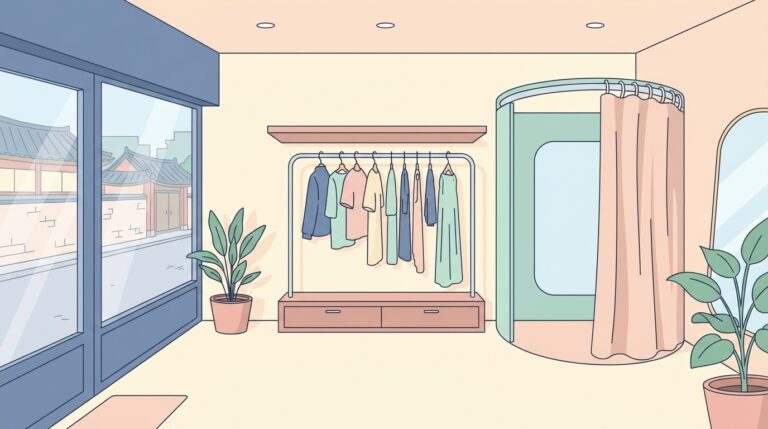
Shopping in Korea: How to Ask “Can I Try This On?” Like a Local
Phase 1: Empathy & Story Intro
안녕하세요! 매일한글 (Daily Hangul) editor here!
Imagine walking down a trendy street in Seongsu or Hongdae. The music is upbeat, the aesthetics are impeccable, and you spot an oversized vintage jacket that looks like it came straight out of your favorite K-drama star’s wardrobe. You gently pick it up, admiring the cut and texture. But suddenly, your heart beats a little faster. You look around, wondering: Can I try this on? Where is the fitting room? Will the staff get upset if I take it off the rack?
If you’ve ever stood frozen with a piece of clothing in your hands in Seoul, you are definitely not alone. Many beginner travelers feel intimidated by Korean boutiques because of unique shopping rules—like the famous “no trying on white t-shirts” or using protective face covers to prevent makeup stains. But don’t worry! With just one simple, polite question, you can unlock a stress-free and confident shopping spree. This guide is crafted from real student experiences and practical local habits to help you shop in Korea like a seasoned pro.
Phase 2: Top 3 Core Expressions Breakdown
1. 이거 입어봐도 돼요? (I-geo i-beo-bwa-do dwae-yo?)
- Pronunciation: [ee-guh ee-buh-bwah-do dweh-yo?] (Think of ‘ee’ like ‘see’ + ‘guh’ like ‘gut’ without the t)
- Meaning: Literal: “Even if I wear this, is it okay?” | Actual: “Can I try this on?”
- K-Culture Moment: In K-dramas, when characters go on surprise makeovers, they hold up an outfit to their chest and excitedly ask the shop owner this exact sentence before disappearing behind the fitting room curtain.
- Editor’s Insight: The ending ~도 돼요? (-do dwae-yo?) is the magic Korean formula for asking polite permission. You can attach it to almost any verb when asking “May I…?”
- Situation Spectrum: Casual: ⚠️ (Use ‘이거 입어봐도 돼?’ with friends) | Semi-formal/Standard: ✅ (Best for shops) | Formal: ✅
- 🤔 Think About It: In English, you say “Can I try this?” In Korean, you literally ask if an action is “acceptable/okay” (돼요). Notice how Korean politeness focuses on checking the listener’s comfort!
2. 피팅룸 어디에 있어요? (Pi-ting-rum eo-di-e i-sseo-yo?)
- Pronunciation: [pee-ting-room uh-dee-eh ee-ssuh-yo?]
- Meaning: Literal: “Fitting room, at where does it exist?” | Actual: “Where is the fitting room?”
- K-Culture Moment: Seen frequently in reality shows like I Live Alone when celebrities browse flagship designer stores and ask the clerk where the dressing area is located.
- Editor’s Insight: Koreans use the English loanword “피팅룸” (Fitting room) or “탈의실” (Tal-ui-sil), but in casual clothing stores and boutiques, “피팅룸” is the most natural word to say.
- Situation Spectrum: Casual: ⚠️ | Semi-formal/Standard: ✅ | Formal: ✅
- 🤔 Think About It: Korean places the location question word (어디 – where) right before the verb “to exist” (있어요). It’s like saying “Fitting room, where is?”
3. 다른 사이즈 있어요? (Da-reun sa-i-jeu i-sseo-yo?)
- Pronunciation: [tah-reun sah-ee-jeu ee-ssuh-yo?]
- Meaning: Literal: “Different size, is there?” | Actual: “Do you have another size?”
- K-Culture Moment: When trying on oversized Korean streetwear that turns out too oversized, this is the go-to line to ask the friendly clerk for a smaller cut.
- Editor’s Insight: Many boutique items in Korea are “Free Size” (one size fits most), so asking for different sizes is very normal and welcomed.
- Situation Spectrum: Casual: ⚠️ | Semi-formal/Standard: ✅ | Formal: ✅
- 🤔 Think About It: Instead of saying “Can you bring me…”, Korean simply asks about availability (“Does it exist?”), which feels humble and soft.
Phase 3: Textbook Korean vs. Real Native Korean
Situation 1: Asking to try on clothes
- 📖 Textbook Korean: 이 옷을 착용해 보아도 됩니까? (I oseul chak-yong-hae bo-a-do doep-ni-kka?)
- 🗣️ Real Native Korean: 이거 입어봐도 돼요? (I-geo i-beo-bwa-do dwae-yo?)
- 💡 Why is it different? “착용” (chak-yong) is an overly formal Sino-Korean word used in safety manuals or official announcements. Real Koreans use the everyday verb “입다” (ip-da – to wear).
Situation 2: Asking for the fitting room
- 📖 Textbook Korean: 탈의실의 위치가 어디입니까? (Tal-ui-sil-ui wi-chi-ga eo-di-im-ni-kka?)
- 🗣️ Real Native Korean: 피팅룸 어디예요? (Pi-ting-rum eo-di-ye-yo?)
- 💡 Why is it different? While “탈의실” is correct, everyday clothing stores in Seoul almost exclusively use “피팅룸” for a friendly, modern feel.
Phase 4: K-Culture Deep Dive & Non-Verbal Manners
4-1. 눈치 (Nunchi) & Body Language at Fitting Rooms
- The Two-Hand Hold: When presenting a garment to the clerk while asking “이거 입어봐도 돼요?”, hold the hanger with both hands or gently gesture with open palms. It instantly conveys respect.
- The Face Cover (페이스 커버): If you are trying on tops and wearing makeup or sunscreen, the staff will hand you a thin non-woven fabric bag called a “face cover.” Slip it over your head before pulling the shirt over your face. Putting it on without being asked shows top-tier Korean shopping Nunchi (situational awareness)!
- Shoes Off vs. Shoes On: Look at the fitting room floor! If you see a raised wooden platform or a mat with slippers, take your shoes off outside the curtain before stepping in.
4-2. The “Free Size” (프리사이즈) Culture
In many independent boutiques in Hongdae or underground shopping malls like Goto Mall (Gangnam Terminal), many casual tops, skirts, and dresses are labeled Free Size. This usually corresponds to a standard US Small/Medium (Korea size 55-66). Always ask before fitting, as white tops, knitwear, and delicate silks are often final-sale or display-only.
Phase 5: Real-Life Roleplay Scenario
- Setting: A trendy minimalist boutique in Seongsu-dong. Soft lo-fi K-indie music plays in the background.
- Characters:
- Clerk (Minji): Polite, trendy, wearing a neat apron.
- You (The Shopper): Holding an aesthetic beige cardigan.
- You: 저기요, 이거 입어봐도 돼요? 🎭 (Holding the cardigan politely with both hands)
(Jeo-gi-yo, i-geo i-beo-bwa-do dwae-yo? / Excuse me, may I try this on?) - Minji: 네, 그럼요! 피팅룸으로 안내해 드릴게요. 🎭 (Smiling and gesturing toward the back)
(Ne, geu-reom-yo! Pi-ting-rum-eu-ro an-nae-hae deu-ril-ge-yo. / Yes, of course! Let me guide you to the fitting room.) - You: 피팅룸 어디예요? 🎭 (Looking around curiously)
(Pi-ting-rum eo-di-ye-yo? / Where is the fitting room?) - Minji: 안쪽 오른쪽이에요. 페이스 커버 착용 부탁드려요! 🎭 (Hands you a white face cover)
(An-jjok o-reun-jjok-i-e-yo. Pe-i-seu keo-beo chak-yong bu-tak-deu-ryeo-yo! / It’s inside on the right. Please use this face cover!) - You: 네, 감사합니다! 🎭 (Bowing slightly with a warm smile)
(Ne, gam-sa-ham-ni-da! / Yes, thank you!) - Minji: 편하게 입어보세요~ 🎭 (Pulls the curtain back for you)
(Pyeon-ha-ge i-beo-bo-se-yo~ / Take your time trying it on~) - You: (After stepping out) 저기요, 다른 색상도 있어요? 🎭 (Pointing to the beige knit)
(Jeo-gi-yo, da-reun saek-sang-do i-sseo-yo? / Excuse me, do you have this in other colors too?) - Minji: 네! 블랙이랑 네이비도 있어요. 🎭 (Pulls out options from the rack)
(Ne! Beul-laek-i-rang ne-i-bi-do i-sseo-yo. / Yes! We also have black and navy.)
🔀 Interactive Choice Point
You try on the jacket, but it feels slightly tight around the shoulders. What do you say when you step out of the fitting room?
- Option A: “이거 너무 작아요! 큰 거 주세요.” (This is too small! Give me a big one.)
- Option B: “혹시 더 큰 사이즈 있어요?” (By any chance, do you have a larger size?)
- Option C: “안 맞아요.” (Doesn’t fit.) and drop it on the counter.
Feedback:
* Option A (Risk): Grammatically understandable, but sounds demanding and blunt due to “주세요” without polite softeners.
* Option B (Best! ⭐): Adding “혹시” (by any chance) and “더 큰 사이즈” (a bigger size) makes you sound exceptionally polite and natural!
* Option C (Bad): Too curt and can be perceived as cold or rude in Korean retail etiquette.
Phase 6: 10-Second Emotion Shadowing Drill
Practice matching the exact rhythm and feeling of a friendly shopper:
[😊 Politeness & Curiosity]
저기요, / 이거 / 입어봐도 돼요?
(Jeo-gi-yo / i-geo / i-beo-bwa-do dwae-yo?)-
[🤔 Gentle Inquiry]
혹시 / 더 큰 사이즈 / 있어요?
(Hok-si / deo keun sa-i-jeu / i-sseo-yo?) -
[🙏 Sweet Gratitude]
입어볼게요, / 감사합니다!
(I-beo-bol-ge-yo / gam-sa-ham-ni-da!)
Phase 7: K-Culture Mini Dictionary
- 피팅룸 (Pi-ting-rum) | Fitting Room | The standard term used in 90% of shopping malls, department stores, and roadside clothing shops across South Korea.
- 프리사이즈 (Peu-ri-sa-i-jeu) | Free Size / One Size | Garments designed with elastic bands or loose silhouettes intended to fit standard body types.
- 페이스 커버 (Pe-i-seu Keo-beo) | Face Cover | A disposable spunbond hood provided by stores to prevent foundation or lipstick from staining clothing necklines.
- 교환 / 환불 (Gyo-hwan / Hwan-bul) | Exchange / Refund | Important keywords on your receipt. Many small boutiques only allow exchanges (교환) within 7 days, so keep your receipt safe!
Phase 8: Traveler’s Survival Kit
TOP 3 Survival Phrases
- 이거 새 상품 있어요? (I-geo sae sang-pum i-sseo-yo?) — “Do you have a brand-new/unopened one for this?”
- Pro Tip: Display items are tried on by dozens of people daily. Asking for a new one from the back storage is standard practice!
- 입어만 볼게요. (I-beo-man bol-ge-yo.) — “I’ll just try it on (without pressure to buy).”
- Pro Tip: Great to use if the shop staff is hovering attentively and you want to look at yourself in peace.
- 계산해 주세요. (Gye-san-hae ju-se-yo.) — “Please ring this up / I’d like to pay.”
- Pro Tip: Say this while walking toward the checkout counter (카운터).
🧳 Editor’s Travel Note
- Navigation Essential: Download the Naver Map App for English navigation to find boutique clusters in Seongsu, Hannam-dong, and Sinsa-dong easily.
- Tax Refund Tip: Bring your passport! Look for the Tax Free logo at checkout. In major shopping areas like Myeongdong, immediate tax deductions are applied right on the spot.
Phase 9: One Step Deeper (Reflection Essay)
In Korean culture, the phrase “~도 돼요?” reflects a deep-rooted cultural norm of mutual consideration. Rather than stating a direct desire (“I want to try this on”), Korean speakers habitually frame their needs as asking for permission. This subtle linguistic soft-landing respects the shop owner’s space and creates harmony. As you shop in Seoul, you aren’t just a customer making a transaction; you are participating in a brief, respectful human connection.
💬 Your Turn: What item of Korean fashion (an oversized blazer, street hoodie, or traditional modern Hanbok) are you most excited to try on during your trip? Let us know in the comments below!
Phase 10: FAQ & Common Mistakes
Q: Can I try on white shirts or graphic tees in Korean boutiques?
A: In many small independent boutiques and underground shops, trying on white t-shirts, knits, or silk tops is restricted due to makeup stain risks. Always point and ask “이거 입어봐도 돼요?” first. If they say no, they will usually explain “화이트는 착용 안 되세요” (White cannot be tried on).
Q: How do shoe sizes work in Korea?
A: Korean shoe sizes are measured in millimeters (mm). For example, US Women’s 7 is typically 240mm, and US Men’s 9 is around 270mm. Ask: “240 (이백사십) 사이즈 있어요?”
Q: What should I do with clothes I decided NOT to buy after trying them on?
A: Hand them back politely to the staff outside the fitting room while saying, “이거 둘게요, 감사합니다” (I’ll leave this here, thank you) rather than leaving them piled on the fitting room floor.
🚨 Common Mistakes Alert
- ❌ Mistake 1: Walking straight into a fitting room without speaking to the staff.
- 👉 Correct Action: Catch the staff’s eye, hold up the item, and ask “이거 입어봐도 돼요?” first.
- ❌ Mistake 2: Forgetting to use the Face Cover when trying on pullover shirts.
- 👉 Correct Action: Use the provided face mask/cover before pulling tops over your head.
- ❌ Mistake 3: Stepping into the fitting room with shoes on when there is a floor mat.
- 👉 Correct Action: Slip off your shoes at the curtain boundary if a mat/platform is present.
Phase 11: Action Missions
- 🥉 Bronze Mission (Solo): Say “이거 입어봐도 돼요?” 5 times aloud in front of your mirror while holding an outfit.
- 🥈 Silver Mission (Social): Comment below with your favorite color in Korean that you want to buy (e.g., 블랙 / 화이트 / 베이지).
- 🥇 Gold Mission (Real Life): Visit a local Korean clothing store, K-Pop merchandise shop, or use it on your upcoming trip to Korea with confidence!
- 🎮 K-Culture Mission: Watch an episode of a fashion-oriented K-drama (like Record of Youth or Crash Landing on You) and spot the shopping scene where the character checks an outfit in the mirror.
Phase 12: Interactive Quiz Challenge
Q1. You want to ask the staff if you can try on a pair of pants. What is the most natural sentence?
* A) 이거 입어봐도 돼요?
* B) 이거 착용하겠다.
* C) 바지 줘요.
Q2. Fill in the blank:
“저기요, 피팅룸 _________?” (Where is the fitting room?)
* A) 뭐예요
* B) 어디예요
* C) 누구예요
Q3. True or False?
“In Korea, you should always wear the provided face cover over your head when trying on tops if you have makeup or sunscreen on.”
🔍 Click to view answers and explanations!
- Q1 Answer: A) 이거 입어봐도 돼요?
- Explanation: This is the most polite and natural everyday way to ask permission to try on clothes.
- Q2 Answer: B) 어디예요
- Explanation: 어디 (eo-di) means “where,” so 피팅룸 어디예요? means “Where is the fitting room?”
- Q3 Answer: True
- Explanation: Using the face cover protects garments from makeup/cosmetics and is an appreciated store manner in Korea!







