

Phase 1: Empathy (Storytelling Opening)
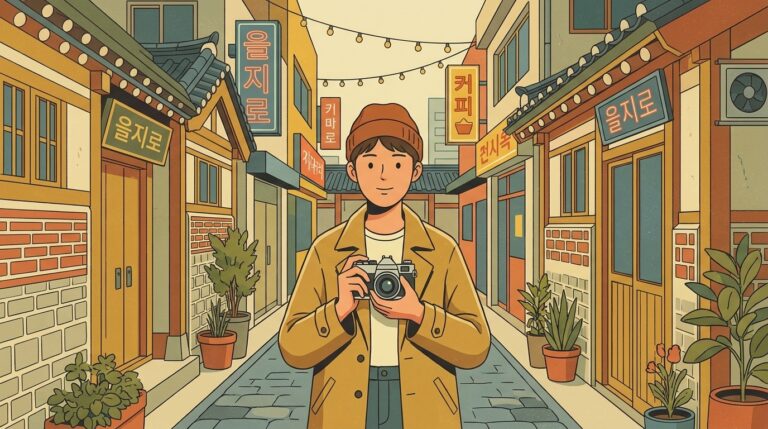
안녕하세요! 매일한글 에디터입니다. Have you ever stepped into a dimly lit, charming film photo lab tucked away in the retro alleys of Euljiro, Seoul, holding a spent roll of 35mm film? You spent the afternoon capturing vintage brick buildings, cozy cafes, and golden hour street shadows. But when you hand over your roll to the master lab technician, a sudden panic hits: How do you explain the exact tone, grain, and contrast you want? Dictating aesthetic nuances in a second language requires more than basic dictionary lookups—it demands C1-level mastery of sensory and artistic expression.
Many intermediate and advanced learners express frustration when their precise creative intent gets lost in generic textbook terms like “사진을 찍다” (to take a photo) or “현상하다” (to develop). You want to discuss warm tones, film grain, light leaks, and digital scans without sounding like an instruction manual. Based on real feedback from our community of K-culture enthusiasts and photography lovers, this guide breaks down authentic, high-level Korean expressions used by native film lovers in Korea. By mastering these nuanced phrases, you will gain the confidence to walk into any vintage studio in Korea, converse effortlessly with local creators, and capture the true aesthetic soul of Seoul.
Phase 2: Deep Dive into 3 Core Expressions
1. 현상하다 (Hyeonsang-hada) vs 스캔하다 (Skaen-hada)
- Pronunciation: [Hyeon-sang-ha-da] (Sounds like hyun-sung-ha-dah, like the flow of “hyun” in rhythm)
- Meaning: Literally “to develop film” (chemical process) vs “to scan film into digital files”. Native speakers explicitly distinguish chemical development from digital scanning.
- K-Culture Moment: Seen frequently in indie K-dramas or vintage photo vlogs where characters request both physical development and digital file transfers at neighborhood labs.
- Editor’s Insight: While textbook Korean often bundles photo processing into “사진을 찾다” (to pick up photos), C1 speakers clearly separate chemical processing (현상) from high-resolution digital file conversion (스캔).
- Situation Spectrum: Casual ✅ | Semi-formal ✅ | Formal ✅
- 🤔 Think About It: How does separating physical craftsmanship (chemical developing) from modern digitizing reflect Korea’s blend of traditional analog culture and hyper-speed digital tech?
2. 감성이 살다 (Gamseong-i salda)
- Pronunciation: [Gam-seong-i sal-da] (Pronounced gam-sung-ee sal-dah, with a subtle pause after the subject marker)
- Meaning: Literal: “The emotion/vibe comes alive.” Actual nuance: To describe an image or object that successfully captures a rich, captivating vintage mood or aesthetic.
- K-Culture Moment: Commonly used on Instagram captions or during photography discussions in Seongsu-dong when admiring vintage film grain.
- Editor’s Insight: “감성” goes far beyond the English word “vibe” or “feeling.” It represents a deep, atmospheric mood. Pairing it with “살다” (to live/come alive) elevates your speech to native fluency.
- Situation Spectrum: Casual ✅ | Semi-formal ✅ | Formal ⚠️ (Use 감성이 잘 드러나다 in formal critique)
- 🤔 Think About It: Why is “감성” such a central cultural concept in modern Korean youth culture and photography trends?
3. 색감을 잡다 (Saekgam-eul japda)
- Pronunciation: [Saek-gam-eul jap-da] (Sounds like saek-gam-eul jahp-dah, with a crisp final stop)
- Meaning: Literal: “To catch the color feeling.” Actual nuance: To dial in or capture the exact color tone/palette during photography or post-processing.
- K-Culture Moment: Used by film enthusiasts and photofinishers discussing film stock characteristics (e.g., Kodak’s warm yellow vs. Fuji’s cool green tones).
- Editor’s Insight: C1 speakers use “색감” (color sense/tone) instead of just “색” (color). Using “잡다” implies deliberate creative effort to achieve a desired aesthetic.
- Situation Spectrum: Casual ✅ | Semi-formal ✅ | Formal ✅
- 🤔 Think About It: How does expressing subtle color nuances change the way you interact with local visual artists in Korea?
Phase 3: Textbook Korean vs Real Korean
Situation 1: Requesting High-Resolution Film Scans at a Photo Lab
- 📖 교과서 한국어: “이 필름을 현상해 주시고 스캔도 함께 해주세요.”
(Please develop this film and scan it as well.) - 🗣️ 진짜 한국어: “필름 현상해서 고화질 스캔으로 부탁드려요.”
(I’d like this film developed and scanned in high-res, please.) - 💡 왜 다를까? Real Koreans drop redundant conjunctions (“해 주시고”) and specify quality expectations concise, professional noun phrases like “고화질 스캔” (high-resolution scan).
Situation 2: Admiring Retro Aesthetic in a Photo
- 📖 교과서 한국어: “이 사진은 구식 카메라 특유의 분위기가 잘 들어맞습니다.”
(This photo fits the unique atmosphere of an old camera well.) - 🗣️ 진짜 한국어: “아, 이 레트로한 필름 특유의 감성이 제대로 사네요!”
(Ah, the unique retro film vibe really comes alive here!) - 💡 왜 다를까? Native speakers combine modern loanwords like “레트로한” with expressive idiomatic phrases like “감성이 제대로 살다” to sound energetic and contemporary.
Phase 4: K-Culture Deep Dive & Non-Verbal Manners
4-1. Nunchi (눈치) & Gestures at Korean Photo Labs
When visiting traditional film laboratories in areas like Euljiro or Chungmuro, showing respect for the technician’s craft creates instant rapport. Handing over your film canister with two hands (양손 사용) demonstrates politeness. When describing desired color adjustments, point gently to reference images on your phone screen rather than tapping aggressively. Maintain soft eye contact and nod slowly to acknowledge their technical advice—this signals high emotional intelligence (눈치).
4-2. Cultural Code: Retro Nostalgia (복고 & Y2K) in Seoul
The resurgence of 35mm film and quick-snap disposable cameras (일회용 카메라) isn’t just a trend; it’s part of Korea’s broader Newtro (뉴트로) movement. Young Koreans seek refuge from hyper-digital perfection in the raw, unpredictable textures of analog photography. K-pop groups and indie artists deliberately shoot album art on film to evoke warmth and nostalgia. Knowing terms like “입자감” (grain texture) and “빛번짐” (light leak/bloom) connects you directly to this vibrant artistic subculture.
Phase 5: Real-World Roleplay Scenario
Setting: A cozy, vintage film studio in Euljiro filled with shelves of expired film and classic cameras.
Characters:
* You (학습자): An enthusiastic film camera lover.
* Min-ho (민호): A skilled, warm-hearted film lab technician in his 30s.
Dialogue:
1. You: 🎭 (Holding out a roll of film with both hands) 안녕하세요! 이 필름 현상이랑 스캔 부탁드리려고요. (Hello! I’d like to get this film developed and scanned, please.)
2. Min-ho: 🎭 (Taking the film carefully and checking the cartridge) 네, 안녕하세요! 필름이 코닥 골드네요. 스캔은 일반 화질로 해드릴까요?
3. You: 🎭 (Smiling enthusiastically) 고화질로 부탁드려요! 코닥 특유의 따뜻한 색감을 잘 살리고 싶거든요. (High-res, please! I really want to bring out that warm color tone unique to Kodak.)
4. Min-ho: 🎭 (Nodding approvingly) 감성을 잘 아시네요! 노출 손실된 CUT이 좀 있을 수 있는데, 보정해 드릴까요? (You really know your aesthetics! There might be a few underexposed shots; would you like me to adjust them?)
5. You: 🎭 (Gently gesturing) 너무 인위적이지 않게, 필름 특유의 입자감만 유지해 주세요. (Keep it natural without making it feel artificial; just keep that signature film grain intact.)
6. Min-ho: 🎭 (Writing down notes on the order sheet) 알겠습니다. 현상 완료되면 카카오톡 알림톡으로 다운로드 링크 보내드릴게요. (Got it. Once developing is done, I’ll send a download link via KakaoTalk notification.)
7. You: 🎭 (Slightly bowing) 감사합니다! 작업 시간은 얼마나 걸릴까요? (Thank you! How long will the process take?)
8. Min-ho: 🎭 (Waving warmly) 한 두 시간 정도 걸려요. 근처 카페 계시면 금방 끝납니다! (It takes about an hour or two. If you’re at a nearby cafe, it’ll be ready in no time!)
🔀 Interactive Branching Choice
What would you say if you want your photos to look slightly cooler/greener in tone?
* Option A: “색감을 조금 더 차갑고 푸른 톤으로 잡아주실 수 있나요?”
* Option B: “사진 색깔을 그냥 초록색으로 다 바꿔주세요.”
* Option C: “필름이 맛이 갔으니까 스캔 잘 해주세요.”
Feedback:
* Option A (Best Choice): Perfect! You used natural nuance terms (“차갑고 푸른 톤”, “색감을 잡다”) with smooth honorific forms. Technicians will immediately understand your creative vision.
* Option B (Bad Choice): Too blunt and unnatural. Asking to change everything to green sounds like a digital filter malfunction rather than color grading.
* Option C (Risk Choice): Impolite! “맛이 갔다” is crude slang meaning “spoiled/went bad.” Using it about film stock sounds overly disrespectful to the master technician.
Phase 6: 10-Second Emotion Shadowing Drill
Practice saying these lines aloud with correct emotional inflection and pauses (/ marks a half-second breathing pause).
- [😊 Expressing excited aesthetic preference]
“코닥 특유의 / 따뜻한 색감이 / 제대로 살았네요!”
(The warm color tone unique to Kodak / really comes alive here!) -
[🥺 Politeness with subtle request]
“너무 인위적이지 않게 / 필름 입자감을 / 살려주실 수 있나요?”
(Could you please keep it natural / and preserve the film grain texture?) -
[😎 Confident, natural native phrasing]
“필름 현상해서 / 고화질 스캔으로 / 부탁드릴게요!”
(I’d like the film developed / and scanned in high-res, / please!)
Phase 7: K-Culture Mini Dictionary
- 입자감 (Iptja-gam) | Film Grain Texture | Used to describe the artistic rough grit in analog film photos. Highly prized in retro photography aesthetics.
- 빛번짐 (Bit-beon-jim) | Light Bleed / Light Leak | The dreamy flare or light bleed created when light hits film prematurely, often used intentionally for romantic aesthetic shots.
- 결과물 (Gyeolgwamul) | Final Output / Scanned Results | Refers to the final high-res image files produced after film developing and scanning.
- 필카샷 (Pilka-sot) | Film Camera Shot | Popular internet slang compounding “필름 카메라” (Film Camera) and “샷” (Shot). Frequently used in social media tags.
Phase 8: Survival Kit for Travelers
TOP 3 Essential Photography Expressions
- “필름 현상되나요?” (Pilreum hyeonsang-doenayo?) — Do you develop film here?
- “스캔본은 이메일로 받나요?” (Skaenboneun imaeillo bannayo?) — Do I receive the scanned files via email?
- “일회용 카메라 하나 주세요.” (Irhweyong kamera hana juseyo.) — Please give me one disposable camera.
Editor’s Travel Note
When hunting for vintage film photo spots in Seoul, head straight to Euljiro 3-ga or Yeonnam-dong. Download the Naver Map Application to search for localized terms like “필름현상소” (Film Developing Shop) rather than generic English terms. Many traditional labs accept mobile KakaoTalk transfers or local cards, but keeping around 10,000 to 20,000 KRW in cash is helpful for purchasing rare expired film rolls!
Phase 9: One Step Deeper (Thoughtful Reflection)
In hyper-modern Korea, where 5G internet speeds and AI cameras dominate daily life, the enduring passion for analog film represents a fascinating cultural paradox. Young Koreans deliberately slow down, waiting hours for chemical film scans to arrive on their smartphones. This pursuit of “slow aesthetic” (천천히 느끼는 감성) shows that language isn’t just about speed or convenience—it’s a medium for expressing patience, nostalgia, and personal identity.
💬 Your Turn: Have you ever shot film in your home country or during travel? How would you describe your favorite film photo tone in Korean? Share your thoughts in the comments below!
Phase 10: FAQ & Common Mistakes
Q: What is the difference between 현상 (Hyeonsang) and 인화 (Inhwa)?
A: 현상 (Hyeonsang) refers to chemically processing exposed negative film so images become visible (and later scanned into digital files). 인화 (Inhwa) specifically means printing those images onto physical photographic paper. If you only want digital files on your phone, ask for “현상과 스캔” (developing and scanning).
Q: Can I use the word “사진을 찍다” for film cameras as well?
A: Yes, “사진을 찍다” is universal. However, to sound sophisticated at C1 level, you can say “필름에 담다” (literally: to capture/contain in film) when describing artistic photo-taking.
Q: How do I tell the technician that I want high resolution for printing later?
A: You can say, “나중에 인화할 수도 있어서 고화질 스캔(고용량 스캔)으로 부탁드려요.” (I might print them later, so high-resolution scan, please).
🚨 Common Mistakes TOP 3
- Mistake: Saying “사진을 현상해주세요” when you mean physical paper prints.
- Correct Action: Say “사진을 인화해주세요” for prints, and “현상해서 스캔해주세요” for digital file downloads.
- Mistake: Using “옛날 분위기” exclusively to mean retro aesthetic.
- Correct Action: Elevate your speech by using “레트로한 감성” or “아날로그 분위기”.
- Mistake: Calling disposable cameras “한 번 쓰는 카메라”.
- Correct Action: Use the exact native terminology: “일회용 카메라” (Disposable Camera).
Phase 11: Action Mission & Engagement
- Bronze Mission: Practice saying Phase 6 emotion shadowing sentences out loud 3 times with expressive pauses.
- Silver Mission: Post a photo on your Instagram or social media using the caption: “오늘의 필카 감성 📸 #매일한글 #필름카메라”.
- Gold Mission: Visit a local film lab (or practice a mock scenario) and order developing using high-level phrasing: “필름 현상하고 고화질 스캔 부탁드립니다!”
🎮 K-Culture Mission: Watch a modern Korean indie music video or vlog and write down 2 sentences where characters describe photos or visual aesthetics!
Phase 12: Interactive Quiz Challenge
Test your knowledge before wrapping up today’s lesson!
1. Situation Quiz: You want digital files of your film sent to your phone. What should you ask for?
a) 인화만 해주세요.
b) 현상하고 스캔해주세요.
c) 필름을 세척해주세요.
🔍 Click to reveal answer & explanation
Correct Answer: b) 현상하고 스캔해주세요.
Explanation: Developing (현상) processes the chemicals, and scanning (스캔) turns negatives into digital image files. 인화 (a) means physical paper prints.
2. Fill-in-the-blank: Choose the word that best fits the sentence: “이 사진은 필름 특유의 [ _____ ]이 잘 살아서 멋지네요.”
a) 노출
b) 감성
c) 수량
🔍 Click to reveal answer & explanation
Correct Answer: b) 감성
Explanation: “감성” (aesthetic vibe) fits naturally with “살다” (to come alive) when praising film photography output.
3. True or False: In Korea, “일회용 카메라” means a high-end digital SLR camera.
🔍 Click to reveal answer & explanation
Correct Answer: False
Explanation: “일회용 카메라” literally translates to single-use / disposable analog camera.






