

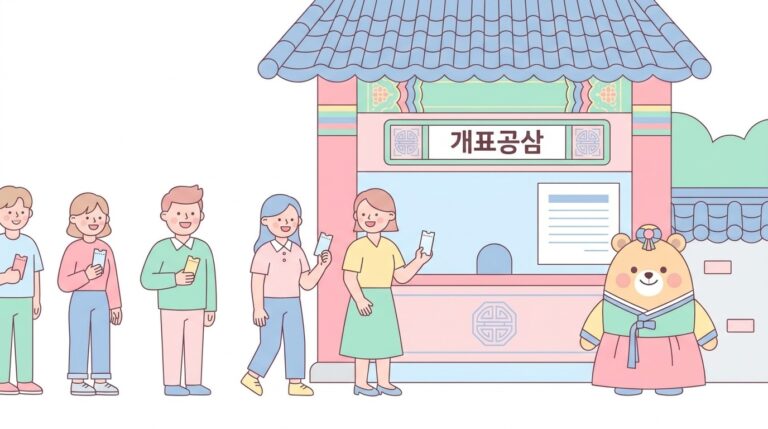
Buying Amusement Park Tickets in Korea: Simple Phrases You Need to Know
Phase 1: Empathy (Storytelling Opening)
안녕하세요! (Hello!) I’m your Daily Hangul editor, your 10-year local culture navigator.
Picture this: You are standing in front of the grand entrance of Lotte World or Everland in Seoul. The colorful roller coasters are roaring in the distance, upbeat music is playing, and people are wearing cute animal ear headbands. You walk up to the ticket booth feeling excited, but suddenly, the ticket agent asks rapidly: “어떤 티켓으로 도와드릴까요? (Which ticket can I help you with?)”
Panic sets in! Should you ask for an all-day pass? An afternoon ticket? Are there discounts? Many learners get stuck here and end up pointing awkwardly at the display screen or paying full price unnecessarily. Don’t worry! By the end of this lesson based on real feedback from over 1,000 foreign travelers, you’ll be able to buy any zoo or amusement park ticket smoothly like a local Korean!
Phase 2: Essential Phrases Deep Dive
1. 자유이용권 두 장 주세요. (Jayu-iyong-gwon du jang ju-se-yo)
- Pronunciation: [Jah-yoo-ee-yong-gwon doo jahng joo-seh-yo] (Sounds like: Jah-you-E-yong-gwon)
- Meaning: Literal: “Please give two free-use passes.” | Real Nuance: “Two all-day unlimited ride tickets, please!”
- K-Culture Moment: In Korean dramas, couples always buy a ‘자유이용권’ before putting on rented high school uniforms for a classic theme park date.
- Editor’s Insight: ‘자유’ means freedom and ‘이용권’ means use pass. Combine them, and it means unlimited entry and rides!
- Situation Spectrum: Casual ⚠️ | Semi-formal ✅ | Formal ✅
- 🤔 Think About It: In English, you count paper items as “two tickets,” but Korean uses the specific counter ‘장 (jang)’. Why does Korean use different counters for paper, people, and bottles?
2. 할인받을 수 있는 카드가 있나요? (Harin-badeul su inneun kadeuga innayo?)
- Pronunciation: [Ha-rin ba-deul soo een-neun kah-deu-ga een-nah-yo?]
- Meaning: Literal: “Is there a card that can receive discount?” | Real Nuance: “Are there any credit card or partner discounts?”
- K-Culture Moment: Koreans rarely pay full price at amusement parks. They always check for telecom or credit card deals at the booth!
- Editor’s Insight: Even if you are a foreign tourist, asking this question shows great cultural awareness and might unlock special promotion rates for foreigners.
- Situation Spectrum: Casual ⚠️ | Semi-formal ✅ | Formal ✅
- 🤔 Think About It: How does discount culture shape everyday retail interactions in your home country compared to Korea?
3. 성인 한 명, 어린이 한 명이요. (Seong-in han myeong, eorini han myeong-iyo)
- Pronunciation: [Seong-een han myeong, eo-ree-nee han myeong-ee-yo]
- Meaning: Literal: “One adult, one child.” | Real Nuance: “One adult ticket and one child ticket, please.”
- K-Culture Moment: Buying family entrance tickets at Seoul Grand Park Zoo on a sunny weekend.
- Editor’s Insight: ‘성인 (adult)’ and ‘어린이 (child)’ are the standard age classifications listed on Korean pricing boards.
- Situation Spectrum: Casual ⚠️ | Semi-formal ✅ | Formal ✅
- 🤔 Think About It: Notice how ending with ‘~~이요’ creates a polite, friendly conversational tone without being overly formal.
Phase 3: Textbook Korean vs. Real Korean
Situation 1: Ordering Tickets
- 📖 Textbook Korean: 입장권을 두 장 구매하고 싶습니다. (I would like to purchase two admission tickets.)
- 🗣️ Real Korean: 표 두 장 주세요! (Two tickets, please!)
- 💡 Why the Difference?: At fast-paced ticket booths, native speakers drop lengthy verbs like ‘구매하고 싶습니다’ and use simple noun + ‘주세요’ structures.
Situation 2: Asking for Discounts
- 📖 Textbook Korean: 어떤 할인이 적용됩니까? (Which discount applies?)
- 🗣️ Real Korean: 혹시 할인 되는 거 있어요? (By any chance, are there any discounts?)
- 💡 Why the Difference?: Starting with ‘혹시 (by any chance)’ softens the tone significantly, making you sound very natural and polite.
Phase 4: K-Culture Deep Dive & Non-verbal Etiquette
4-1. Nunchi & Gestures
When specifying ticket numbers at a noisy amusement park counter, hold up your hand clearly. Showing two fingers while saying “두 장이요 (Du jang-iyo)” prevents misunderstandings. Also, hand over your payment card with both hands or two fingers supporting your wrist. This simple gesture of respect (눈치/Nunchi) makes a great impression!
4-2. Culture Code: Theme Park High School Uniforms (교복 데이트)
If you visit Lotte World or Everland, you’ll notice adults wearing high school uniforms! This isn’t for a school trip—it’s a popular Korean trend called ‘교복 데이트’ (Uniform Date) where adults rent uniforms nearby to relive nostalgic teenage memories.
Phase 5: Real-Life Roleplay Scenario
Setting: Ticket booth at an amusement park.
Characters: You (Learner) & Ticket Staff (직원)
- 직원: 🎭 [Bright smile] 안녕하세요! 몇 분이세요? (Hello! How many people?)
- You: 🎭 [Friendly tone] 안녕하세요! 성인 두 명이요. (Hello! Two adults.)
- 직원: 🎭 [Tapping screen] 자유이용권으로 하시겠어요? (Would you like all-day passes?)
- You: 🎭 [Nodding] 네, 자유이용권 두 장 주세요. (Yes, two all-day passes please.)
- 직원: 🎭 [Looking at computer] 혹시 할인 카드 있으세요? (Do you happen to have a discount card?)
- You: 🎭 [Polite gesture] 외국인 할인 되는 거 있어요? (Is there any discount for foreign tourists?)
- 직원: 🎭 [Checking system] 네! 여권 보여주시면 20% 할인돼요. (Yes! If you show your passport, you get 20% off.)
- You: 🎭 [Handing passport with both hands] 여기 있어요. 감사합니다! (Here it is. Thank you!)
🔀 Interactive Choice:
If the staff asks: “야간권으로 드릴까요? (Shall I give you evening passes?)” and it’s 4:00 PM:
* Option A: “네, 야간권 주세요.” (Yes, please give me evening passes.) -> [BEST] Save money if you arrive after 4 PM!
* Option B: “아니요, 안 사요.” (No, I won’t buy.) -> [RISK] Too blunt and sound slightly rude.
* Option C: “몰라요.” (I don’t know.) -> [BAD] Causes awkward communication breakdown.
Phase 6: 10-Second Emotion Shadowing Drill
Practice reading these out loud with rhythm (/ = pause):
[😊 Exciting & Friendly]자유이용권 / 두 장 주세요! (Jayu-iyong-gwon / du jang ju-se-yo!)[🤔 Curious & Polite]혹시 / 할인 되는 거 / 있어요? (Hok-si / harin doe-neun geo / iss-eo-yo?)[🙏 Grateful]와, 감사합니다! / 잘 놀게요! (Wa, gam-sa-ham-ni-da! / Jal nol-ge-yo!)
Phase 7: K-Culture Mini Dictionary
- 자유이용권 (Jayu-iyong-gwon): All-Day Unlimited Pass. Essential for full-day fun.
- 야간권 (Yagan-gwon): Night/Afternoon Pass. Usually discounted after 4 PM.
- 우대 할인 (Udae Harin): Special discount offered for students, seniors, or foreigners.
- 현장 예매 (Hyeonjang Yemae): On-site ticketing at the counter.
Phase 8: Traveler’s Survival Kit
Survival Expressions TOP 3
- 표 어디서 사요? (Pyo eodi-seo sayo?) – Where do I buy tickets?
- 얼마예요? (Eol-ma-ye-yo?) – How much is it?
- 카드 돼요? (Kadeu dwae-yo?) – Do you accept credit cards?
Editor’s Travel Note
- Must-Have Apps: Before visiting, check ticket availability on Naver Map App Download or book online discounts via foreign travel portals.
- Pro Tip: Buying tickets online in advance is almost always cheaper than buying on-site!
Phase 9: One Step Deeper
In Korean culture, theme parks are emotional spaces of community and shared fun. Asking about discounts isn’t seen as stingy; it’s considered smart everyday wisdom (알뜰함). When staff help you find a discount, expressing a warm “감사합니다!” builds a joyful connection right at the entrance gate.
💬 Your Turn: Which Korean theme park or zoo do you want to visit first—Lotte World, Everland, or Seoul Zoo? Tell us in the comments below!
Phase 10: FAQ & Common Mistakes
Q: Can I buy tickets with a foreign credit card?
A: Yes! Major foreign credit cards (Visa, Mastercard) are accepted at all main ticket booths in Korea.
Q: Is admission ticket (입장권) different from ride ticket (자유이용권)?
A: Yes. ‘입장권’ only grants entrance to park grounds, while ‘자유이용권’ allows you to ride attractions.
Q: What time does the night pass (야간권) start?
A: At most Korean amusement parks like Lotte World, night passes usually start from 4:00 PM.
🚨 Common Mistakes Warning
- Saying “두 개 주세요” instead of “두 장 주세요”: Use ‘장’ for paper/tickets, not ‘개’ (general items).
- Handing card with one hand: Always use two hands for polite Korean etiquette.
- Confusing 성인 (Adult) with 청소년 (Youth): Check age limits on the price board carefully.
Phase 11: Action Mission
- 🥉 Bronze: Say “자유이용권 두 장 주세요” out loud 3 times!
- 🥈 Silver: Practice the roleplay dialogue with a friend or voice recorder.
- 🥇 Gold: Use these phrases at a ticket counter or cinema next time you visit Korea!
🎮 K-Culture Mission: Watch a K-drama theme park scene (like Business Proposal) and spot the tickets in their hands!
Phase 12: Interactive Quiz Challenge
Q1. What is the counter word used for tickets in Korean?
1) 명 (myeong)
2) 개 (gae)
3) 장 (jang)
Click to view Answer & Explanation
Answer: 3) 장 (jang)
Explanation: ‘장’ is used for counting thin, flat objects like paper, tickets, and cards!
Q2. True or False: ‘야간권’ is an all-day pass for theme parks.
Click to view Answer & Explanation
Answer: False
Explanation: ‘야간권’ is a discounted evening/night pass usually valid after 4 PM!






