

Master Korean Post Office Phrases: Handling Fragile Items Like a Local!
Phase 1: Welcome! (안녕하세요! 매일한글 에디터입니다.)
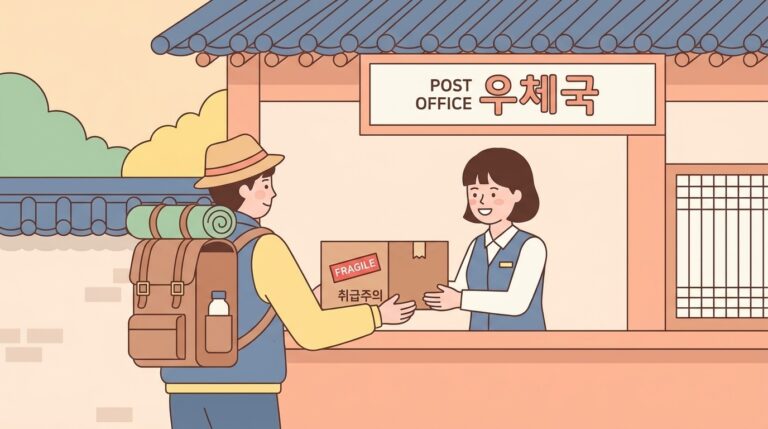
안녕하세요! I’m your Daily Hangul editor and your personal Korean culture navigator! Imagine this: You’re standing inside a busy Korean Post Office (우체국) in Hongdae. You just bought a gorgeous handmade ceramic mug or a delicate K-Beauty glass bottle set to send back home to your family. You step up to the counter, the friendly clerk takes your package, and you suddenly freeze. How do I say ‘This is fragile, please handle with care’ in Korean?
Don’t panic! Sending fragile items in Korea is super simple once you know a few magic words. Based on real feedback from beginner learners living in Seoul, expressing item safety is one of the top stress-relief moments at the post office. By mastering today’s A1-level phrase, you’ll feel completely confident sending souvenirs, delicate gifts, or fragile goodies anywhere in Korea or across the globe!
Phase 2: Core 3 Expressions Deep Dive
1. 깨지는 물건이에요 (Kkaejineun mulgeonieyo)
- Pronunciation: [Kkae-ji-neun mool-geon-i-e-yo] (Sounds like ‘kkae’ as in ‘kettle’, ‘ji’ as in ‘jeans’, ‘neun’ as in ‘noon’, ‘mool’ as in ‘pool’, ‘geon’ as in ‘gun’)
- Meaning: Literal: “It is an item that breaks.” / Real Nuance: “This is a fragile item.”
- K-Culture Moment: In K-Dramas, whenever characters ship hand-painted pottery or vintage glass frames, they point at the box and softly say this phrase to the courier.
- Editor’s Insight: ‘깨지다’ means to break/shatter. Adding ‘-는 물건이에요’ turns it into a polite, descriptive sentence perfect for beginners!
- Situation Spectrum: Casual 🚫 | Semi-formal ✅ | Formal ✅
- 🤔 Think About It: In English, we say “It’s fragile.” In Korean, describing the action directly (“It breaks”) is more common and intuitive. Isn’t that direct yet gentle?
2. 조심히 다뤄 주세요 (Joshimhi darwo juseyo)
- Pronunciation: [Jo-shim-hi da-rwo joo-se-yo] (Sounds like ‘Jo’ as in ‘Joe’, ‘shim’ as in ‘shim’, ‘hi’ as in ‘he’, ‘da-rwo’ as in ‘da-row’, ‘joo-se-yo’ as in ‘juice-eh-yo’)
- Meaning: Literal: “Please handle carefully.” / Real Nuance: “Please handle with care!”
- K-Culture Moment: You will hear idols say this on reality shows when carrying delicate birthday cakes or glass trophies!
- Editor’s Insight: ‘조심히’ means ‘carefully’. ‘주세요’ means ‘please give/do’. Put them together for an instant polite request.
- Situation Spectrum: Casual ⚠️ | Semi-formal ✅ | Formal ✅
- 🤔 Think About It: Adding ‘주세요’ at the end instantly makes any Korean sentence polite and warm!
3. 취약주의 스티커 붙여 주세요 (Chwi-yak-joo-ui seu-ti-keo boot-yeo juseyo)
- Pronunciation: [Chwi-yak-joo-ui seu-ti-keo boot-yeo joo-se-yo]
- Meaning: Literal: “Please stick a fragile sticker on it.” / Real Nuance: “Could you put a ‘Fragile’ sticker on this package?”
- K-Culture Moment: Post office staff in Korea keep red ‘파손주의’ (Fragile) stickers right on their desks.
- Editor’s Insight: You can also simply say “스티커 붙여 주세요” (Please put a sticker on it) while pointing!
- Situation Spectrum: Casual 🚫 | Semi-formal ✅ | Formal ✅
- 🤔 Think About It: Visual stickers give immediate peace of mind when mailing items anywhere in the world.
Phase 3: Textbook Korean vs. Real Korean
Situation 1: Telling the clerk the package is fragile
- 📖 Textbook Korean: 이것은 파손 위험이 있는 물품입니다. (Igeoseun pason wiheomi inneun mulpumimnida.)
- 🗣️ Real Korean: 깨지는 물건이에요! (Kkaejineun mulgeonieyo!)
- 💡 Why the difference? The textbook version is overly formal and legalistic. In real daily life, natural spoken Korean keeps it short and sweet!
Situation 2: Asking for careful delivery
- 📖 Textbook Korean: 안전하게 배송해 주시기를 바랍니다. (Anjeonhage baesonghae jusigireul baramnida.)
- 🗣️ Real Korean: 조심히 다뤄 주세요~ (Joshimhi darwo juseyo~)
- 💡 Why the difference? Adding a soft tone to ‘주세요’ feels friendly and approachable to post office staff.
Phase 4: K-Culture Deep Dive & Non-Verbal Manners
4-1. Nunchi & Gestures
When handing over a package containing fragile items in Korea, use both hands to hold the package. Holding objects with both hands shows deep respect. While placing it on the scale, tap your package gently and say, “깨지는 물건이에요” with a soft smile and a slight nod.
4-2. Korean Post Office Speed & Safety
Korea’s postal service (우체국 택배) is famous worldwide for incredible speed and care! Usually, domestic packages arrive the very next day. Post offices provide bubble wrap (뽁뽁이 – ppokppoki) and boxes for free or small fees at the packing station before you approach the counter.
Phase 5: Real-Life Roleplay Scenario
Setting: A cozy Korean post office. You are speaking with Mr. Kim, a helpful postal clerk.
- Clerk (Mr. Kim): 안녕하세요! 어떤 거 도와드릴까요? 🎭 (Smiling warmly at the counter)
(Annyeonghaseyo! Eotteon geo dowadeureilkkayo? / Hello! How can I help you?) - You: 안녕하세요! 이거 보낼게요. 🎭 (Placing the box with both hands on the desk)
(Annyeonghaseyo! Igeo bonaelgeyo. / Hello! I’d like to send this.) - Clerk (Mr. Kim): 안에 뭐가 들어있나요? 🎭 (Looking at the box)
(Ane mweoga deureoinnnayo? / What is inside?) - You: 깨지는 물건이에요. 조심히 다뤄 주세요! 🎭 (Pointing gently at the box with a polite nod)
(Kkaejineun mulgeonieyo. Joshimhi darwo juseyo! / It’s fragile. Please handle with care!) - Clerk (Mr. Kim): 아, 그렇군요! 파손주의 스티커 붙여드릴게요. 🎭 (Reaching for a red sticker)
(A, georeotgunyo! Pasonjui seutikeo boot-yeodeureilgeyo. / Ah, I see! I’ll put a Fragile sticker on it.) - You: 감사합니다! 스티커 붙여 주세요. 🎭 (Bowing slightly with a relieved smile)
(Gamsahamnida! Seutikeo boot-yeo juseyo. / Thank you! Please put the sticker on.) - Clerk (Mr. Kim): 주소 확인 부탁드립니다. 🎭 (Pointing to the screen)
(Juso hwagin boutakdeureumnida. / Please confirm your address.) - You: 네, 맞아요. 수고하세요! 🎭 (Handing over your credit card)
(Ne, majayo. Sugohaseyo! / Yes, that’s right. Thank you for your work!)
🔀 Interactive Choice Point
The clerk asks: “안에 뭐가 들어있나요?” (What is inside?) How do you reply?
* Choice A: 깨지는 물건이에요. (Kkaejineun mulgeonieyo.)
* Choice B: 몰라요. (Mollayo. / I don’t know.)
* Choice C: 그냥 박스예요. (Geunyang bakseuyeo. / It’s just a box.)
Feedback:
* Choice A (Best): Perfect! Clear, polite, and instantly lets the clerk know to apply a fragile sticker.
* Choice B (Bad): Too blunt and unhelpful! The clerk won’t know if special handling is required.
* Choice C (Risk): Risky! If it’s ceramic or glass, your items might break during transit without protection.
Phase 6: 10-Second Emotion Shadowing Drill
Practice speaking with feeling! Follow the pause markers (/) and emotional cues:
[😊 Warm & Polite]깨지는 / 물건이에요. / 조심히 / 다뤄 주세요!
(Kkae-ji-neun / mul-geon-i-e-yo. / Jo-shim-hi / da-rwo joo-se-yo!)[🥺 Worried & Earnest]유리예요! / 진짜 / 깨지는 물건이에요.
(Yu-ri-ye-yo! / Jin-jja / kkae-ji-neun mul-geon-i-e-yo.)[🙏 Grateful]스티커 / 붙여 주세요. / 감사합니다!
(Seu-ti-keo / boot-yeo joo-se-yo. / Gam-sa-ham-ni-da!)
Phase 7: K-Culture Mini Dictionary
- 뽁뽁이 (Ppok-ppok-i): Bubble wrap. Onomatopoeia for the sound of popping bubbles!
- 파손주의 (Pa-son-ju-ui): “Handle with Care” /
Frequently Asked Questions (FAQ)
Q: What does "깨지는 물건이에요 (Kkaejineun mulgeonieyo)" mean in Korean and how do you pronounce it?
A: In Korean, "깨지는 물건이에요 (Kkaejineun mulgeonieyo)" is pronounced [Kkae-ji-neun mool-geon-i-e-yo] and means: Literal: "It is an item that breaks." / Real Nuance: "This is a fragile item."
Q: What does "조심히 다뤄 주세요 (Joshimhi darwo juseyo)" mean in Korean and how do you pronounce it?
A: In Korean, "조심히 다뤄 주세요 (Joshimhi darwo juseyo)" is pronounced [Jo-shim-hi da-rwo joo-se-yo] and means: Literal: "Please handle carefully." / Real Nuance: "Please handle with care!"
Q: What does "취약주의 스티커 붙여 주세요 (Chwi-yak-joo-ui seu-ti-keo boot-yeo juseyo)" mean in Korean and how do you pronounce it?
A: In Korean, "취약주의 스티커 붙여 주세요 (Chwi-yak-joo-ui seu-ti-keo boot-yeo juseyo)" is pronounced [Chwi-yak-joo-ui seu-ti-keo boot-yeo joo-se-yo] and means: Literal: "Please stick a fragile sticker on it." / Real Nuance: "Could you put a 'Fragile' sticker on this package?"







