

Phase 1: Empathy (Story-Driven Opening)
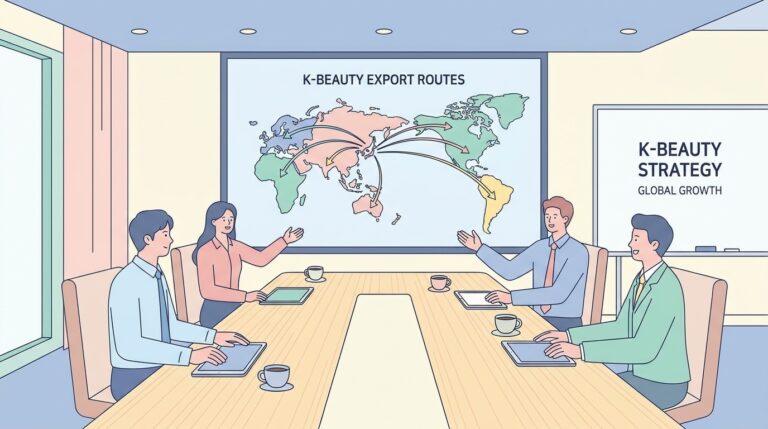
안녕하세요! I’m your lead editor at Daily Hangul. Imagine sitting in a sleek boardroom in Gangnam’s cosmetics district. The projector screen shows a dramatic chart: sales figures in the Chinese market, once the undisputed backbone of K-Beauty’s global empire, are trending downward due to the rise of domestic Chinese brands (C-Beauty) and shifting consumer sentiment. But nobody in the room is panicking. Instead, executives are animatedly discussing strategic pivots toward North America, Europe, and Southeast Asia.
If you are operating at a C2 level in Korean, mastering casual everyday conversations is no longer enough. You need the linguistic precision to analyze complex economic pivots, articulate corporate strategy, and participate in high-level industry discussions. Navigating the business landscape of K-Beauty requires understanding subtle nuances like moving from simple export expansion to deep localization and structural transformation.
In this lesson, curated from real-world strategic meetings and industry feedback from insider professionals, we will dive deep into the sophisticated vocabulary and cultural mindsets behind K-Beauty’s export diversification strategy. Mastering these advanced expressions will empower you to discuss global commerce and executive decisions in Korean with absolute authority and natural flair.
Phase 2: Core 3 Expressions Analysis
1. 체질 개선 (Chae-jil gae-seon)
- Pronunciation: [Chae-jil gae-seon] (Sounds like chae-jeel gae-sehn, literally ‘improving bodily constitution’)
- Meaning: Literal: Improving physical health/constitution | Real Nuance: Fundamental restructuring or reconditioning of a business model/strategy to build long-term immunity against market shocks.
- K-Culture Moment: Frequently used in business news broadcasts and corporate strategy meetings when describing how K-beauty firms are reducing fixed costs in China to invest heavily in R&D and global market expansion.
- Editor’s Insight: While ‘구조조정’ (gujo-jojeong) implies painful corporate restructuring like layoffs, ‘체질 개선’ carries a proactive, positive tone—focusing on becoming healthier, leaner, and more competitive for the future.
- Situation Spectrum: Casual 🚫 | Semi-formal ⚠️ | Formal ✅
- 🤔 Think About It: In Korean business culture, health metaphors are frequently applied to corporations. What body-related metaphors does your native culture use when discussing corporate turnarounds?
2. 시장 다변화 (Si-jang da-byeon-hwa)
- Pronunciation: [Si-jang da-byeon-hwa] (Sounds like see-jahng dah-byeohn-hwah)
- Meaning: Literal: Market diversification | Real Nuance: Strategically spreading risk by expanding into new geographic markets (e.g., US, Japan, Europe) instead of relying heavily on a single dominant market.
- K-Culture Moment: Overheard at cosmetic trade shows in COEX, Seoul, where managers discuss transitioning away from Chinese tourist dependency toward global e-commerce platforms like Amazon or Shopee.
- Editor’s Insight: ‘다변화’ (diversification) consists of ‘다’ (many), ‘변’ (change), and ‘화’ (transformation). It highlights an active, multi-pronged approach rather than a passive reaction.
- Situation Spectrum: Casual 🚫 | Semi-formal ⚠️ | Formal ✅
- 🤔 Think About It: Why do you think market diversification is framed not merely as a sales tactic in Korea, but as a crucial national economic strategy?
3. 탈중국 (Tal-jung-guk)
- Pronunciation: [Tal-jung-guk] (Sounds like tahl-joong-gook)
- Meaning: Literal: Escaping/exiting China | Real Nuance: Pivoting corporate operations and marketing focus away from over-reliance on the Chinese market toward broader international markets.
- K-Culture Moment: A hot-button buzzword featured prominently in Korean economic journals and beauty executive keynotes analyzing post-pandemic global trade shifts.
- Editor’s Insight: The prefix ‘탈-‘ (tal-) denotes shedding or breaking free from something (e.g., 탈출 – escape, 탈플라스틱 – plastic-free). It conveys a decisive strategy to cut unhealthy reliance.
- Situation Spectrum: Casual ⚠️ | Semi-formal ✅ | Formal ✅
- 🤔 Think About It: How does the framing of ‘탈중국’ reflect Korea’s broader geopolitical and economic agility when faced with external market disruptions?
Phase 3: Textbook Korean vs. Real Korean
Situation 1: Expressing the need to change business focus
- 📖 교과서 한국어: 우리는 중국 외에 다른 나라에도 제품을 많이 팔아야 합니다. (We must sell products in many other countries besides China.)
- 🗣️ 진짜 한국어: 대중국 의존도를 낮추고 북미와 유럽으로 시장 다변화를 속도감 있게 추진해야 합니다. (We need to lower our dependency on China and aggressively push for market diversification into North America and Europe.)
- 💡 왜 다를까?: Advanced corporate discussions do not use basic verbs like ‘팔다’ (sell). Instead, executives use highly structured Sino-Korean nouns paired with action verbs like ‘추진하다’ (push forward) and modifiers like ‘속도감 있게’ (with momentum/speed) to convey strategic urgency.
Situation 2: Describing brand repositioning in a difficult market
- 📖 교과서 한국어: 중국에서 영업이 어려워서 브랜드 컨셉을 바꿉니다. (Since business in China is hard, we are changing the brand concept.)
- 🗣️ 진짜 한국어: 단순한 가격 경쟁력에서 벗어나 프리미엄 현지화 전략으로 체질 개선을 도모하고 있습니다. (Moving beyond simple price competitiveness, we are driving structural improvement through premium localization strategies.)
- 💡 왜 다를까?: Native C2 professionals avoid victim-mentality language like ‘어려워서’ (because it’s hard). They reframe commercial challenges as strategic evolutions using terms like ‘체질 개선을 도모하다’ (seek structural refinement).
Phase 4: K-Culture Deep Dive & Non-verbal Manners
4-1. Nunchi & Executive Gestures
In executive strategy meetings surrounding market diversification, non-verbal cues carry immense weight. When executives present news regarding declining performance in traditional markets, they maintain a firm, upright posture with direct eye contact to project confidence and strategic control. Rather than pointing directly at charts with index fingers, presenters use an open palm gesture (‘손바닥 펴기’) when indicating data slides showing growth in new markets like the US or Japan. Nunchi (눈치) comes into play when sensing executive reactions: subtle nods (‘가벼운 목례’) signify agreement with a proposed high-risk pivot, while silence accompanied by slow pen-tapping indicates a demand for deeper financial risk analysis.
4-2. Cultural Code Analysis: The Agility of K-Beauty (팔리팔리 Pivot)
Korea’s beauty industry is internationally recognized for its incredible speed (‘빠르기’) and adaptability. When the Chinese market dynamics shifted due to rising local competition and regulatory changes, Korean beauty giants did not wait for conditions to improve. They leveraged Korea’s dynamic supply chain agility to reformulate products, rebrand packaging for Western aesthetics, and adopt digital-first influencer strategies within months. This rapid pivot illustrates the core Korean business mindset of ‘위기를 기회로’ (turning crisis into opportunity).
Phase 5: Real Roleplay Scenario
Setting: A high-level strategy boardroom in Pangyo Techno Valley. Strategic Director Min-woo (민우) is presenting the Q3 global expansion report to Chief Operating Officer Ji-won (지원).
Characters:
* 민우 (Director): Sharp, analytical, and eager to push expansion into Western markets.
* 지원 (COO): Pragmatic, risk-averse, focused on profit margins and execution speed.
Dialogue
- 민우: (슬라이드를 넘기며) 이사님, 대중국 매출 비중이 전년 대비 25% 감소했습니다.
(Sulaide-reul neomgimyeo) Isanim, dae-jung-guk maechul bijung-i jeon-nyeon daebi isip-o-pro gamso-haess-seumnida.
(Flipping the slide) Director, our share of revenue from China has dropped by 25% year-over-year. -
지원: (자료를 눈여겨보며) 예상보다 여파가 크군요. 현지 C-뷰티 브랜드의 추격 때문인가요?
(Jaryo-reul nun-yeogyeo-bomyeo) Yesang-boda yeopa-ga keugun-yo. Hyeonji C-beauty beuraendeu-ui chugyeok ttaemun-in-gayo?
(Examining the document closely) The fallout is bigger than expected. Is it due to the catch-up of local C-Beauty brands? -
민우: (단호한 목소리로) 네, 그렇습니다. 따라서 단순 마케팅 강화보다는 시장 다변화가 시급한 시점입니다.
(Danhohan moksori-ro) Ne, geureoh-seumnida. Ttaraseo dansun maketing ganghwa-bodaneun sijang dabyeonhwa-ga sigeup-han sijeom-imnida.
(In a firm tone) Yes, exactly. Therefore, rather than simple marketing boosts, market diversification is now urgent. -
지원: (고개를 끄덕이며) 동의합니다. 구체적인 타깃 지역과 실행 계획은 어떻게 됩니까?
(Gogae-reul kkeudeog-imyeo) Dong-ui-hamnida. Guche-jeogin tagit jiyeok-gwa silhaeng gyehoek-eun eotteohke doem-nika?
(Nodding) Agreed. What are our specific target regions and execution plans? -
민우: (열정적인 제스처로) 북미 아마존 채널과 일본 뷰티 편집숍을 중심으로 라인업을 재편하고자 합니다.
(Yeoljeong-jeogin jeseucheo-ro) Bukmi Amazon chaeneol-gwa Ilbon beauty pyeonjip-syob-eul jungsim-euro line-up-eul jaepyeon-hagoja hamnida.
(With passionate gestures) We plan to reorganize our product lineup focusing on Amazon US and Japanese beauty select shops. -
지원: (턱을 괴고 생각하며) 체질 개선을 위한 인프라 투자 비용이 만만치 않을 텐데요.
(Teog-eul goego saenggak-hamyeo) Chae-jil gae-seon-eul wi-han inpeura tuja biyongs-i manmanchi aneul tendeyo.
(Resting chin on hand thoughtfully) The infrastructure investment cost for structural improvement won’t be small. -
민우: (신뢰감을 주는 눈빛으로) 중국 법인 고정비를 감축하여 신규 시장 마케팅 예산으로 재배치할 예정입니다.
(Sinhoegam-eul juneun nunbit-euro) Jungguk beobin gojeongbi-reul gamchuk-hayeo singyu sijang maketing yesan-euro jaebaechi-hal yejeong-imnida.
(With a reassuring look) We plan to reduce fixed costs in our China subsidiary and reallocate those funds into new market marketing budgets. -
지원: (미소를 지으며) 좋습니다. 신속하게 체질 개선을 완료하고 다음 주 이사회에 보고합시다.
(Miso-reul jieumyeo) Joh-seumnida. Sinsok-hage chae-jil gae-seon-eul wanryo-hago daeum ju isahoe-e bogo-hapsida.
(Smiling) Excellent. Let’s complete the structural transition swiftly and report to the board next week.
🔀 Interactive Branching Point
How should Director Min-woo respond if the COO asks: “What if sales in North America don’t pick up fast enough?”
- Choice A: “중국 시장이 다시 회복될 때까지 기다리는 것이 안전할 것 같습니다.” (Wait until the China market recovers.)
- Choice B: “북미 현지 인플루언서 협업과 K-콘텐츠 연계 마케팅으로 초기 진입 장벽을 낮추겠습니다.” (Lower entry barriers through US local influencer collabs and K-content cross-promotion.)
- Choice C: “매출이 안 나오면 즉시 다른 유럽 국가로 다시 옮기면 됩니다.” (If sales fail, we can just move immediately to another European country.)
Feedback:
* Choice A (Risk – Bad): Demonstrates a lack of strategic drive and relies on passive market recovery. Executives will question your strategic foresight.
* Choice B (Best): Action-oriented, realistic, and leverages proven high-impact modern marketing tactics tailored to regional needs.
* Choice C (Bad): Suggests reckless, uncoordinated jumping between markets without strategic consolidation.
Phase 6: 10-Second Emotion Shadowing Drill
Master your delivery tone for high-level boardroom discussions! Practice reading these aloud with exact pauses (/) and emotional framing.
[📊 Firm & Data-Driven]
단순한 마케팅 강화보다는 / 시장 다변화가 / 시급한 시점입니다.
(Dansun-han maketing ganghwa-bodaneun / sijang dabyeonhwa-ga / sigeup-han sijeom-imnida.)-
[💡 Strategic & Reassuring]
중국 법인 고정비를 감축하여 / 신규 시장 마케팅 예산으로 / 재배치하겠습니다.
(Jungguk beobin gojeongbi-reul gamchuk-hayeo / singyu sijang maketing yesan-euro / jaebaechi-hagess-seumnida.) -
[🚀 Confident & Decisive]
신속하게 체질 개선을 완료하고 / 글로벌 시장 점유율을 / 확대해 나가겠습니다.
(Sinsok-hage chae-jil gae-seon-eul wanryo-hago / geullobeol sijang jeomyuyul-eul / hwagdae-hae nagagess-seumnida.)
Phase 7: K-Culture Mini Dictionary
-
현지화 전략 (Hyeonji-hwa Jeonryag) | Localization Strategy
- Developing formulations, shades, and packaging custom-designed for local consumer tastes rather than selling domestic Korean inventory directly.
- C-뷰티 추격 (C-Beauty Chugyeok) | The Rise/Pursuit of Chinese Beauty Brands
- The rapid technological and aesthetic catch-up of domestic Chinese cosmetics brands offering competitive quality at lower prices.
- 뷰티 테크 (Beauty Tech) | Beauty Technology
- The integration of AI diagnostics, personalized skincare tech, and smart devices into beauty offerings to establish premium differentiation.
- K-웨이브 프리미엄 (K-Wave Premium) | Hallyu Brand Premium
- The added marketing value and brand trust generated globally through correlation with K-Dramas, K-Pop, and Korean lifestyle trends.
Phase 8: Professional & Traveler Survival Kit
Survival Expressions TOP 3
- 시장 반응을 모니터링하고 있습니다.
(Sijang baneung-eul monitoring-hago isseumnida.)- We are monitoring market responses.
- Pro Tip: Perfect when updating clients on initial product performance in a new country.
- 포트폴리오 다각화가 필요합니다.
(Poteupollio dagak-hwa-ga pil-yo-hamnida.)- We need to diversify our product portfolio.
- Pro Tip: Use this in planning meetings to suggest expanding product lines into suncare or vegan skincare.
- 현지 파트너사와의 협력이 핵심입니다.
(Hyeonji partner-sa-wa-ui hyeobryeok-i haeksim-imnida.)- Collaboration with local distribution partners is key.
- Pro Tip: Essential phrasing during international partnership negotiations.
Editor’s Business Note
When attending beauty trade expos or business summits in Seoul (such as K-Beauty Expo at KINTEX or Beauty Week at DDP), stay updated with real-time trade statistics. You can access detailed industry metrics via the Korea Customs Service Trade Data Portal to reference precise export data in your corporate presentations.
Phase 9:
Frequently Asked Questions (FAQ)
Q: What does "체질 개선 (Chae-jil gae-seon)" mean in Korean and how do you pronounce it?
A: In Korean, "체질 개선 (Chae-jil gae-seon)" is pronounced [Chae-jil gae-seon] and means: Literal: Improving physical health/constitution | Real Nuance: Fundamental restructuring or reconditioning of a business model/strategy to build long-term immunity against market shocks.
Q: What does "시장 다변화 (Si-jang da-byeon-hwa)" mean in Korean and how do you pronounce it?
A: In Korean, "시장 다변화 (Si-jang da-byeon-hwa)" is pronounced [Si-jang da-byeon-hwa] and means: Literal: Market diversification | Real Nuance: Strategically spreading risk by expanding into new geographic markets (e.g., US, Japan, Europe) instead of relying heavily on a single dominant market.
Q: What does "탈중국 (Tal-jung-guk)" mean in Korean and how do you pronounce it?
A: In Korean, "탈중국 (Tal-jung-guk)" is pronounced [Tal-jung-guk] and means: Literal: Escaping/exiting China | Real Nuance: Pivoting corporate operations and marketing focus away from over-reliance on the Chinese market toward broader international markets.







