

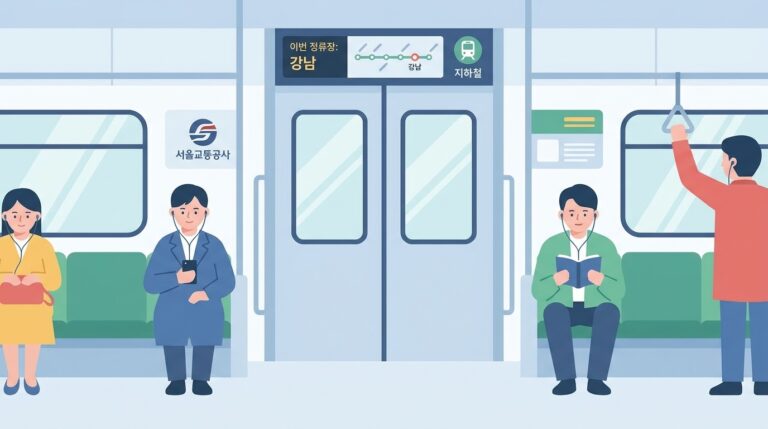
안녕하세요! I’m your Daily Hangul editor, your 10-year Korean culture navigator! Today, let’s talk about a situation almost every traveler or expat in Korea experiences at least once. Picture this: You are riding Seoul Subway Line 2 during evening rush hour. The train is packed shoulder-to-shoulder, yet it is amazingly quiet. You put on your wireless earbuds, turn up your favorite K-Pop playlist, and get lost in the groove. Suddenly, you notice an elderly gentleman next to you tapping his foot rhythmically—not to the music, but in slight annoyance. Or maybe the person beside you politely glances at your ears twice in five seconds. That moment of sudden anxiety hits: Is my music leaking out of my headphones?
In Korea’s highly connected public transportation network, maintaining a peaceful, quiet shared space is a core cultural value. Accidental sound bleeding (이어폰 소리 밖으로 안 새게 하기) is one of the most common micro-embarrassments foreign commuters face. But don’t worry! After reading this guide based on real learner experiences, you will know exactly how to check your volume politely, apologize smoothly, and master public transit etiquette like a seasoned local.
1. 이어폰 소리가 밖으로 새나요? (I-eopon so-ri-ga bak-geuro sae-na-yo?)
- Pronunciation: [ee-uh-pon so-ri-ga bak-geu-ro sae-na-yo?] (Think of ‘say-na-yo’ as asking if sound is ‘saying’ hello outside!)
- Meaning: “Is the sound leaking out of my earphones?” (Literal vs. Nuance: Literarily “Does earphone sound leak outside?”, used as a polite inquiry to confirm if your volume is disturbing others.)
- K-Culture Moment: You often see this polite inquiry in office K-Dramas when a colleague gently double-checks their headphone volume during silent desk work hours.
- Editor’s Insight: The verb 새다 (sae-da) means “to leak” (like water or sound). Using this word shows that you understand Korean public etiquette and care about community comfort.
- Situation Spectrum:
- Casual (Friends): 소리 새? (🚫)
- Semi-formal (Public/Strangers): 혹시 소리 새나요? (✅)
- Formal (Official): 이어폰 소리가 새는지 확인해주시겠습니까? (⚠️ Too formal)
- 🤔 Think About It: How does asking about minor inconveniences before someone complains reflect Korea’s collective mindfulness?
2. 볼륨 좀 줄여 주시겠어요? (Bol-ryum jom ju-ryeo ju-si-get-eo-yo?)
- Pronunciation: [bol-ryum jom joo-ryuh joo-si-get-uh-yo?]
- Meaning: “Could you please turn down the volume a bit?”
- K-Culture Moment: Heard on long-distance KTX trains when someone forgets to lower their phone volume while watching a broadcast.
- Editor’s Insight: Adding 좀 (jom – a little/please) softens the request tremendously. Without 좀, the phrase can sound slightly demanding.
- Situation Spectrum:
- Casual: 볼륨 줄여줘. (🚫 to strangers)
- Semi-formal: 볼륨 좀 줄여 주시겠어요? (✅)
- Formal: 음량을 낮춰 주시면 감사하겠습니다. (✅)
- 🤔 Think About It: Notice how Korean uses soft requests rather than direct orders to preserve harmony in shared spaces.
3. 소리 많이 새나요? 죄송합니다. (So-ri man-i sae-na-yo? Joe-song-ham-ni-da.)
- Pronunciation: [so-ri mahn-ee sae-na-yo? jo-song-ham-ni-dah.]
- Meaning: “Is it leaking a lot? I am so sorry.”
- K-Culture Moment: Used immediately when someone makes eye contact with your headphones and you realize your volume was too high.
- Editor’s Insight: Combining a soft question with 죄송합니다 (I am sorry) diffuses any potential tension in seconds.
- Situation Spectrum:
- Casual: 미안, 소리 컸지? (🚫 to strangers)
- Semi-formal: 소리 많이 새나요? 죄송합니다. (✅)
- Formal: 소음으로 불편을 드려 죄송합니다. (⚠️ Excessively official)
- 🤔 Think About It: Why is acknowledging inconvenience quickly considered a key social skill in Korean metropolitan life?
Situation 1: Asking if your volume is disturbing a neighbor
- 📖 교과서 한국어 (Textbook): 제 이어폰 소리가 큽니까? (Je i-eopon so-ri-ga keum-ni-ka? / Is my earphone sound big?)
- 🗣️ 진짜 한국어 (Real-Life): 혹시 제 이어폰 소리 들려요? (Hok-si je i-eopon so-ri deul-ryeo-yo? / Excuse me, can you hear my earphones?)
- 💡 왜 다를까? Textbook phrases sound stiff and clinical. Real native speakers use soft hedges like 혹시 (by any chance) to initiate polite conversation without sounding aggressive.
Situation 2: Asking someone nearby to lower their audio
- 📖 교과서 한국어 (Textbook): 소리를 줄이십시오. (So-ri-reul ju-ri-sip-si-o. / Decrease the sound.)
- 🗣️ 진짜 한국어 (Real-Life): 저기, 죄송하지만 볼륨 조금만 줄여주실 수 있나요? (Jeo-gi, joe-song-ha-ji-man bol-ryum jo-geum-man ju-ryeo-ju-sil su in-na-yo? / Excuse me, I’m sorry, but could you turn the volume down just a little?)
- 💡 왜 다를까? Direct imperatives like “줄이십시오” feel harsh in public. Native Koreans sandwich requests between polite cushions like 저기 (excuse me) and 죄송하지만 (sorry but).
4-1. Nunchi (눈치) & Non-verbal Gestures
In Korean public transport, explicit vocal confrontations are rare. Instead, people rely on Nunchi (눈치)—the art of reading subtle social cues. If someone glances at your ears, taps their own ear, or clears their throat softly (‘흠흠’), check your audio right away. When apologizing, pair your words with a slight 15-degree head tilt (bow) and immediately tap your phone’s volume button to show visible effort.
4-2. Cultural Code: Quiet Carriage Etiquette
Korean subways and buses are viewed as shared relaxation extensions of personal living space after long working hours. Playing music loudly or letting sound leak breaks this unwritten social contract. This is why automated announcements frequently remind passengers to set phones to silent mode (진동 모드) and use earphones responsibly.
Setting: A packed Line 9 Express train during peak morning hours.
Character: Min-jun (민준), a quiet office worker sitting next to you.
- Turn 1 (Min-jun): (🎭 Glances at your wireless earphones and hesitates, looking slightly uncomfortable) 저기… 혹시… (Jeo-gi… hok-si… / Excuse me… by any chance…)
- Turn 2 (You): 네? 무슨 일 있으세요? (Ne? Mu-seun il i-seu-se-yo? / Yes? Is something the matter?)
- Turn 3 (Min-jun): (🎭 Points gently toward your earphones) 이어폰 소리가 조금 새 나오는 것 같아서요. (I-eopon so-ri-ga jo-geum sae na-o-neun geot gat-a-seo-yo. / It seems like some sound is leaking from your earphones.)
- Turn 4 (You): 아, 진짜요? 소리가 많이 큰가요? (A, jin-jja-yo? So-ri-ga man-i keun-ga-yo? / Oh, really? Is the sound very loud?)
- Turn 5 (Min-jun): 엄청 큰 건 아닌데, 비트 소리가 조금 들려요. (Eom-cheong keun geon a-nin-de, bi-teu so-ri-ga jo-geum deul-ryeo-yo. / It’s not super loud, but I can hear the bass beat a bit.)
- Turn 6 (You): (🎭 Bows head slightly and presses volume down button instantly) 아, 몰랐어요! 정말 죄송합니다. 바로 줄일게요. (A, mol-ras-seo-yo! Jeong-mal joe-song-ham-ni-da. Ba-ro ju-ril-ge-yo. / Oh, I didn’t realize! I’m so sorry. I’ll turn it down right away.)
- Turn 7 (Min-jun): (🎭 Smiles warmly and nods) 아녜요, 감사합니다. (A-nye-yo, gam-sa-ham-ni-da. / No problem, thank you.)
- Turn 8 (You): 혹시 지금도 들리시나요? (Hok-si ji-geum-do deul-ri-si-na-yo? / Can you still hear it now?)
🔀 Interactive Choice Point
How would you respond if you aren’t sure if your sound is still leaking?
* Choice A:
Frequently Asked Questions (FAQ)
Q: What does "이어폰 소리가 밖으로 새나요? (I-eopon so-ri-ga bak-geuro sae-na-yo?)" mean in Korean and how do you pronounce it?
A: In Korean, "이어폰 소리가 밖으로 새나요? (I-eopon so-ri-ga bak-geuro sae-na-yo?)" is pronounced [ee-uh-pon so-ri-ga bak-geu-ro sae-na-yo?] and means: "Is the sound leaking out of my earphones?" (Literal vs. Nuance: Literarily "Does earphone sound leak outside?", used as a polite inquiry to confirm if your volume is disturbing others.)
Q: What does "볼륨 좀 줄여 주시겠어요? (Bol-ryum jom ju-ryeo ju-si-get-eo-yo?)" mean in Korean and how do you pronounce it?
A: In Korean, "볼륨 좀 줄여 주시겠어요? (Bol-ryum jom ju-ryeo ju-si-get-eo-yo?)" is pronounced [bol-ryum jom joo-ryuh joo-si-get-uh-yo?] and means: "Could you please turn down the volume a bit?"
Q: What does "소리 많이 새나요? 죄송합니다. (So-ri man-i sae-na-yo? Joe-song-ham-ni-da.)" mean in Korean and how do you pronounce it?
A: In Korean, "소리 많이 새나요? 죄송합니다. (So-ri man-i sae-na-yo? Joe-song-ham-ni-da.)" is pronounced [so-ri mahn-ee sae-na-yo? jo-song-ham-ni-dah.] and means: "Is it leaking a lot? I am so sorry."







