

Phase 1: 공감 (Storytelling Opening)
안녕하세요! 매일한글 에디터입니다.
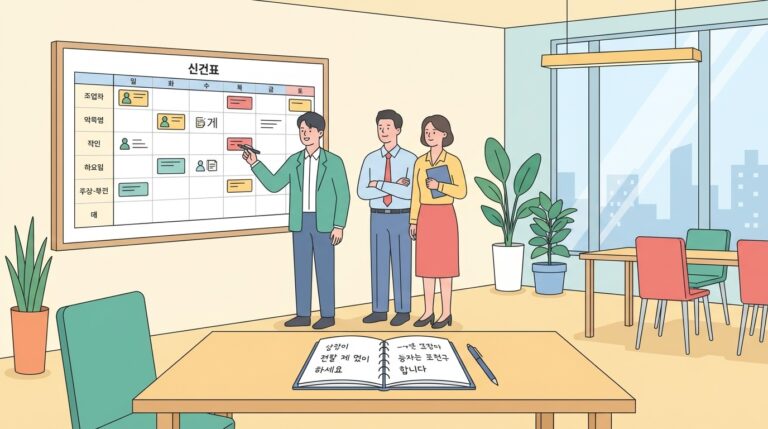
Imagine this scene from a popular corporate K-Drama: You are sitting in a sleek conference room in Yeouido, Seoul. The meeting slide displays a complex project roadmap. Suddenly, the project director looks around the table and asks, “이 프로젝트 담당자는 누구로 할까요? 그리고 향후 일정은 어떻게 되나요?” (Who will be the lead for this project, and what is the upcoming schedule?).
Your heart beats a little faster. You know the answers in your mind, but you hesitate. Should you say “제가 할게요”? Is that too casual? How do you professionally assign tasks to team members without sounding overly demanding or awkward?
Setting meeting agendas, setting upcoming timelines, and assigning task leads (담당자) are pivotal skills for intermediate (B2) Korean learners. Based on real feedback from international professionals working in Korean companies, mastering business task delegation transforms you from a nervous listener into an active, respected team player. Today, let’s unlock the exact native nuances you need to sound professional, polite, and confident in any Korean corporate setting!
Phase 2: 핵심 표현 3선 심층 분석
1. 제가 담당하겠습니다 (Jega damdang-hagesseumnida)
- Pronunciation: [Je-ga dam-dang-ha-get-seum-ni-da] (Sounds like: “jeh-gah dam-dahng ha-get-seum-nee-dah”)
- Meaning: Direct: “I will take charge of this.” / Nuance: Confident, respectful, and proactive ownership of a task in formal settings.
- K-Culture Moment: Seen frequently in K-dramas when a dedicated protagonist takes initiative on an ambitious team assignment.
- Editor’s Insight: While “제가 할게요” is common in casual setups, replacing “할게요” with “담당하겠습니다” (from 担当 – to take responsibility) elevates your speech register instantly to B2-level business Korean.
- Situation Spectrum: Casual 🚫 / Semi-formal ⚠️ / Formal ✅
- 🤔 Think About It: How does stepping up proactively influence trust and team dynamics in your own work culture compared to Korea?
2. 추후 일정을 공유해 드리겠습니다 (Chuhu iljeongeul gong-yuhae deurigesseumnida)
- Pronunciation: [Chu-hu il-jeong-eul gong-yu-hae deu-ri-get-seum-ni-da] (Sounds like: “choo-hoo eel-jung-eul gong-yoo-hae deu-ree-get-seum-nee-dah”)
- Meaning: Direct: “I will share the future schedule with you.” / Nuance: Professional commitment to update team members on timelines.
- K-Culture Moment: Used right before wrapping up a business presentation or sending post-meeting follow-up emails.
- Editor’s Insight: Using Sino-Korean vocabulary like “추후” (추후 – later/subsequently) instead of basic “나중에” makes your communication sound structured and highly competent.
- Situation Spectrum: Casual 🚫 / Semi-formal ⚠️ / Formal ✅
- 🤔 Think About It: Why do formal Korean business settings prefer Sino-Korean words over native informal words?
3. ~님께서 맡아 주시겠어요? (~nim-kkeseo mata jusigess-eoyo?)
- Pronunciation: [~nim-kke-seo ma-ta ju-si-get-eo-yo?] (Sounds like: “~neem-kkeh-seh-oh mah-tah joo-see-get-oh-yo?”)
- Meaning: Direct: “Could you take charge of this, [Name]?” / Nuance: Extremely polite, respectful task delegation among peers or subordinates.
- K-Culture Moment: A team leader assigning key roles during a collaborative brainstorming session in a modern tech startup.
- Editor’s Insight: Combining the title “~님”, honorific subject marker “께서”, and honorific verb “-시-” allows you to delegate authority without appearing bossy.
- Situation Spectrum: Casual 🚫 / Semi-formal ✅ / Formal ✅
- 🤔 Think About It: How do subtle honorific markers balance authority and teamwork in horizontal corporate environments?
Phase 3: 교과서 한국어 vs 진짜 한국어
Situation 1: Finalizing the next meeting schedule
- 📖 교과서 한국어: 다음 회의 일정을 정합시다. (Daeum hoeei iljeongeul jeonghapsida.)
- 🗣️ 진짜 한국어: 다음 일정은 추후 정리해서 공유드릴게요. (Daeum iljeongeun chuhu jeongrihaeseo gongyudeurilgeyo.)
- 💡 왜 다를까?: “~합시다” (Let’s do…) can sound overly imperative or outdated when speaking across corporate levels. Modern Korean professionals prefer humble action promises ending in “~공유드릴게요” (I will share with you).
Situation 2: Assigning a project lead
- 📖 교과서 한국어: 이 일을 당신이 하세요. (I ireul dangshini haseyo.)
- 🗣️ 진짜 한국어: 이 부분은 민우 님께서 담당해 주실 수 있으실까요? (I bubuneun Minwoo-nimkkeseo damdanghae jusil su isseusilkkal-yo?)
- 💡 왜 다를까?: Never use “당신” (you) in a Korean office! Native speakers address colleagues using Name + 님 and frame delegating tasks as soft request questions.
Phase 4: K-Culture 딥다이브 & 비언어적 매너
4-1. Nunchi (눈치) & Non-verbal Manners
- Eye Contact & Nods: Maintain calm, attentive eye contact when discussing schedules. Nod gently to confirm understanding when deadlines are set.
- Two-Handed Handouts: When passing physical meeting materials or business cards, always hold them with both hands or support your right wrist with your left hand.
- Postural Respect: Sit upright without leaning back too deeply during agenda discussions, showing active engagement.
4-2. Corporate Culture Code Analysis
In recent years, Korean companies (from conglomerates like Samsung and CJ to modern IT unicorns) have transitioned toward flatter, honorific-based communication systems. While job titles were once strictly hierarchical, using “~님” paired with refined honorific phrasing like “~해주실 수 있으실까요?” fosters psychological safety while ensuring clear accountability (담당자 designation).
Phase 5: 실전 롤플레이 시나리오
Setting: A brightly lit conference room at a Seoul media agency. You are meeting with Team Leader Park (박 팀장님) to finalize the Q3 marketing launch.
- 박 팀장님: 자, 다음 분기 신제품 런칭 안건으로 넘어가죠. 향후 일정은 어떻게 정하면 좋을까요?
(Ja, daeum bungi sinjepum leonching angeon-euro neomeogajo. Hyanghu iljeongeun eotteohge jeonghameyeon joh-eul-kkal-yo?)
🎭 [Attentive, looking at the screen] Well, let’s move on to the new product launch agenda for next quarter. How should we set the future timeline? -
You: 우선 다음 주까지 세부 계획안을 작성하고, 추후 일정을 다시 공유해 드리겠습니다.
(Useon daeum jukkaji sebu gyehoean-eul jakseonghago, chuhu iljeongeul dasi gong-yuhae deurigesseumnida.)
🎭 [Confidently, holding your tablet] First, I will draft the detailed plan by next week and share the schedule right after. -
박 팀장님: 좋습니다. 그럼 이번 안건의 메인 담당자는 누구로 지정할까요?
(Johseumnida. Geureom ibeon angeon-ui mein damdangjaneun nuguro jijeonghalkkayo?)
🎭 [Nodding approvingly] Great. Then who shall we designate as the main person in charge for this item? -
You: 제가 메인 담당자로 진행하겠습니다!
(Jega mein damdangjaro jinhaenghagesseumnida!)
🎭 [Smiling professionally, making clear eye contact] I will take charge as the main project lead! -
박 팀장님: 든든하네요! 그럼 소셜 미디어 디자인 작업은 누구한테 부탁할까요?
(Deundeunhaneyo! Geureom sosyeol mideio dijain jageobeun nuguhante 부탁halkkayo?)
🎭 [Pleased] Reliable as always! Who should we ask for the social media design work? -
You: 디자인 부분은 지민 님께서 맡아 주시겠어요?
(Dijain bubuneun Jimin-nimkkeseo mata jusigess-eoyo?)
🎭 [Turning politely toward colleague Jimin with a warm hand gesture] Could Jimin-nim take charge of the design section? -
지민: 네, 제가 시안 작성해서 다음 회의 전까지 공유드릴게요.
(Ne, jega sian jakseonghaeseo daeum hoeei jeoncaji gong-yudeurilgeyo.)
🎭 [Nodding happily] Yes, I’ll prepare the drafts and share them before the next meeting. -
박 팀장님: 완벽합니다. 오늘 회의록 정리해서 모두에게 피드백 보내주세요.
(Wanbyeokhamnida. Oneul hoeeirok jeongrihaeseo moduege pideubaek bonaejuseyo.)
🎭 [Closing notebook with satisfaction] Perfect. Please organize today’s meeting notes and send feedback to everyone.
🔀 Interactive Choice Point
How would you ask a senior colleague to take responsibility for preparing the financial budget report?
- Option A: “이거 예산안 계산 좀 해줄래?” (Igeo yesanan gyesan jom haejullae?)
- Option B: “예산안 작성은 수진 님께서 담당해 주실 수 있으실까요?” (Yesanan jakseongeun Sujin-nimkkeseo damdanghae jusil su isseusilkkal-yo?)
- Option C: “당신이 예산안을 만드세요.” (Dangshini yesanan-eul manduseyo.)
Feedback:
* Best Choice: Option B! Polished, honorific, and perfect for business setting.
* Bad Choice: Option A! Informal speech (반말) is inappropriate for workplace tasks.
* Risk Choice: Option C! Using “당신” is offensive in business environments.
Phase 6: 10초 감정 섀도잉 드릴
Practice reading these sentences aloud with natural pauses (/) and emotional tone!
[👔 자신감 넘치고 당당하게]
제가 / 이번 안건의 담당자로 / 진행하겠습니다.
(Jega / ibeon angeon-ui damdangjaro / jinhaenghagesseumnida.)-
[🤝 정중하고 세련되게]
세부 일정은 / 정리 후 / 추후 공유해 드리겠습니다.
(Sebu iljeongeun / jeongri hu / chuhu gong-yuhae deurigesseumnida.) -
[😊 배려 깊은 어조로]
이 부분은 / 수진 님께서 / 맡아 주시겠어요?
(I bubuneun / Sujin-nimkkeseo / mata jusigess-eoyo?)
Phase 7: K-Culture 미니 사전 (핵심 키워드 4개)
- 담당자 (Damdangja) | Person in charge / Task lead
- Usage: Essential word when assigning responsibilities in meetings or emails.
- 일정 (Iljeong) | Schedule / Timeline
- Usage: Used constantly in business (“일정 확인”) and casual meeting planning.
- 추후 (Chuhu) | Subsequently / Later on
- Usage: High-level Sino-Korean adverb that makes any commitment sound refined.
- 피드백 (Pideubaek) | Feedback
- Usage: Widely adopted corporate loanword used when requesting notes or review.
Phase 8: 여행자 & 현지 체류자를 위한 생존 키트
Survival Expressions TOP 3
- 일정 확인 부탁드립니다. (Iljeong hwag-in 부탁dureimnida.)
- Pro Tip: Use when asking a colleague or vendor to check timelines.
- 제가 바로 처리하겠습니다. (Jega baro cheorihagesseumnida.)
- Pro Tip: Great for promising quick resolution on a task.
- 관련 자료 공유해 주세요. (Gwanryeon jaryo gong-yuhae juseyo.)
- Pro Tip: Handy when requesting files or presentation slides post-meeting.
Editor’s Travel & Life Note
Navigating business meetings in Seoul often requires traveling across tech hubs like Gangnam, Pangyo, or Yeouido. Download the 네이버 지도 앱 다운로드 to easily check subway transfer schedules and ensure you arrive at your meeting venue 10 minutes early—a critical punctuality metric in Korean professional culture!
Phase 9: “한 발 더 깊이” (생각 질문)
In modern Korea, workplace culture is striking a balance between traditional hierarchy and modern agile collaboration. By using polite task delegation forms like “~님께서 맡아 주시겠어요?”, you respect personal boundaries while promoting team efficiency. Language in Korea is not just a tool for communication—it reflects mutual care and respect for everyone’s role.
💬 Your Turn: How are task assignments and agendas handled in your native country? Is communication direct or soft? Share your experience in the comments below!
Phase 10: FAQ & 오해 방지 (FAQ Schema)
Q: Is it okay to use ‘나중에’ instead of ‘추후’ in a meeting?
A: While ‘나중에’ is understood, ‘추후’ sounds far more professional at a B2 level during formal business agenda discussions.
Q: How do I assign a task to someone senior to me?
A: If delegating to a senior team member, frame it as a request for their expertise: “이 부분은 팀장님의 조언을 바탕으로 진행하겠습니다” (I will proceed based on team lead’s advice).
Q: Can I say ‘제가 할게요’ in business meetings?
A: You can use ‘제가 할게요’ with close peers in casual workplace chats, but ‘제가 담당하겠습니다’ is recommended for client or team meetings.
🚨 흔한 실수 (Common Mistakes) TOP 3
- Mistake: Addressing a colleague as “당신”.
- Correct Action: Use [Name] + 님 (e.g., 민우 님).
- Mistake: Saying “이거 해” (Do this) to assign work.
- Correct Action: Ask politely: “~맡아 주실 수 있으실까요?”.
- Mistake: Using casual speech (반말) when discussing deadlines.
- Correct Action: Stick to ~하겠습니다 / ~공유드릴게요 endings.
Phase 11: 액션 미션 & 참여 유도
- 🥉 Bronze Mission: Read the 3 core expressions aloud 3 times using the Shadowing Drill.
- 🥈 Silver Mission: Leave a comment below introducing yourself as the lead of a project using “제가 [Project Name] 담당자입니다”.
- 🥇 Gold Mission: Try using “추후 공유해 드리겠습니다” in your next real or simulated Korean business email or dialogue!
🎮 K-Culture Mission: Watch an episode of an office K-Drama like Misaeng or Agency and spot how many times characters say “담당자” or “일정”!
Phase 12: 인터랙티브 퀴즈 챌린지
1. Situation Quiz: You want to state that you will share the schedule later in a formal meeting. Which phrase is best?
* A) 나중에 알려줄게
* B) 추후 일정을 공유해 드리겠습니다
* C) 일정은 몰라요
🔍 정답 및 해설 보기
Correct Answer: B! ‘추후 일정을 공유해 드리겠습니다’ is formal, polite, and B2-level business appropriate.
2. Fill in the blank: “이 프로젝트는 지민 님께서 ____ 주시겠어요?” (Could you take charge of this project, Jimin-nim?)
* A) 먹어
* B) 맡아
* C) 가어
🔍 정답 및 해설 보기
Correct Answer: B! ‘맡아 주시겠어요?’ comes from ‘맡다’ (to take charge of/handle).
3. True or False: Calling your colleague “당신” during a meeting agenda discussion is polite in Korean office culture.
🔍 정답 및 해설 보기
Correct Answer: False! ‘당신’ should be avoided in office settings; use Name + 님 instead.







