

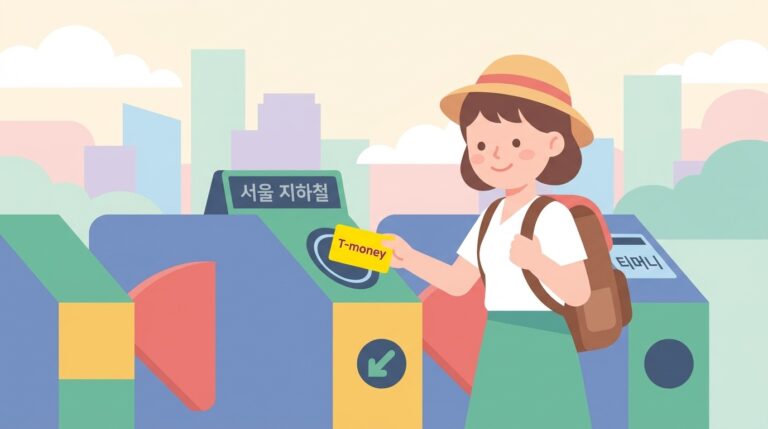
Don’t Panic at the Subway Gate! Tap Your Korean Transit Card Like a Local
Phase 1: Empathy (Story-driven Opening)
안녕하세요! I’m the Daily Hangul editor, your 10-year local culture navigator in Korea!
Picture this: You’ve just arrived in Seoul. The vibrant energy of the city is buzzing around you as you walk down into a bustling subway station during evening rush hour. Commuters move past you with incredible speed and rhythm. You step up to the turnstile gate, pull out your sleek T-money card, and touch it to the reader.
Suddenly… “삐빅!” (Bbi-bik!)
A loud beep rings out, the screen flashes red, and the turnstile barrier closes firmly! The crowd behind you slows down, and you feel a wave of panic. What did I do wrong? What does the screen say?
Don’t worry—every single foreign traveler in Korea faces this exact moment! Tapping your transit card smoothly is like the ultimate rite of passage when navigating Korea. Based on real feedback from hundreds of beginner Korean learners, this guide will turn that moment of panic into complete confidence. Today, you’ll learn essential A1 Korean phrases, master unspoken transit etiquette, and glide through Seoul subway gates just like a born-and-raised local!
Phase 2: Core Expressions
1. 카드를 대 주세요 (Kadeureul dae juseyo)
- Pronunciation: [Ka-deu-reul dae ju-se-yo] (Sounds like “Car-doo-reul day zoo-say-yo”)
- Meaning: “Please touch/place your card.” (Literal: Card + touch + please give)
- K-Culture Moment: You’ll hear this crisp automated voice audio in K-dramas, buses, and subway stations across Seoul whenever a card isn’t detected properly.
- Editor’s Insight: The verb “대다” (dae-da) means to touch or hold something close to a surface. You don’t need to press hard; simply hover or lightly place your card flat against the sensor pad!
- Situation Spectrum: Casual (⚠️) / Semi-formal (✅) / Formal (✅)
- 🤔 Think About It: Notice how even automated machines in Korea use polite honorific language (“~주세요”). What does this tell you about Korean public manners?
2. 찍고 들어갈게요 (Jjitgo deureogalgeyo)
- Pronunciation: [Jjit-go deu-reo-gal-ge-yo] (Sounds like “Jit-go doo-raw-gal-geh-yo”)
- Meaning: “I will tap (my card) and go in.”
- K-Culture Moment: Imagine walking through Gangnam station while talking on the phone with your Korean friend, letting them know you’re heading down to the platform.
- Editor’s Insight: While “찍다” (jjik-da) literally means to stamp or take a photo, native Koreans playfully use it for tapping transit or payment cards!
- Situation Spectrum: Casual (✅) / Semi-formal (✅) / Formal (⚠️)
- 🤔 Think About It: In English, we say “tap” or “swipe”. How does your native language express paying with a contactless card?
3. 잔액이 부족합니다 (Janaegi bujokhamnida)
- Pronunciation: [Jan-ae-gi bu-jok-ham-ni-da] (Sounds like “Jan-ae-gi boo-jok-hahm-nee-da”)
- Meaning: “The remaining balance is insufficient.”
- K-Culture Moment: The dreaded message that pops up on the turnstile screen when your card runs out of money!
- Editor’s Insight: When you spot “잔액” (jan-aek = balance), don’t stress! Simply step aside and look for the yellow card reload machine (“교통카드 충전기”).
- Situation Spectrum: Casual (🚫) / Semi-formal (⚠️) / Formal (✅)
- 🤔 Think About It: How does official written/announcement Korean (-합니다) differ from friendly spoken Korean in daily life?
Phase 3: Textbook Korean vs Real Korean
Situation 1: Asking where to place your card at the gate
- 📖 교과서 한국어: “교통카드를 어디에 접촉해야 합니까?” (Where should I contact the transit card?)
- 🗣️ 진짜 한국어: “카드 어디에 찍어요?” (Where do I tap the card?)
- 💡 왜 다를까?: “접촉하다” is formal academic vocabulary. Real native speakers almost exclusively use the casual verb “찍다” in everyday life.
Situation 2: Telling your friend you are entering the gates
- 📖 교과서 한국어: “지하철 승차장으로 진입하겠습니다.” (I will enter the subway platform.)
- 🗣️ 진짜 한국어: “나 카드 찍고 들어가!” (I’m tapping my card and going in!)
- 💡 왜 다를까?: In everyday conversation, Koreans prefer short, vibrant action verbs over official transit terms.
Phase 4: K-Culture Deep Dive & Non-verbal Etiquette
4-1. Nunchi (눈치) & Subway Gestures
In fast-paced Seoul, speed and flow at transit gates are key. Good Nunchi (cultural awareness) means having your card ready in hand before reaching the gate. If your card gets an error beep, step slightly to the side to let commuters behind you pass. A tiny nod or half-apologetic bow while saying “죄송합니다” (sorry) diffuses any awkward moment instantly!
4-2. Culture Code: The 30-Minute Transfer Magic
Korean public transportation is internationally famous for efficiency. Did you know that if you tap out of the subway and transfer to a city bus within 30 minutes, your transfer (“환승” – hwan-seung) is almost free? That iconic “삐빅!” sound isn’t just a beep—it’s the heartbeat of Seoul’s seamless urban mobility.
Phase 5: Interactive Roleplay Scenario
Setting: Turnstile gate at Gangnam Station. The gate flashes red with an error beep. A helpful station staff officer (NPC: Mr. Kim) approaches.
- NPC (Mr. Kim): “안녕하세요! 무슨 일 있으세요?” (Hello! Is there a problem?)
- 🎭 Friendly station attendant steps forward with hands folded politely.
- You: “저기요, 카드가 안 돼요.” (Excuse me, my card isn’t working.)
- 🎭 Pointing at the card reader with a helpless, polite expression.
- NPC: “아, 카드를 여기에 대 주세요.” (Ah, please place your card right here.)
- 🎭 Tapping the center sensor pad gently with his finger to show you the spot.
- You: “아, 여기요? 찍고 들어갈게요!” (Ah, here? I’ll tap and go in!)
- 🎭 Lightly holding the card flat against the sensor pad.
- (Gate sound: “삐빅!”)
- NPC: “네, 잘 되셨네요! 좋은 하루 보내세요!” (Great, it worked! Have a nice day!)
- 🎭 Smiling and giving a light bow as the barrier opens.
- You: “감사합니다!” (Thank you!)
- 🎭 Walking through the gate cheerfully with a slight bow.
🔀 Interactive Decision Point!
What should you do if the screen displays “잔액이 부족합니다” (Insufficient balance)?
- Option A: Slip right under the gate barrier quietly.
- Option B: Ask the officer: “충전 어디서 해요?” (Where do I reload?)
- Option C: Stand still at the gate until someone pushes past.
Feedback:
* Option A [Risk 🚫]: Alarm speakers will ring loudly! Never force your way through turnstiles in Korea.
* Option B [Best ✅]: Excellent! Asking for “충전” (recharge) gets you instant directions to the cash kiosk.
* Option C [Bad ⚠️]: Gate areas move quickly; stopping in the middle creates a bottleneck for commuters.
Phase 6: 10-Second Emotion Shadowing Drill
Practice these lines with rhythm and natural emotion! The / symbol indicates a brief breath pause.
[😊 Upbeat & Confident]카드를 / 대 주세요! (Ka-deu-reul / dae ju-se-yo!)[😮 Surprised & Curious]카드 / 어디에 / 찍어요? (Ka-deu / eo-di-e / jjik-eo-yo?)[😃 Relieved & Energetic]찍고 / 들어갈게요! (Jjit-go / deu-reo-gal-ge-yo!)
Phase 7: K-Culture Mini Dictionary
- 교통카드 (Gyo-tong-ka-deu) | Transit Card | T-money card or Korea-issued credit card used for paying fares.
- 찍다 (Jjik-da) | To Tap / Stamp | Colloquial verb for tapping a card or scanning a QR code.
- 환승 (Hwan-seung) | Transfer | Discounted fare system when switching between subways and buses.
- 충전 (Chung-jeon) | Recharge / Reload | Adding cash balance to your transit card at kiosks or convenience stores.
Phase 8: Traveler Survival Kit
TOP 3 Survival Expressions
- 카드가 안 돼요. (Ka-deu-ga an dwae-yo.) – My card isn’t working. Pro Tip: Point to your card and touch sensor together!
- 어디서 충전해요? (Eo-di-seo chung-jeon-hae-yo?) – Where do I reload? Pro Tip: Look for yellow card machine kiosks.
- 지하철 타요. (Ji-ha-cheol ta-yo.) – I take the subway. Pro Tip: Use this when discussing route plans with friends.
Editor’s Travel Note
Before starting your journey, be sure to complete your [Naver Map App Download] for precise real-time subway navigation and door-by-door exit numbers. Also, keep at least 10,000 KRW cash in your wallet—subway station reload kiosks only accept Korean paper banknotes!
Phase 9: One Step Deeper
Korea’s subway efficiency is a reflection of “Palli-Palli” (빨리빨리 – Hurry, Hurry) culture blended with deep public consideration. By tapping your card quickly and keeping to the right on escalators, you participate in a shared civic trust that keeps a mega-city of 10 million people moving effortlessly every day.
💬 Your Turn: Have you ever had a confusing or funny card-tapping moment while traveling abroad? Share your story in the comments below!
Phase 10: FAQ & Common Mistakes
Q: Can I use my international credit card directly at Seoul subway gates?
A: Generally, no. Standard foreign credit/debit cards without Korean transit chips won’t work at turnstiles. Always buy a T-money card or Climate Card at convenience stores or airport kiosks upon arrival!
Q: What should I do if the gate barrier closes and locks me inside or outside?
A: Step back from the sensor area, locate the side gate with the yellow “Help” (도움) button, and press it to talk directly to station staff.
Q: Do I need to tap my card when exiting the station?
A: Yes, absolutely! Tapping out (“하차”) is required to calculate distance fares. If you forget, you will be penalized maximum fare fees on your next tap.
🚨 Common Mistakes TOP 3
- Tapping a wallet with multiple payment cards: Reader gets confused! Correct Action: Pull out your single T-money card.
- Swiping the card too fast: Reader misses the signal. Correct Action: Hold the card flat on the pad for 1 full second.
- Panicking on error beeps: Correct Action: Calmly step aside, look at the error screen, or ask for help politely.
Phase 11: Action Mission & Gamification
- 🥉 Bronze Level: Practice saying “카드를 대 주세요” and “찍고 들어갈게요” out loud 3 times.
- 🥈 Silver Level: Share this guide with a friend who loves K-dramas or is planning a travel trip to Korea!
- 🥇 Gold Level: Tap your T-money card smoothly at a Seoul subway turnstile like a total local without pausing!
🎮 K-Culture Mission: Watch any Korean travel vlog or subway scene in a drama, and listen closely for the electronic gate beep (“삐빅!”) sound!
Phase 12: Interactive Quiz Challenge
Question 1: What does the slang verb “찍다” mean in public transit context?
Click to reveal Answer & Explanation
Answer: To tap or scan your card!
While it dictionary-translates to stamp or take a photo, native Koreans use it daily for tapping payment cards.
Question 2: Fill in the missing word: “카드를 _______ 해야 돼요.” (I need to reload my card.)
Click to reveal Answer & Explanation
Answer: 충전 (Chung-jeon)
Full sentence: “카드를 충전해야 돼요.” (I need to reload my card.)
Question 3: True or False? You don’t need to tap your transit card when leaving the station in Seoul.
Click to reveal Answer & Explanation
Answer: False!
You MUST tap out when exiting to receive distance discounts and avoid fare penalties.







