

Phase 1: Empathy (Story-Driven Opening)
안녕하세요! 매일한글 에디터입니다.
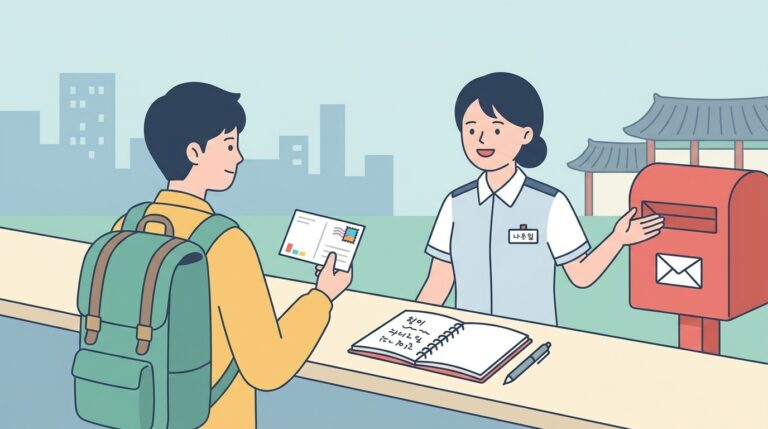
Imagine standing inside a cozy, bustling post office in Seoul after writing heartfelt postcards to your friends back home. You hold your colorful postcard in hand, but as you approach the counter, a wave of nervous panic hits: How do I ask for a postage stamp in Korean? Where exactly do I stick it? Do I need glue?
Don’t worry! Navigating a Korean post office (우체국 – Ucheguk) is remarkably easy, fast, and friendly once you know just a few simple phrases. Based on real feedback from hundreds of elementary Korean learners, this guide breaks down the exact expressions, etiquette, and secret post-office hacks you need to buy and attach stamps without hesitation. By the end of this guide, you’ll feel completely confident walking up to any Korean postal counter!
Phase 2: 3 Key Expressions Deep Dive
1. 우표 좀 주세요. (Upyo jom juseyo.)
- Pronunciation:
[U-pyo jom ju-se-yo](Sounds like: Ooh-pyo johm joo-say-yo) - Meaning: Direct: “Please give me stamps.” / Real Nuance: “I’d like to buy some stamps, please.”
- K-Culture Moment: In nostalgic K-dramas set in retro Seoul, characters often stop by neighborhood counters to buy stamps for handwritten love letters.
- Editor’s Insight: The tiny word ‘좀’ (jom) literally means “a little,” but here it acts as a magical softener that turns a direct command into a warm, natural request.
- Situation Spectrum: Casual ⚠️ / Semi-formal ✅ / Formal ✅
- 🤔 Think About It: How does adding a softening word like “please” or “a little” change the feeling of making a purchase in your culture?
2. 어디에 붙여야 해요? (Eodie buchyeoya haeyo?)
- Pronunciation:
[Eo-di-e bu-chyeo-ya hae-yo](Sounds like: Uh-dee-eh boo-chyuh-yah hay-yo) - Meaning: Direct: “Where must I attach it?” / Real Nuance: “Where should I stick the stamp?”
- K-Culture Moment: Travelers decorating custom souvenir postcards before dropping them off at local postal hubs.
- Editor’s Insight: This uses the essential A2 grammar pattern ‘-야 돼요/해요’ (must/should do). Master this pattern to ask about rules anywhere in Korea!
- Situation Spectrum: Casual ⚠️ / Semi-formal ✅ / Formal ✅
- 🤔 Think About It: Is stamp placement strictly enforced on mail in your home country?
3. 여기 붙이면 돼요? (Yeogi buchimyeon dwaeyo?)
- Pronunciation:
[Yeo-gi bu-chi-myeon dwae-yo](Sounds like: Yuh-gee boo-chee-myuhn dway-yo) - Meaning: Direct: “If I stick it here, is it okay?” / Real Nuance: “Is it okay to put it right here?”
- K-Culture Moment: Pointing to the top-right corner of an envelope to confirm placement with a smiling postal worker.
- Editor’s Insight: The pattern ‘-면 돼요?’ (Is it okay if…?) is your ultimate safety net phrase in Korean for double-checking actions.
- Situation Spectrum: Casual ⚠️ / Semi-formal ✅ / Formal ✅
- 🤔 Think About It: Why is double-checking with a gesture so effective when communicating in a foreign language?
Phase 3: Textbook Korean vs Real Korean
Situation 1: Buying stamps at the counter
- 📖 Textbook Korean: 우표를 구입하고 싶습니다. (Upyoreul guiphago sipseumnida.)
- 🗣️ Real Korean: 우표 좀 주세요! (Upyo jom juseyo!)
- 💡 Why is it different? While textbook Korean teaches stiff verbs like ‘구입하다’ (to purchase), native speakers prefer simple daily requests using ‘주세요’ (please give).
Situation 2: Asking where to place the stamp
- 📖 Textbook Korean: 이 우표를 어디에 부착해야 합니까? (I upyoreul eodie buchakhaeya hamnikka?)
- 🗣️ Real Korean: 여기 붙이면 돼요? (Yeogi buchimyeon dwaeyo?)
- 💡 Why is it different? ‘부착하다’ is official administrative jargon. Real locals stick to the friendly verb ‘붙이다’ (to stick/attach).
Phase 4: K-Culture Deep Dive & Non-verbal Manners
4-1. Nunchi & Gestures (눈치 센스)
When receiving stamps or handing over your money, always use two hands (or hold your right wrist with your left hand). This non-verbal gesture shows respect and fast-tracks positive rapport with the clerk!
4-2. The Iconic Red Mailbox & Free Stationer Desk
Inside every Korean post office, you’ll find a central communal desk stocked with free glue sticks (풀), tape, and pens. Unlike some countries where stamps are self-adhesive stickers, standard Korean postage stamps usually require a quick dab from these shared glue sticks!
Phase 5: Practical Roleplay Scenario
Setting: Dongdaemun Post Office counter. Postal worker Mr. Min smiles as you approach.
- Turn 1 (You): 안녕하세요! (Annyeonghaseyo! / Hello!)
- Turn 2 (Clerk): 안녕하세요. 무엇을 도와드릴까요? 🎭 [Smiles warmly] (Annyeonghaseyo. Mueoseul dowadeorilkayo? / Hello. How can I help you?)
- Turn 3 (You): 미국으로 편지 보낼 거예요. 우표 좀 주세요. (Migugeuro pyeonji bonael geoyeyo. Upyo jom juseyo. / I’m sending a letter to the US. Stamps, please.)
- Turn 4 (Clerk): 네, 국제 우표 1,000원입니다. 여기 있습니다. 🎭 [Hands stamp] (Ne, gukje upyo cheon-won-imnida. Yeogi isseumnida. / Sure, international stamp is 1,000 KRW. Here you go.)
- Turn 5 (You): 감사합니다. 그런데 우표는 어디에 붙여야 해요? (Gamsahamnida. Geurende upyoneun eodie buchyeoya haeyo? / Thank you. But where should I attach the stamp?)
- Turn 6 (Clerk): 오른쪽 위에 붙이시면 됩니다. 저기 풀도 있어요. 🎭 [Points to central desk] (Orenjjok wie buchisimyeon doemnida. Jeogi puldo isseoyo. / Put it on the top right. There’s glue over there too.)
- Turn 7 (You): 아, 오른쪽 위요? 여기 붙이면 돼요? 🎭 [Points to top right corner] (A, orenjjok wiyo? Yeogi buchimyeon dwaeyo? / Ah, top right? Is it okay if I stick it here?)
- Turn 8 (Clerk): 네, 맞아 요! 밖에 있는 빨간 우체통에 넣으세요. (Ne, majayo! Bakke inneun bbalgan uchetonge neoheuseyo. / Yes, that’s right! Put it in the red mailbox outside.)
🔀 Interactive Branching Choice
Scenario: You go to the desk, but you don’t see glue immediately.
* Option A: Ask politely: “저기요, 풀 어디 있어요?” (Best Choice ✅ – Direct, polite, natural!)
* Option B: Demand: “풀 주세요!” (Bad Choice ⚠️ – A bit too blunt without ‘jom’ or ‘저기요’)
* Option C: Lick the back of the stamp (Risk Choice 🚫 – Yikes! Korean stamps are not taste-flavored stickers; use the glue stick!)
Phase 6: 10-Second Emotion Shadowing Drill
[😊 Bright & Friendly]안-녕-하-세-요! / 우-표 좀 주-세-요![🤔 Curious]우-표-는 / 어-디-에 부-쳐-야 해-요?[확신에 찬 Confidence]여-기 / 부-치-면 돼-요?
Phase 7: K-Culture Mini Dictionary
- 우표 (Upyo) | Postage Stamp | Essential item for mailing postcards and physical letters.
- 우체통 (Uchetong) | Mailbox | The iconic bright red mailbox found near post offices and major streets.
- 풀 (Pul) | Glue / Glue Stick | Stationed on post office desks for attaching stamps.
- 편지 (Pyeonji) | Letter | Handwritten letter or postcard sent to friends or idols.
Phase 8: Survival Kit for Travelers
Survival TOP 3
- 우표 있어요? (Upyo isseoyo? / Do you have stamps?)
- 얼마예요? (Eolmayeoyo? / How much is it?)
- 국제 우편이에요. (Gukje upyeon-ieyo. / It’s international mail.)
Editor’s Travel Note
Need to find the nearest post office in Seoul? Open the 네이버 지도 앱 (Naver Map App) and search for 우체국. Post offices usually operate Monday through Friday from 09:00 to 18:00. You can pay with Korean T-Money, cash, or credit cards!
Phase 9: One Step Deeper (Reflection)
Korean post offices highlight the country’s unique high-trust community culture. The presence of public supply tables equipped with free tape, scissors, and glue sticks relies on a mutual unspoken promise that everyone keeps public items clean and organized.
💬 Your Turn: Have you ever sent a postcard while traveling abroad? What did your favorite souvenir stamp look like? Tell us in the comments below!
Phase 10: FAQ & Common Mistakes
Q: Do Korean stamps have sticky self-adhesive backs?
A: Some special commemorative stamps do, but standard regular postal stamps require glue stick application. Use the free glue provided on the post office writing desks!
Q: Can I buy postage stamps at local convenience stores?
A: A few convenience stores carry them, but stock is unpredictable. Visiting an official post office (우체국) is much faster and hassle-free.
Q: How fast is international postcard delivery from Seoul?
A: Standard international airmail usually takes about 7 to 14 business days to reach North America or Europe.
🚨 Common Mistakes TOP 3
- Licking the stamp: Always use the provided glue stick on the table.
- Placing stamp on the bottom left: Stamps belong strictly on the top-right corner (오른쪽 위).
- Handing items with one hand: Use two hands when paying or receiving your stamps!
Phase 11: Action Mission
- 🥉 Bronze: Say “우표 좀 주세요” out loud 3 times with a bright smile!
- 🥈 Silver: Search “우체국” on Naver Maps and pin one near your dream Seoul hotel.
- 🥇 Gold: Visit a Korean post office, buy a stamp, and mail a real postcard back home!
- 🎮 K-Culture Mission: Spot a red mailbox (우체통) in a K-drama and take a screenshot!
Phase 12: Interactive Quiz Challenge
- Placement Quiz: Where do you attach postage stamps on an envelope in Korea?
- A) Bottom Left
- B) Top Right
- Fill-in-the-Blank: “우표 ____ 주세요.” (Please give me stamps politely)
- True or False: Korean post offices provide glue sticks for free on writing desks. (T/F)
Click to reveal Quiz Answers!
- B) Top Right (오른쪽 위)
- 좀 (우표 좀 주세요)
- True! (Korean post offices provide shared glue and pens on central desks)







