

안녕하세요! I’m your Daily Hangul editor and your 10-year Korean culture navigator!
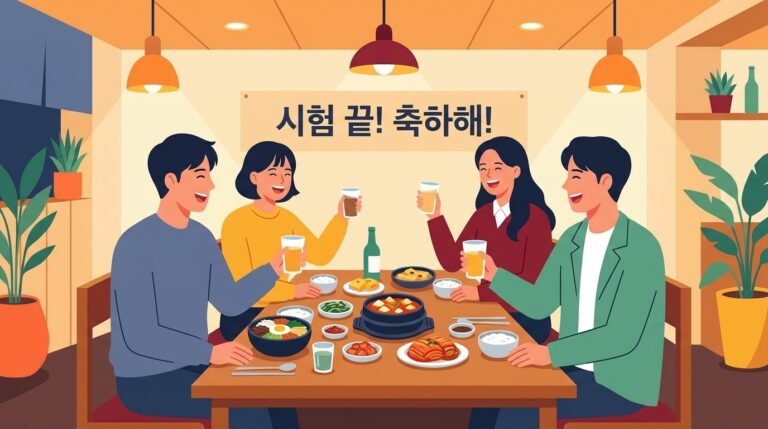
Imagine this: You’ve just submitted your final exam paper at a Korean university. Your brain feels fried, you’ve been surviving on instant coffee for three days, and all you want to do is collapse. But as you step out of the lecture hall, you see your classmates gathering in small huddles, laughing and whispering. They are planning a 뒤풀이 (dwitpuri)—the legendary post-exam after-party! You want to join or invite them out, but your mind goes blank. Should you say “같이 식사할까요?” (Shall we have a meal together?), or does that sound like an ancient textbook reading?
Don’t worry! Navigating university life in Korea is all about timing and warmth. Knowing how to invite friends to hang out right after an exam is a rite of passage. In this guide, built from real student experiences and native feedback, you will learn authentic B1-level Korean expressions that will instantly make you feel like part of the crew.
Phase 2: Core Expressions Deep Dive
1. 오늘 시험 끝났는데 뒤풀이 갈래?
- Pronunciation: [O-neul si-heom kkeut-nan-neun-de dwit-pu-ri gal-rae?]
(Pronunciation tip: ‘끝났는데’ sounds like kkeun-nan-neun-de—think of the quick, rhythmic transition of ‘nn’ in ‘funny’)- Meaning: Direct: “Today exam finished, so want to go to after-party?” | Real Niuance: “Exams are finally over today! Want to grab a drink/food together?”
- K-Culture Moment: Seen in almost every Korean campus drama (like Weightlifting Fairy Kim Bok-joo) where students drop their pens and immediately yell about heading to a pub or chicken place.
- Editor’s Insight: The word 뒤풀이 (dwitpuri) combines ‘뒤’ (after) and ‘풀이’ (unwinding/releasing). It’s not just a party; it’s a therapeutic ritual to release exam stress.
- Situation Spectrum: Casual ✅ | Semi-formal ⚠️ (오늘 시험 끝났는데 뒤풀이 가실래요?) | Formal 🚫
- 🤔 Think About It: In your country, do students have a specific word for an exam after-party, or do you just say “let’s get dinner”?
2. 한잔하면서 스트레스 풀자!
- Pronunciation: [Han-jan-ha-myeon-seo seu-teu-rae-seu pul-ja!]
(Pronunciation tip: ‘풀자’ sounds like pul-ja with a relaxed ‘l’ sound, like ‘pool’)- Meaning: Direct: “While taking a drink, let’s untie stress!” | Real Niuance: “Let’s grab a drink and wash away all this stress!”
- K-Culture Moment: The classic line spoken while holding up a glass of refreshing beverage right after the last bell rings.
- Editor’s Insight: Korean people use the verb 풀다 (pul-da), which means ‘to untie’ or ‘to solve’, when talking about stress (스트레스를 풀다). You are literally ‘untying’ the knot in your mind!
- Situation Spectrum: Casual ✅ | Semi-formal ⚠️ | Formal 🚫
- 🤔 Think About It: Why do you think Koreans use ‘untie’ (풀다) instead of ‘reduce’ or ‘stop’ for stress?
3. 오늘 밤은 밤새 노는 거야!
- Pronunciation: [O-neul ba-meun bam-sae no-neun geo-ya!]
(Pronunciation tip: ‘밤새’ [bam-sae] flows naturally like ‘balm-say’)- Meaning: Direct: “Tonight is playing all night long!” | Real Niuance: “Tonight, we’re pulling an all-nighter—just for fun!”
- K-Culture Moment: Spoken right after entering karaoke (Noraebang) or a lively Pochangmacha after midnight.
- Editor’s Insight: After pulling all-nighters to study (밤새 공부하다), students reclaim their freedom by pulling an all-nighter to celebrate (밤새 놀다).
- Situation Spectrum: Casual ✅ | Semi-formal 🚫 | Formal 🚫
- 🤔 Think About It: How does staying up all night for fun feel different after working hard together?
Phase 3: Textbook Korean vs Real Native Korean
Situation 1: Suggesting a post-exam hangout
- 📖 Textbook Korean: 오늘 시험이 끝났으니까 같이 식사하러 갈까요? (It is formal and sounds like a business lunch meeting.)
- 🗣️ Real Native Korean: 시험도 끝났는데 우리 뒤풀이 가야지! (Casual, enthusiastic, and implies ‘of course we should go!’)
- 💡 Why the difference? In Korean campus culture, using ending forms like ~야지 (-yaji) creates a strong sense of intimacy and shared understanding, making the invitation feel natural.
Situation 2: Toasting to relieve exam burden
- 📖 Textbook Korean: 술을 마시면서 스트레스를 해소합시다. (Very rigid and academic.)
- 🗣️ Real Native Korean: 짠~ 오늘 시험 진짜 매웠다! 스트레스 다 날려버리자! (Vibrant and conversational.)
- 💡 Why the difference? Natives use slang like 매웠다 (maewotda) to mean ‘the test was insanely hard/spicy’ and 날려버리다 (nallyeobeorida) for ‘blow away stress’.
Phase 4: K-Culture Deep Dive & Non-verbal Manners
4-1. Nunchi & Gestures
- The Relief Exhale (휴~ Sigh): Right after exiting the classroom, dramatically wiping imaginary sweat off your forehead while saying “아, 살았다!” (Ah, I survived!) signals to classmates that you’re ready to celebrate.
- The Clinking Courtesy: During 뒤풀이, when clinking glasses with seniors or slightly older classmates, lower your glass slightly below theirs as a subtle sign of respect while maintaining warm eye contact.
4-2. Culture Code: The Magic of ‘Dwitpuri’
In Korean universities, 뒤풀이 is not just an optional party; it’s where real friendships are forged. After struggling through tough assignments and exams together, sharing Samgyeopsal (pork belly) or Chimaek (chicken and beverage) helps break down formal barriers. It’s common to split the bill equally among peers (N분의 1 / N-bbang), while senior students (선배) often generously cover a part of it.
Phase 5: Real Roleplay Scenario
Setting: Outside classroom 302 right after the Korean History final exam. You spot your study partner, Minji, packing her bag.
- Minji: 아, 드디어 기말고사 끝났다! 머리가 터질 것 같아…
(Ah, finals are finally over! My head feels like exploding…) - You (🎭 Exhaling dramatically): 맞아요, 진짜 매운 시험이었어요! 민지 씨, 오늘 시험 끝났는데 뒤풀이 갈래?
(I know, right? That test was super hard! Minji, exams are over, wanna go to an after-party?) - Minji: 뒤풀이? 와, 완전 좋지! 어디로 갈까?
(After-party? Wow, I’d love to! Where should we go?) - You (🎭 Smiling brightly): 학교 앞 치킨집 어때요? 한잔하면서 스트레스 풀자!
(How about the chicken place in front of school? Let’s grab a drink and blow away the stress!) - Minji: 좋아요! 다른 친구들도 불러볼까? 수현이도 아직 학교에 있을 텐데.
(Sounds great! Should we call other friends too? Suhyun might still be on campus.) - You: 네, 좋아요! 다 같이 가면 더 재미있을 것 같아요.
(Yes, great! It’ll be even more fun if we all go together.) - Minji: 좋아, 그럼 수현이한테 메시지 보낼게. 오늘 밤은 밤새 노는 거야!
(Cool, I’ll message Suhyun. Tonight we’re partying all night!) - You (🎭 High-fiving): 좋아요, 출발해요!
(Awesome, let’s get going!)
🔀 Interactive Choice Point
Minji asks: “시험 어땠어?” (How was your exam?)
* Option A: “완전히 망했어요. 너무 어려웠어요.” (Best – Honest, relatable, opens the door to commiserating together)
* Option B: “저는 다 맞은 것 같아요! 너무 쉬웠는데요?” (Bad – Comes off boastful and ruins the group’s bonding vibe)
* Option C: “말시키지 마세요.” (Risk – Too cold and shuts down conversation)
Phase 6: 10-Second Emotion Shadowing Drill
Practicing with correct rhythm and pause points (/):
[😊 Relief & Excitement]오늘 / 시험 끝났는데 / 뒤풀이 갈래?[🔥 Passionate]한잔하면서 / 스트레스 / 다~ 날려버리자![🥳 High Energy]오늘 밤은 / 밤새 / 노는 거야!
Phase 7: K-Culture Mini Dictionary
- 뒤풀이 (Dwitpuri): An after-party held after an exam, event, or performance to unwind.
- 벼락치기 (Byeorakchigi): Cramming for an exam at the last minute (literally ‘lightning strike study’).
- 짠 (Jjan): The Korean word for “Cheers!” when clinking glasses.
- 총무 (Chongmu): The designated treasurer in a student group who collects money for group meals.
Phase 8: Traveler & Student Survival Kit
Top 3 Post-Exam Survival Expressions
- 오늘 시험 끝! (Exams are done today!)
- 여기 맛집으로 가자. (Let’s go to a famous delicious spot here.)
- N분의 1로 하자! (Let me split the bill equally!)
Editor’s Travel Note
When navigating university food alleys in Seoul (like Hongdae, Sinchon, or Anam), standard map apps might not show small popular spots. Download the Naver Map App for Korean Local Search to easily check store hours, reviews, and student discounts!
Phase 9: One Step Deeper
In many Western cultures, celebrating exam completion can be an individual choice. In Korea, however, shared struggle fosters 정 (Jeong)—a deep sense of connection. Gathering for 뒤풀이 allows students to transform anxiety and tiredness into shared happiness. Experiencing this camaraderie will give you a heartfelt glimpse into true Korean campus life.
💬 Your Turn: What’s your favorite way to de-stress after a big exam or project? Have you ever tried Korean chicken and beer? Share in the comments below!
Phase 10: FAQ & Common Mistakes
Q: Is ‘뒤풀이’ only used for university students?
A: No! It is used after company workshops, concert performances, sports matches, or any major team milestone.
Q: Can I use ‘밤새 노는 거야’ to a professor or older senior?
A: No! That expression is casual (반말). To an older senior, say: “오늘 고생 많으셨습니다. 뒤풀이 참석하시나요?”
Q: What should I say if I cannot attend the after-party?
A: Politely say: “오늘 너무 가고 싶은데, 다음 스케줄이 있어서 아쉽네요. 다음엔 꼭 갈게요!”
🚨 Common Mistakes
- Saying “스트레스를 죽이다” (Kill stress): Incorrect! Always use 스트레스를 풀다 (untie/release stress).
- Calling a casual hangout “연회” (Banquet): Too formal! Use 모임 or 뒤풀이.
- Using formal ~습니다 at a pub with classmates: It creates distance. Stick to polite ~요 or friendly 반말 if you are close.
Phase 11: Action Mission
- Bronze: Say “오늘 시험 끝났는데 뒤풀이 갈래?” aloud 3 times with excitement!
- Silver: Leave a comment below using the word 스트레스 풀다 in your own Korean sentence.
- Gold: Try inviting a classmate or language partner to grab food after your next study session!
🎮 K-Culture Mission: Watch a episode of a college K-drama (like Reply 1994) and spot the scene where characters cheer “짠!” at a pub.
Phase 12: Interactive Quiz Challenge
🔍 Question 1: What is the correct phrase to express ‘releasing stress’ in Korean?
Answer: 스트레스를 풀다!
* Explanation: ‘풀다’ means to untie or loosen, perfectly describing how Koreans view easing mental tension.
🔍 Question 2: Fill in the blank: “오늘 시험 끝났는데 ________ 갈래?” (after-party)
Answer: 뒤풀이
* Explanation: 뒤풀이 (Dwitpuri) is the essential term for post-event gatherings.
🔍 Question 3: True or False: You should clink your glass higher than your senior’s glass as a sign of respect.
Answer: False!
* Explanation: Lowering your glass slightly below the senior’s glass shows politeness and modesty in Korean etiquette.







