

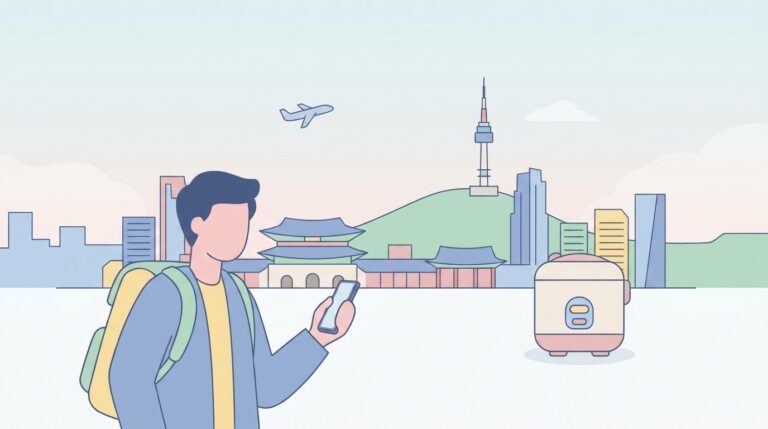
안녕하세요! 매일한글 에디터입니다. (Annyeonghaseyo! Maeilhangeul editeoimnida. — Hello! I’m your Daily Hangul editor.) Have you ever stood at a bright Seoul electronics store, ready to buy a sleek new fridge before a big trip, only to freeze when the cashier whispers card limit trouble? It feels just like a tense K-drama plot twist! Last month, a student told me she tapped her Korean card app for a temporary limit increase, got confused by installment fees, and almost canceled her flight. You are not alone. Based on real expat feedback, this guide gives you exact intermediate Korean phrases to raise your limit, check eligibility, and ask about fees like a local pro.
Phase 2: Deep Dive into 3 Core Expressions
1. 일시 한도 상향 좀 신청하려고요 (Ilsi hando sanghyang jom sincheongharyeogoyo)
- Pronunciation: [il-si han-do sang-hyang jom sin-cheong-ha-ryeo-go-yo] (Sounds like: “eel-shee hahn-doe sahng-hyahng johm sheen-chung-ha-ryuh-go-yo” — notice how the “h” in haryeogoyo softens smoothly, almost like “sin-chung-a-ryuh-go-yo”.)
- Meaning: Literal: “I am intending to apply for a temporary limit elevation a little.” / Real Nuance: “I’d like to request a temporary credit limit increase, please.”
- K-Culture Moment: Picture an episode of a realistic Korean office drama like Misaeng or My Liberation Notes, where a character sits in a quiet café on their lunch break, calling the card company’s customer service before buying their parents a new air conditioner.
- Editor’s Insight: At an intermediate level, adding 좀 (jom) (a little) and ending with -(으)려고요 (-(eu)ryeogoyo) (I intend to…) is pure magic. Without them, 신청해요 (sincheonghaeyo) sounds abrupt. Using -(으)려고요 signals your purpose politely and invites the counselor to guide you to the next step. A helpful synonym for 일시 (ilsi) (temporary) is 임시 (imsi), while 상향 (sanghyang) (upward adjustment) is the opposite of 하향 (hahyang) (downward adjustment).
- Situation Spectrum: Casual 🚫 (Way too formal for friends) | Semi-formal ✅ (Perfect with store clerks or bank tellers) | Formal ✅ (Great on customer service calls, or swap -요 for -합니다)
- 🤔 Think About It: In English, we often say “I need to raise my limit,” focusing directly on what we want. Why do Koreans soften financial requests with 좀 (a little) and -(으)려고요 (I’m planning to)? It reflects a culture that avoids putting pressure on the listener, treating service interactions as cooperative rather than transactional.
2. 무이자 할부가 몇 개월까지 돼요? (Muija halbuga myeot gaewolkkaji dwaeyo?)
- Pronunciation: [mu-i-ja hal-bu-ga myeot gae-wol-kka-ji dwae-yo] (Sounds like: “moo-ee-jah hahl-boo-gah myuht geh-wohl-kkah-jee dweh-yo” — make sure to bounce on the double “kk” in kkaji, similar to the crisp “k” in “sky”.)
- Meaning: Literal: “Interest-free installment is possible up to how many months?” / Real Nuance: “How many months of zero-interest installments can I get on this?”
- K-Culture Moment: Think of Korean variety shows like I Live Alone (나 혼자 산다) when a cast member visits a massive Samsung or LG flagship store to upgrade their TV or kimchi fridge—checking 무이자 할부 (muija halbu) is practically a national ritual!
- Editor’s Insight: Notice the word 무이자 (mu-ija), where 무 (無) means “none” and 이자 means “interest.” If it is not interest-free, it’s called 유이자 할부 (yuija halbu), which comes with 할부 수수료 (halbu susuryo – installment fee). Also, 되다 (doeda) here means “to be available/applicable,” which sounds much more natural than asking 가능해요? (ganeunghaeyo?) in everyday shopping.
- Situation Spectrum: Casual ⚠️ (Fine with a close friend working at a shop) | Semi-formal ✅ (Standard polite shopping Korean) | Formal ✅ (Add -되나요? (doenayo?) for extra politeness at a bank)
- 🤔 Think About It: In many Western countries, paying in installments on a credit card automatically implies high APR interest or using separate Buy-Now-Pay-Later apps. In Korea, 무이자 할부 is deeply built into everyday card infrastructure. How does your home culture view splitting big purchases into monthly chunks?
3. 해외 결제 차단이 풀려 있는지 확인하고 싶어요 (Haeoe gyeolje chadani pullyeo inneunji hwaginhago sipeoyo)
- Pronunciation: [hae-oe gyeol-je cha-da-ni pul-lyeo in-neun-ji hwa-gin-ha-go si-peo-yo] (Sounds like: “heh-weh gyuhl-jeh chah-dah-nee pool-lyuh een-neun-jee hwah-geen-hah-go shee-puh-yo” — the “nn” in inneunji flows smoothly like “in-neun-jee”.)
- Meaning: Literal: “I want to check whether the overseas payment block is untied.” / Real Nuance: “I’d like to make sure overseas transactions are enabled on my card.”
- K-Culture Moment: Imagine a chaotic airport scene in a travel reality show like Earth Arcade or Youn’s Stay—the cast is rushing through duty-free or tapping their card abroad, panicking that their security lock wasn’t lifted in the app!
- Editor’s Insight: The verb 풀리다 (pullida) literally means “to be untied/released” (like untying a knot or clearing a misunderstanding). Pairing -아/어 있는지 (-a/eo inneunji) shows a resulting state—whether the block is currently lifted. If you want to sound even smoother at level 3, you can also ask about 해외 원화 결제 차단 (haeoe wonhwa gyeolje chadan), which blocks Dynamic Currency Conversion (DCC) fees abroad!
- Situation Spectrum: Casual 🚫 (Unnatural for casual chat) | Semi-formal ✅ (Ideal for card app live chat or phone support) | Formal ✅ (Very clear and articulate)
- 🤔 Think About It: Notice how Korean uses physical imagery—”tying” (묶다) or “blocking” (차단하다) and “untying” (풀다)—for digital card security. What metaphors does your native language use for turning bank features on and off?
Phase 3: Textbook Korean vs. Real Korean
Situation 1: Checking Credit Card Eligibility & Income Requirements
- 📖 Textbook Korean: 신용카드를 발급받기 위한 자격 조건을 알려 주십시오. (Sinyongkadeureul balgeupbatgi wihan jagyeok jogeoneul allyeo jusipsio. — Please inform me of the qualification conditions to receive a credit card.)
- 🗣️ Real Korean: 저 외국인인데, 신용카드 만들려면 조건이 어떻게 돼요? (Jeo oegugininde, sinyongkadeu mandeullyeomyeon jogeoni eotteoke dwaeyo? — I’m a foreigner, so what are the requirements if I want to get a credit card?)
- 💡 Why the difference? Textbook Korean uses heavy Sino-Korean words like 발급받다 (balgeupbatda – be issued) and stiff -십시오 endings. In real life, even educated professionals say 만들다 (mandeulda – to make) for getting a card and 어떻게 돼요? (eotteoke dwaeyo?) to gently ask “how does it work?” Starting with 저 외국인인데… (Since I’m a foreigner…) gives the banker immediate context.
Situation 2: Finding Out Your Card Was Declined Due to Limit
- 📖 Textbook Korean: 죄송하지만 카드 한도가 초과되어 결제가 불가능합니다. (Joesonghajiman kadeu handoga chogwadoeeo gyeoljega bulganeunghamnida. — I apologize, but the card limit is exceeded so payment is impossible.)
- 🗣️ Real Korean: 어, 한도 초과 떴네요! 앱에서 일시 상향 먼저 해야겠어요. (Eo, hando chogwa tteonneyo! Aebeseo ilsi sanghyang meonjeo haeyagesseoyo. — Oh, “limit exceeded” popped up! I’ll need to do a temporary increase in the app first.)
- 💡 Why the difference? When a message appears on a Korean POS terminal or smartphone screen, Koreans almost always use the verb 뜨다 (tteuda – to pop up/appear)! Saying 한도 초과 떴다 is super natural, everyday Korean.
Phase 4: K-Culture Deep Dive & Non-Verbal Manners
4-1. Nunchi (눈치) & Gestures
When you’re standing at an electronics mega-store like Lotte Hi-Mart or Samsung Store trying to finalize a big purchase while troubleshooting your card app, 눈치 (nunchi – social awareness) goes a long way:
* The “Hold On” Signal: If your app takes 30 seconds to approve a temporary limit increase (일시 한도 상향), don’t just stare silently at your phone. Make brief eye contact, give a slight apologetic nod, and say 잠시만요, 앱에서 확인 좀 할게요 (Jamsimanyo, aebeseo hwagin jom halgeyo — Just a moment, I’ll check in the app).
* Two-Handed Card Etiquette: Even with modern tap-to-pay, when handing your physical credit card or ID (신분증 / 외국인등록증) to a store clerk or bank teller, hold it with both hands (or support your right wrist with your left hand). It instantly earns warmth and patience!
4-2. Cultural Code: Korea’s “Appliance + Installment + Card Perk” Trifecta
In Korean culture, buying major appliances (대형 가전제품) isn’t just shopping—it’s a major life milestone, especially for newlyweds (혼수 – honsu) or people moving into a new apartment (이사). Because flagship appliances can cost millions of won, Korean card companies compete fiercely with electronics stores by offering 제휴 카드 할인 (affiliate card discounts) and up to 12 or 24 months of 무이자 할부 (interest-free installments).
At the same time, Koreans are masters of 실적 채우기 (siljeok chaeugi)—meeting the minimum monthly spending requirement to unlock airport lounge passes or overseas cashback before a big trip! Understanding why locals obsess over 전월 실적 (last month’s spending) and 일시 상향 (temporary limit hikes) will make you feel like a true insider.
Phase 5: Real-Life Roleplay Scenario
Setting: Inside a gleaming electronics store in Gangnam, cool air conditioning humming, rows of silver refrigerators shining under bright lights. You are at the counter ready to buy a new washer-dryer combo before your flight to Europe next week. Your card limit was too low, so you just tapped “Temporary Limit Increase” in your card app and are calling the card company’s counselor, Kim Min-ji, on speaker/earbuds to confirm your installment fees and overseas lock.
- Min-ji: 안녕하세요, 행복카드 상담원 김민지입니다. 무엇을 도와드릴까요? (Annyeonghaseyo, Haengbokkadeu sangdamwon Kim Min-jiimnida. Mueoseul dowadeurilkkayo? — Hello, this is Kim Min-ji from Happy Card. How may I help you?) 🎭 Speaks in a bright, fast, crisp customer-service voice.
- You: 안녕하세요. 제가 다음 주에 해외여행도 가고 오늘 가전제품도 살 게 있어서요. 방금 앱에서 일시 한도 상향 좀 신청하려고요. (Annyeonghaseyo. Jega daeum jue haeoeyeohaengdo gago oneul gajeonjepumdo sal ge isseoseoyo. Banggeum aebeseo ilsi hando sanghyang jom sincheongharyeogoyo. — Hello. I’m going on an overseas trip next week and have appliances to buy today. I just tried to apply for a temporary limit increase in the app.) 🎭 Steps slightly away from the counter for privacy, holding the phone close.
- Min-ji: 네, 고객님! 본인 확인 먼저 도와드릴게요. 성함과 생년월일 말씀해 주시겠어요? (Ne, gogaengnim! Bonin hwagin meonjeo dowadeurilgeyo. Seonghamgwa saengnyeonworil malsseumhae jusigesseoyo? — Yes, customer! I’ll help you verify your identity first. Could you tell me your full name and date of birth?) 🎭 Types briskly on her keyboard in the background.
- You: 이름은 알렉스이고, 생년월일은 1995년 5월 10일이에요. 승인이 바로 되나요? (Ireumeun Allekseuigo, saengnyeonworireun cheongubaekgusibonyeon owol sibilieyo. Seungini baro doenayo? — My name is Alex, and my birth date is May 10, 1995. Does it get approved right away?) 🎭 Glances anxiously toward the cashier waiting with the receipt.
- Min-ji: 확인 감사합니다. 신용 조건을 보니까 한도 상향은 바로 승인되셨어요! 혹시 할부로 결제하실 예정이신가요? (Hwagin gamsahamnida. Sinyong jogeoneul bonikka hando sanghyangeun baro seungindoesyeosseoyo! Hoksi halburo gyeoljehasil yejeongisingayo? — Thank you for verifying. Looking at your credit eligibility, the limit increase was approved right away! By any chance, are you planning to pay in installments?) 🎭 Her tone warms up, relieved to deliver good news.
- You: 네, 6개월 무이자 할부가 되는지, 아니면 할부 수수료가 나오는지 궁금해요. (Ne, yukgaewol muija halbuga doeneunji, animyeon halbu susuryoga naoneunji gunggeumhaeyo. — Yes, I’m wondering if 6-month interest-free installments are available, or if installment fees apply.) 🎭 Checks the store’s promotional sign on the counter while listening.
- Min-ji: 아, 가전제품 매장은 6개월까지 무이자 할부 가능하세요. 다만 해외 결제는 일시불만 되니까 참고해 주세요! (A, gajeonjepum maejaengeun yukgaewolkkaji muija halbu ganeunghaseyo. Daman haeoe gyeoljeoneun ilsibulman doenikka chamgohae juseyo! — Oh, appliance stores qualify for up to 6 months of interest-free installments. However, please note that overseas payments only allow lump-sum payments!) 🎭 Pauses slightly to emphasize the rule about overseas transactions.
- You: 아, 그렇군요! 그럼 마지막으로 해외 결제 차단이 풀려 있는지도 확인해 주실 수 있어요? (A, geureokgunyo! Geureom majimageuro haeoe gyeolje chadani pullyeo inneunjido hwaginhae jusil su isseoyo? — Oh, I see! Then lastly, could you also check if the overseas payment block is lifted?) 🎭 Smiles in relief and waves to the cashier that you’re almost ready.
🔀 Interactive Branching Point
The counselor confirms your overseas lock is lifted, and now you turn to the store cashier to pay. The cashier asks: 일시불로 해드릴까요, 할부로 해드릴까요? (Ilsibullo haedeurilkkayo, halburo haedeurilkkayo? — Shall I run it as lump-sum or installment?) How do you reply?
- Option A: 6개월 할부로 해 주세요. 무이자 맞죠? (Yukgaewol halburo hae juseyo. Muija matjyo? — Please do 6-month installments. It’s interest-free, right?)
- Feedback (Best! ✅): Natural, confident, and smart! Using -로 해 주세요 (please do it as…) with a quick confirmation 무이자 맞죠? ensures no surprise fees appear on your statement.
- Option B: 할부 수수료 안 내고 싶으니까 그냥 6개월 주세요. (Halbu susuryo an naego sipeunikka geunyang yukgaewol juseyo. — Since I don’t want to pay installment fees, just give me 6 months.)
- Feedback (Risk! ⚠️): Grammatically understandable, but 6개월 주세요 sounds like you’re ordering 6 months of an item rather than choosing a payment plan, and -고 싶으니까 can sound a bit blunt to a cashier.
- Option C: 일시 한도 상향 안 해 주세요! (Ilsi hando sanghyang an hae juseyo! — Please don’t do a temporary limit increase!)
- Feedback (Bad! ❌): Oops! You worked so hard to raise your limit, and now you’re telling the cashier not to—plus cashiers don’t control card limits anyway!
Phase 6: 10-Second Emotion Shadowing Drill
Read these aloud at natural speed, pausing briefly at every /. Channel the emotion in brackets!
- [😊 Bright and relieved]
일시 한도 상향 / 바로 승인됐어요? / 정말 다행이네요!
(Ilsi hando sanghyang / baro seungindwaesseoyo? / Jeongmal dahaengineyo! — The temporary limit increase / was approved right away? / What a relief!) -
[🤔 Curious and careful]
무이자 할부가 / 몇 개월까지 돼요? / 수수료는 없죠?
(Muija halbuga / myeot gaewolkkaji dwaeyo? / Susuryoneun eopjyo? — Interest-free installments / up to how many months? / There’s no fee, right?) -
[😅 Slightly flustered but polite]
잠시만요, / 해외 결제 차단이 / 풀려 있는지 확인 좀 할게요.
(Jamsimanyo, / haeoe gyeolje chadani / pullyeo inneunji hwagin jom halgeyo. — Just a moment, / let me check whether / the overseas payment block is lifted.)
Phase 7: K-Culture Mini Dictionary
- 한도 (Hando) | Credit Limit | Used for both credit cards (카드 한도) and daily transfer caps (이체 한도). Expect to see 한도 초과 (limit exceeded) or 한도 증액 (limit increase) in banking apps.
- 할부 vs. 일시불 (Halbu vs. Ilsibul) | Installment vs. Lump-Sum | Every Korean cashier asks this! 일시불 (ilsibul) means paying the full amount at once; 할부 (halbu) splits it across months (e.g., 3개월 할부).
- 전월 실적 (Jeonwol siljeok) | Previous Month’s Spending Requirement | The total you spent last month to unlock card discounts this month. Many apps show a progress bar for 실적 충족 (requirement met).
- 연회비 (Yeonhoebi) | Annual Fee | Charged once a year by the card issuer. When checking card eligibility (발급 조건), Koreans always compare whether the perks outweigh the 연회비.
Phase 8: Survival Kit for Travelers & Residents
Top 3 Survival Phrases
- 외국인도 카드 발급 돼요? (Oegugindo kadeu balgeup dwaeyo? — Can foreigners get a card issued too?)
- Pro Tip: Most Korean banks ask for an ARC (외국인등록증), proof of income (소득 증빙), or a fixed deposit collateral.
- 할부 수수료가 얼마예요? (Halbu susuryoga eolmayeyo? — How much is the installment fee?)
- Pro Tip: Interest rates vary by month count (e.g., 4–5 months might have a fee while 2–3 months are 무이자).
- 원화 결제 차단해 주세요. (Wonhwa gyeolje chadanhae juseyo. — Please block KRW payments abroad.)
- Pro Tip: Blocking overseas KRW billing saves you 3–8% in sneaky conversion markups!
Editor’s Travel Note
Before heading to the airport or a big electronics store, make sure you install your card company’s official Korean app (like Hyundai Card, Shinhan SOL Pay, or KB Pay) and activate 해외 원화 결제 차단 inside the security menu. If you prefer visiting a branch in person to check card eligibility, check the Naver Map App for nearby bank branches so you don’t arrive after the 4:00 PM closing bell! Also keep your passport and 외국인등록증 (Alien Registration Card) handy whenever requesting permanent limit hikes.
Phase 9: “One Step Deeper” — Thought Question
In Korean society, credit (신용 – sinyong) is much more than a numerical score; it is deeply tied to social trust and stability. That is why foreigners often feel surprised when banks ask for strict eligibility proof (발급 조건) before issuing a card, yet reward established cardholders with generous perks like 무이자 할부 and instant in-app 일시 한도 상향. Even in high-stakes money conversations, Koreans soften requests with indirect grammar like -(으)려고요 and -아/어 주실 수 있어요? to preserve harmony. Understanding both the strict paperwork and the gentle language helps you navigate Korean finance with confidence.
💬 Your Turn: Have you ever had a funny or stressful moment trying to use a Korean banking app or paying in installments? Share your story in the comments below!
Phase 10: FAQ & Myth-Busting
Q: Can I get a temporary credit limit increase directly in a Korean card app without calling? A: Yes, in most cases! Search for 일시 한도 상향 (temporary limit increase) or 특별 한도 (special limit) in your card app. If your credit eligibility meets the criteria, approval happens in seconds, though foreign residents without automated income verification on file may occasionally need a quick phone call.
Q: Can I use installment payments (할부) when traveling overseas with my Korean credit card? A: Usually, overseas transactions default to 일시불 (lump-sum) at the checkout terminal. However, many Korean card apps offer a post-purchase feature called 해외 이용 할부 전환 (converting overseas lump-sum to installments) after the charge posts—just note that this usually carries an installment fee (할부 수수료).
Q: What documents do foreigners typically need to check credit card eligibility in Korea? A: Generally, banks check your 외국인등록증 (ARC), remaining visa validity (usually at least 6 months to 1 year), and proof of steady income (재직증명서 / 소득금액증명원) or a qualifying bank balance.
🚨 Common Mistakes Warning Board
- Mistake: Saying “일시불” when you actually want a temporary limit increase (일시 상향).
- Correct Action: Remember 일시불 (ilsibul) = lump-sum payment; 일시 한도 상향 (ilsi hando sanghyang) = temporary limit increase!
- Mistake: Assuming all installments are interest-free (무이자).
- Correct Action: Always ask 몇 개월까지 무이자예요? (Up to how many months is interest-free?) before tapping your card, because 4+ months can sometimes add 할부 수수료.
- Mistake: Forgetting to lift the overseas payment block (해외 결제 차단) before boarding your flight.
- Correct Action: Check your app’s 해외 이용 관리 (Overseas Usage Settings) 2–3 days before departure.
Phase 11: Action Mission & Engagement
- 🥉 Bronze Mission (Solo Practice): Open your voice recorder and practice the 3 Core Expressions from Phase 2 until you can say 해외 결제 차단이 풀려 있는지 확인하고 싶어요 smoothly in one breath!
- 🥈 Silver Mission (Share & Connect): Screenshot your favorite phrase from the Mini Dictionary and share it on Instagram or with a study buddy, explaining the difference between 일시불 and 할부.
- 🥇 Gold Mission (Real-World Use): Next time you buy something over 50,000 KRW in Korea—or open your Korean card app—locate the 한도 관리 (Limit Management) menu and practice reading the terms aloud in Korean.
🎮 K-Culture Mission: Watch a Korean moving-day or shopping vlog on YouTube (search 가전제품 구매 브이로그). Spot at least two times the creator mentions 무이자 할부, 일시불, or 카드 혜택!
Phase 12: Interactive Quiz Challenge
1. Situational Judgment: You are at a Korean department store buying a new laptop and want to split the payment across 3 months without paying extra fees. What is the smartest question to ask the clerk?
A) 3개월 일시불 돼요?
B) 3개월 무이자 할부 돼요?
C) 3개월 한도 초과 돼요?
Click to reveal Answer & Explanation
Correct Answer: B) 3개월 무이자 할부 돼요?
Explanation: 무이자 할부 means interest-free installments. Option A contradicts itself (일시불 means lump-sum, so 3 months doesn’t apply), and Option C asks if “3-month limit exceeded” is possible!
2. Fill in the Blank: Complete the polite sentence to request a temporary limit increase:
“해외여행을 앞두고 일시 한도 ______ 좀 신청하려고요.” (sanghyang = upward increase)
Click to reveal Answer & Explanation
Correct Answer: 상향 (sanghyang)
Explanation: 상향 means raising/increasing (a limit), whereas 하향 (hahyang) means lowering it.
3. True or False (Culture Quiz): In Korea, if you ask for a 10-month installment plan (10개월 할부), it is guaranteed by law to have zero installment fees (무이자).
Click to reveal Answer & Explanation
Correct Answer: False!
Explanation: Only specific promotional periods or month counts (commonly 2–3 months, or up to 6–12 months during special appliance events) are 무이자. Otherwise, 유이자 할부 applies and you will pay 할부 수수료 (installment fees).
🎬 Watch Our Daily Videos! (Daily Hangul Official Instagram)
Review the expressions you learned in this article with our fun daily short videos! Check out native pronunciation and real-life nuances in action.
- Instagram @dailyhangul_en
Frequently Asked Questions (FAQ)
Q: What does "일시 한도 상향 좀 신청하려고요 (Ilsi hando sanghyang jom sincheongharyeogoyo)" mean in Korean and how do you pronounce it?
A: In Korean, "일시 한도 상향 좀 신청하려고요 (Ilsi hando sanghyang jom sincheongharyeogoyo)" is pronounced [il-si han-do sang-hyang jom sin-cheong-ha-ryeo-go-yo] and means: Literal: "I am intending to apply for a temporary limit elevation a little." / Real Nuance: "I'd like to request a temporary credit limit increase, please."
Q: What does "무이자 할부가 몇 개월까지 돼요? (Muija halbuga myeot gaewolkkaji dwaeyo?)" mean in Korean and how do you pronounce it?
A: In Korean, "무이자 할부가 몇 개월까지 돼요? (Muija halbuga myeot gaewolkkaji dwaeyo?)" is pronounced [mu-i-ja hal-bu-ga myeot gae-wol-kka-ji dwae-yo] and means: Literal: "Interest-free installment is possible up to how many months?" / Real Nuance: "How many months of zero-interest installments can I get on this?"
Q: What does "해외 결제 차단이 풀려 있는지 확인하고 싶어요 (Haeoe gyeolje chadani pullyeo inneunji hwaginhago sipeoyo)" mean in Korean and how do you pronounce it?
A: In Korean, "해외 결제 차단이 풀려 있는지 확인하고 싶어요 (Haeoe gyeolje chadani pullyeo inneunji hwaginhago sipeoyo)" is pronounced [hae-oe gyeol-je cha-da-ni pul-lyeo in-neun-ji hwa-gin-ha-go si-peo-yo] and means: Literal: "I want to check whether the overseas payment block is untied." / Real Nuance: "I'd like to make sure overseas transactions are enabled on my card."







