

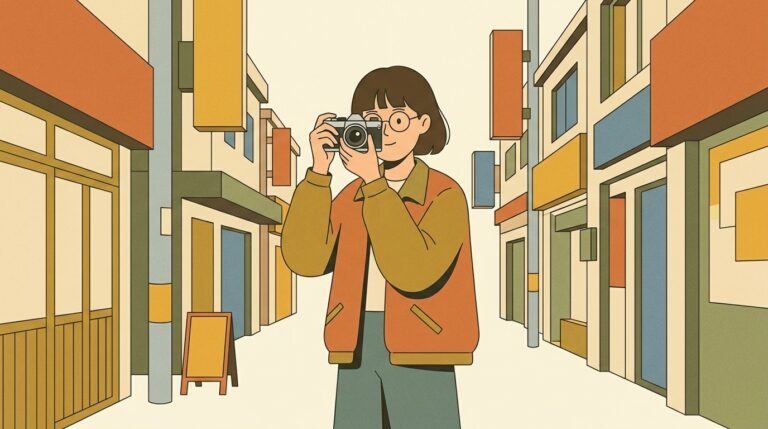
안녕하세요! 매일한글 에디터입니다. Have you ever stepped into a dimly lit vinyl bar in Euljiro, surrounded by the warm crackle of LP records and the nostalgic click of a mechanical camera shutter? Korea is currently experiencing a massive ‘Newtro’ (New + Retro) revolution. Young Koreans in Seongsu and Euljiro are stepping back from slick digital screens to embrace the tangible, imperfect charm of analog hobbies—especially film photography.
As a C2-level Korean speaker, simply saying “이 사진 예뻐요” (This photo is pretty) won’t capture the deep aesthetic nuances of this cultural movement. You need vocabulary that expresses color tone, sensory tactile feedback, and the subtle art of waiting for film processing. In this lesson, we will explore the poetic and precise language of film camera culture so you can converse like a true Seoul creative!
Phase 2: Core Expressions Deep Dive
1. 필카 감성 (Pil-ka Gam-seong)
- Pronunciation: [Pil-ka Gam-seong] (Sounds like Peel-car Calm-sung)
- Meaning: Literal: “Film camera aesthetic/vibe”. Nuance: The unique, warm, slightly faded, and tactile nostalgic mood created exclusively by film photography.
- K-Culture Moment: Frequently seen in youth K-dramas (like Twenty-Five Twenty-One) or aesthetic Instagram posts by K-pop idols showcasing candid, unedited life moments.
- Editor’s Insight: At C2 level, distinguish ‘감성’ (emotional resonance/aesthetic atmosphere) from simple ‘분위기’ (general ambiance). ‘필카 감성’ implies a romanticization of grain, imperfect lighting, and raw memory.
- Situation Spectrum: Casual ✅ | Semi-formal ✅ | Formal ⚠️
- 🤔 Think About It: Why do hyper-digitized societies like South Korea crave the intentional slowness of analog aesthetics?
2. 현상하다 vs 인화하다 (Hyeon-sang-ha-da vs In-hwa-ha-da)
- Pronunciation: [Hyeon-sang-ha-da / In-hwa-ha-da] (Hyeon-sang rhymes with ‘song’, In-hwa like ‘in-hah’)
- Meaning: 현상하다 = To chemically develop exposed film negatives. 인화하다 = To print those developed images onto photographic paper.
- K-Culture Moment: Visiting historic film labs along Chungmuro or trendy scan studios in Yeonnam-dong where photographers request digital scans (스캔) alongside chemical development.
- Editor’s Insight: Native Korean speakers often confuse these, but a C2 speaker shines by using them accurately! Never say “사진을 개발하다” (to develop photos—’개발’ is for software or land!).
- Situation Spectrum: Casual ✅ | Semi-formal ✅ | Formal ✅
- 🤔 Think About It: How does precise vocabulary elevate your appreciation of traditional craftsmanship?
3. 아날로그적 손맛 (A-nal-lo-geu-jeok Son-mat)
- Pronunciation: [A-nal-lo-geu-jeok Son-mat] (Son-mat sounds like ‘son-mat’)
- Meaning: Literal: “Analog hand-taste”. Nuance: The satisfying, sensory tactile feedback of manual labor or mechanical operation (winding a camera lever, tuning a dial, flipping a record).
- K-Culture Moment: Commonly used when discussing handmade crafts, mechanical watches, barista drip coffee, or winding a manual film camera shutter in Seongsu-dong workshops.
- Editor’s Insight: ‘손맛’ originally referred to a cook’s instinctive touch or a fisherman’s feeling when catching a fish. Applying it to mechanical hobbies signifies deep sensory engagement.
- Situation Spectrum: Casual ✅ | Semi-formal ✅ | Formal ⚠️
- 🤔 Think About It: Korean language frequently uses body-part metaphors (손맛, 입맛, 눈맛) to express aesthetic pleasure. How does your native language handle sensory metaphors?
Phase 3: Textbook Korean vs Real Korean
Situation 1: Dropping off film at a lab
- 📖 교과서 한국어: 필름을 개발해 주시고 사진을 출력해 주세요. (Film-eul gae-bal-hae ju-si-go sa-jin-eul chul-ryeok-hae ju-se-yo.)
- 🗣️ 진짜 한국어: 필름 현상이랑 스캔 부탁드려요. 사진은 몇 장만 골라서 인화할게요. (Pil-reum hyeon-sang-i-rang seu-kaen bu-tak-deu-ryeo-yo. Sa-jin-eun myeot jang-man gol-ra-seo in-hwa-hal-ge-yo.)
- 💡 왜 다를까?: Native speakers never use ‘개발’ (software/land development) or ‘출력’ (office paper printing) for film. We specify chemical development (현상), digital scan file generation (스캔), and paper photo printing (인화).
Situation 2: Praising a vintage photo print
- 📖 교과서 한국어: 이 사진은 예전 느낌이 나고 분위기가 매우 아름답습니다. (I sa-jin-eun ye-jeon meok-kim-i na-go bun-wi-gi-ga mae-u a-reum-dap-seumni-da.)
- 🗣️ 진짜 한국어: 와, 특유의 빛바랜 노이즈 감성이 미쳤는데요? 색감이 완전 레트로해요. (Wa, teuk-yu-ui bit-ba-raen no-i-jeuk gam-seong-i mi-chyeot-neun-de-yo? Saek-gam-i wan-jeon re-teu-ro-hae-yo.)
- 💡 왜 다를까?: C2 mastery requires specific aesthetic modifiers like ‘빛바랜’ (faded with age), ‘색감’ (color palette/rendering), and slang like ‘미쳤다’ (insanely good/stunning).
Phase 4: K-Culture Deep Dive & Non-verbal Etiquette
4-1. Nunchi & GestureEtiquette in Film Studios & Alleyways
When visiting old film laboratories in Chungmuro or shooting in historical neighborhoods like Ikseon-dong:
* Handling Darkroom Items: Always hold film canisters or negative sleeves with both hands (두 손으로 받기) as a sign of respect toward the technician’s craft.
* Alleyway Photography (골목길 촬영): Korea has strict privacy enforcement. Avoid taking direct close-up photos of local residents without asking. If someone looks uncomfortable, lower your camera slightly and nod politely (살짝 고개를 숙여 목인사).
4-2. Cultural Code: The ‘Hipjiro’ Analog Renaissance
Why are young Koreans obsessed with film cameras? Euljiro, once an aging industrial print shop district, was transformed into ‘Hipjiro’ by youth seeking raw authenticity. Film cameras represent an antidote to digital overload—where photos cannot be instantly deleted or filtered. The value lies precisely in waiting for the results (기다림의 미학).
Phase 5: Real-World Roleplay Scenario
Setting: A cozy, vintage film lab named ‘Chungmuro Film Studio’ in Euljiro.
Character: Mr. Park (60s, master film technician with 35 years of darkroom experience).
- Turn 1 (Mr. Park): 어서 오세요. 필름 맡기시려고요? 몇 롤 가져오셨어요?
(Eo-seo o-se-yo. Pil-reum mat-gi-si-ryeo-go-yo? Myeot rol ga-jyeo-o-syeos-seo-yo?)
“Welcome! Looking to drop off film? How many rolls did you bring?” -
Turn 2 (You – 🎭 Hands over two film canisters with both hands): 네, 두 롤인데요. 하나는 흑백이고 하나는 컬러 C-41 공정이에요. 현상이랑 고화질 스캔 부탁드립니다.
(Ne, du rol-in-de-yo. Ha-na-neun heuk-baek-i-go ha-na-neun keol-ler C-41 gong-jeong-i-eoy-o. Hyeon-sang-i-rang go-hwa-jil seu-kaen bu-tak-deu-rim-ni-da.)
“Yes, two rolls. One is black and white, and the other is color C-41 process. High-res scan and development, please.” -
Turn 3 (Mr. Park): 오, 흑백은 직접 감은 롤 같은데… 감도(ISO) 얼마로 두고 찍으셨어요?
(O, heuk-baek-eun jik-jeop gam-eun rol gat-eun-de… Gam-do eol-ma-ro du-go jjeog-eu-syeos-seo-yo?)
“Oh, the black and white looks like hand-spooled film… What ISO rating did you shoot it at?” -
Turn 4 (You – 🎭 Points to handwritten label on canister): ISO 400으로 적어뒀는데, 실내 촬영이 많아서 1스탑 푸시 현상 부탁드려도 될까요?
(ISO sa-baek-eu-ro jeok-eo-dwot-neun-de, sil-nae chwal-yeong-i man-a-seo il-seu-tap pu-si hyeon-sang bu-tak-deu-ryeo-do doel-kka-yo?)
“I noted ISO 400, but since I shot indoors a lot, could you push it by 1 stop during development?” -
Turn 5 (Mr. Park – 🎭 Impressed nod): 호오, 푸시 현상까지? 필름 제대로 하시는 분이네! 스캔본은 카톡으로 보내드리면 되죠?
(Ho-o, pu-si hyeon-sang-kka-ji? Pil-reum je-dae-ro ha-si-neun bun-i-ne! Seu-kaen-bon-eun Ka-tok-eu-ro bo-nae-deu-ri-myeon doe-jo?)
“Oho, even push processing? You really know your film! Can I send scans via KakaoTalk?” -
Turn 6 (You – 🎭 Smiles warm-heartedly): 네! 그리고 필름 밀착 인화 한 장이랑, 이 중에서 제일 잘 나온 색감 사진 두 장은 4×6으로 인화하고 싶어요.
(Ne! Geu-ri-go pil-reum mil-chak in-hwa han jang-i-rang, i jung-e-seo je-il jal na-on saek-gam sa-jin du jang-eun 4×6-eu-ro in-hwa-ha-go sip-eo-yo.)
“Yes! Also, I’d like one contact sheet print, and I’d like to print two photos with the best color tones in 4×6 size.” -
Turn 7 (Mr. Park): 알겠습니다. 필름 특유의 거친 입자감 살려서 깔끔하게 작업해 둘게요. 저녁 6시쯤 메신저 확인해 보세요.
(Al-get-seumnida. Pil-reum teuk-yu-ui geo-chin ip-ja-gam sal-ryeo-seo kkal-kkeum-ha-ge jak-eop-hae dul-ge-yo. Jeo-nyeok yeos-eot-si-jjeum me-sin-jeo hwak-in-hae bo-se-yo.)
“Got it. I’ll preserve the characteristic gritty grain texture nicely. Check your messenger around 6 PM.” -
Turn 8 (You – 🎭 Bows politely): 감사합니다, 사장님! 손맛 담긴 정성스러운 작업 기대할게요.
(Gam-sa-ham-ni-da, sa-jang-nim! Son-mat dam-gin jeong-seong-sreu-eon jak-eop gi-dae-hal-ge-yo.)
“Thank you, boss! I look forward to your meticulous work with that authentic touch.”
🔀 Interactive Choice Point
Mr. Park asks: “실수로 감광된 사진이 몇 장 있는 것 같은데, 스캔에서 빼드릴까요?” (Looks like a few frames got light-leaked/exposed accidentally, should I leave them out of the scans?)
- Choice A: “빛 번짐도 필카 감성이니까 그냥 전부 다 스캔해 주세요!” (Scan everything! Even light leaks are part of the film vibe!)
- Choice B: “망한 사진은 돈 아까우니까 그냥 잘 나온 것만 골라서 스캔해 주세요.” (Wasted photos are a waste of money, so scan only good ones.)
- Choice C: “사장님께서 보시고 예술적인 느낌이 사는 건 남겨주세요.” (Please keep what you think looks artistically valid, sir.)
Feedback:
- 🏆 Best Choice A: Perfectly captures the true enthusiast attitude! Film lovers embrace light leaks (빛 번짐) as unique artistic anomalies.
- ⚠️ Risk Choice B: Practical, but misses the fun aesthetic conversation with the shop owner.
- 🚫 Bad Choice C: Puts an unnecessary subjective decision burden on the busy shop technician.
Phase 6: 10-Second Emotion Shadowing Drill
[😊 설레며 / Excitement]
디지털 카메라랑은 / 차원이 다른 / 아날로그 특유의 / 따뜻한 손맛이 있어요.
(Di-ji-teol ka-me-ra-rang-eun / cha-won-i da-reun / a-nal-lo-geu teuk-yu-ui / tta-tteut-han son-mat-i it-seo-yo.)-
[🥺 아쉽고 애틋하게 / Nostalgic longing]
빛바랜 사진 속 / 필름 입자감을 보면 / 왠지 지나간 시간이 / 더 그리워져요.
(Bit-ba-raen sa-jin sok / pil-reum ip-ja-gam-eun bo-myeon / waen-ji ji-na-gan si-gan-i / deo geu-ri-wo-jyeo-yo.) -
[😎 당당하고 자신 있게 / C2 Advanced Confidence]
초점이 살짝 나갔지만 / 오히려 그 불완전함이 / 이 사진의 감성을 / 완성해 주네요.
(Cho-jeom-i sal-jjak na-gat-ji-man / o-hi-reo geu bul-wan-jeon-ham-i / i sa-jin-ui gam-seong-eul / wan-seong-hae ju-ne-yo.)
Phase 7: K-Culture Mini Dictionary
- 현상소 (Hyeon-sang-so) | Noun | Film processing lab/darkroom studio. Used when locating film developing services in Seoul.
- 출사 (Chul-sa) | Noun | Photography outing/trip. Short for ‘출사표를 던지다’ (going out into the field to shoot photos).
- 뉴트로 (Newtro) | Noun | Modern interpretation of vintage/retro styles popular among Korean Gen MZ.
- 초점 (Cho-jeom) | Noun | Focus/focal point. Commonly used figuratively (e.g., “대화의 초점” = focus of conversation) or technically in photography (“초점이 맞춰지다/나가다”).
Phase 8: Survival Kit for Travelers
TOP 3 Survival Phrases
- 필름 스캔본 이메일로 받아볼 수 있나요?
(Pil-reum seu-kaen-bon i-me-il-ro ba-da-bol su it-na-yo?)
Can I receive the film digital scans via email? - 유통기한 지난 필름도 판매하시나요?
(Yu-tong-gi-han ji-nan pil-reum-do pan-mae-ha-si-na-yo?)
Do you also sell expired film? (A popular trend for eccentric color shifts!) - C-41 컬러 현상 오늘 바로 되나요?
(C-41 keol-ler hyeon-sang o-neul ba-ro doe-na-yo?)
Can C-41 color development be done today?
Editor’s Travel Note
When navigating Euljiro’s hidden film shops, street signs can be confusing because labs are often hidden on the 3rd or 4th floors of old print manufacturing buildings. Make sure to download 네이버 지도 앱 다운로드 to search terms like “충무로 현상소” or “을지로 필름 카메라” for pin-point building entrance coordinates!
Phase 9: A Step Deeper (Thinking Question)
In South Korea’s fast-paced society (빠르빠르 문화), the re-emergence of film photography and LP record listening is not merely a aesthetic trend. It represents an intentional slowing down—a psychological sanctuary where young Koreans reclaim control over time. By intentionally embracing delayed gratification (기다림의 시간), analog hobbies serve as mindfulness practices in urban Seoul.
💬 Your Turn: What analog hobby provides you mental clarity in your busy daily life? Let us know in the comments below in Korean using the word ‘감성’ or ‘손맛’!
Phase 10: FAQ & Mistake Prevention
Q: Can I use the word “개발하다” when referring to photo developing?
A: No. In Korean, 개발하다 (Gae-bal-ha-da) refers exclusively to software development, economic growth, or personal skill development. For photo film development, you must always use 현상하다 (Hyeon-sang-ha-da).
Q: Is “필카” understood by everyone in Korea?
A: Yes! “필카” is a widely accepted abbreviation of 필름 카메라 (Film Camera). Similarly, digital cameras are abbreviated as 디카 (Digital Camera).
Q: What is the difference between ‘색감’ and ‘색상’?
A: 색상 (Saek-sang) is the literal color hue (red, blue, green). 색감 (Saek-gam) refers to the overall tone, feel, or emotional warmth of color rendering in a photo or painting.
🚨 Common Mistakes TOP 3
- ❌ 사진을 출판하고 싶어요. (I want to publish photos – Incorrect word choice for prints)
👉 Correct Action: Use 사진을 인화하고 싶어요 (I want to print photos on photo paper). - ❌ 필름을 찍다. (To shoot film – Unnatural phrasing)
👉 Correct Action: Use 필름으로 사진을 찍다 (To take photos with film) or 필름 카메라를 쓰다 (To use a film camera). - ❌ 이 카메라 노이즈가 예뻐요. (Describing film texture simply as digital noise)
👉 Correct Action: Use 필름 입자감이 살아있어요 (The film grain texture is vibrant).
Phase 11: Action Mission
- 🥉 Bronze: Read Phase 6 Shadowing sentences out loud 3 times with expressive emotion.
- 🥈 Silver: Leave a comment on your favorite vintage photo on Instagram using the phrase “빛바랜 감성이 완전 제 취향이에요!”
- 🥇 Gold: Visit a local film lab or record shop and describe your preferences in Korean using 현상, 색감, and 손맛.
🎮 K-Culture Mission: Watch a scene from the movie Architecture 101 (건축학개론) or Twenty-Five Twenty-One and spot the analog gadgets (CD players, film cameras, pagers). Write down 2 expressions used to describe them!
Phase 12: Interactive Quiz Challenge
Quiz 1. Fill in the blank (Advanced Vocabulary)
필름 카메라 특유의 따뜻한 ( )과 입자감이 정말 마음에 들어요.
(Options: ① 개발 / ② 색감 / ③ 출력 / ④ 인쇄)
🔍 Check Answer & Explanation
Answer: ② 색감
Explanation: ‘색감’ refers to the unique color tone/rendering, which fits best when complimenting film aesthetics.
Quiz 2. True or False Cultural Quiz
In Korean, chemical processing of film negatives is called ‘인화’ and paper printing is called ‘현상’. (T/F?)
🔍 Check Answer & Explanation
Answer: False!
Explanation: It is the reverse! Chemical processing of negatives is 현상 (Hyeon-sang) and printing onto photo paper is 인화 (In-hwa).







