

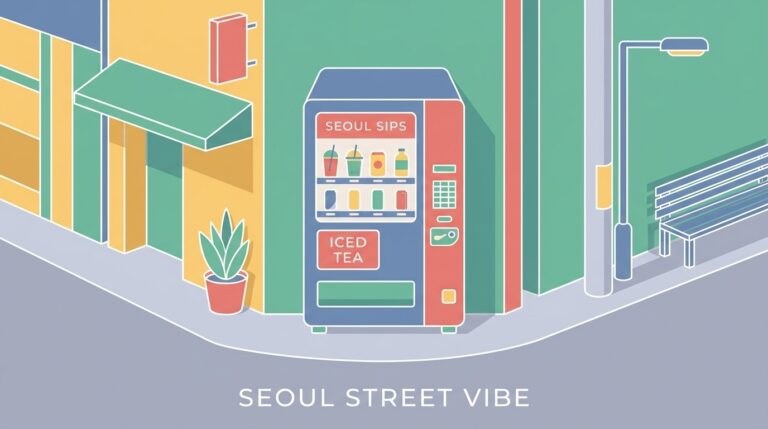
Phase 1: 공감 (Story Opening)
안녕하세요! 매일한글 에디터입니다. 👋
Imagine walking through the bustling streets of Hongdae or waiting at a quiet Seoul subway station after hours of sightseeing. You’re thirsty, and right in front of you stands a colorful machine filled with refreshing Korean beverages—banana milk, warm canned coffee, and ice-cold green tea! But wait… how do you ask someone where the nearest machine is? Or how do you ask if your credit card works on it?
Don’t worry! Vending machines in Korea are ultra-modern, convenient, and everywhere. Many foreign learners get nervous trying to figure out payment options or asking locals for help. Based on feedback from hundreds of beginner Korean learners, this guide will give you the exact 3-second phrases you need to navigate Korean vending machines like a local. Let’s make your Korean journey smooth and delicious! 🥤✨
Phase 2: 핵심 표현 3선 심층 분석
1. 자판기 어디에 있어요? (Japangi eodie isseoyo?)
- Pronunciation: [Jah-pahn-gee oh-dee-eh it-so-yo?] (Think of ‘Jah’ like ‘Jar’, ‘pahn’ like ‘pan’, ‘gee’ like ‘geese’)
- Meaning: Direct: Where is the vending machine? / Nuance: Excuse me, where can I find a beverage machine nearby?
- K-Culture Moment: In K-dramas, you often see lead characters sharing a warm canned coffee outside a convenience store or near a subway vending machine on a crisp autumn night.
- Editor’s Insight: “자동판매기” (Jadong-panmae-gi) is the long dictionary word, but natives always shorten it to “자판기” (Japangi).
- Situation Spectrum: Casual (⚠️) | Semi-formal (✅) | Formal (✅)
- 🤔 Think About It: In your home country, where are vending machines usually placed? How does Korea’s high public safety make outdoor vending machines so common?
2. 이거 어떻게 써요? (Igeo eotteokke sseoyo?)
- Pronunciation: [Ee-geo uh-ttuk-ke ssuh-yo?]
- Meaning: Direct: How do I use this? / Nuance: Could you show me how to operate this machine?
- K-Culture Moment: You want to pay with your T-money card, but the screen menu looks unfamiliar. You politely turn to a local and ask this simple sentence!
- Editor’s Insight: This is a magic phrase! You can point at anything in Korea—a ticket kiosk, a vending machine, or a self-checkout counter—and ask “이거 어떻게 써요?”
- Situation Spectrum: Casual (⚠️) | Semi-formal (✅) | Formal (✅)
- 🤔 Think About It: Asking strangers for simple operational help is very common and warmly received in Korea.
3. 카드로 돼요? (Kadeuro dwaeyo?)
- Pronunciation: [Kah-deu-ro dwae-yo?]
- Meaning: Direct: Is it okay with a card? / Nuance: Can I pay with a credit card or transit card?
- K-Culture Moment: Korea is virtually a cashless society. Almost every modern vending machine takes transportation cards like T-money or contactless credit cards.
- Editor’s Insight: Instead of asking long grammatical sentences like “결제할 수 있습니까?”, just ask “카드로 돼요?” (Card OK?).
- Situation Spectrum: Casual (⚠️) | Semi-formal (✅) | Formal (✅)
- 🤔 Think About It: How cashless is your native daily life compared to Seoul’s high-tech payment ecosystem?
Phase 3: 교과서 한국어 vs 진짜 한국어
Situation 1: Asking for a vending machine
- 📖 교과서 한국어: 자동판매기가 어디에 있습니까? (Jadongpanmaegiga eodie isseumnika?)
- 🗣️ 진짜 한국어: 자판기 어디에 있어요? (Japangi eodie isseoyo?)
- 💡 왜 다를까?: “자동판매기” is formal and clunky. Native speakers exclusively shorten it to “자판기” in daily conversations.
Situation 2: Asking if card payment works
- 📖 교과서 한국어: 신용카드로 결제할 수 있습니까? (Sinyongkadeuro gyeoljehal su isseumnika?)
- 🗣️ 진짜 한국어: 카드로 돼요? (Kadeuro dwaeyo?)
- 💡 왜 다를까?: Native Koreans prefer short, efficient expressions. “돼요?” (Does it work?) replaces complex verbs like “결제하다” (to pay).
Phase 4: K-Culture 딥다이브 & 비언어적 매너
4-1. 눈치 (Nunchi) & Gestures
When asking a stranger for help at a vending machine, hold up your card lightly with both hands or point gently toward the machine screen. Making eye contact with a friendly smile while saying “저기요~” (Jeogiyo – Excuse me) creates immediate goodwill!
4-2. Culture Code Analysis: Warm Drinks in Winter
Did you know Korean vending machines serve heated drinks in autumn and winter? Look for items marked with a red tag that says ‘따뜻함’ (Hot/Warm)! Grab a hot canned sweet grain drink (식혜) or coffee to warm up your hands while exploring Seoul.
Phase 5: 실전 롤플레이 시나리오
Setting: Seoul Subway Line 2 station platform. You are looking for a drink machine.
NPC: Friendly university student waiting for the train.
- User: 저기요, 자판기 어디에 있어요? (Jeogiyo, japangi eodie isseoyo?)
🎭 [Politely waving hand] - NPC: 아, 저기 계단 옆에 있어요! (A, jeogi gyaedan yeope isseoyo!)
🎭 [Pointing towards stairs] - User: 아, 감사합니다! 그런데 이거 카드로 돼요? (A, gamsahamnida! Geureonde igeo kadeuro dwaeyo?)
🎭 [Holding up T-money card] - NPC: 네, 교통카드도 돼요! (Ne, gyotongkadeudo dwaeyo!)
🎭 [Nodding warmly] - User: 진짜요? 어떻게 써요? (Jinjjayo? Eotteokke sseoyo?)
🎭 [Looking curious] - NPC: 카드를 여기에 대고 음료를 누르세요. (Kadeureul yeogie daego eumryoreul nureuseyo.)
🎭 [Tapping air with finger] - User: 아! 나왔어요. 정말 감사합니다! (A! Nawasseoyo. Jeongmal gamsahamnida!)
🎭 [Smiling happily] - NPC: 천만에요! 맛있게 드세요. (Cheonmaneyo! Masitge deuseyo.)
🎭 [Waving goodbye]
🔀 Interactive Branching Point
What do you do if your drink gets stuck inside the machine?
* Option A: Press the return button and politely ask someone: “안 나와요. 도와주세요!” (It didn’t come out. Please help!)
* Option B: Shake and kick the vending machine hard.
* Option C: Leave silently without doing anything.
Feedback:
* Option A (Best Choice): Perfect! Locals will gladly check the refund lever or phone the maintenance number for you.
* Option B (Risk Choice): Danger! Shaking machines causes public disturbance and is considered highly disrespectful in Korea.
* Option C (Bad Choice): You lose your money and stay thirsty! Always feel comfortable asking for assistance.
Phase 6: 10초 감정 섀도잉 드릴
Practice reading these out loud with appropriate emotion and pauses (/ marks a pause):
[😊 Bright & Friendly]자판기 / 어디에 / 있어요? (Japangi / eodie / isseoyo?)[🥺 Polite & Curious]카드로 / 돼요? (Kadeuro / dwaeyo?)[😮 Eager to Learn]이거 / 어떻게 / 써요? (Igeo / eotteokke / sseoyo?)
Phase 7: K-Culture 미니 사전 (Core Keywords)
- 자판기 (Japangi): Vending machine. Everyday short form of 자동판매기.
- 교통카드 (Gyotong-kadeu): Transportation card (e.g., T-money). Used on transit, vending machines, and convenience stores.
- 캔커피 (Canned Coffee): Ready-to-drink canned coffee available hot or cold.
- 잔돈 (Jandon): Small change or coins returned after cash payment.
Phase 8: 여행자를 위한 생존 키트
Survival Expressions TOP 3
- 이거 있어요? (Igeo isseoyo?) – Do you have this? (Point at drink picture)
- 도와주세요. (Dowajuseyo.) – Please help me. (Use when machine glitches)
- 얼마예요? (Eolmayeyo?) – How much is it? (Check drink price)
Editor’s Travel Note
Before heading out to explore Korea’s automated kiosks, subway stations, and neighborhood spots, download the Naver Map App for Korean Travel Navigation to easily find facilities and transportation hubs anywhere in Seoul!
Phase 9: 한 발 더 깊이 (Culture Thought)
Korean vending machines reflect the incredible public trust, low crime rate, and high-tech cashless infrastructure of modern Korean society. Seeing spotless vending machines working late at night in quiet alleys is a true testament to civic safety. Experiencing these small everyday interactions gives you a glimpse into Korea’s fast-paced yet helpful culture.
💬 Your Turn: Have you ever used a vending machine in another country that surprised you? Share your experience in the comments below!
Phase 10: FAQ & Common Mistakes
Q: Can I pay with foreign credit cards at Korean vending machines?
A: Most modern machines accept foreign cards like VISA/Mastercard, but using a T-money transit card is always 100% reliable!
Q: What should I do if my drink gets stuck?
A: Point at the machine and politely say “도와주세요” (Dowajuseyo – Please help me) to any nearby staff or local.
Q: Do vending machines accept cash?
A: Yes, most accept 1,000 won bills and 100/500 won coins, but cash-only machines are becoming rare.
🚨 Common Mistakes TOP 3
- Using textbook words: Saying “자동판매기” instead of “자판기”. (Fix: Stick to ‘자판기’)
- Expecting cash-only: Trying to insert bills when a card scanner is available. (Fix: Tap your T-money card!)
- Forgetting polite endings: Saying “어디 있어?” instead of “어디 있어요?”. (Fix: Always add ‘~요’ to strangers!)
Phase 11: 액션 미션 & 참여 유도
- Bronze Mission: Say “자판기 어디에 있어요?” out loud 3 times right now!
- Silver Mission: Record your voice practicing Phase 6 shadowing drill and tag @DailyHangul on Instagram!
- Gold Mission: Spot a vending machine while watching a K-drama today and yell “자판기다!” (It’s a vending machine!)
🎮 K-Culture Mission: Watch a K-drama scene where characters drink warm canned drinks, and spot whether they use cash or card!
Phase 12: 인터랙티브 퀴즈 챌린지
Q1. What is the natural, everyday Korean word for ‘vending machine’?
A) 자동판매기
B) 자판기
C) 계산기
Q2. Fill in the blank: “카드로 _____?” (Can I pay with a card?)
A) 돼요
B) 가요
C) 있어요
Q3. True or False: T-money transit cards can be used to purchase drinks at Korean vending machines. (True / False)
Click to reveal Quiz Answers & Explanations!
- Answer: B) 자판기 – Short, natural, and used by everyone daily!
- Answer: A) 돼요 – “카드로 돼요?” is the ultimate 3-word phrase for card payment.
- Answer: True – T-money transportation cards are accepted at almost all modern vending machines in Korea.







