

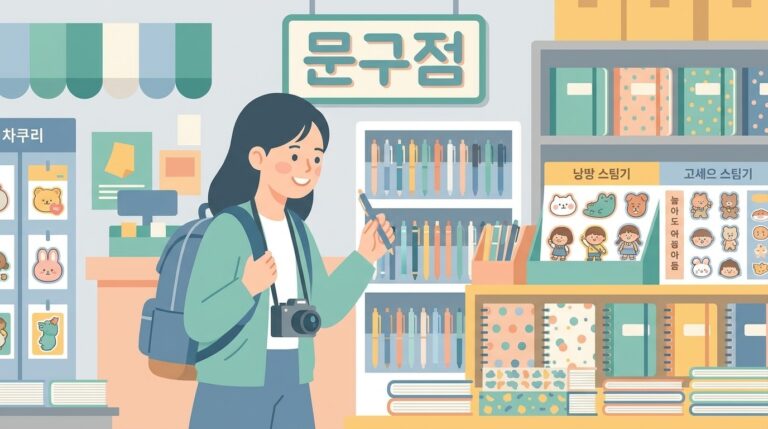
Browsing Cute Korean Stationery: How to Shop Like a Local at Kyobo Bookstore!
안녕하세요! Editor Min here from Daily Hangul! Have you ever walked into a massive Korean bookstore like Kyobo or Bandi & Luni’s, heading straight for the stationery section (문구 코너), and immediately felt overwhelmed? You see rows of adorable stickers, aesthetic planners, and sleek pens, but you panic when a friendly staff member approaches and asks if you need help!
Don’t worry, you’re not alone! Many of our A2 learners tell us they end up holding three different cute highlighters in silence, afraid to ask if there are other colors or if they can test the pens. Shopping for stationery in Korea is a legendary experience—from aesthetic bullet journal supplies to idol-themed merchandise. Today, I’m sharing my 10-year experience as your local culture navigator to help you confidently ask questions, test products, and buy your favorite stationery items in Korean!
Phase 2: Core Expressions Deep Dive
1. 이거 테스트해 봐도 돼요? (Igeo teseuteuhae bwa-do dwae-yo?)
- Pronunciation: [ee-geo teh-sue-teu-hae bwa-do dwae-yo?] (Sounds like ‘e-go test-house-by-door-dway-yo’)
- Meaning: “Can I test this out?” (Literal: Is it okay even if I try testing this?)
- K-Culture Moment: You are in the pen section looking at smooth gel pens. You want to write on the scratchpad provided to see how the ink flows.
- Editor’s Insight: In Korean stationery shops, testing pens on sample paper pads (시성지) is totally normal! Just ask politely before opening packaged samples.
- Situation Spectrum: Casual ⚠️ | Semi-formal ✅ | Formal ✅
- 🤔 Think About It: In your country, do shops encourage you to test stationery before purchasing, or do you have to guess?
2. 다른 색상도 있어요? (Dareun saeksang-do isseoyo?)
- Pronunciation: [da-reun saek-sang-do ee-sseo-yo?]
- Meaning: “Do you have other colors too?”
- K-Culture Moment: You found an adorable bear planner, but it’s only available in yellow on the display shelf.
- Editor’s Insight: ‘색상’ (saeksang) means color (formal/shopping context), while ‘색’ (saek) is the casual word.
- Situation Spectrum: Casual ⚠️ | Semi-formal ✅ | Formal ✅
- 🤔 Think About It: How does asking for stock options differ when shopping online versus in physical stores in your hometown?
3. 이것 좀 포장해 주세요. (Igeot jom pojang-hae ju-seyeo.)
- Pronunciation: [ee-geot jom poh-jang-hae joo-seh-yo]
- Meaning: “Could you please wrap/package this up for me?”
- K-Culture Moment: Buying a cute souvenir notebook as a gift for your friend back home.
- Editor’s Insight: ‘포장’ (pojang) means wrapping or packaging. Adding ‘좀’ (jom) makes your request softer and more natural!
- Situation Spectrum: Casual 🚫 | Semi-formal ✅ | Formal ✅
- 🤔 Think About It: In Korea, gift wrapping services at stationery stores are often neat and beautiful—a reflection of showing respect through presentation!
Phase 3: Textbook Korean vs. Real Native Korean
Situation 1: Asking if a pen writes well
- 📖 Textbook Korean: 이 볼펜이 잘 써집니까? (I bolpen-i jal sseojimnikka?)
- 🗣️ Real Native Korean: 이 펜 잘 나와요? (I pen jal nawayo?)
- 💡 Why the difference? Native speakers ask if the ink “comes out well” (잘 나와요) rather than using passive grammatical verb forms.
Situation 2: Looking for popular items
- 📖 Textbook Korean: 어떤 문구류가 가장 인기 있습니까? (Eotteon mungguru-ga gajang inki isseumnikka?)
- 🗣️ Real Native Korean: 요즘 뭐가 제일 잘 나가요? (Yojeum mwo-ga jeil jal nagayo?)
- 💡 Why the difference? “잘 나가요” literally means “sells well / moves fast,” which is the exact colloquial idiom Koreans use for bestsellers.
Phase 4: K-Culture Deep Dive & Non-Verbal Manners
4-1. Nunchi & Polite Body Language
When testing pens or browsing delicate paper goods, hold items gentle with both hands if handing them to staff. When receiving your wrapped item or change, place both hands forward or hold your right elbow with your left hand—a subtle gesture showing deep politeness!
4-2. The Korean Stationery Obsession
In Korea, stationery isn’t just school supplies; it’s a lifestyle movement known as ‘Dakku’ (다꾸 – Decorating Diaries). Kyobo Hottracks and ARTBOX are ultimate paradises filled with aesthetic stickers, masking tapes (마스킹 테이프), and custom sticky notes. Taking time to browse quietly is standard etiquette!
Phase 5: Real Roleplay Scenario
Setting: Kyobo Hottracks Stationery Corner
NPC: Friendly Store Staff (직원)
- 직원: 손님, 찾으시는 문구류 있으세요?
(Son-nim, chajeu-si-neun munggu-ryu isseuseyo? / Welcome! Looking for any specific stationery?)
🎭[😊 Smiling warmly with arms crossed behind back] -
You: 안녕하세요! 이 스티커 다른 색상도 있어요?
(Annyeonghaseyo! I seutikeo dareun saeksang-do isseoyo? / Hello! Do you have this sticker in other colors too?)
🎭[내밀며 - Holding up a pastel sticker sheet] -
직원: 아, 그 스티커는 핑크색이랑 하늘색도 있어요! 잠시만요.
(A, geu seutikeo-neun pingkeu-saek-iranghaneul-saek-do isseoyo! Jamsimannyo. / Ah, that sticker also comes in pink and sky blue! Just a moment.)
🎭[pointing toward the lower drawer] -
You: 와, 감사합니다. 이 볼펜도 써봐도 돼요?
(Wa, gamsahamnida. I bolpen-do sseobwa-do dwae-yo? / Wow, thank you. Can I test this ballpoint pen too?)
🎭[pointing at a pen display] -
직원: 네! 옆에 있는 시성지에 써보시면 됩니다.
(Ne! Yeop-e inneun siseongji-e sseobosimyeon doemnida. / Yes! You can write on the test paper right next to it.)
🎭[nodding gently] -
You: 오, 되게 부드럽게 잘 나오네요! 이걸로 할게요.
(O, doege budeureopge jal naonaeyo! Igeollo halgeyo. / Oh, it writes really smoothly! I’ll take this one.)
🎭[smiling happily after testing] -
직원: 네, 선물 포장도 해드릴까요?
(Ne, seonmul pojang-do haedeureil-kkayo? / Great, would you like gift wrapping as well?)
🎭[holding a small gift box] -
You: 네, 선물용으로 포장해 주세요!
(Ne, seonmul-yong-euro pojang-hae ju-seyeo! / Yes, please wrap it as a gift!)
🎭[handing over items with two hands]
🔀 Interactive Choice Point
The staff member asks if you need a shopping bag: “봉투 필요하세요?” (Bongtu pil-yo-haseyo?)
- Choice A: “네, 담아주세요.” (Ne, dama-juseyo.)
- Choice B: “아니요, 괜찮아요. 가방에 넣을게요.” (Aniyo, gwaenchana-yo. Gabang-e neoeul-geyo.)
- Choice C: “무료예요?” (Muryo-yeyo?)
💬 Feedback:
- Best (Choice A): Perfect! “Yes, please put it in a bag.” Smooth and natural.
- Good (Choice B): Excellent eco-friendly response! “No, it’s okay. I’ll put it in my bag.”
- Risk (Choice C): While not rude, shopping bags in Korea cost 100-500 KRW by law, so asking if it’s free might sound a bit blunt. Better to say Choice A or B!
Phase 6: 10-Second Emotion Shadowing Drill
[😊 Excitement]이 볼펜 / 진짜 잘 나오네요! (I bolpen / jin-jja jal naonaeyo!)[🤔 Curious]혹시 / 다른 색상도 있어요? (Hoksi / dareun saeksang-do isseoyo?)[🥺 Polite Request]이것 좀 / 포장해 주실 수 있나요? (Igeot jom / pojang-hae jusil su innayo?)
Phase 7: K-Culture Mini Dictionary
- 다꾸 (Dakku) | Diary Decorating | Short for ‘다이어리 꾸미기’. A massive trend in Korea involving decorating planners with stickers, tape, and colorful pens.
- 문구덕후 (Mungu-deokhu) | Stationery Geek | Someone who passionately collects high-quality notebooks, pens, and cute aesthetic office supplies.
- 시성지 (Siseongji) | Test Paper Pad | Small scratchpads placed next to pen displays in Korean bookstores so shoppers can test ink flow.
- 핫트랙스 (Hottracks) | Hottracks | The major stationery & lifestyle sub-brand located inside Kyobo Bookstores nationwide.
Phase 8: Traveler’s Survival Kit
TOP 3 Survival Phrases
- 이거 재고 있어요? (Igeo jaego isseoyo?) – Do you have this in stock?
- 봉투에 넣어주세요. (Bongtu-e neoeu-juseyo.) – Please put it in a bag.
- 계산 어디서 해요? (Gyesan eodiseo haeyo?) – Where do I pay?
Editor’s Travel Note
When navigating major stores in Seoul, use the Naver Map App Download to easily find the nearest Kyobo Bookstore or ARTBOX location. Remember that plastic bags cost around 100 KRW, so keeping a small reusable tote bag in your backpack is super convenient!
Phase 9: One Step Deeper
In Korea, stationery stores are social hubs of creativity and micro-happiness (소확행). Buying a small pastel notepad or a smooth gel pen isn’t just about utility; it represents taking care of one’s personal routine. When you practice asking store staff for stationery options in Korean, you are participating in a quiet, polite culture of everyday aesthetic appreciation.
💬 Your Turn: What’s your favorite piece of stationery to collect when traveling? Tell us in the comments below!
Phase 10: FAQ & Common Mistakes
Q: Can I open sealed sticker packages to look inside?
A: No, please do not break seals on packaged goods! Only sample items marked ‘샘플’ (Sample) can be touched or tested.
Q: What is the difference between 색상 (saeksang) and 색 (saek)?
A: ‘색상’ is a slightly more formal retail term for color options, whereas ‘색’ is used in general everyday conversation.
Q: How do I ask if credit card payment is accepted?
A: You can ask, “카드 돼요?” (Kadeu dwae-yo?). Credit cards are accepted almost everywhere in Korea!
🚨 Common Mistakes TOP 3
- Mistake: Pointing directly at staff while asking questions.
- Correct Action: Open your hand flat toward the item or direction when speaking.
- Mistake: Using basic informal speech like “이거 얼마?” (Igeo eolma?).
- Correct Action: Always append polite endings: “이거 얼마예요?” (Igeo eolma-yeyo?).
- Mistake: Writing long sentences on test paper (시성지).
- Correct Action: Just draw lines, squiggles, or short Korean letters like ‘안녕’ to test ink!
Phase 11: Action Missions
- 🥉 Bronze Mission: Practice saying “이거 테스트해 봐도 돼요?” out loud 3 times in front of a mirror!
- 🥈 Silver Mission: Post a photo of your favorite stationery item on Instagram and tag
@DailyHangulwith the caption “이 거 잘 나와요!”. - 🥇 Gold Mission: Visit a local Korean market or stationery store and successfully buy an item using only Korean!
🎮 K-Culture Mission: Watch a Korean Vlog (브이로그) on YouTube featuring ‘다꾸’ (Dakku) and spot at least 2 stationery terms you learned today!
Phase 12: Interactive Quiz Challenge
Q1. How do you ask store staff if you can test out a pen in Korean?
a) 이거 버려도 돼요?
b) 이거 테스트해 봐도 돼요?
c) 이거 먹어도 돼요?
👉 Click to see Answer & Explanation
Answer: b) 이거 테스트해 봐도 돼요?
Explanation: ‘테스트해 보다’ means to test out. Option a means ‘Can I throw this away?’ and option c means ‘Can I eat this?’!
Q2. True or False: You can open sealed packages in Korean stationery stores as long as you buy them later.
👉 Click to see Answer & Explanation
Answer: False!
Explanation: You should never break seals on unopened products. Look for items labeled ‘샘플’ (Sample) or ask the staff for help.







