

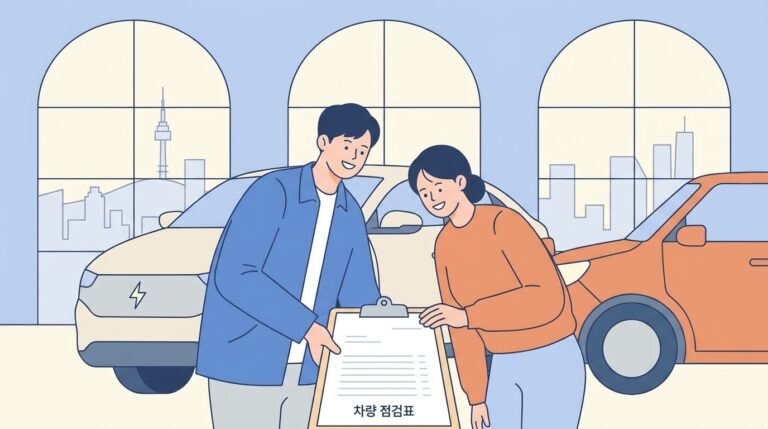
Navigating Used Car Market Prices and Bargaining like a Native Korean
Phase 1: Empathy (Story-driven Opening)
안녕하세요! 매일한글 에디터입니다. Have you ever dreamed of taking a scenic road trip along Jeju’s coastal roads or driving up to Gangwon-do for a weekend camping trip? Buying a used car in Korea is often the most practical route to freedom, but stepping into places like Janganpyeong Used Car Market or scrolling through platforms like Encar (엔카) can be intimidating—even for advanced Korean learners!
Picture this: You find a pristine silver sedan online that fits your budget. You meet the dealer, inspect the tires, look under the hood, and then comes the crucial moment—discussing the actual market price (시세) and negotiating a fair deal. You don’t want to sound like a rigid textbook, nor do you want to sound impolite when questioning an inflated price.
Many C1 learners share with us that while they can converse fluently on general topics, negotiating high-value purchases like cars feels like a whole different game. The key is mastering native-level nuanced phrasing that balances politeness (존댓말) with sharp, tactical confidence. Today, we’re unlocking the exact expressions, cultural etiquette, and strategic phrasing that native Koreans use when evaluating used car prices and negotiating a bargain smoothly.
Phase 2: Core Expressions Deep Dive
1. 시세보다 얹어 부르다
- Pronunciation: [Si-se-bo-da eon-jeo bu-reu-da] (Sounds like eon-juh as in placing something on top)
- Meaning: Literal: To quote a price by adding extra on top of market rate / Nuance: Quoting an inflated price higher than the standard market value.
- K-Culture Moment: Seen frequently in K-Dramas featuring business drama or car market scenes, where a sharp buyer calls out a shady dealer trying to overcharge.
- Editor’s Insight: At C1 level, rather than saying “가격을 너무 높게 불렀어요” (You called too high a price), using “시세보다 좀 얹어 부르신 것 같은데요” subtly signals that you know the market inside out without creating an outright argument.
- Situation Spectrum: Casual ⚠️ / Semi-formal ✅ / Formal ✅
- 🤔 Think About It: In your native culture, do buyers confront inflated prices directly, or do they use indirect financial vocabulary to state their market knowledge?
2. 네고 여지
- Pronunciation: [Ne-go yeo-ji] (Nego comes from English ‘negotiation’, yeo-ji means room/leverage)
- Meaning: Literal: Negotiation room / Nuance: Asking if there is any flexibility or margin to lower the price.
- K-Culture Moment: Resale apps like Karrot (당근) and car trading sites where buyers ask if the price is fixed or if there’s room for a small discount.
- Editor’s Insight: Pairs perfectly with verbs like 있다 (exists) or 있다/없다. Asking “네고 여지가 좀 있을까요?” is far more sophisticated than simply saying “깎아 주세요” (Please discount it).
- Situation Spectrum: Casual ✅ / Semi-formal ✅ / Formal ⚠️
- 🤔 Think About It: Notice how Korean creates functional hybrid words like ‘네고’ paired with traditional words like ‘여지’. How does your language blend foreign loanwords with native terms?
3. 쿨거래
- Pronunciation: [Kul-geo-rae] (Cool + Geor-ae transaction)
- Meaning: Literal: Cool trade / Nuance: A fast, hassle-free transaction executed on the spot without tedious back-and-forth haggling if a fair condition is met.
- K-Culture Moment: Online resale forums where sellers promise a discount if the buyer promises a 쿨거래 (instant payment, fast pickup).
- Editor’s Insight: This is your ultimate leverage! Saying “오늘 바로 계약하면 쿨거래 조건으로 얼마까지 가능할까요?” promises the seller convenience in exchange for a lower price.
- Situation Spectrum: Casual ✅ / Semi-formal ✅ / Formal 🚫
- 🤔 Think About It: Speed and convenience (Palli-Palli) are core values in Korean society. How does offering a smooth deal reflect broader cultural values?
Phase 3: Textbook Korean vs. Real Native Korean
Situation 1: Asking for a discount when buying a car
- 📖 Textbook Korean: “가격을 조금만 할인해 주시겠습니까?” (Would you please discount the price a little?)
- 🗣️ Real Native Korean: “혹시 현금가나 당일 계약 조건으로 네고 여지가 좀 있을까요?” (Is there any room for negotiation if I pay cash or sign today?)
- 💡 Why the difference? Advanced speakers frame their discount request with a conditional incentive (cash/same-day agreement) rather than simply begging for a price drop.
Situation 2: Asking if the car has a history of accidents
- 📖 Textbook Korean: “이 차는 사고가 난 적이 없습니까?” (Has this car never had an accident?)
- 🗣️ Real Native Korean: “성능점검표상 완전 무사고인지, 단순 교환 이력이 있는지 확인 가능할까요?” (Could I verify on the inspection sheet if it’s completely accident-free or if there’s any history of minor panel replacement?)
- 💡 Why the difference? Native Koreans refer specifically to official documentation (성능점검표) and distinguish between major structural accidents (사고) and minor cosmetic replacements (단순 교환).
Phase 4: K-Culture Deep Dive & Etiquette
4-1. Nunchi & Non-verbal Manners
When negotiating a used car in Korea, quiet confidence wins over aggressive demanding. Maintain polite eye contact while slowly reviewing the inspection report (성능점검표). Gently tapping a specific line item on the sheet while asking questions shows high attention to detail. Keep your body language relaxed—never raise your voice. Ending sentences in soft intermediate forms like “~시죠” or “~일까요?” signals respect while keeping your stance firm.
4-2. Culture Code: The Digital Transformation of K-Car Markets
In the past, physical used car lots in Korea had a reputation for aggressive sales tactics and 허위매물 (bait-and-switch listings). Today, technology platforms like Encar, K-Car, and HeyDealer have revolutionized the market with verified vehicle histories and digital appraisals. This shift has elevated buyer expectations: modern Korean buyers rely heavily on data, depreciation rates (감가상각), and market benchmarks before ever shaking hands with a dealer.
Phase 5: Real-Life Roleplay Scenario
Setting: A modern used car dealership in Gimpo. You (Buyer) are speaking with Dealer Mr. Park.
- Dealer: 고객님, 이 아반떼 차량은 연식 대비 주행거리도 짧고 상태가 아주 특A급입니다. (Customer, considering the year, this Avante has low mileage and is in top-tier condition.)
- User (Buyer): 🎭 [Politely pointing at the inspection document] 차는 깔끔해 보이는데, 최근 동급 모델 시세보다 살짝 얹어 부르신 것 같아요. (The car looks clean, but it seems quoted slightly above current market price for comparable models.)
- Dealer: 아, 최근 소모품 교환도 다 끝냈고 타이어도 새 거라 그렇습니다. (Ah, that’s because we recently replaced all consumables and the tires are brand new.)
- User (Buyer): 🎭 [Nodding thoughtfully] 그렇군요. 그래도 성능점검표를 보니휀다 쪽 단순 교환 이력이 찍혀 있네요. (I see. Still, looking at the inspection sheet, there’s a simple fender replacement recorded.)
- Dealer: 단순 교환이라 프레임 상 문제는 전혀 없습니다! (It’s just a simple replacement, so there are zero frame issues!)
- User (Buyer): 🎭 [Smiling confidently] 네, 이해합니다. 혹시 당일 계약 진행하는 조건으로 네고 여지가 좀 있을까요? (Yes, I understand. Is there any room for negotiation if we proceed with same-day signing?)
- Dealer: 음… 당일 계약이시면 30만 원 정도는 빼드릴 수 있습니다. (Hmm… If it’s a same-day contract, I can take off around 300,000 KRW.)
- User (Buyer): 🎭 [Offering a handshake] 쿨거래 조건으로 50만 원까지 맞추어 주시면 지금 바로 계약서 쓰겠습니다. (If we can settle on 500,000 KRW off for an instant deal, I’ll sign the contract right now.)
🔀 Interactive Decision Point
How do you respond if the dealer says, “50만 원은 너무 무리입니다” (500,000 KRW off is too much)?
- Option A (Best): “그럼 중간선에서 40만 원 할인이랑 블랙박스 설치 서비스 포함으로 맞춰주시면 바로 진행할게요.” (Then if we compromise at 400,000 KRW discount plus blackbox installation service, I’ll proceed immediately.)
- Feedback: Perfect C1 strategy! Re-anchoring with added value (free service) creates a win-win outcome.
- Option B (Bad): “안 되면 그냥 안 살래요. 다른 매장 갈게요.” (If not, I won’t buy. I’ll go to another shop.)
- Feedback: Too blunt and burns the bridge instantly, killing negotiation leverage.
- Option C (Risk): “그럼 얼마까지 가능하신데요? 계속 깎아주세요.” (Then how much is possible? Keep discounting it.)
- Feedback: Lacks strategic anchoring and sounds repetitive/unprofessional.
Phase 6: 10-Second Emotion Shadowing Drill
Practice these sentence structures using the emotional cues and pacing marks (/):
[🧐 차분하고 날카롭게 / Calm & Sharp]
성능점검표상 / 단순 교환 이력이 있는데, / 시세 반영이 / 좀 안 된 것 같아요.[😊 친근하지만 확신에 차서 / Friendly & Confident]
오늘 바로 계약하는 / 쿨거래 조건으로 / 네고 여지가 / 좀 있을까요?[🤝 정중하고 단호하게 / Polite & Decisive]
이 가격으로 맞춰 주시면 / 지금 바로 / 계약서 작성하시죠.
Phase 7: K-Culture Mini Dictionary
- 허위매물 (Heo-wi-mae-mul) | Bait-and-switch listing | Fake or artificially low online used car listings designed to lure buyers into dealership lots.
- 성능점검표 (Seong-neung-jeom-geom-pyo) | Vehicle Inspection Record | The legally binding official document disclosing frame damage, component status, and replacement history.
- 감가상각 (Gam-ga-sang-gak) | Depreciation | The loss in value over time, heavily referenced when determining whether a car’s price fits its age and mileage.
- 탁송 (Tak-song) | Consignment Delivery | Having the purchased used car delivered directly to your doorstep via a hired driver or transporter truck.
Phase 8: Traveler & Expat Survival Kit
Top 3 Survival Expressions
- “성능점검표 보여주세요.” [Seong-neung-jeom-geom-pyo bo-yeo-ju-se-yo.] (Please show me the inspection record.)
- Pro Tip: Always ask for this official document before discussing price.
- “취등록세 포함 총 이전비용이 어떻게 되나요?” [Chwi-deung-rok-se po-ham chong i-jeon-bi-yong-i eot-teo-ke doe-na-yo?]
- Pro Tip: Asking for total transfer costs (including acquisition taxes) prevents surprise fees.
- “탁송으로 받아볼 수 있나요?” [Tak-song-eu-ro ba-da-bol su in-na-yo?]
- Pro Tip: Use this if you want the car delivered to your residence after finalizing payment.
Editor’s Travel Note
Before visiting any physical dealership in Korea, check mobile appraisal tools. You can consult the 엔카 앱 공식 다운로드 가이드 to cross-reference market prices in real-time. Additionally, keep your Alien Registration Card (ARC) or Residence Card handy, as well as a Korean bank account capable of quick electronic transfers for seamless transactions.
Phase 9: One Step Deeper (Reflection Essay)
In Korean business culture, negotiation is rarely about absolute confrontation; it is about finding a shared harmony (화, 和) where both parties save face. When you negotiate a used car price, stating your awareness of market rates (시세) combined with offering a fast, effortless sale (쿨거래) gives the seller a respectable rationale to lower the price without feeling defeated. Respecting their business margin while firmly protecting your budget is the hallmark of advanced Korean linguistic and cultural fluency.
💬 Your Turn: Have you ever negotiated a big purchase in another country? How does the balance between politeness and firmness work in your home culture? Share your thoughts in the comments below!
Phase 10: FAQ & Common Mistakes
Q: Is asking for a discount considered rude at a Korean car dealership?
A: Not at all! However, asking bluntly without justification can be off-putting. Framing your request around market comparisons, cash payments, or immediate contract signing makes it professional and expected.
Q: What is the difference between ‘사고차’ and ‘단순교환’?
A: ‘사고차’ (Accident car) refers to vehicles with structural frame damage. ‘단순교환’ (Simple exchange) means external panels like doors or fenders were replaced without frame damage. Knowing this distinction protects you from overpaying.
Q: Can I buy a used car in Korea as a foreign resident?
A: Yes! You will need a valid Alien Registration Card (ARC) with remaining visa duration, proof of residence, driver’s license, and local auto insurance before taking possession.
🚨 Common Mistakes Warning Box
- ❌ Mistake: Saying “더 깎아주면 살게요” (I’ll buy if you discount it more).
- Correct Action: Use precise conditional phrasing: “당일 계약 조건으로 OO만 원선까지 가능하면 바로 진행하겠습니다.”
- ❌ Mistake: Confusing overall price with registration taxes.
- Correct Action: Always ask for “총 이전비용” (Total transfer expenses including taxes).
- ❌ Mistake: Negotiating without checking the 성능점검표 first.
- Correct Action: Review the inspection sheet beforehand so you have actual evidence for price adjustments.
Phase 11: Action Mission & Engagement
Action Mission 3-Step Challenge
- 🥉 Bronze: Record yourself practicing the 3 core expressions using the shadowing drill in Phase 6.
- 🥈 Silver: Open a Korean used car app (Encar or K-Car) and locate the 성능점검표 on 3 different listings.
- 🥇 Gold: Draft a mock negotiation script for your dream car in Korean and share it with a native friend or tutor!
🎮 K-Culture Mission: Watch a scene from a Korean drama or YouTube vlog involving used car purchases or marketplace bargaining. Spot at least one loanword negotiation term like ‘네고’ or ‘쿨거래’!
Phase 12: Interactive Quiz Challenge
Test your knowledge below! Click each drawer to reveal the answers.
- Situation Quiz: Which expression best fits when asking if the seller can lower the price if you pay immediately today?
a) 시세보다 얹어 부르다
b) 당일 계약 조건으로 네고 여지가 있다
c) 단순 교환 이력이 없다
👉 Click to see Answer & Explanation
Answer: b) 당일 계약 조건으로 네고 여지가 있다
Explanation: Asking for ‘네고 여지’ (negotiation margin) under the condition of same-day signing is the standard C1 native expression.
- Fill-in-the-Blank: “오늘 바로 결제하는 ______ 조건으로 가격 좀 맞춰주실 수 있나요?”
a) 허위매물
b) 쿨거래
c) 감가상각
👉 Click to see Answer & Explanation
Answer: b) 쿨거래
Explanation: ‘쿨거래’ refers to a smooth, instant transaction without unnecessary delays.
- True / False: In Korea, ‘단순교환’ (simple panel exchange) means the car suffered structural frame damage.
👉 Click to see Answer & Explanation
Answer: False
Explanation: ‘단순교환’ refers only to outer cosmetic panels (e.g., doors, fenders) being replaced without frame damage.







