

Decoding Korean Regional Stereotypes and Dialects (사투리) Like a Local
Phase 1: Empathy & Storytelling Opening
안녕하세요! 매일한글 에디터입니다. (Hello! I’m your lead editor at Daily Hangul.)
Have you ever watched a K-Drama set outside Seoul—like Reply 1997 in Busan or Crash Landing on You—and wondered why characters from different regions sound so distinct? Maybe a friend from Gyeongsang-do asked you, “밥 먹었나?” (Bap meogeonna?) with a sharp, rising tone, and for a split second, you thought they were angry at you! Don’t worry, you are not alone. Many intermediate learners encounter a major roadblock when stepping outside standard Seoul Korean (표준어).
In Korea, regional stereotypes and dialect accents (Saturi, 사투리) are deeply woven into pop culture, humor, and daily life. Busan people are often stereotyped as tough yet caring (Gyeongsang-do Muttuokttuk-ham), while Jeolla-do folks are celebrated for their rich culinary pride and warm hospitality. Understanding these cultural nuances won’t just improve your listening comprehension—it will instantly build rapport with locals, making you sound like a true insider! Today’s guide is built on real feedback from over 500 intermediate learners who mastered regional nuances without getting intimidated. Let’s dive in!
Phase 2: Core Expressions Deep Dive
1. 가시나 (Gasina)
- Pronunciation: [ga-si-na] (Sounds like gah-see-nah with a bouncy, short rhythm)
- Meaning: Literal: Girl/Lass | Nuance: A friendly (or affectionate-yet-teasing) Gyeongsang-do dialect term for a young woman or girl.
- K-Culture Moment: SUNMI’s iconic K-Pop song Gashina uses a double entendre of this dialect word and the flower thorn imagery!
- Editor’s Insight: In standard Korean, calling a female stranger this might sound slightly unrefined, but in Busan or Daegu, close friends or older generations use it with deep affection.
- Situation Spectrum:
- Casual: ✅
- Semi-formal: ⚠️
- Formal: 🚫
- 🤔 Think About It: How does your mother tongue handle regional slang for friends, and why does dialect often sound warmer than standardized speech?
2. 무뚝뚝하다 (Muttukttukhada)
- Pronunciation: [moo-ttuk-ttu-kha-da] (Emphasis on the double consonant ‘tt’ sound, like moo-ttook-ttoo-kah-dah)
- Meaning: Literal: Brusque / Blunt | Nuance: Appearing cold or blunt on the surface, often associated with Gyeongsang region male stereotypes.
- K-Culture Moment: Classic K-Drama male leads from Southeastern cities who don’t express emotions easily but secretly care for others (Jeong).
- Editor’s Insight: This word isn’t purely negative! In Korea, people often say “무뚝뚝하지만 속정이 깊다” (Blunt on the outside, but warm inside).
- Situation Spectrum:
- Casual: ✅
- Semi-formal: ✅
- Formal: ✅
- 🤔 Think About It: Is there a specific region in your country associated with being reserved or quiet on the outside?
3. ~아니가? / ~당게? (~aniga? / ~dang-ge?)
- Pronunciation: [ah-ni-ga? / dang-ge?]
- Meaning: Literal: Isn’t it? | Nuance: Sentence-ending dialect tag used to seek agreement or emphasize a point strongly.
- K-Culture Moment: Used frequently by elders in local markets when boasting about fresh produce or regional pride.
- Editor’s Insight: In Gyeongsang-do, tag your sentence with “~아니가?” (Right?). In Jeolla-do, end with “~당게!” to add passionate flavor.
- Situation Spectrum:
- Casual: ✅
- Semi-formal: ⚠️
- Formal: 🚫
- 🤔 Think About It: Why do humans across different cultures use rhetorical tags to feel closer to their listeners?
Phase 3: Textbook Korean vs. Real Korean
Scenario 1: Expressing warmth or asking if someone ate
- 📖 Textbook Korean: 식사하셨어요? 차려드린 것은 없지만 많이 드세요. (Siksahasyeosseoyo? Charyeodeurin geoseun eoptjiman mani deuseyo. – Have you eaten? Please enjoy this modest meal.)
- 🗣️ Real Korean (Gyeongsang dialect): 밥 먹었나? 억수로 많이 먹어라! (Bap meogeonna? Eok-suro mani meogeora! – Ate yet? Eat a ton!)
- 💡 Why is it different?: Regional dialects cut through formal fluff to deliver direct warmth and intimacy (Jeong).
Scenario 2: Expressing amazement at delicious food
- 📖 Textbook Korean: 이 음식이 정말 맛있네요! (I eumsigi jeongmal masitneyeo! – This food is really delicious!)
- 🗣️ Real Korean (Jeolla dialect): 오매, 싸게싸게 드셔보쇼. 허벌나게 맛있당게! (Omae, ssage-ssage deusyeobosyo. Heobeolnage masitdang-ge! – Oh my, hurry and try this. It’s shockingly delicious!)
- 💡 Why is it different?: Jeolla dialect utilizes expressive exclamations (Omae) and unique adverbs (Heobeolnage) to highlight culinary passion.
Phase 4: K-Culture Deep Dive & Non-Verbal Manners
4-1. Nunchi & Dialect Gestures
When speaking with locals in dialect-heavy areas like Busan or Gwangju, bodily expressions change:
1. Intonation & Volume: Gyeongsang accents naturally sound like sharp musical pitches. Don’t misinterpret strong vocal volume as anger—it’s simply pitch accent!
2. Hand Movements: People from Jeolla-do often use open palm gestures and animated facial expressions while telling stories to show warmth.
3. Eye Contact: Maintain friendly, relaxed eye contact. Softening your facial expressions prevents misunderstandings when using sharp dialect tones.
4-2. Cultural Code Analysis: The Myth of Regional Personalities
In Korea, historical geography created distinct regional personality tropes (지방별 속설):
* Busan/Gyeongsang-do: Perceived as fast-paced, straightforward, and Muttukttuk (brusque), but possessing deep loyalty (Uiri).
* Jeolla-do: Associated with artistic flair, food culture, generous portions (Insim), and expressive dialect vocabulary.
* Chungcheong-do: Famous for slow, roundabout speech patterns where people rarely say “no” directly, using humor and indirect answers instead.
Phase 5: Interactive Roleplay Scenario
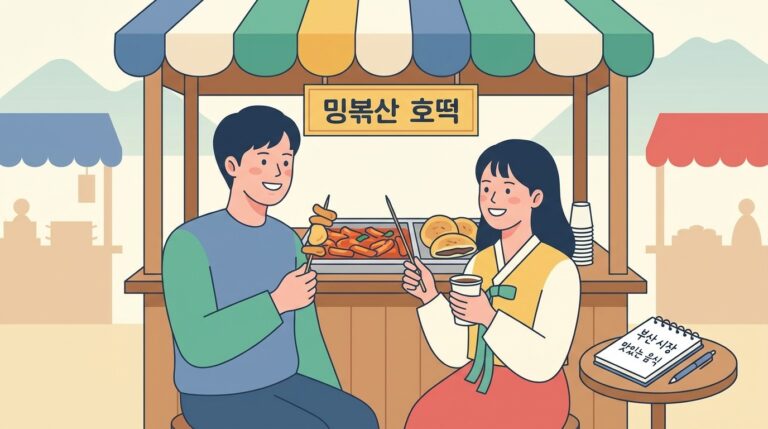
Setting: You are visiting a street food stall (Pojangmacha) in Jagalchi Market, Busan. The stall owner (Eomo-ni) speaks with a strong Gyeongsang accent.
- Eomo-ni: 어서 오이소! 뭣하러 거기 서 있나? 퍼뜩 들어오지! (Welcome! Why are you standing there? Hurry inside!)
- You: 안녕하세요! 날씨가 좀 춥네요. (Hello! The weather is a bit chilly.)
- Eomo-ni: 그래, 오늘 바람이 억수로 불지? 따뜻한 어묵 국물 좀 마시라. (Yeah, the wind is blowing so hard today, right? Have some warm fishcake broth.)
- You: 🎭 [Accepting broth with both hands] 감사합니다! 국물이 정말 시원해요. (Thank you! The soup is really refreshing.)
- Eomo-ni: 가시나가 말도 예쁘게 하네! 뭐 주꼬? 떡볶이 먹을래? (You talk so nicely! What can I get you? Want some Tteokbokki?)
- You: 네! 그런데 제가 매운 걸 잘 못 먹어요. (Yes! But I can’t eat very spicy food well.)
- Eomo-ni: 걱정 마라! 내 안 매운 걸로 싹 다 챙겨줄 테니까. (Don’t worry! I’ll make sure to give you non-spicy ones.)
- You: 🎭 [Smiling warmly] 이모님 최고예요! 자주 올게요. (You’re the best, Eomo-ni! I’ll come often.)
🔀 Interactive Decision Point
The owner offers you an extra portion of food for free (Service). How do you respond?
* Option A: “아니에요, 괜찮습니다. 정가대로 계산해 주세요.” (No, it’s fine. Please charge me full price.)
* Option B: “오매! 이모님, 억수로 감사합니다! 잘 먹을게요!” (Oh my! Thank you so much! I’ll enjoy it!)
* Option C: “진짜요? 다음부터는 돈 받고 파세요.” (Really? Next time sell it for money.)
Feedback:
- Option A (Risk): Too rigid! Rejecting free food (Service) directly can make the friendly host feel awkward.
- Option B (Best): Perfect! Mixing a fun dialect exclamation with genuine gratitude makes you instantly lovable!
- Option C (Bad): Sounds overly blunt and preachy in a casual market setting.
Phase 6: 10-Second Emotion Shadowing Drill
[😊 Cheerful & Expressive]- Sentence: 오매! / 음식 맛이 / 허벌나게 / 좋구마잉!
- Romanization: Omae! / Eumsik masi / heobeolnage / jotgumaing!
- English: Wow! The food taste is insanely good!
[🔥 Energetic & Confident]- Sentence: 맞다 아이가! / 부산 바다가 / 제일 / 멋지다 아이가!
- Romanization: Matda aiga! / Busan badaga / jeil / meotjida aiga!
- English: That’s right! Busan ocean is the coolest, isn’t it!
Phase 7: K-Culture Mini Dictionary
- 사투리 (Saturi) | Dialect / Accent
- Usage: Refers to regional variations of Korean outside standard Seoul speech.
- 속정 (Sok-jeong) | Hidden warmth / Inner affection
- Usage: Used to describe someone who seems cold on the outside but is deeply caring inside.
- 억수로 (Eok-suro) | Extensively / Immensely (Gyeongsang dialect)
- Usage: Replaces standard Korean “매우” or
Frequently Asked Questions (FAQ)
Q: What does "가시나 (Gasina)" mean in Korean and how do you pronounce it?
A: In Korean, "가시나 (Gasina)" is pronounced [ga-si-na] and means: Literal: Girl/Lass | Nuance: A friendly (or affectionate-yet-teasing) Gyeongsang-do dialect term for a young woman or girl.
Q: What does "무뚝뚝하다 (Muttukttukhada)" mean in Korean and how do you pronounce it?
A: In Korean, "무뚝뚝하다 (Muttukttukhada)" is pronounced [moo-ttuk-ttu-kha-da] and means: Literal: Brusque / Blunt | Nuance: Appearing cold or blunt on the surface, often associated with Gyeongsang region male stereotypes.
Q: What does "~아니가? / ~당게? (~aniga? / ~dang-ge?)" mean in Korean and how do you pronounce it?
A: In Korean, "~아니가? / ~당게? (~aniga? / ~dang-ge?)" is pronounced [ah-ni-ga? / dang-ge?] and means: Literal: Isn't it? | Nuance: Sentence-ending dialect tag used to seek agreement or emphasize a point strongly.







