

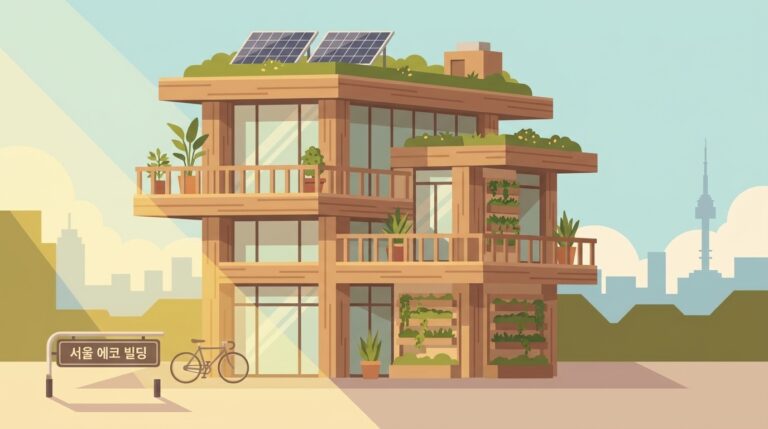
Master C2 Korean: Eco-Friendly Timber Architecture & Fire Safety Secrets
Phase 1: Empathy & Storytelling Opening
안녕하세요! 매일한글 에디터입니다. 👋
Imagine standing inside a soaring, light-filled modern atrium in downtown Seoul. The air smells subtly of fresh pine, and warm wooden beams rise up toward a glass roof. You are presenting an eco-friendly architectural design to a panel of Seoul urban development officials. They look intrigued by the sustainable timber construction (친환경 목조 건축), but then comes the critical, inevitable question from the chief city engineer: “목재 건축물인데, 화재 안전성은 어떻게 확보하셨습니까?” (Since it’s a timber structure, how did you secure fire safety?)
At the C2 level, responding with basic high school vocabulary just won’t cut it. To build authority and articulate technical nuance in Korean, you need precise terms like 내화 성능 (fire-resistance performance), 탄화층 (charred layer), and 구조적 안정성 (structural integrity).
Today, based on feedback from our advanced learners working in design, engineering, and urban planning in Korea, we will dive deep into the sophisticated linguistic universe of eco-friendly architectural Korean. Mastering this unit will empower you to speak with professional poise, negotiate regulatory reviews, and appreciate how modern South Korea bridges ancient timber traditions with cutting-edge green building technology.
Phase 2: Deep Dive into Core C2 Expressions
1. 내화 성능을 확보하다
- Pronunciation: [nae-hwa seong-neung-eul hak-bo-ha-da] (Think: “nae” like neighbor + “hwa” like Far + “seong” like song + “neung” like neong + “hak-bo-ha-da”)
- Meaning: To secure fire-resistance performance (Literally: To guarantee fire-endurance capabilities)
- K-Culture Moment: Seen during high-stakes corporate architectural presentations in architectural K-dramas or ESG sustainability summits in Seoul.
- Editor’s Insight: Standard Korean uses “불에 타지 않다” for non-flammable, but in high-level architectural discourse, “내화 성능을 확보하다” demonstrates professional mastery of regulatory standards.
- Situation Spectrum: Casual 🚫 | Semi-formal ⚠️ | Formal ✅
- 🤔 Think About It: How does utilizing formal technical terms in Korean instantly transform the listener’s perception of your professional expertise?
2. 탄소 배출을 저감하다
- Pronunciation: [tan-so bae-chul-eul jeo-gam-ha-da]
- Meaning: To reduce carbon emissions (Literally: To lower and diminish carbon discharge)
- K-Culture Moment: Frequently featured in Korean news reports discussing South Korea’s 2050 Carbon Neutrality goals and green architecture policies.
- Editor’s Insight: While “줄이다” means to reduce, “저감하다” (저/低 lower + 감/減 diminish) is the official C2 academic term preferred in environmental policy papers and corporate ESG reports.
- Situation Spectrum: Casual 🚫 | Semi-formal ⚠️ | Formal ✅
- 🤔 Think About It: Why does Sino-Korean vocabulary (한자어) carry higher formality and precision in administrative settings?
3. 구조적 안전성을 입증하다
- Pronunciation: [gu-jo-jeok an-jeon-seong-eul ib-jeung-ha-da]
- Meaning: To prove structural safety/integrity
- K-Culture Moment: Used when presenting lab test results or engineering certifications to municipal zoning boards in Korea.
- Editor’s Insight: “입증하다” implies presenting empirical, verifiable evidence—essential when overcoming public skepticism regarding timber skyscrapers.
- Situation Spectrum: Casual 🚫 | Semi-formal ⚠️ | Formal ✅
- 🤔 Think About It: How does framing safety arguments with data-backed verbs reflect Korean corporate workplace expectations?
Phase 3: Textbook Korean vs. Real Professional Korean
Scenario 1: Explaining timber behavior during a fire
- 📖 Textbook Korean: 목재는 불에 타지만 두꺼운 나무는 천천히 탑니다. (Wood burns, but thick wood burns slowly.)
- 🗣️ Real Professional Korean: 대단면 목재는 화재 시 표면에 탄화층을 형성하여 내부 구조를 보호합니다. (Mass timber forms a protective char layer on the surface during fire, preserving the internal structure.)
- 💡 Why it differs: Elementary textbooks oversimplify material reactions. C2 professional discourse relies on technical precision (대단면 목재, 탄화층) to reassure technical experts.
Scenario 2: Addressing regulatory approvals
- 📖 Textbook Korean: 안전 규칙을 잘 지켜서 허가를 받아야 합니다. (We must keep safety rules well to get permission.)
- 🗣️ Real Professional Korean: 엄격한 화재 안전 기준을 충족하여 인허가 절차를 완수하겠습니다. (We will satisfy stringent fire safety standards to complete the licensing process.)
- 💡 Why it differs: Using formal administrative verbs like 충족하다 (satisfy/fulfill) and 완수하다 (accomplish/complete) reflects native level executive communication.
Phase 4: K-Culture Deep Dive & Non-Verbal Etiquette
4-1. Nunchi & Professional Gestures
When presenting technical plans to senior Korean engineers or government officials, 눈치 (Nunchi) dictates balancing bold confidence with respectful humility:
* Eye Contact & Posture: Keep a erect, comfortable stance. Maintain direct eye contact while explaining key metrics, but gently nod when answering senior panel members’ concerns.
* Two-Handed Courtesy: When handing over blueprint documents or digital tablets for review, always use both hands (양손 사용).
* Affirmative Listening: Use active listening cues such as “네, 검토해 주신 바와 같이…” (Yes, as you have reviewed…) before offering counter-arguments.
4-2. Architectural Culture Code: Hanok Philosophy Meets Mass Timber
Korea’s modern push toward heavy timber construction (중목구조) is not merely a modern Western trend—it connects deeply with historic Korean architectural heritage. Traditional 한옥 (Hanok) prioritized harmony with nature, passive ventilation, and non-toxic natural materials. Today’s urban Seoul architects combine CLT (Cross-Laminated Timber) engineering with ancient Hanok joinery principles, proving that sustainability is rooted in traditional Korean philosophy.
Phase 5: Real-World Interactive Roleplay Scenario
Setting: A formal consultation room at the Seoul Metropolitan Government Architectural Review Board.
Characters:
* 민준 (Min-jun): Lead Eco-Architect (played by You)
* 박 팀장 (Team Leader Park): Senior Municipal Safety Examiner (NPC)
- Turn 1 (박 팀장): “민준 씨, 이번 목조 복합단지 설계안은 친환경적이고 인상적입니다. 하지만 화재 안전성 부분에 대한 염려가 큰 게 사실입니다.” (Min-jun, this timber complex design is eco-friendly and impressive. However, it’s true that there are great concerns regarding fire safety.)
- 🎭 Action: Adjusts glasses and looks closely at the cross-sectional blueprint.
- Turn 2 (민준): “네, 팀장님. 그 부분에 대해 사전에 철저히 검토를 마쳤습니다.” (Yes, Team Leader Park. We have thoroughly reviewed that point in advance.)
- 🎭 Action: Maintains calm eye contact and opens the fire resistance data portfolio.
- Turn 3 (박 팀장): “구체적으로 고층 목조건축물의 내화 성능을 어떻게 입증하실 계획입니까?” (Specifically, how do you plan to prove the fire-resistance performance of a high-rise timber building?)
-
Turn 4 (민준): “대단면 목재의 탄화 저항 특성을 활용하여 2시간 이상의 내화 시간을 확보했습니다.” (Utilizing the charring resistance properties of mass timber, we have secured a fire endurance rating of over 2 hours.)
-
Turn 5 (박 팀장): “탄화층이 내부 구조를 보호한다는 뜻이군요. 그럼 스프링클러나 추가 불연재 보강은 어떻게 되나요?” (You mean the char layer protects the inner structure. Then what about sprinklers or additional non-combustible material reinforcement?)
-
Turn 6 (민준): “이중 소화 시스템과 불연 마감재를 혼용하여 화재 확산을 원천 차단하도록 설계했습니다.” (We designed it to fundamentally prevent fire spread by combining a dual suppression system with non-combustible finishing materials.)
-
Turn 7 (박 팀장): “음, 기술적 근거가 아주 명확하군요. 탄소 배출 저감 효과와 안전성을 동시에 잡은 점을 높이 평가합니다.” (Hmm, the technical evidence is very clear. I highly evaluate the fact that you achieved carbon emission reduction and safety simultaneously.)
-
Turn 8 (민준): “감사합니다. 관련 시험 성적서와 인증 서류도 완벽히 제출하겠습니다.” (Thank you. We will also submit all relevant test certificates and certification documents completely.)
- 🎭 Action: Bows slightly at 15 degrees with hands folded respectfully.
🔀 Interactive Choice Point
How would you respond if Team Leader Park asks: “목재 건축이 기존 콘크리트 건물보다 정말 친환경적입니까?”
- Choice A: “네, 나무가 콘크리트보다 당연히 몸에 좋고 훨씬 예쁩니다!” (Yes, wood is obviously better for health and much prettier than concrete!)
- Choice B: “목재는 제조 과정에서 탄소 배출을 저감할 뿐만 아니라, 탄소를 가두는 효과가 있어 자원순환 측면에서 탁월합니다.” (Timber not only reduces carbon emissions during production, but also stores carbon, making it superior in terms of resource circulation.)
- Choice C: “콘크리트는 환경에 안 좋으니까 이제 전부 나무로 바꿔야 합니다.” (Because concrete is bad for the environment, we must replace everything with wood now.)
Feedback:
- Best (Choice B): Perfect! You used C2 concepts (탄소 배출 저감, 자원순환) and maintained professional objectivity.
- Bad (Choice A): Too casual and subjective for an executive architectural review.
- Risk (Choice C): overly aggressive and dismissive of traditional building methods; lacks professional diplomacy.
Phase 6: 10-Second Emotional Shadowing Drill
Practice reading these C2 phrases aloud using natural cadence and emotion markers:
- [💼 단호하고 전문적으로 / Firm & Professional]
“본 설계안은 / 엄격한 내화 시험을 통과하여 / 구조적 안전성을 / 완전히 입증했습니다.”
(This design / passed rigorous fire tests / and structural safety / has been fully proven.) -
[🌱 진정성 있고 설득력 있게 / Sincere & Persuasive]
“친환경 목조건축은 / 탄소 배출을 저감하고 / 도심 속 자연과의 공존을 / 실현하는 열쇠입니다.”
(Eco-friendly timber architecture / reduces carbon emissions / and coexistence with nature in the city / is the key to achieving.)
Phase 7: K-Culture Mini Dictionary
- 탄화층 (Tanhwacheung) | Charred Layer | The protective carbon surface formed when heavy timber is exposed to fire, slowing heat transfer to the inner core.
- 중목구조 (Jungmok-gujo) | Heavy Timber / Mass Timber Construction | Architectural system using large structural timber elements (such as CLT or Glulam) with high load-bearing and fire capacity.
- 친환경 건축 인증 (Chinhwangyeong geonchuk injeung) | Green Building Certification | South Korea’s official accreditation program (G-SEED) evaluating energy efficiency and eco-friendly materials.
- 불연재 (Buryeonjae) | Non-Combustible Material | Construction materials that do not catch fire or release toxic fumes under standard fire conditions.
Phase 8: Traveler & Professional Survival Kit
Survival Top 3 Expressions
- “이 건축물의 내화 등급은 어떻게 되나요?” (What is the fire-resistance rating of this building?)
- “목재 표면 탄화 처리가 적용되었습니까?” (Has timber surface charring treatment been applied?)
- “친환경 건축 인증 항목을 확인하고 싶습니다.” (I would like to verify the green building certification items.)
Editor’s Travel Note
Planning an architectural tour of Seoul’s leading eco-timber structures? Use official navigation apps rather than global maps for accurate routing. You can 네이버 지도 앱 다운로드 to search for landmark timber projects such as the Korea Forest Service Eco Timber Hub or Seoul Wood Architecture Centers.
Phase 9: One Step Deeper (Reflection)
Korea’s modern urban landscape is rapidly evolving. For decades, concrete apartments defined rapid industrialization. Today, the resurgence of wooden architecture symbolizes a cultural shift toward wellness, ecological responsibility, and connection to heritage. By blending traditional woodworking philosophies with cutting-edge engineering, contemporary Korean architects are proving that progress doesn’t mean leaving natural roots behind.
💬 Your Turn: How does eco-friendly architecture in your home country balance safety regulations with sustainable design? Share your thoughts in Korean in the comments below!
Phase 10: FAQ & Common Mistakes
Q: Is wood architecture legal for tall buildings in South Korea?
A: Yes! Recent revisions in South Korea’s Building Act and fire safety codes allow mass timber structures (중목구조) provided they pass strict fire-resistance performance tests (내화성능 기준).
Q: Does “목재” mean the same thing as “나무”?
A: While both mean wood/tree, “나무” is everyday Korean for living trees or raw wood, whereas “목재” refers specifically to wood as an processed architectural or industrial material.
Q: How do I express carbon reduction in a formal report?
A: Use “탄소 배출 저감” or “탄소 중립” (Carbon Neutrality) rather than everyday phrases like “탄소 줄이기”.
🚨 Common Mistakes TOP 3
- Wrong: “목재가 불에 안 타요.” (Wood doesn’t burn – scientifically inaccurate).
- Correct Action: “대단면 목재는 높은 내화 성능을 지닙니다.” (Mass timber possesses high fire-resistance performance).
- Wrong: “친환경을 만들다.” (Awkward verb collocation).
- Correct Action: “친환경 가치를 실현하다 / 구현하다.” (Realize / embody eco-friendly value).
- Wrong: Using informal speech when presenting to city officers.
- Correct Action: Stick strictly to formal endings (-ㅂ니다 / -습니다).
Phase 11: Action Mission
- 🥉 Bronze: Record yourself reading the 2 shadowing sentences from Phase 6 with accurate pause markers.
- 🥈 Silver: Write a 3-sentence summary in formal Korean explaining why mass timber is fire safe.
- 🥇 Gold: Watch an episode of a Korean design documentary or architectural webinar and spot 3 vocabulary words learned today!
Phase 12: Interactive Quiz Challenge
Quiz 1: Nuance Check
Which phrase is most appropriate when submitting an official safety evaluation report to Seoul city hall?
* A) 불이 안 나게 조심하겠습니다.
* B) 내화 성능 시험을 통과하여 구조적 안전성을 입증하였습니다.
* C) 나무가 두꺼워서 괜찮습니다.
Quiz 2: True or False
Mass timber relies on its surface forming a charred layer (탄화층) to slow down thermal penetration to its structural core during a fire. (True / False)
🔍 Click to reveal answers & explanations!
- Quiz 1 Answer: B — Professional corporate context requires exact technical terms like 내화 성능 and 구조적 안전성.
- Quiz 2 Answer: True — The formation of a 탄화층 (char layer) is the primary scientific mechanism allowing heavy timber buildings to meet stringent structural fire safety criteria.







