

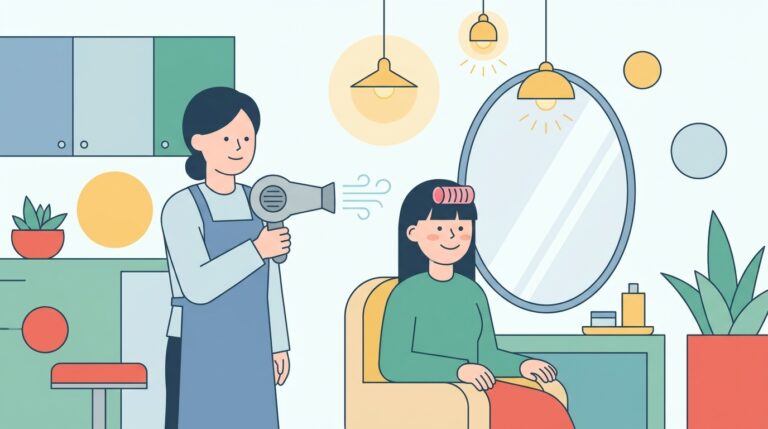
Getting Your Hair Dried at a Korean Salon: Master the Breeze Like a Local!
Phase 1: Empathy (Welcome to the K-Beauty Chair!)
안녕하세요! (Annyeonghaseyo!) Welcome back to Daily Hangul, your friendly neighborhood guide to mastering Korean culture and language. I’m your lead editor, and today we are stepping into one of the most exciting yet slightly nerve-wracking places in Korea: the K-Beauty Hair Salon (미용실 – mi-yong-sil)!
Picture this: You’ve just had a luxurious, relaxing hair wash. Your scalp feels amazing. You sit back down in the styling chair. The stylist grabs the hairdryer. Suddenly, they ask you a question over the roaring sound of the fan, or perhaps they start blow-drying your hair in a way that’s too hot, or maybe you want to ask them to dry it thoroughly because it’s freezing outside.
Many of our learners tell us: “I knew how to ask for a haircut, but when it came to the drying and styling part, I just froze and nodded like a robot!”
Don’t worry! Today, we are going to learn exactly how to communicate your needs during the drying phase, using simple, natural, and polite A2-level Korean. Let’s dive in!
Phase 2: Deep Dive into 3 Key Expressions
1. 바짝 말려주세요 (ba-jjak mal-lyeo-ju-se-yo)
- Pronunciation: “Bah-jjak mahl-lyuh-joo-seh-yo” (Sounds like ‘bah-jjak’ as in a quick, crisp snap!)
- Meaning: Please dry it completely / bone-dry.
- K-Culture Moment: In Korea, especially during the freezing winter (han-pa), leaving a salon with damp hair is a big no-no because your hair might literally freeze! Stylists will often ask if you want it fully dried or naturally styled.
- Editor’s Insight: 바짝 (ba-jjak) is an adverb meaning “completely” or “closely.” It shows you want no moisture left behind.
- Situation Spectrum: Casual ⚠️ | Semi-formal ✅ | Formal 🚫
- 🤔 Think About It: In your home country, do people usually leave the salon with damp hair to let it dry naturally, or do they always dry it completely? Why do you think Koreans prefer a quick, complete dry?
2. 찬바람으로 말려주세요 (chan-ba-ram-eu-ro mal-lyeo-ju-se-yo)
- Pronunciation: “Chahn-bah-rahm-eu-ro mahl-lyuh-joo-seh-yo” (Think of ‘chan’ as ‘chilly’ and ‘baram’ like the wind blowing through trees.)
- Meaning: Please dry it with cool air.
- K-Culture Moment: Many Koreans are highly invested in scalp care (du-pi care). Hot air can damage sensitive scalps and dry out color-treated hair, so asking for cool air is a very common and smart request!
- Editor’s Insight: 찬 (chan) comes from 차갑다 (cha-gap-da – to be cold), and 바람 (ba-ram) means “wind/breeze.”
- Situation Spectrum: Casual ⚠️ | Semi-formal ✅ | Formal 🚫
- 🤔 Think About It: Does your local salon automatically use cool air, or do you have to ask for it? Learning to ask for this keeps your hair healthy anywhere!
3. 앞머리는 구루프(헤어롤) 말아주세요 (ap-meo-ri-neun gu-ru-peu mar-a-ju-se-yo)
- Pronunciation: “Ahp-muh-ree-neun goo-roo-peuh mahl-ah-joo-seh-yo” (‘Ap-meori’ means bangs, and ‘gu-ru-peu’ is the Korean-style loanword for hair rollers/curlers.)
- Meaning: Please put my bangs in a hair roller.
- K-Culture Moment: If you walk down the streets of Seoul, you will inevitably see students and young women riding the subway or walking with a giant plastic roller (구루프) in their bangs. It is the ultimate K-Beauty styling secret for bouncy volume!
- Editor’s Insight: Even inside the salon, asking the stylist to set your bangs with a roller while drying the rest of your hair ensures that perfect, airy K-drama fringe.
- Situation Spectrum: Casual ⚠️ | Semi-formal ✅ | Formal 🚫
- 🤔 Think About It: Why do you think the hair roller became an acceptable public fashion accessory in Korea? It shows how much Koreans value the perfect volume of their bangs!
Phase 3: Textbook Korean vs. Real-Life Korean
Let’s compare what textbooks teach you versus what Koreans actually say in the salon chair.
Scenario 1: Asking to dry the hair
- 📖 Textbook Korean: 머리를 건조해 주세요. (meo-ri-reun geon-jo-hae ju-se-yo) – “Please desiccate/dry my hair.”
- 🗣️ 진짜 (Real-Life) Korean: 머리 말려주세요. (meo-ri mal-lyeo-ju-se-yo) – “Please dry my hair.”
- 💡 Why the difference? 건조 (geon-jo) is a clinical, chemical term for “drying/dehydration.” If you use it, you sound like a washing machine manual! In real life, always use the verb 말리다 (mal-li-da) for drying hair, clothes, or hands.
Scenario 2: Asking not to use hot air
- 📖 Textbook Korean: 뜨거운 공기를 사용하지 마세요. (tteu-geo-un gong-gi-reul sa-yong-ha-ji ma-se-yo) – “Do not use hot air.”
- 🗣️ 진짜 (Real-Life) Korean: 너무 뜨거워요! (neo-mu tteu-geo-wo-yo!) – “It’s too hot!”
- 💡 Why the difference? The textbook version sounds like a strict command or safety warning. Simply saying 너무 뜨거워요! with a polite tone gets the job done instantly and naturally.
Phase 4: K-Culture Deep Dive & Non-Verbal Manners
4-1. Nunchi (눈치) & Salon Gestures
When your hair is being blow-dried, the noise is loud, making verbal communication tricky. This is where 눈치 (Nunchi – situational wit) and body language come in handy:
1. The Gentle Head Tilt: If the stylist nudges your head slightly, don’t resist! Keep your neck relaxed and let them guide your head to get the perfect drying angle.
2. The Hand Shield: If the hot air gets too close to your forehead or ears, gently raise your hand near your face. The stylist will immediately see this gesture and adjust the angle or temperature.
4-2. The “Volume” Obsession (뿌리 볼륨)
In Korean beauty culture, flat hair is considered a styling emergency! Stylists spend a significant amount of time drying the hair upside down or using round brushes at the roots. This is called 뿌리 볼륨 (ppoo-ri bol-lyum – root volume). Don’t be surprised if they dry your hair in directions you didn’t expect; they are just trying to give you that gorgeous, voluminous K-beauty look!
Phase 5: Real-Life Roleplay Scenario
Meet Ji-su (지수), a friendly stylist at a trendy salon in Hongdae. Today, you are sitting in her chair!
Character Profile:
* Ji-su (Stylist): Energetic, uses a sweet tone, and wants to make sure you love your hair.
* You (Customer): Wants a nice, cool-air dry because your scalp is sensitive.
The Dialogue (8 Turns)
- 지수: 🎭 [Smiles and wraps a towel around your shoulders]
머리 시원하셨어요? 이제 드라이 해드릴게요.
(meo-ri si-won-ha-syeot-eou-yo? i-je deu-ra-i hae-deu-ril-ge-yo.)
“Was the hair wash refreshing? I’ll dry your hair now.” -
You: 네, 정말 시원했어요! 감사합니다.
(ne, jeong-mal si-won-haet-eo-yo! gam-sa-hap-ni-da.)
“Yes, it was really refreshing! Thank you.” -
지수: 🎭 [Turns on the hairdryer]
바람 온도 괜찮으세요?
(ba-ram on-do gwen-chan-eu-se-yo?)
“Is the air temperature okay?” -
You: 🎭 [Gently raises a hand]
아, 조금 뜨거워요. 찬바람으로 말려주세요.
(ah, jo-geum tteu-geo-wo-yo. chan-ba-ram-eu-ro mal-lyeo-ju-se-yo.)
“Ah, it’s a little hot. Please dry it with cool air.” -
지수: 🎭 [Quickly adjusts the setting]
아, 죄송해요! 이제 괜찮으세요?
(ah, joe-song-hae-yo! i-je gwen-chan-eu-se-yo?)
“Ah, I’m sorry! Is it okay now?” -
You: 네, 지금 딱 좋아요!
(ne, ji-geum ttak jo-a-yo!)
“Yes, it’s perfect right now!” -
지수: 앞머리도 드라이 해드릴까요?
(ap-meo-ri-do deu-ra-i hae-deu-ril-kka-yo?)
“Should I blow-dry your bangs too?” -
You: 앞머리는 구루프 말아주세요!
(ap-meo-ri-neun gu-ru-peu mar-a-ju-se-yo!)
“Please put my bangs in a hair roller!”
🔀 Interactive Choice Point
Ji-su asks you if you want any styling hair essence at the end:
“에센스 발라드릴까요? (e-sen-se bal-la-deu-ril-kka-yo? – Shall I apply some hair essence?)”
- A) “네, 조금만 발라주세요.” (ne, jo-geum-man bal-la-ju-se-yo.)
👉 Best Choice! You politely asked for “just a little bit” of essence. Perfect for keeping your hair shiny but not oily. - B) “아니요, 괜찮아요.” (a-ni-yo, gwen-chan-a-yo.)
👉 Good Choice! A polite way to decline if you prefer your hair product-free. - C) “싫어요.” (sil-eo-yo.)
👉 Risk Choice! This means “I hate it/No.” It sounds too blunt and rude to use with a stylist who is trying to help! Use option B instead.
Phase 6: 10-Second Emotion Shadowing Drill
Practice saying these lines with the correct feeling! The / represents a short pause to help you sound natural.
- [🥺 Politely asking for cool air]
- 조금 뜨거워요. / 찬바람으로 / 말려주세요.
- (jo-geum tteu-geo-wo-yo. / chan-ba-ram-eu-ro / mal-lyeo-ju-se-yo.)
- [😊 Happy and satisfied]
- 네, / 지금 딱 / 좋아요!
- (ne, / ji-geum ttak / jo-a-yo!)
- [🙋♀️ Confidently requesting a hair roller]
- 앞머리는 / 구루프 / 말아주세요!
- (ap-meo-ri-neun / gu-ru-peu / mar-a-ju-se-yo!)
Phase 7: K-Culture Mini Dictionary
- 드라이 (deu-ra-i) | Blow-dry / Styling
- Usage: Used as a noun. Salons often charge separately for “cut” (커트) and “dry” (드라이).
- 구루프 (gu-ru-peu) | Hair Roller / Curler
- Usage: A loanword derived from Japanese/English, universally used in Korea for plastic velcro rollers.
- 앞머리 (ap-meo-ri) | Bangs / Fringe
- Usage: Literally translates to “front hair.”
- 에센스 (e-sen-se) | Hair Serum / Essence
- Usage: Applied at the very end of drying to protect hair ends.
Phase 8: Traveler’s Survival Kit
Survival Expressions TOP 3
- 뜨거워요! (tteu-geo-wo-yo!) – It’s hot!
- Pro Tip: Use this immediately if the dryer gets too close to your ears.
- 바짝 말려주세요. (ba-jjak mal-lyeo-ju-se-yo.) – Please dry it completely.
- Pro Tip: Perfect to say during winter so you don’t catch a cold outside.
- 자연스럽게 해주세요. (ja-yeon-seu-rop-ge hae-ju-se-yo.) – Please style it naturally.
- Pro Tip: If you don’t want heavy hairspray or tight curls.
📌 Editor’s Travel Note: To book a trendy hair salon in Seoul, we highly recommend using the Naver Map App where you can search for “미용실” near you and even book appointments directly. Note: Salon prices and booking systems are subject to change depending on the shop’s policy.
Phase 9: “A Step Deeper” (Reflections on Korean Politeness)
In Korean culture, when you are receiving a service (like a haircut or a taxi ride), it is customary to show appreciation for the worker’s effort. Instead of just saying “No” or “Yes,” adding soft words like “감사합니다” (Thank you) or “조금만요” (Just a little) makes a huge difference in how you are perceived.
💬 Your Turn: Have you ever been to a Korean hair salon? What was your experience like? Let us know in the comments below!
Phase 10: FAQ & Avoiding Common Mistakes
Q: Can I use the word “드라이기” (deu-ra-i-gi) to mean blow-dry?
A: 드라이기 (deu-ra-i-gi) refers to the physical machine (hairdryer). If you want to talk about the action of styling/drying, use 드라이 (deu-ra-i) or 말리기 (mal-li-gi).
Q: How do I tell them my scalp is sensitive?
A: You can say, “두피가 민감해요” (du-pi-ga min-gam-hae-yo). This lets the stylist know to keep the heat low.
Q: Should I tip the stylist in Korea?
A: No! Tipping is not practiced in South Korea. The price on the bill is exactly what you pay.
🚨 Common Mistakes Alert!
- Mistake: Saying “머리를 건조하세요” (meo-ri-reul geon-jo-ha-se-yo).
- Correct Action: Say “머리 말려주세요” (meo-ri mal-lyeo-ju-se-yo). 건조 sounds like a science experiment!
- Mistake: Screaming “뜨겁다!” (tteu-geop-da!) when it’s hot.
- Correct Action: This is the casual/impersonal form. Always add -요 to be polite: “뜨거워요!” (tteu-geo-wo-yo!).
Phase 11: Action Mission!
- 🥉 Bronze Mission: Read the 3 key expressions aloud 5 times in front of a mirror while pretending to hold a hair roller.
- 🥈 Silver Mission: Share this post on your Instagram or Twitter and tag us with the phrase you want to use most!
- 🥇 Gold Mission: Next time you wash your hair at home, practice saying “찬바람으로 말려야지!” (I should dry it with cool air!) to yourself.
Phase 12: Interactive Quiz Challenge
1. Which word refers to “cool air” in Korean?
- A) 뜨거운 바람 (tteu-geo-un ba-ram)
- B) 찬바람 (chan-ba-ram)
- C) 물바람 (mul-ba-ram)
정답 보기 (View Answer)
정답: B) 찬바람 (chan-ba-ram)
해설: ‘찬’ comes from cold, and ‘바람’ means wind. A means hot air, and C is a made-up word!
2. True or False: “구루프” is used to style bangs.
- True
- False
정답 보기 (View Answer)
정답: True
해설: Yes! ‘구루프’ (hair roller) is famously used by Koreans to keep their bangs voluminous and bouncy.







