

Happy New Year the Korean Way! Master “Saehae Bok Mani Badeuseyo”
Phase 1: Empathy (Welcome to Seollal!)
안녕하세요! (Annyeonghaseyo!) I’m your senior editor and Korean culture navigator at Daily Hangul.
Imagine this: It’s late January, and you are invited to a Korean friend’s home for Seollal (설날 – Lunar New Year). The house smells like delicious sesame oil and savory pan-fried jeon (전). Everyone is dressed in beautiful pastel-colored Hanboks. Your friend’s grandmother looks at you with a warm smile, waiting for a greeting.
You want to say “Happy New Year,” but suddenly your mind goes blank. Is it “Saehae… what?” Do I bow? Do I wave?
Don’t worry! Every beginner gets nervous during their first Korean holiday. Today, we are going to learn the most essential, magical phrase that will instantly melt the hearts of any Korean family: “새해 복 많이 받으세요” (Saehae bok mani badeuseyo). Let’s make you look like a Korean culture pro!
Phase 2: Deep Dive into Key Expressions
1. 새해 복 많이 받으세요 (Saehae bok mani badeuseyo)
- Pronunciation: Sae-hae bok mah-nee bah-deu-seh-yo (Sounds like: “Say-hay bok mah-nee bah-deh-say-yo”)
- Meaning: “Please receive a lot of good fortune in the New Year.”
- K-Culture Moment: You will see your favorite K-Pop idols wearing Hanbok on YouTube, bowing to the camera, and saying this in unison.
- Editor’s Insight: Unlike the English “Happy New Year,” which is a statement of emotion, the Korean greeting is a beautiful wish of blessing (“복/bok” means luck or blessing) to the other person.
- Situation Spectrum: Casual: 🚫 | Semi-formal: ✅ | Formal: ✅
- 🤔 Think About It: Why do you think Koreans wish for “receiving fortune” rather than just “being happy”? How does this reflect the community-focused culture of Korea?
2. 새해 복 많이 받아 (Saehae bok mani bada)
- Pronunciation: Sae-hae bok mah-nee bah-dah
- Meaning: “Receive lots of New Year’s luck!” (Casual/Banmal)
- K-Culture Moment: Best friends texting each other at midnight on New Year’s Eve with cute heart emojis.
- Editor’s Insight: Drop the polite “요 (yo)” only when talking to someone younger than you or of the exact same age who you are very close with.
- Situation Spectrum: Casual: ✅ | Semi-formal: 🚫 | Formal: 🚫
3. 건강하고 행복하세요 (Geonganghago haengbokhaseyo)
- Pronunciation: Geon-gang-hah-go haeng-bok-hah-seh-yo
- Meaning: “Please be healthy and happy.”
- K-Culture Moment: Often written on beautiful handmade New Year cards sent to teachers, bosses, or elderly relatives.
- Editor’s Insight: This is the perfect follow-up sentence to use right after saying “Saehae bok mani badeuseyo.”
- Situation Spectrum: Casual: ⚠️ | Semi-formal: ✅ | Formal: ✅
Phase 3: Textbook Korean vs. Real-Life Korean
Situation 1: Texting a Korean friend on New Year’s Day
- 📖 Textbook Korean: “새해 복 많이 받으십시오.” (Saehae bok mani badeusipsio – Extremely formal, sounds like a military broadcast)
- 🗣️ Real-Life Korean: “새해 복 많이 받아! 🧧 올 한 해도 건강하자!” (Saehae bok mani bada! Ol han haedo geonganghaja! – “Get lots of New Year’s luck! Let’s stay healthy this year too!”)
- 💡 Why the difference? Real-life friendships thrive on “Banmal” (casual language) which creates instant warmth and intimacy, avoiding stiff textbook grammar.
Situation 2: Greeting your Korean partner’s parents
- 📖 Textbook Korean: “새해 축하합니다.” (Saehae chukahamnida – “Congratulations on the New Year”)
- 🗣️ Real-Life Korean: “어머님, 아버님, 새해 복 많이 받으세요! 항상 건강하세요.” (Eomoneom, abeonim, saehae bok mani badeuseyo! Hangsang geonganghaseyo. – “Mother, Father, please receive lots of New Year’s luck! Please always be healthy.”)
- 💡 Why the difference? Using “어머님” (Mother) and “아버님” (Father) shows high respect, and wishing for their health is the ultimate polite gesture.
Phase 4: K-Culture Deep Dive & Non-Verbal Manners
4-1. The Art of the Seobaerae (세배 – New Year Bow)
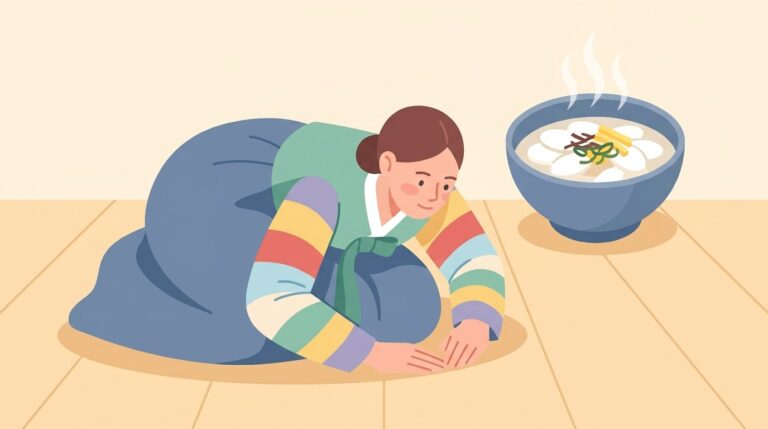
When saying “Saehae bok mani badeuseyo” to elders during Seollal, you don’t just stand there! You perform Sebae (세배), a deep formal bow to the ground.
* For Men: Place your left hand over your right hand, kneel, and bow your head to your hands.
* For Women: Place your right hand over your left hand, raise your hands to chin level, sit down gently, and bow.
* Eye Contact: Keep your eyes downcast to show utmost respect. Do not look directly into their eyes while bowing!
4-2. Tteokguk (떡국) and Aging
Did you know that in Korea, eating a bowl of Tteokguk (rice cake soup) on Seollal is what officially makes you one year older? If a Korean auntie asks you: “Tteokguk myeot geurot meogeosseo?” (How many bowls of tteokguk did you eat?), she is playfully asking how old you are!
Phase 5: Real-Life Roleplay Scenario
Setting: You are visiting your Korean friend Minjun’s house on Seollal morning. Minjun’s grandmother (Halmeoni) is sitting on the living room floor.
- Halmeoni: “어머, 외국인 친구가 왔네! 반가워요.” (Oh, a foreign friend is here! Nice to meet you.)
- You (🎭 Bowing slightly): “안녕하세요, 할머니!” (Hello, Grandmother!)
- Minjun: “할머니한테 세배 드려야지!” (You should do the Sebae bow to Grandmother!)
- You (🎭 Kneeling slowly and bowing deep to the floor): “새해 복 많이 받으세요!” (Please receive lots of luck in the New Year!)
- Halmeoni (🎭 Smiling warmly, giving you a crisp 10,000 won bill as Sebaetdon – pocket money): “아이구, 기특해라! 올 한 해 건강하고 공부 열심히 해요!” (Oh, how admirable! Stay healthy and study hard this year!)
- You (🎭 Holding the money with both hands): “감사합니다, 할머니!” (Thank you, Grandmother!)
- Minjun: “우와, 너 세뱃돈 받았다! 부럽다~” (Wow, you got New Year money! I’m jealous~)
- You (🎭 Smiling brightly): “헤헤, 할머니 최고!” (Hehe, Grandmother is the best!)
🔀 Choose Your Next Move!
- Option A: You immediately put the pocket money into your pocket with one hand.
- Option B: You hold the money with two hands, bow slightly, and say “감사합니다 (Gamsahamnida).”
- Option C: You say “No, thank you” and push the money back to the grandmother.
Feedback:
- Option A (Risk): Uh-oh! Taking money from an elder with one hand or pocketing it too quickly can look slightly impolite. Always use two hands!
- Option B (Best): Perfect! Receiving gifts or money with both hands while expressing gratitude is the peak of Korean manners.
- Option C (Bad): Oh no! Refusing Sebaetdon from elders is actually impolite as it rejects their blessing. Accept it with a happy heart!
Phase 6: 10-Second Emotion Shadowing Drill
Let’s practice the rhythm! Speak with the specified emotions to sound natural.
[😊 Super warm and respectful]
*
Frequently Asked Questions (FAQ)
Q: What does "새해 복 많이 받으세요 (Saehae bok mani badeuseyo)" mean in Korean and how do you pronounce it?
A: In Korean, "새해 복 많이 받으세요 (Saehae bok mani badeuseyo)" is pronounced [Sae-hae bok mah-nee bah-deu-seh-yo (Sounds like: "Say-hay bok mah-nee bah-deh-say-yo"] and means: "Please receive a lot of good fortune in the New Year."
Q: What does "새해 복 많이 받아 (Saehae bok mani bada)" mean in Korean and how do you pronounce it?
A: In Korean, "새해 복 많이 받아 (Saehae bok mani bada)" is pronounced [Sae-hae bok mah-nee bah-dah] and means: "Receive lots of New Year's luck!" (Casual/Banmal)
Q: What does "건강하고 행복하세요 (Geonganghago haengbokhaseyo)" mean in Korean and how do you pronounce it?
A: In Korean, "건강하고 행복하세요 (Geonganghago haengbokhaseyo)" is pronounced [Geon-gang-hah-go haeng-bok-hah-seh-yo] and means: "Please be healthy and happy."






