

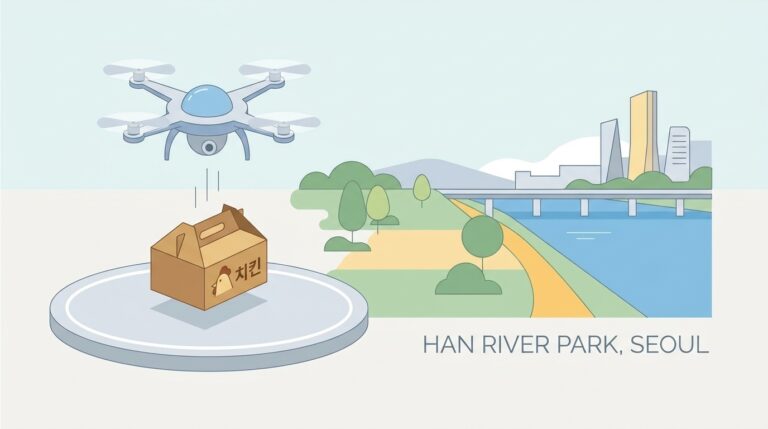
Chasing the Future: Is Korea Ready for Drones to Deliver Your Fried Chicken?
안녕하세요! It’s your K-culture companion and senior editor at Daily Hangul (매일한글). Have you ever stood by the Han River, ordered a box of crispy Korean fried chicken via an app, and had it delivered to your exact picnic mat within 30 minutes? Korea’s delivery culture (배달 문화 – baedal munhwa) is legendary. But as technology advances, we are on the verge of a massive shift: drone delivery (드론 배달 – deuron baedal).
For advanced learners (C1), discussing futuristic logistics isn’t just about vocabulary; it’s about debating societal readiness, tech skepticism, and the deeply rooted Korean desire for ultra-fast service. Today, let’s dive into how Koreans talk about the commercialization of drone deliveries, master high-level nuance, and explore the cultural psychology behind the tech!
Phase 2: Deep-Dive into 3 Essential Advanced Expressions
To debate drone delivery like a native, you need words that capture transition, skepticism, and commercial viability. Let’s analyze three premium C1-level expressions.
1. 상용화 단계에 접어들다 (sang-yong-hwa dang-gye-e jeob-eo-deul-da)
- Pronunciation: Sang-yong-hwa dang-gye-e jub-uh-deul-da (Sounds like “sahng-yong-hwah” + “dahng-gyeh-eh” + “jub-uh-deul-dah”)
- Meaning: To enter the phase of commercialization / To become commercially viable.
- K-Culture Moment: You will hear this phrase constantly on Korean tech news programs like SBS Biz or JTBC News when anchorpersons discuss self-driving cars or drone deliveries in remote islands like Jeju or Gapyeong.
- Editor’s Insight: ‘상용화’ (commercialization) combines ‘상업’ (commerce) and ‘이용’ (utilization). ‘접어들다’ means to physically enter a path or reach a certain time/state. It sounds highly professional and is perfect for business meetings.
- Situation Spectrum: Casual 🚫 | Semi-formal ⚠️ | Formal ✅
- 🤔 Think About It: How does your home country define the point when a technology is “commercially viable”? Is it safety first, or market demand?
2. 시기상조이다 (si-gi-sang-jo-i-da)
- Pronunciation: She-ghee-sahng-jo-ee-dah (Rhymes with “she-ghee” + “sahng-jo” + “is-da”)
- Meaning: It is premature / Too early to tell.
- K-Culture Moment: In K-Dramas featuring corporate boardrooms (like Start-Up), a conservative director will inevitably wave their hand at a new proposal and sigh, “그건 아직 시기상조입니다” (That is still premature).
- Editor’s Insight: This is a four-character idiom (사자성어) derivative: 時期尙早. It’s a sophisticated way to express skepticism without sounding flatly negative.
- Situation Spectrum: Casual ⚠️ | Semi-formal ✅ | Formal ✅
- 🤔 Think About It: Why are Koreans, who usually love speed (빨리빨리), sometimes conservative about drone safety? What is the balance between speed and security?
3. 발목을 잡다 (bal-mok-eul jap-da)
- Pronunciation: Bal-mok-eul jahp-dah (Sounds like “bahl-mohk-eul” + “jahp-dah”)
- Meaning: To hold someone back / To hinder progress (Literal: “To grab someone’s ankle”).
- K-Culture Moment: Used widely in sports news when an injury holds back a star player, or in economic debates when “규제” (regulations) hold back tech startups.
- Editor’s Insight: This idiom perfectly describes regulatory bottlenecks preventing drone flights over high-density apartment complexes in Seoul.
- Situation Spectrum: Casual ✅ | Semi-formal ✅ | Formal ✅
- 🤔 Think About It: Is there an ankle-grabbing regulatory hurdle in your country that stops cool technology from launching?
Phase 3: Textbook Korean vs. Real-Life Korean
When debating tech feasibility, textbook phrases can make you sound like an instruction manual. Let’s look at how native speakers actually voice these concepts.
Scenario 1: Expressing that something is hard to believe/achieve right now
- 📖 Textbook: 드론 배달은 현재 실현되기 어렵습니다. (Deuron baedareun hyeonjae silhyeondegi eoryeopseumnida. – Drone delivery is difficult to realize currently.)
- 🗣️ Real-Life: 드론 배달이 진짜 대세가 되기엔 아직 갈 길이 멀었죠. (Deuron baedari jinjja daesega doegien ajik gal giri meoreotjyo. – Drone delivery still has a long way to go before it becomes mainstream.)
- 💡 Why the Difference? Natives use “갈 길이 멀다” (to have a long way to go) and “대세” (mainstream trend) to sound conversational, engaging, and realistic rather than robotic.
Scenario 2: Highlighting regulatory problems
- 📖 Textbook: 법적인 규제가 드론 배달을 방해하고 있습니다. (Beopjeogin gyujega deuron baedareul banghaehago isseumnida. – Legal regulations are interfering with drone delivery.)
- 🗣️ Real-Life: 촘촘한 규제가 드론 상용화의 발목을 잡고 있어요. (Chomchomhan gyujega deuron sangyonghwayi balmokeul japgo isseoyo. – Tight regulations are holding back drone commercialization.)
- 💡 Why the Difference? “촘촘하다” (dense/tightly woven, like a net) and “발목을 잡다” (holding the ankle) add vivid visual imagery to abstract policy debates.
Phase 4: K-Culture Deep-Dive & Non-Verbal Nuance
4-1. Nunchi (눈치) & Gesture: The Tech Debate Body Language
When Koreans discuss sensitive topics like drones (privacy concerns, falling hazards in crowded cities), they maintain harmony using specific non-verbal cues:
* The Head Tilt and Slow Nod: To show respect for an opposing view before disagreeing, tilt your head slightly (about 5 degrees) and say “그렇긴 한데…” (That’s true, but…). This displays high-level nunchi.
* The Hand Barrier: Raising your hand slightly with fingers together, palm facing outward, when saying “그건 시기상조인 것 같아요” signals polite hesitation rather than aggressive rejection.
4-2. The Cultural Context: Korea’s Delivery Obsession
Korea’s “Baedal” culture is built on high urban density. With 50% of the population living in apartment complexes in Seoul, the logistics are highly vertical. Drones struggle with high-rises because they cannot press elevator buttons! This has led to the development of hybrid delivery concepts where drones deliver to a ground hub, and outdoor delivery robots (like ‘배민로봇’) navigate the sidewalks.
Phase 5: Real-Life Roleplay Scenario
Setting: A trendy cafe in Yeouido, Seoul. Ji-min (a tech-savvy startup founder) and Min-woo (a conservative logistics manager) are discussing the future of food delivery.
Characters:
- 지민 (Ji-min): Enthusiastic, tech-optimist, speaks passionately.
- 민우 (Min-woo): Realistic, safety-first, speaks with a calm, cautious tone.
지민: (태블릿으로 뉴스를 보여주며) 민우 씨, 이거 봤어요? 제주도에서 드론으로 고기 배달하는 서비스를 본격적으로 시작했대요!
      (Ji-min: Showing a news clip on her tablet. Min-woo, did you see this? They said they started a full-scale drone pork delivery service in Jeju!)

민우: (안경을 고쳐 쓰며 씁쓸하게 웃는다) 아, 봤어요. 하지만 섬이나 산간 지역이 아닌 서울 도심에서는 아직 시기상조 아닐까요?
      (Min-woo: Adjusting his glasses with a wry smile. Ah, I saw that. But in urban Seoul, not islands or mountain areas, isn't it still premature?)

지민: (손짓을 크게 하며) 물론 규제가 발목을 잡고 있긴 하죠. 하지만 기술적으로는 이미 상용화 단계에 접어들었어요!
      (Ji-min: Gesticulating eagerly. Of course, regulations are holding us back. But technically, we have already entered the commercialization stage!)

민우: (고개를 가볍게 저으며) 기술도 기술이지만, 아파트 숲인 서울에서 추락 사고라도 나면 인명 피해가 클 텐데요. 사생활 침해 문제도 있고요.
      (Min-woo: Shaking his head slightly. Technology is one thing, but if a crash happens in Seoul's apartment jungle, the casualties would be huge. There are privacy concerns too.)

지민: (동의한다는 듯 고개를 끄덕인다) 맞아요, 사생활과 안전이 중요하긴 해요. 그래서 요즘엔 아파트 옥상 패드나 지정된 배달 거점까지만 배달하는 하이브리드 방식이 대안으로 떠오르고 있어요.
      (Ji-min: Nodding in agreement. True, privacy and safety are crucial. That's why hybrid methods—delivering to apartment rooftop pads or designated hubs—are emerging as alternatives.)

민우: (흥미로운 듯 턱을 괴며) 오, 배달 거점요? 그렇다면 라이더들과의 일자리 갈등 문제도 어느 정도 해결할 수 있겠네요.
      (Min-woo: Resting his chin on his hand with interest. Oh, delivery hubs? If so, that might also solve the job conflict with delivery riders to some extent.)

지민: (미소를 지으며) 그렇죠! 무조건 일자리를 없애는 게 아니라 기술과 인간이 상생하는 방향으로 가야죠.
      (Ji-min: Smiling. Exactly! Instead of just eliminating jobs, we should go in a direction where technology and humans coexist.)

민우: (따뜻하게 웃으며) 듣고 보니 아주 불가능한 미래는 아닌 것 같네요. 일단 오늘 치킨은 사람이 배달해 주는 걸로 시킵시다!
      (Min-woo: Smiling warmly. Hearing that, it seems like a not-so-impossible future. For now, let's order today's chicken delivered by a human!)
🔀 Interactive Choice Points
Your Turn! How would you respond to Min-woo’s concern: “서울 도심에서는 드론 배달이 안전상 위험하지 않을까요?” (Isn’t drone delivery unsafe in urban Seoul?)
- Option A: “맞아요, 안전 대책 없이는 절대 상용화될 수 없어요.” (Agreeing fully and prioritizing safety.)
- Feedback (Best): Shows empathetic negotiation skill and high cultural fluency using “절대” (never) with negative form to emphasize safety.
- Option B: “무슨 소리예요? 기술을 믿어야죠!” (Dismissive of his safety concern.)
- Feedback (Bad): Too confrontational. Violates Korean nunchi in professional/social conversations.
- Option C: “안전은 정부가 알아서 규제하겠죠.” (Indifferent, placing responsibility on government.)
- Feedback (Risk): Sounds overly detached and kills the flow of an intellectual debate.
Phase 6: 10-Second Emotion Shadowing Drill
Practice saying these lines with natural pause points (/) and distinct emotional coloring.
- [😤 Frustrated by slow progress due to laws]
- “촘촘한 규제가 / 드론 상용화의 / 발목을 잡고 있어요!”
- Chom-chom-han gyujega / deuron sang-yong-hwayi / balmokeul japgo isseoyo!
- [🤔 Skeptical but polite]
- “서울 도심에서 / 드론 배달은 / 아직 시기상조인 것 같아요.”
- Seoul doshimeseo / deuron baedareun / ajik si-gi-sang-jo-in geot gat-ayo.
Phase 7: K-Culture Mini Dictionary
- 배달 앱 (baedal aep) | Delivery App: Refers to platforms like Baemin (배달의민족), Coupang Eats, and Yogiyo that have digitized Korea’s food ecosystem.
- 라이더 (ra-i-deo) | Delivery Riders: The motorcycle delivery couriers who form the backbone of Korean instant logistics.
- 상생 (sang-saeng) | Win-win / Coexistence: A highly regarded social value in Korean business; finding a path where new tech doesn’t destroy existing livelihoods.
- 규제 샌드박스 (gyuje saendeubakseu) | Regulatory Sandbox: A legal framework allowing startups to test technologies (like drones) in specific zones without traditional regulatory hurdles.
Phase 8: The Traveler’s Survival Kit
Top 3 Drone-Era Delivery Expressions
- “배달 주소를 어디로 지정해야 하나요?” (Baedal jusoreul eodiro jijyeonghaeya hanayo?)
- Pro Tip: Use this when trying to get a delivery to an unconventional spot like a park or drone zone.
- “드론 배달 구역이 따로 있나요?” (Deuron baedal guyeoki ttaro innayo?)
- Pro Tip: Essential if you visit smart cities like Sejong or drone-testing resorts in Gapyeong.
- “직접 수령해야 해요?” (Jikjeop suryeonghaeya haeyo?)
- Pro Tip: Ask if you must pick up the package physically from the landing pad.
Editor’s Travel Note:
If you are traveling in Korea, download the Kakao T App or Baedal Minjok App to experience state-of-the-art logistics. Currently, drone delivery is active in trial zones like Jeju Island’s Gapado and parts of Gapyeong camping grounds. If you visit, look for “드론 배송 존” (Drone Delivery Zone) signs!
(Note: App availability and drone delivery zones are subject to change based on local aviation laws.)
Phase 9: “Going Deeper” (Thoughtful Essay)
Korea’s rapid transformation from a war-torn country to a global tech powerhouse is fueled by the cultural psyche of “Palli-Palli” (빨리빨리 – hurry, hurry). This cultural speed-obsession made Korea the perfect breeding ground for lightning-fast deliveries. However, the commercialization of drone technology challenges this very speed culture with another deeply rooted Korean value: public safety and collective responsibility. In a high-density apartment society, a single mechanical failure is a collective threat. Thus, the drone debate in Korea is not just a technological race, but a societal negotiation between the thrill of instant convenience and the safety of the collective neighborhood.
💬 Your Turn: Do you think drone deliveries will replace human riders in your country first, or in Korea? Let’s talk in the comments below!
Phase 10: FAQ & Common Mistakes
Q: Is drone delivery legal in Seoul right now?
A: No, due to national security concerns (proximity to borders and government installations) and high-density residential zones, most of Seoul is a strictly regulated no-fly zone. Only specific regulatory sandboxes outside the capital allow commercial drone deliveries.
Q: Can I use standard delivery apps to order drone delivery?
A: Currently, it is not standard. You must use specialized pilot apps or select specific holiday regions (like beach zones in Taean or camping zones in Gapyeong) on partner delivery apps.
🚨 Common Mistakes Alert!
- Mistake 1: Using “비행기 배달” (bihaenggi baedal) to mean drone delivery.
- Correction: Use 드론 배달 (deuron baedal). “비행기” means passenger airplane.
- Mistake 2: Saying “상용화 만들다” (to make commercialized).
- Correction: The correct collocation is 상용화하다 (to commercialize) or 상용화 단계에 접어들다 (to enter the phase of commercialization).
Phase 11: Action Mission
- Bronze Medal 🥉: Read Phase 6 out loud 5 times, practicing the dynamic pauses.
- Silver Medal 🥈: Share on your social media what you think about Korea’s drone delivery viability using the tag #DailyHangul and the phrase “아직 시기상조” or “상용화 단계”.
- Gold Medal 🥇: Write a short 3-sentence paragraph in Korean under this blog debating the safety of drones vs. their convenience.
Phase 12: Interactive Quiz Challenge
Q1. Which idiom means “to hold back/hinder progress” (literally “to grab the ankle”)?
1) 머리를 굴리다
2) 발목을 잡다
3) 어깨가 무겁다
Q2. True or False: Drone delivery is currently widely available in every district of Seoul.
🔍 Reveal Answers & Explanations
- Q1 Answer: 2) 발목을 잡다
- Explanation: 1) means to spin one’s brain (think hard), and 3) means one’s shoulders are heavy (bearing heavy responsibility).
- Q2 Answer: False
- Explanation: Seoul has strict flight restrictions due to high population density and national security regulations, so drone delivery is restricted to select trial zones outside Seoul.







