

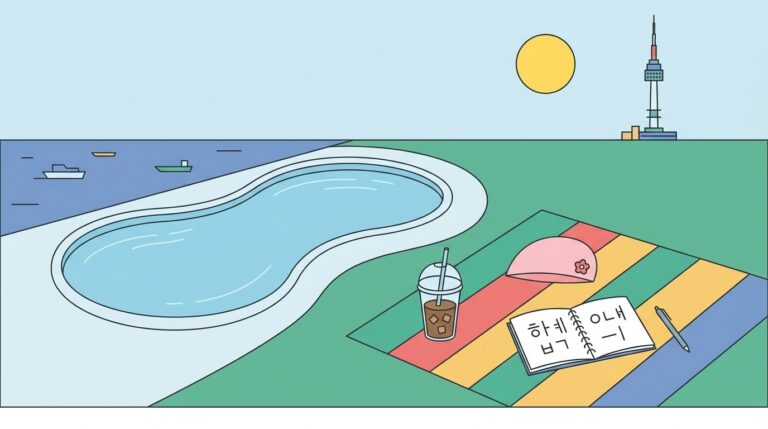
Beat the Heat Like a Local: Your Ultimate Guide to Hangang River Outdoor Pools
Phase 1: Empathy (Welcome to the Summer Oasis!)
안녕하세요! (Annyeonghaseyo!) Daily Hangul’s Chief Editor and your personal cultural navigator here!
Imagine this: It’s mid-July in Seoul. The humidity is so thick you feel like you’re walking through warm tteokbokki soup. Your shirt is sticking to your back, and even the iced Americano in your hand is sweating as fast as you are. You want to escape the concrete jungle, but a trip to Busan’s Haeundae Beach feels too far for a weekend. What do local Seoulites do? They grab their swimsuits and head straight to the Hangang River Outdoor Pools (한강 야외수영장)!
If you’ve ever felt intimidated about visiting a public pool in Korea—wondering about the strict swim cap rules, how to rent a sunbed without awkward gestures, or how to order that legendary poolside ramen—you are in the right place. Many of our intermediate learners have shared that while they want to experience this ultimate summer vibe, they worry about not understanding the staff’s fast-paced Korean. Today, we’re going to master the exact phrases, unspoken rules, and cultural “Nunchi” you need to dive into the Hangang pool scene like an absolute pro!
Phase 2: Deep Dive into 3 Essential Expressions
1. 돗자리 어디에 깔아야 돼요? (Dot-jari eodi-e kkal-a-ya dwae-yo?)
- Pronunciation: Dot-jah-ree uh-dee-eh kkal-ah-yah dway-yo? (Sounds like “dot” + “ja-ry” … “eon” without ‘n’ + “dee-eh” … “kkal” + “ah-yah” … “dway-yo”)
- Meaning: Where should I lay down my picnic mat?
- K-Culture Moment: In K-Dramas, you often see friends carrying a rolled-up metallic or colorful mat under their arms at Han River parks. This mat is called a 돗자리 (dot-jari). Before you do anything else at a Hangang pool, you must secure your “territory” by laying this down.
- Editor’s Insight: The verb 깔다 (kkal-da) means “to spread out” or “to lay down.” Using this phrase shows you understand the foundational Korean picnic culture.
- Situation Spectrum:
- Casual: 돗자리 어디에 깔까? (⚠️ – Use with close friends)
- Semi-formal: 돗자리 어디에 깔아야 돼요? (✅ – Best for pool staff or neighbors)
- Formal: 돗자리를 어디에 설치하면 되겠습니까? (🚫 – Overly robotic/military style)
- 🤔 Think About It: In many Western countries, people lay directly on towels. In Korea, using a plastic/foil dot-jari is essential to keep clean. Why do you think communal cleanliness is so highly prioritized in Korean shared spaces?
2. 수영모 꼭 써야 돼요? (Suyeong-mo kkok sseo-ya dwae-yo?)
- Pronunciation: Soo-young-mo kkok suh-yah dway-yo? (Make sure to double the ‘k’ in kkok for emphasis, like a sharp “K!”)
- Meaning: Do I absolutely have to wear a swim cap?
- K-Culture Moment: You might look stylish in your sunglasses and swimsuit, but the pool guards (라이프가드) are strict. If you step into the water without a 수영모 (suyeong-mo – swim cap) or a baseball cap that fully covers your hair, you will hear a loud whistle blast!
- Editor’s Insight: 꼭 (kkok) means “surely” or “without fail.” It expresses a sense of necessity. Note that at Hangang pools, a regular baseball cap (볼캡) is usually allowed instead of a tight silicone swim cap, which is a lifesaver for your style!
- Situation Spectrum:
- Casual: 야, 모자 꼭 써야 돼? (⚠️)
- Semi-formal: 수영모 꼭 써야 돼요? (✅ – Perfect for asking lifeguards)
- Formal: 수영모 착용이 필수입니까? (🚫 – Too stiff, sounds like an official inquiry)
- 🤔 Think About It: Rules in public spaces in Korea are often strictly enforced for public hygiene. How does this compare to rules in your hometown’s public pools?
3. 교대 시간 언제예요? (Gyodae sigan eonje-ye-yo?)
- Pronunciation: Gyo-deh she-gan uhn-jeh-yeh-yo?
- Meaning: When is the shift change / rotation break time?
- K-Culture Moment: Hangang pools operate on a strict “45 minutes swimming, 15 minutes break” rule. When the siren sounds, everyone must exit the pool. This break is called 교대 시간 (gyodae sigan) or 휴식 시간 (hyusik sigan).
- Editor’s Insight: 교대 (gyodae) literally means shift rotation or alternation. Knowing this word helps you plan your quick run to the food stalls (매점) without missing precious swimming time.
- Situation Spectrum:
- Casual: 언제 쉬는 시간이야? (⚠️)
- Semi-formal: 교대 시간 언제예요? (✅ – Natural and polite)
- Formal: 다음 휴식 시간은 몇 시입니까? (✅ – Also acceptable, but a bit formal)
Phase 3: Textbook Korean vs. Real-Life Korean
Situation 1: Asking if there are sunbeds available
- 📖 Textbook Korean: 선베드를 대여할 수 있습니까? (Seonbeadeu-reul daeyeo-hal su isseumnika? – “Is it possible to lease a sunbed?”)
- 🗣️ Real-Life Korean: 선베드 남은 거 있어요? (Seonbeadeu nameun geo isseoyo? – “Are there any sunbeds left?”)
- 💡 Why the difference? Textbook Korean uses formal verbs like daeyeo-hada (to lease/rent). In real life, locals use the casual and fast nameun geo isseoyo? (Are there left-over ones?) which sounds much friendlier and natural.
Situation 2: Expressing that the water is refreshing
- 📖 Textbook Korean: 물이 아주 시원합니다. (Mul-i aju siwon-hamnida. – “The water is very cool.”)
- 🗣️ Real-Life Korean: 와, 대박 시원하다! (Wa, daebak siwon-hada! – “Wow, this is crazy refreshing!”)
- 💡 Why the difference? When dipping your feet into cold water, nobody speaks in full formal sentences. Daebak (awesome/crazy) combined with the exclamation form siwon-hada captures the genuine joy of escaping the heat.
Phase 4: K-Culture Deep Dive & Non-Verbal Etiquette
4-1. Nunchi (눈치) & Poolside Manners
- The Rash Guard Phenomenon: If you wear a tiny bikini or shirtless trunks, you might feel a bit exposed. Why? 90% of Koreans wear 래쉬가드 (rash guards) and swim leggings to protect their skin from the intense sun. While bikinis are allowed, wearing a rash guard helps you blend in effortlessly.
- The Foot-Washing Grace Note: Before entering the pool, you must pass through a small foot-washing pool (발 씻는 곳). Walking directly into the main pool with sandy feet is a major
Frequently Asked Questions (FAQ)
Q: What does "돗자리 어디에 깔아야 돼요? (Dot-jari eodi-e kkal-a-ya dwae-yo?)" mean in Korean and how do you pronounce it?
A: In Korean, "돗자리 어디에 깔아야 돼요? (Dot-jari eodi-e kkal-a-ya dwae-yo?)" is pronounced [Dot-jah-ree uh-dee-eh kkal-ah-yah dway-yo? (Sounds like "dot" + "ja-ry" ... "eon" without 'n' + "dee-eh" ... "kkal" + "ah-yah" ... "dway-yo"] and means: Where should I lay down my picnic mat?
Q: What does "수영모 꼭 써야 돼요? (Suyeong-mo kkok sseo-ya dwae-yo?)" mean in Korean and how do you pronounce it?
A: In Korean, "수영모 꼭 써야 돼요? (Suyeong-mo kkok sseo-ya dwae-yo?)" is pronounced [Soo-young-mo kkok suh-yah dway-yo? (Make sure to double the 'k' in kkok for emphasis, like a sharp "K!"] and means: Do I absolutely have to wear a swim cap?
Q: What does "교대 시간 언제예요? (Gyodae sigan eonje-ye-yo?)" mean in Korean and how do you pronounce it?
A: In Korean, "교대 시간 언제예요? (Gyodae sigan eonje-ye-yo?)" is pronounced [Gyo-deh she-gan uhn-jeh-yeh-yo?] and means: When is the shift change / rotation break time?







