

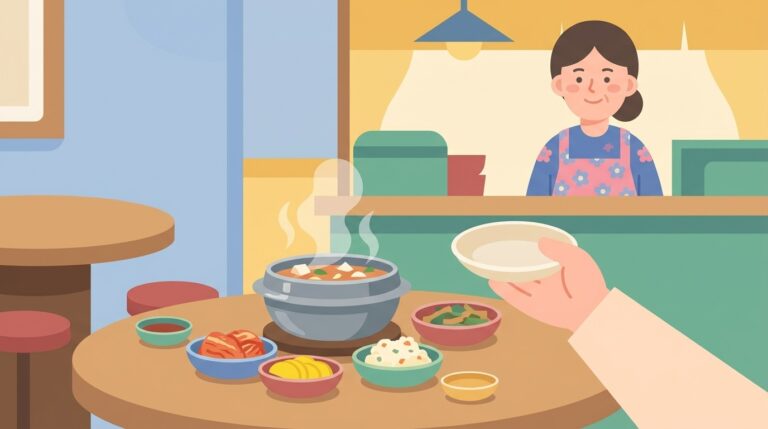
“Excuse Me, Auntie!” How to Confidently Ask for Side Dish Refills in Korea
Phase 1: Empathy (Welcome, Chingu!)
안녕하세요! (Annyeonghaseyo!) Welcome back to Daily Hangul. I’m your chief editor and local culture navigator, and today, we are diving into one of the most delicious, yet surprisingly nerve-wracking, aspects of dining in Korea: asking for banchan (반찬 – side dish) refills!
Picture this: You are sitting in a cozy, bustling local restaurant in Seoul. The smell of sizzling Korean BBQ fills the air. You take a bite of the crispy, savory kimchi. It’s absolute perfection. Before you know it, the small ceramic dish is completely empty. You look around. Other tables are getting their dishes refilled effortlessly, but your heart starts racing.
“How do I ask for more without being rude? Do I have to pay extra? What if I call the server the wrong name?”
Don’t worry! Every single Korean learner has stood in those exact shoes. In fact, many of our intermediate (B1) students tell us they used to just go without their favorite pickled radish because they were too shy to ask. Today, we’re going to transform you from a hesitant onlooker into a confident dining pro who can command the table with warmth and local flair. Let’s unlock the secrets of Korea’s legendary free refill culture together!
Phase 2: Core Expressions Deep Dive
Here are the top three magic phrases you need to know. Let’s look at their literal meanings, their actual vibes, and how to use them.
1. 반찬 좀 더 주실 수 있나요? (Banchan jom deo jusil su innayo?)
- Pronunciation: Bahn-chahn johm duh joo-shil soo een-nah-yo? (Think of “jom” like the word “gym” but with an ‘o’ sound: j-oh-m).
- Meaning: Can I have some more side dishes, please? (Lit: “Could you give me a little more side dishes?”)
- K-Culture Moment: This is the golden standard. It’s polite, soft, and warm. You’ll hear this in almost every family K-Drama when the main characters are having a comforting meal together.
- Editor’s Insight: The word 좀 (jom) literally means “a little,” but in Korean culture, it acts as a magical softener. It makes your request sound humble and polite, rather than demanding.
- Situation Spectrum: Casual ⚠️ | Semi-formal ✅ | Formal ✅
- 🤔 Think About It: In many Western countries, extra sides cost money. In Korea, jeong (정 – collective affection) means sharing food generously. How does your home country’s restaurant culture compare to this free refill philosophy?
2. 이거 더 주세요! (Igeo deo juseyo!)
- Pronunciation: Ee-guh duh joo-seh-yo! (Rhymes with “get her” without the ‘t’ sound: ee-guh).
- Meaning: More of this, please! (Lit: “Give me more of this!”)
- K-Culture Moment: You’re pointing directly to that empty, delicious plate of potato salad (gamja sarada) while making friendly eye contact with the restaurant staff.
- Editor’s Insight: This is simple, direct, and incredibly effective. It works perfectly in noisy, busy restaurants where you need to communicate quickly while pointing to the specific dish you want refilled.
- Situation Spectrum: Casual ✅ | Semi-formal ✅ | Formal ⚠️
3. 사장님, 여기 리필해 주세요! (Sajangnim, yeogi ripil-hae juseyo!)
- Pronunciation: Sah-jahng-neem, yuh-gi ree-peel-hae joo-seh-yo!
- Meaning: Boss, please refill this here!
- K-Culture Moment: You are in a lively local pub (sooljip) or a neighborhood diner, and you want to catch the owner’s attention respectfully.
- Editor’s Insight: 사장님 (Sajangnim) literally means “CEO/President,” but in Korea, we use it to politely address restaurant owners. It is incredibly flattering and warm!
- Situation Spectrum: Casual ✅ | Semi-formal ✅ | Formal 🚫
Phase 3: Textbook Korean vs. Real-World Korean
Let’s look at how textbooks teach this versus how real Koreans actually talk.
Situation 1: Calling the Server
- 📖 Textbook Korean: 저기요, 여기 와 주시겠습니까? (Jeogiyo, yeogi wa jusigesseumnika? – Excuse me, would you please come here?)
- 🗣️ Real-World Korean: 이모님, 저희 이거 좀 더 주세요! (Imonim, jeohui igeo jom deo juseyo! – Auntie, more of this for us, please!)
- 💡 Why the difference? Calling a female server of a certain age 이모님 (Imonim – Auntie) instantly breaks the ice. It creates a family-like bond, and you might even get a double serving because you called her family!
Situation 2: Checking if Refills are Self-Service
- 📖 Textbook Korean: 여기는 반찬을 직접 가져와야 합니까? (Yeogineun banchaneul jikjeop gajewoya hamnika? – Do I have to bring the side dishes myself here?)
- 🗣️ Real-World Korean: 여기 셀프예요? (Yeogi selpeuyeoyo? – Is this self-serve?)
- 💡 Why the difference? Koreans love efficiency (Pali-Pali culture). The English word “Self” became the Korean slang 셀프 (sel-peu). If you see a sign that says “추가 반찬은 셀프입니다,” it means go grab them yourself!
Phase 4: K-Culture Deep Dive & Non-Verbal Manners
4-1. The Art of “Nunchi” (눈치) & Gestures
Before you shout for a refill, use your 눈치 (Nunchi – situational awareness):
1. Look for the “Self-Bar” (셀프바): If you see a counter with big metal containers of side dishes and a sign saying 셀프 (Self), do not call the server. Walk up with your empty dish and scoop it yourself.
2. The Hand Raise: If it is not self-serve, gently raise your hand to shoulder height, make eye contact, and say “저기요~” (jeogiyo – excuse me).
3. Hold the Dish: When requesting a refill from a server, hold the empty plate slightly off the table with both hands as they take it. It shows immense respect.
4-2. The Cultural Code: Free Refills & Jeong (정)
In Korea, banchan is not considered an “extra” you pay for; it is a sign of hospitality. Sharing food is a way of showing affection. However, the golden rule is never to waste it. Refill only what you can eat! Leaving a table with mountain-high refilled dishes uneaten is considered bad dining etiquette.
Phase 5: Live Roleplay Scenario
Setting: A bustling, traditional Kimchi Jjigae (Kimchi Stew) restaurant near Hongdae.
Characters:
* You (Minji’s friend): Hungry and craving more sweet soy-braised potatoes (gamja jorim).
* Imo (이모 – The Owner/Server): A warm, energetic auntie wearing a floral apron.
Turn 1
You: (Gently raising your hand) 저기요, 이모님!
     (Jeogiyo, imonim!)
     "Excuse me, Auntie!"

Turn 2
Imo: (Wiping her hands on her apron and walking over) 네, 뭐 더 필요한 거 있어요?
     (Ne, mwo deo piryohan geo isseoyo?)
     "Yes, is there something else you need?"

Turn 3
You: (Pointing to the empty potato dish with both hands) 이 감자 조림 너무 맛있어요!
     (I gamja jorim neomu masisseoyo!)
     "These braised potatoes are so delicious!"

Turn 4
Imo: (Smiling proudly) 아이구, 그래요? 직접 만든 거야~
     (Aigu, geuraeyo? Jikjeop mandeun geoya~)
     "Oh, really? I made them myself!"

Turn 5
You: 네! 그래서... 이것 좀 더 주실 수 있나요?
     (Ne! Geuraeseo... igeot jom deo jusil su innayo?)
     "Yes! So... could we have a little more of this, please?"

Turn 6
Imo: (Taking the plate eagerly) 당연하지! 내가 듬뿍 가져다줄게요.
     (Dangyeonhaji! Naega deumppuk gajyeodajulgeyo.)
     "Of course! I'll bring you a generous portion."

Turn 7
You: (Bowing head slightly) 우와, 감사합니다, 이모님!
     (Uwa, gamsahamnida, imonim!)
     "Wow, thank you so much, Auntie!"

Turn 8
Imo: (Returning with a overflowing dish) 많이 먹고 또 필요하면 말해요!
     (Mani meokgo tto piryohamyeon marhaeyo!)
     "Eat plenty, and let me know if you need more!"
🔀 Interactive Choice Point!
What will you say to Imo now to show your ultimate appreciation?
* A) “이모, 최고예요!” (Imo, choegoyeyo! – Auntie, you’re the best!)
* B) “이거 돈 더 내야 해요?” (Igeo don deo naeya haeyo? – Do I have to pay more for this?)
* C) “맛없어요.” (Maseopseoyo. – It tastes bad.)
Feedback on your choice:
- Choice A (Best!): Perfect! Imo will probably give you a free soda or extra meat. You’ve unlocked the ultimate local dining cheat code.
- Choice B (Risk): While polite, it shows you don’t fully understand the free refill culture yet. It might make Imo feel like her hospitality is being treated too transactionally.
- Choice C (Bad): Oh no! You’ve broken Imo’s heart and ruined the cozy vibe of the restaurant. Prepare for some very icy stares!
Phase 6: 10-Second Emotion Shadowing Drill
Practice speaking like a native by following these emotional cues and pause markers (/).
- [🥺 Shy but polite request]
- 저기요… / 이거 / 좀만 / 더 주실 수 있나요?
- Jeogiyo… / igeo / jomman / deo jusil su innayo?
- [😊 Excited and praising the food]
- 진짜 / 너무 / 맛있어요! / 최고예요!
- Jinjja / neomu / masisseoyo! / choegoyeyo!
- [🙋♂️ Confident and friendly call]
- 사장님! / 저희 / 반찬 / 리필해 주세요!
- Sajangnim! / jeohui / banchan / ripil-hae juseyo!
Phase 7: K-Culture Mini Dictionary
- 이모 (Imo) | Auntie | Literally maternal aunt, but used affectionately for middle-aged female servers in casual restaurants.
- 반찬 (Banchan) | Side Dishes | Small dishes served alongside rice, ranging from kimchi to seasoned vegetables and tofu.
- 셀프 (Sel-peu) | Self-service | Short for “self-service,” meaning you need to fetch your own water or side dish refills.
- 정 (Jeong) | Social/Emotional Bond | A deep feeling of attachment, warmth, and mutual sharing unique to Korean society.
Phase 8: Survivor Kit for Travelers
Survival Phrases TOP 3
- 물은 셀프입니다 (Mureun selpeuyimnida): “Water is self-serve.” (Look around for the water purifier!).
- 앞접시 주세요 (Ap-jeopsi juseyo): “Please give me shared/individual plates.”
- 여기 주문할게요 (Yeogi jumunhalgeyo): “We’d like to order here, please.”
📌 Editor’s Travel Note: Don’t get lost looking for a place to eat! Download the Naver Map App before you arrive. Google Maps does not work well for walking directions in Korea.
Note: App interfaces and restaurant layouts can change; always check the latest version of the app before traveling.
Phase 9: “A Step Deeper” (Thought Essay)
In many Western cultures, dining is highly individualized—you order your plate, and you eat your plate. In Korea, eating is a communal act of sharing. The table is a canvas of shared plates (banchan), where everyone’s metal chopsticks cross paths. Asking for a refill isn’t seen as being greedy; it is viewed as an appreciation of the chef’s hard work. By learning to ask for more politely, you are engaging in a beautiful cycle of giving and receiving hospitality.
💬 Your Turn: Have you ever tried Korean banchan before? What is your absolute favorite side dish that you would ask for a refill of? Let me know in the comments below!
Phase 10: FAQ & Common Mistakes
Q: Can I ask for refills of expensive side dishes like raw crab (양념게장) or meat?
A: Generally, vegetable-based side dishes, kimchi, and tofu are limitlessly free. However, premium dishes like raw marinated crab or main meat plates usually incur an extra charge. If you’re unsure, ask politely: “이것도 리필 돼요?” (Igeotdo ripil dwaeyo? – Can this be refilled too?).
Q: Is it rude to call a young female server ‘이모’ (Imo)?
A: Yes, it can be a bit awkward! If the server looks like she is in her 20s or 30s, address her as “저기요” (Jeogiyo – Excuse me) or “언니” (Eonni – older sister, if you are female) instead. Keep “이모” for middle-aged or older maternal figures.
Q: What if I can’t finish the refilled side dishes?
A: Try to avoid this! Leaving a large amount of refilled food is considered wasteful and slightly discourteous to the host. Always start by asking for “a little bit” (jomman) first.
🚨 Common Mistakes Alert!
- Saying “Hey!” (야! – Ya!): Never yell this to get attention. It is highly rude.
- Not checking the self-bar first: Screaming for service when a giant “SELF” sign is right next to you will make you look clueless.
- Mumbling in English: Even if your Korean isn’t perfect, trying to say “Deo juseyo” with a smile works 100% of the time over English.
Phase 11: Action Mission
- 🥉 Bronze: Practice saying “이것 좀 더 주세요!” (Igeot jom deo juseyo!) in front of your mirror 5 times with a bright smile.
- 🥈 Silver: Next time you watch a K-Drama eating scene, listen closely to see if the characters call the server “이모님” (Imonim) or “사장님” (Sajangnim). Write down the drama name in our comments!
- 🥇 Gold: Go to your local Korean restaurant this weekend and ask the staff for a refill of your favorite side dish using our magical phrases. You can do it!
Phase 12: Interactive Quiz Challenge
Test your knowledge before you head out to the restaurant!
1. Which of the following is the most polite yet friendly way to ask a middle-aged female owner for a refill?
- A) 야, 더 가져와! (Ya, deo gajyeowa!)
- B) 이모님, 이거 좀 더 주실 수 있나요? (Imonim, igeo jom deo jusil su innayo?)
- C) 저기요, 물 주세요. (Jeogiyo, mul juseyo.)
🔍 Check Answer
Correct Answer: B
Excellent! This blends respect, warmth, and the polite softener ‘jom’. Option A is incredibly rude, and Option C is just asking for water.
2. True or False: If you see a sign that says ‘추가 반찬은 셀프’, you should sit and wait for the server to refill your plates.
- A) True
- B) False
🔍 Check Answer
Correct Answer: B (False)
Spot on! ‘셀프’ (Sel-peu) means you need to stand up and refill your own side dishes at the designated buffet bar.







