

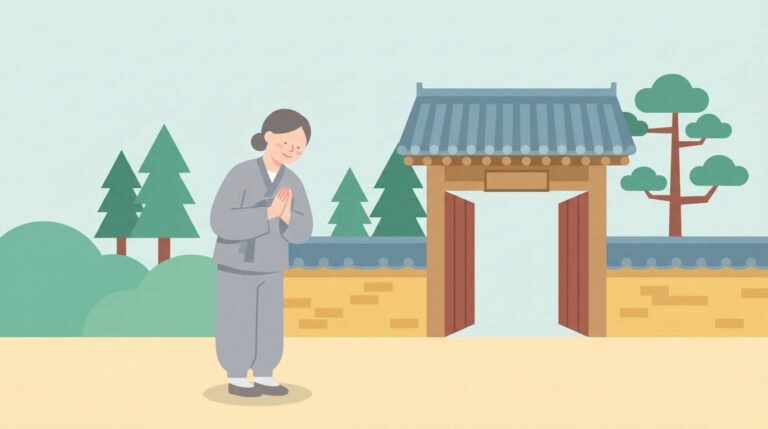
Phase 1: Welcome to Your Mountain Sanctuary
안녕하세요! 매일한글 에디터입니다. (Annyeonghaseyo! Hello from your Daily Hangul Editor!) Imagine trading Seoul’s neon buzz for a misty mountain temple—just like your favorite celebrities on I Live Alone or healing K-dramas. You arrive at your temple stay excited for peace, until the coordinator hands you a baggy gray vest and wide wrap pants. Suddenly, you freeze: How do I ask for a smaller size? Where do my shoes go? Why is everyone bowing with their palms pressed together? Based on real feedback from intermediate learners who felt awkward during orientation, this guide fixes that exact confusion. Master these practical Korean phrases and temple manners today, and you will step onto the wooden veranda with calm, authentic confidence.
Phase 2: Deep Dive into 3 Essential Expressions
1. 사이즈가 좀 넉넉한 편인가요? (Saijeuga jom neokneokhan pyeoningayo?)
- Pronunciation: Sah-ee-jeu-gah johm nuck-nuh-kahn pyuh-nin-gah-yo? (For 넉넉한, think of knuckle without the L plus kahn—notice how the final ㄱ and ㅎ blend into a strong K sound!)
- Meaning: Literally “Does the size tend to be a bit generous?” In real life, it is the polite, natural way to ask if the loose temple uniform (
수련복) runs big.- K-Culture Moment: Picture a K-variety show guest holding up wide-legged gray temple pants that look like a parachute, asking the monk or coordinator with a chuckle before heading to the changing room.
- Editor’s Insight: At the B1 intermediate level, using
-(으)ㄴ 편이다(tends to be) softens your question so you don’t sound like you are complaining about the clothes.- Situation Spectrum: Casual 🚫 | Semi-formal ✅ | Formal ✅
- 🤔 Think About It: In English, we often say directly, “Are these big?” Why do you think Korean speakers prefer softening descriptions with “tends to be” (
편이다) in communal spaces like a temple?2. 사찰 예절을 지키도록 할게요. (Sachal yejeoreul jikidorok halgeyo.)
- Pronunciation: Sah-chahl yeh-juhl-eul jee-kee-doh-rohk hahl-geh-yo. (예절 sounds like yeh in yes + juhl in juggle without the G.)
- Meaning: Literally “I will make sure to keep the temple etiquette.” Nuance: It shows sincere effort and respect toward the host after receiving orientation instructions.
- K-Culture Moment: In healing K-dramas, a city-worn protagonist arrives at a quiet countryside temple, nods humbly to the guiding monk after hearing the house rules, and promises to follow along.
- Editor’s Insight: The intermediate grammar
-도록 하다expresses a gentle personal commitment. It sounds much warmer and more mature than a stiff textbook지키겠습니다(I will obey).- Situation Spectrum: Casual ⚠️ | Semi-formal ✅ | Formal ✅
- 🤔 Think About It: Notice how Korean separates everyday manners (
예의) from formal/sacred etiquette (예절). How does your native language distinguish casual politeness from sacred or traditional respect?3. 합장하고 반배를 하면 되나요? (Hapjanghago banbaereul hamyeon doenayo?)
- Pronunciation: Hahp-jahng-hah-goh bahn-beh-reul hah-myuhn dweh-nah-yo? (합장 sounds like a crisp hop + jahng.)
- Meaning: Literally “Is it okay if I put my palms together and do a half-bow?” In practice, it is your go-to confirmation phrase when checking how to greet monks or bow toward the Dharma Hall.
- K-Culture Moment: Just like guests nervously practicing temple bows before dinner on Korean travel shows, visitors whisper this to confirm whether a full prostration or a gentle half-bow is expected.
- Editor’s Insight:
-아/어/하면 되나요?(“Do I just do X?”) is a lifesaver for learners! It lets you verify cultural steps effortlessly without sounding clueless.- Situation Spectrum: Casual 🚫 | Semi-formal ✅ | Formal ✅
- 🤔 Think About It: Greeting in a temple happens through posture rather than words. How comfortable do you feel expressing respect silently through body language instead of saying “Hello”?
Phase 3: Textbook Korean vs. Real Korean
Situation 1: Asking for a different uniform size
- 📖 Textbook Korean: 이 바지는 저에게 너무 큽니다. 더 작은 것이 있습니까? (I bajineun jeoege neomu keumnida. Deo jageun geosi itseumnikka? – These pants are too big for me. Do you have smaller ones?)
- 🗣️ Real Korean: 바지가 좀 큰 편인데, 한 치수 작은 걸로 바꿔 입어도 될까요? (Bajiga jom keun pyeoninde, han chisu jageun geollo bakkwo ibeodo doelkkayo? – The pants tend to run a bit big; would it be okay if I swapped into one size smaller?)
- 💡 Why the difference? Real Korean smooths out requests using background context (
~편인데, “it tends to be…”) and permission (~아/어도 될까요?) instead of blunt, robotic statements.
Situation 2: Asking about basic temple rules
- 📖 Textbook Korean: 저는 절에서 어떻게 행동해야 합니까? (Jeoneun jeoreseo eotteoke haengdonghaeya hamnikka? – How must I behave at a temple?)
- 🗣️ Real Korean: 제가 처음이라서 그러는데, 여기서 주의할 점이 있을까요? (Jega cheoeumiraseo geureoneunde, yeogiseo juuihal jeomi isseulkkayo? – Since it is my first time, is there anything I should be careful about here?)
- 💡 Why the difference? Saying
~이라서 그러는데(“it’s because it’s my first time, so…”) immediately triggers Korean warmth (정, jeong), making locals eager to guide you gently.
Phase 4: K-Culture Deep Dive & Non-Verbal Manners
4-1. Nunchi (눈치) & Temple Gestures
- Hapjang (합장) & Banbae (반배): When you spot a monk (
스님, Seunim) or another guest on the path, skip waving or saying “Hi!” Instead, press both palms softly together at chest level (합장) and bow at a respectful 45-degree angle (반배). - Chasu (차수): While walking quietly across temple grounds, fold your hands gently in front of your lower abdomen (
차수—usually left hand resting over right). It keeps your posture calm and prevents swinging arms. - Shoes & Doorsills (
신발&문지방): Always take off your shoes before stepping onto wooden verandas, and turn them neatly facing outward. When entering a temple hall, step over the wooden doorsill (문지방), never directly on top of it!
4-2. Cultural Code: K-Travel & Healing Aesthetics
In modern Korea, stress relief isn’t just about spas—it is about “Rest and Reset” (쉼, swim). From hit reality shows like I Live Alone to healing dramas, swapping tailored office suits for oversized, earthy-toned 수련복 (temple training clothes) symbolizes dropping social titles, makeup, and daily anxiety. Everyone wears the exact same loose vest and pants, creating instant equality and quiet mental space.
Phase 5: Practical Roleplay Scenario
Setting: Late afternoon at a serene mountain temple. The scent of pine needles fills the cool air, and wooden floorboards creak softly. Coordinator Minji (민지 팀장님), a warm-hearted temple stay manager with a gentle smile, greets you by the orientation room.
- Minji: 🎭 (handing over a folded gray vest and wide pants) 어서 오세요! 먼저 편한 수련복으로 갈아입고 오실게요. (Eoseo oseyo! Meonjeo pyeonhan suryeonbogeuro garaipgo osilgeyo.) — “Welcome! First, please go change into these comfortable training clothes.”
- You: 🎭 (holding up the wide-legged pants curiously) 감사합니다. 그런데 사이즈가 좀 넉넉한 편인가요? (Gamsahamnida. Geureonde saijeuga jom neokneokhan pyeoningayo?) — “Thank you. By the way, do the sizes tend to run a bit loose?”
- Minji: 🎭 (chuckling warmly) 네, 원래 바람이 잘 통하게 넉넉하게 입는 옷이에요. 만약 너무 크면 한 치수 작은 걸로 바꿔 입어도 돼요. (Ne, wollae barami jal tonghage neokneokhage imneun osieyo. Manyak neomu keumyeon han chisu jageun geollo bakkwo ibeodo dwaeyo.) — “Yes, they are meant to be worn loose for good airflow. If they are too big, you can switch to one size smaller.”
- You: 🎭 (returning a few minutes later, adjusting the vest) 갈아입고 왔어요! 정말 편하네요. 제가 처음이라서 그러는데, 여기서 주의할 점이 있을까요? (Garaipgo wasseoyo! Jeongmal pyeonhaneyo. Jega cheoeumiraseo geureoneunde, yeogiseo juuihal jeomi isseulkkayo?) — “I changed and I’m back! It is really comfortable. Since it’s my first time, is there anything I should be careful about here?”
- Minji: 🎭 (demonstrating hands together at chest height) 절에서는 큰 소리로 말하기보다 합장하고 반배로 인사하는 게 좋아요. (Jeoreseoneun keun soriro malhagiboda hapjanghago banbaero insahaneun ge joayo.) — “At a temple, rather than speaking loudly, it is good to greet with palms together and a half-bow.”
- You: 🎭 (mirroring her hand posture carefully) 아, 스님을 뵈면 이렇게 합장하고 반배를 하면 되나요? (A, seunimeul boemyeon ireoke hapjanghago banbaereul hamyeon doenayo?) — “Ah, when I see a monk, should I put my palms together and do a half-bow like this?”
- Minji: 🎭 (nodding with approval) 네, 아주 잘하시네요! 이제 법당 안으로 들어가 볼까요? (Ne, aju jalhasineyo! Ije beopdang aneuro deureoga bolkkayo?) — “Yes, you are doing great! Shall we head inside the Dharma Hall now?”
🔀 Interactive Branching Point: How do you respond next?
- Option A: “네! 신발을 정리하고 문지방을 밟지 않도록 조심할게요.” (Ne! Sinbareul jeongnihago munjibangeul bapji antorok josimhalgeyo. — “Yes! I will arrange my shoes and be careful not to step on the doorsill.”)
- Feedback (🏆 Best): Brilliant! You combined intermediate grammar (
-지 않도록) with top-tier temple etiquette. Minji will be amazed by your cultural awareness.
- Feedback (🏆 Best): Brilliant! You combined intermediate grammar (
- Option B: “좋아요! 어서 부처님 보러 뛰어 들어가요!” (Joayo! Eoseo bucheonim boreo ttwieo deureogayo! — “Great! Let’s run inside quickly to see the Buddha!”)
- Feedback (🚫 Bad): Too loud and rushed! Running and shouting break the peaceful atmosphere of the temple grounds.
- Option C: “법당 안에서 셀카 찍어도 돼요?” (Beopdang aneseo selka jjigeodo dwaeyo? — “Can I take a selfie inside the Dharma Hall?”)
- Feedback (⚠️ Risk): Always ask politely first, because photography inside the main Dharma Hall (
법당) is usually forbidden during worship or quiet hours. Better to say사진을 찍어도 되는지 여쭤봐도 될까요?(May I ask if photography is permitted?).
- Feedback (⚠️ Risk): Always ask politely first, because photography inside the main Dharma Hall (
Phase 6: 10-Second Emotion Shadowing Drill
Read aloud with the / pause marks and match the emotional cue!
- [😊 Warm and curious] 사이즈가 / 좀 넉넉한 편인가요? (Saijeuga / jom neokneokhan pyeoningayo?)
- [😌 Calm and sincere] 제가 처음이라서 그러는데, / 사찰 예절을 지키도록 할게요. (Jega cheoeumiraseo geureoneunde, / sachal yejeoreul jikidorok halgeyo.)
- [🙏 Respectful and focused] 스님을 뵈면 / 합장하고 반배를 하면 되나요? (Seunimeul boemyeon / hapjanghago banbaereul hamyeon doenayo?)
Phase 7: K-Culture Mini Dictionary
- 수련복 (Suryeonbok) | Loose temple stay uniform (vest and wrap pants) | Used whenever referring to the comfortable gray or brown outfits provided upon check-in at a temple stay.
- 합장 (Hapjang) | Pressing palms together at chest height | The universal silent greeting and gesture of respect across Korean Buddhist temples.
- 차수 (Chasu) | Folding hands calmly in front of the waist while walking | Mentioned during orientation to remind guests to walk peacefully without swinging their arms.
- 공양 (Gongyang) | Mindful temple meal | In Buddhist culture, meals are not just
식사(eating);발우공양(monastic bowl meals) treat food as a sacred offering.
Phase 8: Traveler’s Survival Kit
Top 3 Survival Phrases
- 갈아입는 곳이 어디예요? (Garaimneun gosi eodiyeyo?) — “Where is the changing room?” | Pro Tip: Point gently toward your folded
수련복when asking. - 양말을 신어야 하나요? (Yangmareul sineoya hanayo?) — “Do I need to wear socks?” | Pro Tip: Yes! Bare feet inside Dharma halls are considered impolite in Korea, so pack clean socks.
- 조용히 걸을게요. (Joyonghi georeulgeyo.) — “I will walk quietly.” | Pro Tip: Perfect if your footsteps squeak on an old wooden floor!
Editor’s Travel Note
- Booking & Navigation: Reserve English-friendly programs early via the [Official Korean Templestay Reservation Website] and use the [Naver Map App for Accurate Mountain Bus Schedules] since Google Maps often misses rural temple stops.
- Packing & Transit Tips: Bring a T-money card loaded with cash, as mountain village buses rarely accept foreign credit cards. Also pack warm inner layers (
내복) during autumn or winter because loose수련복are worn right over your base clothes!
Phase 9: One Step Deeper
Why does putting on identical loose clothes matter so much in Korea? In everyday Korean life, clothing, age titles, and job ranks constantly signal where you stand on the social ladder. Stepping into baggy, uniform 수련복 temporarily erases that hierarchy—CEO, student, and traveler all sit side by side on the same wooden floor. Through quiet honorifics and mindful posture (합장), temple etiquette reminds us that respect does not require status; it begins with slowing down and noticing the people around us.
- 💬 Your Turn: Have you ever worn a traditional or uniform outfit while traveling that instantly changed how you felt or moved? Share your story in the comments!
Phase 10: FAQ & Myth Busting
Q: Do I have to be Buddhist to join a Korean temple stay?
A: Not at all! Templestay programs welcome visitors of all faiths and backgrounds as a cultural, mindfulness, and healing experience.
Q: Can I wear shorts or tank tops under my 수련복?
A: Yes, wearing a simple t-shirt and leggings underneath is fine, though avoid revealing necklines or bare feet—clean socks and modest inner layers are essential.
Q: Is it rude to talk while changing or walking outside?
A: Quiet whispering during orientation is okay, but once you enter meditation areas (참선실) or meal halls (공양간), maintaining silence (묵언, mugeon) is deeply respected.
🚨 Common Mistakes Top 3
- Stepping on the wooden doorsill (
문지방) -> Correct Action: Always step cleanly over the raised wooden threshold when entering a temple hall. - Wearing shoes inside or leaving them messy -> Correct Action: Slip off your shoes on the stone step and align the toes facing outward.
- Showing up barefoot in the Dharma Hall -> Correct Action: Always wear clean socks (
양말) inside temple buildings.
Phase 11: Action Mission & Engagement
- 🥉 Bronze Mission (Solo Practice): Stand in front of a mirror, press your palms together (
합장), do a 45-degree bow (반배), and say사찰 예절을 지키도록 할게요(Sachal yejeoreul jikidorok halgeyo) three times. - 🥈 Silver Mission (Share Online): Post a screenshot of your favorite phrase from Phase 2 on your study story and tag a travel buddy you want to visit a mountain temple with.
- 🥇 Gold Mission (Real-World Use): Next time you visit a traditional Korean site or speak with a Korean tutor, use
~라서 그러는데(~iraseo geureoneunde) to ask a polite first-timer question! - 🎮 K-Culture Mission: Watch a temple episode of a Korean variety show (like I Live Alone or 2 Days & 1 Night) and listen closely for words like
수련복(suryeonbok),공양(gongyang), or스님(seunim).
Phase 12: Interactive Quiz Challenge
1. Situational Judgment: You arrive at the temple orientation, and your wrap pants feel way too long. Which response sounds the most natural and polite to Coordinator Minji?
* A) 이 바지는 너무 길어요. 바꿔 주세요. (I bajineun neomu gireoyo. Bakkwo juseyo.)
* B) 바지가 좀 긴 편인데, 한 치수 작은 걸로 바꿔 입어도 될까요? (Bajiga jom gin pyeoninde, han chisu jageun geollo bakkwo ibeodo doelkkayo?)
* C) 사이즈가 싫어요. 다른 옷 있어요? (Saijeuga sireoyo. Dareun ot isseoyo?)
2. Fill in the Blank: Complete the sentence to ask politely how to greet a monk:
“스님을 뵈면 ( _____ )하고 반배를 하면 되나요?” (Seunimeul boemyeon ( _____ )hago banbaereul hamyeon doenayo?)
3. True or False (Culture Quiz): Inside a Korean temple, it is completely fine to walk barefoot on the wooden Dharma Hall floor and step on the doorsill (문지방) as long as you stay quiet.
Click to Reveal Answers & Explanations
- Answer: B — Using
~편인데(tends to be) plus~아/어도 될까요?(would it be okay if…) is polite and natural. (Feedback on A/C: A is a bit too direct for a first greeting, and C sounds complaining with “I dislike the size.”) - Answer: 합장 (Hapjang) — Putting both palms together at chest height before bowing (
반배). - Answer: False — Always wear clean socks (
양말) inside temple halls and step over the wooden doorsill (문지방), never on top of it!
🎬 Watch Our Daily Videos! (Daily Hangul Official Instagram)
Review the expressions you learned in this article with our fun daily short videos! Check out native pronunciation and real-life nuances in action.
- Instagram @dailyhangul_en







