

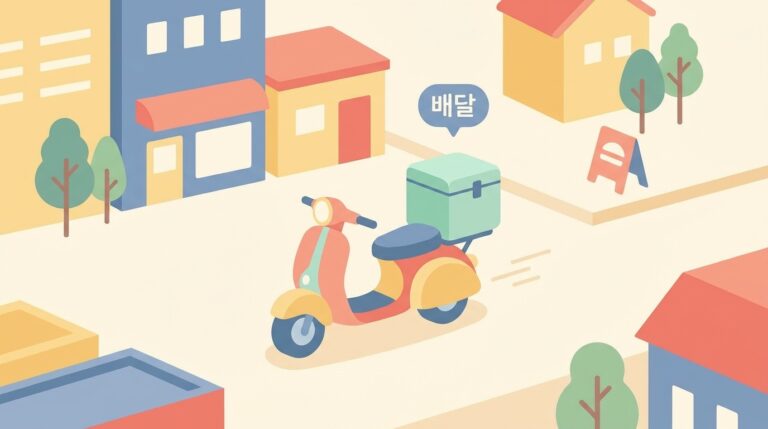
Phase 1: 공감 (The Delivery Dilemma)
안녕하세요! (Annyeonghaseyo!) It’s your trusty Korean bestie and Daily Hangul’s lead editor here!
If you have ever lived in or visited Korea, you know that our delivery culture (배달 문화 – Baedal Munhwa) is next-level. You can get steaming hot Jjajangmyeon, crispy fried chicken, or even a single cup of iced Americano delivered to your picnic mat at the Han River or your apartment doorstep at 2 AM.
But lately, something has changed. Many of my international students have asked me: “Why is my 15,000 KRW chicken order suddenly costing almost 20,000 KRW?” or “What does the app mean by ‘single delivery’ vs. ‘saver delivery’?”
Welcome to the modern era of 배달비 (Baedal-bi – Delivery Fees). Gone are the days of completely free delivery. Today, navigating delivery fees, choosing between pickup (포장) and delivery, and communicating politely with delivery riders (라이더님) are essential survival skills for living like a true local. Today, we’ll unlock the exact, natural intermediate (B2) phrases you need to conquer this system with confidence and respect!
Phase 2: 핵심 표현 3선 심층 분석 (3 Key Expressions Deep Dive)
1. 배달비가 너무 올랐어요 (Baedalbiga neomu ollasseoyo)
- Pronunciation: Bae-dal-bi-ga neo-mu ol-las-seo-yo (Sounds like “Bae-dahl-bee-gah neo-moo ole-lah-suh-yo”)
- Meaning: The delivery fee has gone up too much.
- K-Culture Moment: You will hear this phrase constantly in casual vlogs, office lunch discussions, and K-Dramas when friends are deciding what to eat. When someone suggests ordering delivery, a budget-conscious friend will inevitably sigh and use this expression.
- Editor’s Insight: “배달비” (Delivery Fee) has replaced the older word “배달료”. When you want to emphasize that prices have risen to a shocking degree, we use “올랐어요” (from 오르다 – to rise).
- Situation Spectrum:
- Casual: 배달비 진짜 너무 올랐다. (✅)
- Semi-formal: 배달비가 너무 올랐어요. (✅)
- Formal: 배달비가 너무 올랐습니다. (⚠️ – A bit too formal for casual eating habits, but grammatically perfect.)
- 🤔 Think About It: In your home country, do people complain about delivery fees similarly, or are tips and service charges considered a natural part of the service? How does this reflect the differences in our food culture expectations?
2. 배달 팁 아끼려고 포장 주문 했어요 (Baedal tip akkilyeogo pojang jumun haesseoyo)
- Pronunciation: Bae-dal tip ah-kkee-ryeo-go po-jang ju-mun hae-sseo-yo
- Meaning: I placed a pickup/takeout order to save on the delivery tip.
- K-Culture Moment: Often used when showing off a healthy, budget-friendly lifestyle. You walk to the local chicken shop instead of waiting on your couch. This is highly praised among younger Koreans as “소확행” (small but certain happiness) or smart spending.
- Editor’s Insight: “아끼다” means “to save/spare.” Combined with “-(으)려고” (in order to), it expresses your purpose. “포장” (Pojang) means packaging or takeout. Many apps now offer “포장 할인” (pickup discounts) of 1,000 to 3,000 KRW, making this expression super practical.
- Situation Spectrum:
- Casual: 배달 팁 아끼려고 포장했어. (✅)
- Semi-formal: 배달 팁 아끼려고 포장 주문 했어요. (✅)
- Formal: 배달 팁을 절약하기 위해 포장 주문을 했습니다. (🚫 – Sounds like a business report!)
- 🤔 Think About It: The word “포장” is used for taking out food. In English, we say “to go” or “takeout.” Why do you think Koreans use a word that literally means “packaging”?
3. 라이더님, 안전 운전 하세요 (Laideonim, anjeon unjeon haseyo)
- Pronunciation: Rye-deo-nim, an-jeon un-jeon ha-se-yo
- Meaning: Rider, please drive safely.
- K-Culture Moment: This is a warm, respect-filled message left in the app’s delivery request section (요청사항), especially on rainy or snowy days when roads are dangerous.
- Editor’s Insight: We address delivery workers politely as “라이더님” (Rider-nim) rather than “배달원” (Baedalwon), which can sound slightly outdated or dismissive. Wishing them “안전 운전” (safe driving) shows high empathy and “jeong” (정 – Korean warm-heartedness).
- Situation Spectrum:
- Casual: 라이더님, 안전 운전 하세요! (⚠️ – Even in casual chat, we keep this semi-formal/polite because you are addressing a working professional.)
- Semi-formal: 라이더님, 안전 운전 하세요. (✅ – Most common and highly recommended.)
- Formal: 기사님, 항상 안전 운행 하시길 바랍니다. (✅ – Written, extremely polite.)
- 🤔 Think About It: How does adding “-님” (-nim) change the social dynamic between the customer and the delivery worker?
Phase 3: 교과서 한국어 vs 진짜 한국어 (Textbook vs. Real Korean)
Scenario 1: Checking if there is an extra delivery fee
- 📖 Textbook Style: 배달료는 얼마입니까? (Baedallyoneun eolmaimnikka? – How much is the delivery fee?)
- 🗣️ Real Korean: 혹시 배달비 따로 붙나요? (Hokshi baedalbi ddaro butnayo? – By any chance, does a separate delivery fee get added?)
- 💡 Why the difference? Textbooks teach “배달료” (delivery charge), but real people say “배달비” (delivery fee). The verb “붙다” (to stick/be attached) is used naturally in Korean to describe extra charges being added to a bill.
Scenario 2: Telling the rider where to leave the food
- 📖 Textbook Style: 음식을 문 앞에 놓아 주십시오. (Eumsigeul mun appe noah jusipsio. – Please place the food in front of the door.)
- 🗣️ Real Korean: 문 앞에 두고 벨 눌러주세요. (Mun appe dugo bel nulleojuseyo. – Please leave it at the door and ring the bell.)
- 💡 Why the difference? The textbook version is too stiff and sounds like an automated robot. The real-life version uses the connective form “-고” (and) to smoothly request two sequential actions (leave it, then ring).
Phase 4: K-Culture 딥다이브 & 비언어적 매너 (Nunchi & Culture Code)
4-1. The Art of Delivery Etiquette (Nunchi & App Requests)
In Korea, delivery speed is incredibly fast, but it relies on mutual coordination. When ordering to a Korean apartment, you must provide the 공동 현관 비밀번호 (gongdong hyeongwan bimilbeonho – common lobby entrance password) in the app request.
* The Nunchi Gesture: If you live in an officetel with complex security, waiting near the elevator or opening the lobby door via your wall-pad device when the rider calls shows immense nunchi (social tact).
* The Nod: If you happen to meet the rider in the hallway, do not just take the bag and run! A quick, polite 15-degree bow with a friendly “감사합니다! (Gamsahabnida!)” goes a long way.
4-2. The “Pali-Pali” (빨리빨리) Evolution
Korea’s legendary speed culture has evolved. Previously, apps competed solely on speed, leading to dangerous motorcycle driving. Now, major apps like Baemin (배달의민족) and Coupang Eats (쿠팡이츠) offer two options:
1. 한집배달 (Hanjip Baedal – Single Delivery): The rider delivers only to your house. Fast, but expensive delivery fee.
2. 알뜰배달 (Altteul Baedal – Economy Delivery): The rider bundles deliveries in the same neighborhood. Slower, but significantly cheaper.
Knowing these terms makes you sound like a true Seoulite who understands local economic trends!
Phase 5: 실전 롤플레이 시나리오 (Real-life Roleplay)
Setting: A cozy Friday night at Yumi’s apartment in Hongdae. Mark, an international student, wants to order late-night Korean fried chicken, but he is shocked by the app prices.
- Yumi (The Savvy Local): Wants chicken but hates wasting money on high delivery fees.
- Mark (The Confused Expat): Still getting used to modern Korean delivery apps.
- Yumi: 야, 출출한데 우리 치킨 시켜 먹을까?
(Ya, chulchulhande uri chikin sikyeo meogeulkka?)
(Hey, I’m a bit peckish, should we order some chicken?) -
Mark: 오, 좋아! 내가 배달 앱으로 한번 찾아볼게.
(Oh, joh-a! Naega baedal aebeuro hanbeon chajabolge.)
(Oh, awesome! I’ll look it up on the delivery app.) -
Yumi: 🎭 [폰 화면을 힐끗 보며] 잠깐만, 거기 배달비 얼마로 나와?
(Jamkanman, geogi baedalbi eolmaro nawa?)
(Wait a minute, how much does the delivery fee show there?) -
Mark: 어… 배달비가 5,000원인데? 원래 이렇게 비싸?
(Eo… baedalbiga o-cheon-won-inde? Wonlae ireoke bissa?)
(Uh… the delivery fee is 5,000 won? Is it always this expensive?) -
Yumi: 🎭 [한숨을 쉬며] 요즘 배달비가 너무 올랐어. 한집배달이라 더 비싼가 봐.
(Yojeum baedalbiga neomu ollasseo. Hanjipbaedal-ira deo bissanga bwa.)
(Delivery fees have gone up so much lately. It must be more expensive because it’s a single delivery.) -
Mark: 그럼 우리 배달 팁 아끼게 알뜰배달로 시킬까?
(Georeom uri baedal tip akkige altteulbaedallor sikilkka?)
(Then, should we order through saver delivery to save on the delivery tip?) -
Yumi: 그것보다 바로 집 앞이니까 배달 팁 아끼려고 포장 주문 하자! 내가 갔다 올게.
(Geugeotboda baro jip ap-inikka baedal tip akkilyeogo pojang jumun haja! Naega gatta olge.)
(Actually, since it’s right in front of the house, let’s do a pickup order to save on the delivery tip! I’ll go get it.) -
Mark: 아냐, 내가 같이 갈게! 포장 할인도 만날 수 있으니까 좋네.
(Anya, naega gachi galge! Pojang harindo mannal su isseunikka johne.)
(No, I’ll go with you! It’s great because we can also get a pickup discount.)
🔀 Interactive Choice Point
You are about to finalize the order for pickup on the app. The app asks you to select your pickup preparation completion notification style. What do you do?
- Option A: Select “조심히 천천히 갈게요 (I’ll go carefully and slowly)” and walk casually.
- Option B: Select “바로 갈게요 (I’ll go right away)” and head out immediately.
- Option C: Write a custom memo: “지금 출발합니다! (Leaving now!)”
Feedback:
- Best (Option B): Excellent! Selecting “바로 갈게요” helps the kitchen time your chicken fry perfectly so you get it blazing hot.
- Risk (Option A): While polite, the restaurant might delay packing your chicken to prevent it from getting cold, meaning you might have to wait when you arrive.
- Bad (Option C): A bit too enthusiastic and unnecessary since the app has automated tracking system buttons!
Phase 6: 10초 감정 섀도잉 드릴 (10-Second Shadowing Drill)
Practice saying these out loud with natural pauses (/) and real Korean emotions!
- 배달비 아까우니까 / 그냥 포장해 올게요!
- Bae-dal-bi ah-kka-oo-ni-kka / geu-nyang po-jang-hae ol-ge-yo!
- [😊 Energetic & Determined] “Since delivery fee is a waste, I will just go pick it up!”
- 비도 오는데 / 라이더님, / 안전 운전 하세요.
- Bi-do o-neun-de / la-i-deo-nim, / an-jeon un-jeon ha-se-yo.
- [🥺 Warm & Concerned] “Since it’s raining… Rider, please drive safely.”
Phase 7: K-Culture 미니 사전 (Mini Dictionary)
- 배달비 (Baedal-bi) | Delivery Fee
- Usage: The base charge added to your food order for the distance traveled.
- 배달 팁 (Baedal-tip) | Delivery Tip
- Usage: Often used interchangeably with 배달비 in apps, though it technically refers to peak-hour or weather-related extra surcharges.
- 포장 할인 (Pojang har-in) | Pickup/Takeout Discount
- Usage: A discount (usually 1,000–3,000 KRW) rewarded to customers who walk to pick up their food instead of requesting a rider.
- 공동 현관 비밀번호 (Gong-dong hyeon-gwan bi-mil-beon-ho) | Lobby Password
- Usage: The security code for the apartment complex’s main entrance. Crucial to write this in the app so riders don’t get locked out.
Phase 8: 여행자를 위한 생존 키트 (Traveler’s Survival Kit)
Survival Expressions TOP 3
- 문 앞에 두고 문자 주세요. (Mun appe dugo munja juseyo.)
- “Please leave it at the door and text me.”
- Pro Tip: Perfect for introverts or when you are in your pajamas!
- 벨 누르지 말고 노크해 주세요. (Bel nureuji malgo nokeuhae juseyo.)
- “Please knock instead of ringing the bell.”
- Pro Tip: Essential if you have a sleeping baby or a barking dog.
- 조심히 오세요! (Joshimi oseyo!)
- “Come safely!”
- Pro Tip: A sweet, quick message to send if a rider chats with you through the app.
Editor’s Travel Note 🗺️
If you are traveling in Korea, you must download 네이버 지도 (Naver Map) to find local restaurants near your Airbnb. While major apps like Baedal Minjok require a Korean phone number for identity verification, you can easily use “포장” (pickup) options or use services like Shuttle Delivery which accept foreign credit cards! (Note: App features and verification rules may change over time).
Phase 9: 한 발 더 깊이 (Reflective Essay)
In the early 2010s, Korean delivery was legendary because it was “free and lightning-fast.” However, this system placed immense pressure on riders, leading to high accident rates. The transition to paid 배달비 reflects a societal shift toward recognizing the fair value of labor and physical risk. Today, paying a delivery fee is seen not just as an expense, but as a respect-based transaction for someone’s hard work on the road.
💬 Your Turn: What do you think about Korea’s delivery fee system compared to your home country’s tipping culture? Let us know in the comments below! We love reading your stories!
Phase 10: FAQ & 오해 방지 (FAQ & Common Mistakes)
Q: Do I need to tip the delivery rider in person in cash in Korea?
A: No! Korea is fundamentally a non-tipping culture. All delivery costs are calculated and paid directly through the app (배달비/배달 팁). Giving extra cash in person is extremely rare and might confuse the rider.
Q: Can I order delivery to public parks like Han River?
A: Yes! But you cannot just put your random coordinates. You must go to designated “Delivery Zones” (배달존 – Baedal Zone) marked in the parks and meet the rider there.
Q: Why does my order get cancelled when it rains heavily?
A: During severe rain or snow, delivery apps temporarily limit their radius or suspend service to protect rider safety. This is a normal practice in Korea to prevent motorcycle accidents.
🚨 흔한 실수 (Common Mistakes) 경고판
- Mistake 1: Forgetting to write the lobby gate code in the memo.
- Correct Action: Always write: “공동현관 번호: #1234” (Common entrance code: #1234) in the rider request box.
- Mistake 2: Saying “수고하세요” (Sugo-haseyo) to an elder rider.
- Correct Action: “수고하세요” can sound slightly patronizing to elders. Instead, use: “감사합니다, 조심히 가세요!” (Thank you, go safely!).
- Mistake 3: Assuming all shops deliver 24/7.
- Correct Action: While many chicken and night-food (야식) places open late, regular restaurants close delivery around 9 PM.
Phase 11: 액션 미션 & 참여 유도 (Your Homework!)
- 🥉 Bronze Mission: Copy and paste “문 앞에 두고 벨 눌러주세요” into your phone’s memo app so you are ready to use it on your next trip to Korea!
- 🥈 Silver Mission: Share this post on your social media with the hashtag
#DailyHanguland tell us your favorite late-night Korean food. - 🥇 Gold Mission: Next time you order food in Korea (or at a local Korean restaurant abroad), use the term “포장” (Pojang) to order takeout instead of delivery!
Phase 12: 인터랙티브 퀴즈 챌린지 (Quiz Challenge)
Test your knowledge of Korean delivery culture!
Q1. Which phrase means “I ordered pickup to save on delivery fees”?
- A) 배달비가 너무 올랐어요
- B) 배달 팁 아끼려고 포장 주문 했어요
- C) 문 앞에 두고 벨 눌러주세요
Q2. Fill in the blank: “라이더님, ______ 운전 하세요.”
- A) 빨리 (Fast)
- B) 조용히 (Quietly)
- C) 안전 (Safe)
Q3. True or False: You should pay a separate cash tip directly to the rider when they arrive at your door in Korea.
- A) True
- B) False
👀 Click here to reveal the answers and explanations!
- Q1 Answer: B (배달 팁 아끼려고 포장 주문 했어요 is the perfect match for saving delivery tips via pickup!)
- Q2 Answer: C (안전 – “안전 운전” means safe driving!)
- Q3 Answer: B (False! Korea does not have an in-person cash tipping culture. Everything is paid transparently through the app.)







