

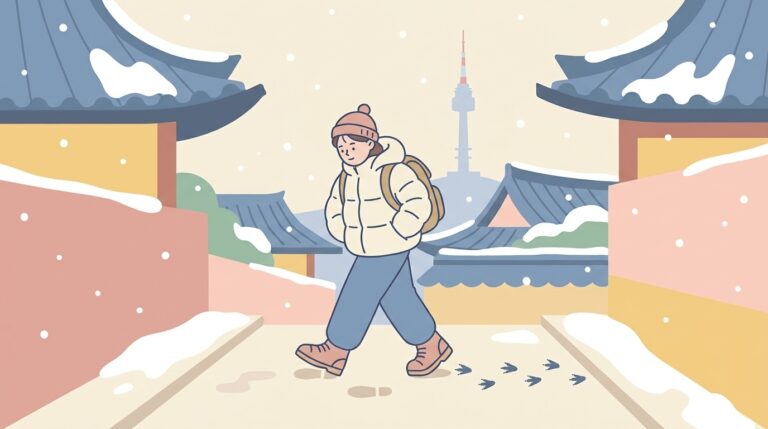
Stay Safe in the Snow: How to Navigate Slippery Korean Roads Like a Local
Phase 1: Empathy (Your Winter Survival Guide)
안녕하세요! (An-nyeong-ha-se-yo!) Your friendly neighborhood editor from Daily Hangul is back! ❄️
Picture this: You are walking down a romantic, snow-covered street in Seoul. It looks exactly like a scene from your favorite K-drama, maybe Goblin or Crash Landing on You. You are looking up at the beautiful snowflakes, feeling the cozy winter vibe, when suddenly—WHOOPS! Your feet slide out from under you on a hidden patch of black ice. You flail your arms, barely catching your balance, while a local grandmother gracefully glides past you like an Olympic figure skater.
If you’ve ever felt intimidated by Korea’s steep, hilly streets during winter, you are not alone! Many of our intermediate (B1) students tell us they know the word for “snow” (눈 – nun), but they freeze up when trying to explain why they are walking so slow or how to warn a friend about the treacherous ice.
Today, we are going to fix that. You will learn how to warn your friends, share your slippery struggles, and navigate icy winter roads like a true Seoulite. Let’s slide right into it!
Phase 2: Core Expressions Deep Dive
Here are the top 3 expressions you need to survive a Korean winter. Let’s break down the grammar, pronunciation, and exact vibes of each.
1. 길가 미끄러우니까 조심해요 (gil-ga mi-kkeu-reo-u-ni-kka jo-sim-hae-yo)
- Pronunciation: Geel-gah mee-kkeu-ruh-oo-nee-kkah jo-sheem-hae-yo (Think of “mee-kkeu” sounding like a quick, slippery slide!)
- Meaning: The street is slippery, so be careful.
- K-Culture Moment: You will hear this constantly in reality shows like Heart Signal or I Live Alone when guests step outside the house on a snowy morning.
- Editor’s Insight: The ending -으니까 (-eu-ni-kka) is a grammatical connector meaning “because” or “since.” It’s perfect for giving reasons when making suggestions or warnings.
- Situation Spectrum: Casual (⚠️ – 길 미끄러우니까 조심해) | Semi-formal (✅ – 길 미끄러우니까 조심해요) | Formal (✅ – 길이 미끄러우니 조심하십시오)
- 🤔 Think About It: Why do you think Koreans prefer using soft warnings like “조심해요” (Please be careful) instead of direct commands like “천천히 걸어요” (Walk slowly)? It shows a cultural emphasis on personal safety and care for the listener.
2. 눈길에 넘어질 뻔했어요 (nun-gi-re neo-meo-jil ppeon-haess-eo-yo)
- Pronunciation: Noon-ghee-reh nuh-muh-jeel ppeon-haess-uh-yo (Focus on the double “pp” in “ppeon”—it’s a tense, popped sound, like “spaghetti” without the ‘s’).
- Meaning: I almost fell on the snowy road.
- K-Culture Moment: Picture a romantic comedy where the lead actress slips, and the male lead catches her dramatic style. She sighs and says this to catch her breath.
- Editor’s Insight: The pattern -(으)ㄹ 뻔했다 (-(eu)l ppeon-haet-da) means “to almost do something” (usually something negative). It is a life-saver for dramatic storytelling with your Korean friends!
- Situation Spectrum: Casual (✅ – 넘어질 뻔했어) | Semi-formal (✅ – 넘어질 뻔했어요) | Formal (🚫 – 넘어질 뻔하였습니다 – sounds too dramatic for business settings)
3. 빙판길 조심하세요 (bing-pan-gil jo-sim-ha-se-yo)
- Pronunciation: Beeng-pahn-geel jo-sheem-hah-seh-yo
- Meaning: Watch out for the icy/frozen roads.
- K-Culture Moment: This is the ultimate warning banner you’ll see on electronic signs in subway stations and bus stops across Korea during January.
- Editor’s Insight: 빙판 (bing-pan) translates to “ice sheet” or “icy plate,” and 길 (gil) means road. Together, they refer to that dangerous, invisible black ice. Adding -하세요 (-ha-se-yo) makes it polite and warm.
- Situation Spectrum: Casual (⚠️ – 빙판길 조심해) | Semi-formal (✅ – 빙판길 조심하세요) | Formal (✅ – 빙판길 조심하시기 바랍니다)
Phase 3: Textbook Korean vs. Real-Life Korean
Let’s compare the stiff phrases from your standard dictionary with what you will actually hear on the streets of Hongdae.
Scenario 1: Warning a friend walking next to you
- 📖 Textbook: “기온이 낮아 도로가 결빙되었습니다.” (The temperature is low, so the road is frozen.)
- 🗣️ Real Korean: “와, 진짜 춥다! 길 다 얼었어, 조심해!” (Wow, it’s freezing! The whole road is frozen, watch out!)
- 💡 Why the difference? The textbook uses Sino-Korean technical terms like “결빙 (gyeol-bing – freezing).” Locals prefer the pure Korean verb “얼다 (eol-da – to freeze)” for a much warmer, natural vibe.
Scenario 2: Expressing your struggle walking on ice
- 📖 Textbook: “보행 시 미끄러짐을 방지하십시오.” (Please prevent slipping when walking.)
- 🗣️ Real Korean: “나 아까 엉덩방아 찧을 뻔했잖아!” (I almost slammed my butt on the ground earlier!)
- 💡 Why the difference? “엉덩방아 찧다 (eong-deong-bang-a jji-da)” is a highly idiomatic, slightly humorous expression meaning “to fall hard on one’s buttocks.” It’s what native speakers use to make light of a clumsy moment!
Phase 4: K-Culture Deepdive & Non-Verbal Manners
4-1. The Korean “Penguin Walk” (펭귄 걸음)
When Korean roads freeze, people immediately adopt a survival posture known as the 펭귄 걸음 (peng-gwin geo-reum)—the Penguin Walk.
* How to do it: Keep your hands out of your pockets (very important for safety!), bend your knees slightly, and take short, waddling steps.
* The Nunchi (눈치) Aspect: If you walk too fast and confidently on an icy hill, locals will judge your lack of “Nunchi” (situational awareness). Walking slowly and cautiously shows you respect the dangerous winter elements.
4-2. The Romanticized “Catch” vs. Reality
In K-Dramas, slipping on snow is a catalyst for romance. However, in Korean society, slipping in public is met with a collective gasp of sympathy. If you see someone slip, the polite reaction is to look away slightly to save their face (체면 – che-myeon) while offering a quiet, concerned “괜찮으세요?” (Are you okay?).
Phase 5: Real-Life Roleplay Scenario
Meet Ji-hoon (지훈), your Korean friend who is taking you to a cozy hot pot restaurant in the hilly neighborhood of Ihwa Mural Village on a snowy evening.
지훈: 사만다, 오늘 눈 진짜 많이 온다! 길 많이 미끄러우니까 내 팔 잡고 걸어요.
      (Samantha, it's snowing so much today! The road is super slippery, so hold onto my arm.)

사만다: 와, 정말 예쁘지만 무서워요. 저 아까 올 때도 미끄러질 뻔했어요.
        (Wow, it's really beautiful but scary. I almost slipped on my way here, too.)

지훈: 🎭 (걱정스러운 눈빛으로 바라보며) 정말요? 다치지 않아서 다행이에요. 여기 골목길은 특히 빙판길이 많아요.
      (Really? Thank goodness you didn't get hurt. The alleys around here have a lot of icy patches especially.)

사만다: 맞아요. 경사가 너무 심해서 진짜 펭귄처럼 걷고 있어요!
        (Exactly. The slope is so steep, I'm literally walking like a penguin!)

지훈: 🎭 (웃음을 터뜨리며) 하하, 펭귄 걸음이 최고예요! 주머니에 손 넣지 말고 천천히 가요.
      (Haha, the penguin walk is the best! Don't put your hands in your pockets, let's go slowly.)

사만다: 네, 지훈 씨도 조심하세요. 어! 저기 앞쪽 길 완전 얼어붙은 것 같아요!
        (Okay, you watch out too, Ji-hoon. Oh! It looks like the road right ahead is completely frozen!)

지훈: 진짜네요. 우리 저쪽 아스팔트 길로 돌아가요. 거기는 제설 작업이 끝난 것 같아요.
      (You're right. Let's detour to that asphalt road over there. It looks like they finished clearing the snow.)

사만다: 좋은 생각이에요. 안전이 제일이죠!
        (Great idea. Safety first!)
🔀 Your Turn: Make Your Choice!
Ji-hoon suddenly slips slightly on a patch of black ice. What do you say?
- A) “지훈 씨, 엉덩방아 찧었어요?”
- B) “지훈 씨, 괜찮아요? 빙판길이라 진짜 미끄럽네요. 조심해요!”
- C) “지훈 씨, 왜 그렇게 걸어요? 조심해야죠!”
🔍 Click here to see the feedback on your choice!
- Best Choice – B: Perfect! You expressed immediate warm concern (“괜찮아요?”) and used the keyword (“빙판길”) to validate the struggle. Extremely natural and caring!
- Risk Choice – A: A bit too direct! Asking if he “slammed his butt” before asking if he is okay might hurt his pride, especially if he didn’t actually fall completely.
- Bad Choice – C: Too critical! Saying “Why are you walking like that?” sounds like you are scolding him. Not the best vibe for a friendly winter walk.
Phase 6: 10-Second Shadowing Drill
Practice speaking with real Korean emotion. Use the slashes / to pause and mimic the emotional cues!
[🥺 걱정스럽고 다정하게 - Worried & Sweetly]
“길이 / 진짜 미끄러우니까 / 조심해서 걸어요!”
(Geel-ee / jeen-jja mee-kkeu-ruh-oo-nee-kkah / jo-sheem-hae-suh guh-ruh-yo!)-
[😱 진짜 놀란 목소리로 - Truly Shocked]
“어머! / 방금 / 넘어질 뻔했어! / 대박…”
(Uh-muh! / bahng-geum / nuh-muh-jeel ppeon-haess-uh! / dae-bahk…)
Phase 7: K-Culture Mini-Dictionary
- 빙판길 (Bing-pan-gil): Icy road. Essential winter term used in news broadcasts and daily warnings.
- 펭귄 걸음 (Peng-gwin geo-reum): Penguin walk. The universally accepted survival walking style in Korea.
- 꽁꽁 (Kkong-kkong): Onomatopoeia for being frozen solid. (e.g., “한강이 꽁꽁 얼었어요” – The Han River is frozen solid.)
- 핫팩 (Hat-paek): Hot pack / Hand warmer. The ultimate winter survival accessory sold at every convenience store.
Phase 8: Traveler’s Survival Kit
Survival Phrases for Snowy Days
- 도와주세요! (Do-wa-ju-se-yo!) – Help me! (Use this if you slip and cannot get up).
- 여기 모래주머니 어디 있어요? (Yeo-gi mo-rae-ju-meo-ni eo-di iss-eo-yo?) – Where is the sandbag container around here? (Koreans place public sandboxes on steep hills to help melt ice).
- 미끄럼 방지 패드 (Mi-kkeu-reom bang-ji pae-deu) – Anti-slip shoe pads. You can buy these at Daiso for 2,000 KRW!
📌 Editor’s Travel Note
If you are traveling in Seoul during winter, steep areas like Ihwa Mural Village, Bukchon Hanok Village, or the hilly parts of Haebangchon can become absolute ice rinks.
* Pro-Tip: Check the terrain using the 네이버 지도 앱 (Naver Map App). If a path looks steep on the map, avoid it after a heavy snowfall and take the main roads instead, as they are cleared of snow first!
Phase 9: One Step Deeper (Korean Shared Safety Culture)
In Western cultures, winter safety is often viewed through the lens of individual responsibility or municipal duty. In Korea, however, dealing with snow is highly communal. You will often see shopkeepers and elderly neighbors waking up at 5 AM to sweep the snow in front of not just their own shops, but the shared public alleyways.
This collective effort is driven by 정 (Jeong – affection/bonding). By warning others with phrases like “조심하세요,” Koreans reinforce this shared safety net.
💬 Your Turn: How does your home country handle icy streets? Is it a neighborhood effort, or do you rely on city plows? Tell us in the comments below!
Phase 10: FAQ & Common Mistakes
Q: Can I use “미끄러운 길” instead of “빙판길”?
A: Yes, both are correct! However, “미끄러운 길” simply means “a slippery road” (could be wet from rain), whereas “빙판길” specifically paints a picture of a dangerous road frozen over with ice. To sound like a local, use 빙판길 in winter!
Q: What is the difference between “조심해요” and “조심하세요”?
A: “조심하세요” (jo-sim-ha-se-yo) is more polite and formal because of the honorific infix -시- (-si-). Use it with strangers, elders, or colleagues. “조심해요” (jo-sim-hae-yo) is semi-formal, perfect for close friends of similar age or younger acquaintances.







