

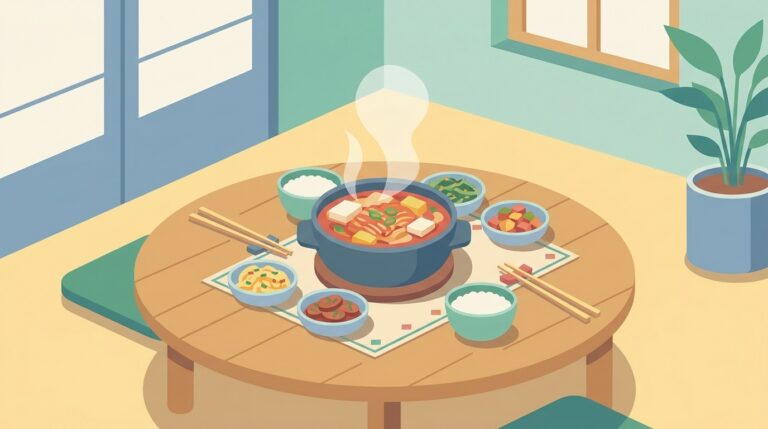
Getting Menu Recommendations & Asking About Ingredients
안녕하세요! 매일한글 에디터입니다. (Annyeonghaseyo! Hello, I’m your Daily Hangul Editor.) Picture this: you finally step into a buzzing Seoul eatery, just like in your favorite K-Drama. The sizzle of pork belly fills the air, a friendly server walks over with a notepad, and you stare at a wall menu with zero pictures and zero English. Panic hits! What’s actually good here? Is that dish super spicy? Does it have pork or peanuts? Don’t worry—you’re not alone. Hundreds of our beginner students told us ordering in local restaurants was their #1 travel hurdle. Today, you’ll learn simple, real-life Korean phrases to get the best menu recommendations and check ingredients effortlessly!
Phase 2: 3 Essential Expressions Deep Dive
1. 처음 왔는데 뭐가 제일 인기 많아요? (Cheoeum wanneunde mwoga jeil ingi manayo?)
- Pronunciation: Cheo-eum wan-neun-de mwo-ga je-il in-gi ma-na-yo? (Think of cheo-eum like “chuh-um” with a relaxed jaw, and je-il like “jay-il” said smoothly together.)
- Meaning: Literally “I came for the first time, so what has the most popularity?” Real nuance: “It’s my first time here—what’s your most popular dish?”
- K-Culture Moment: Just like in the K-Drama Let’s Eat (식샤를 합시다), when a character visits a famous neighborhood gukbap (soup with rice) spot for the first time, they lean in excitedly and ask the owner for the house favorite.
- Editor’s Insight: Adding 처음 왔는데 (cheoeum wanneunde – it’s my first time) instantly melts the ice! Korean restaurant owners love welcoming first-timers and will often give you their proudest recommendation—plus extra helpful tips on how to eat it.
- Situation Spectrum: Casual 🚫 | Semi-formal ✅ | Formal ⚠️
- 🤔 Think About It: In English, you might jump straight to “What do you recommend?” Why do Koreans often give background context (“It’s my first time”) before asking? How does sharing your situation build rapport in your culture?
2. 혹시 여기 안에 뭐가 들어가요? (Hoksi yeogi ane mwoga deureogayo?)
- Pronunciation: Hok-si yeo-gi a-ne mwo-ga deu-reo-ga-yo? (Hok-si sounds like “hoke-she”, and deu-reo-ga-yo rolls quickly like “duh-ruh-gah-yo”.)
- Meaning: Literally “By any chance, what goes inside here?” Real nuance: “Excuse me, what ingredients are in this dish?”
- K-Culture Moment: In Korean food variety shows like Jinny’s Kitchen (서진이네), travelers with food allergies or dietary preferences politely point at the menu and ask what goes inside before ordering.
- Editor’s Insight: You can swap 뭐가 (mwoga – what) with any specific ingredient you want to check! For example: 돼지고기 들어가요? (dwaejigogi deureogayo? – Does pork go in?) or 땅콩 들어가요? (ttangkong deureogayo? – Are there peanuts in it?).
- Situation Spectrum: Casual 🚫 | Semi-formal ✅ | Formal ⚠️
- 🤔 Think About It: Notice how Korean uses the active verb 들어가다 (deureogada – to go in) rather than “contain” or “have.” Does your native language describe ingredients as “going into” a dish or “being inside” it?
3. 이거 안 맵게 해 주세요. (Igeo an maepge hae juseyo.)
- Pronunciation: I-geo an maep-ge hae ju-se-yo. (Maep-ge sounds like “mep-geh” with a light stop on the p, and ju-se-yo rhymes with “chew-say-yo”.)
- Meaning: Literally “Please make this not spicy.” Real nuance: “Could you make this mild / non-spicy, please?”
- K-Culture Moment: On idol travel vlogs like BTS Run or SEVENTEEN’s Going Seventeen, members who can’t handle fiery tteokbokki always negotiate for a milder version using this exact phrase!
- Editor’s Insight: Korean “mild” can still pack a little kick! If you want zero spice, add 조금도 (jogeumdo – not even a little) or ask 안 매운 메뉴 있어요? (an maeun menyu isseoyo? – Do you have a non-spicy menu?).
- Situation Spectrum: Casual 🚫 | Semi-formal ✅ | Formal ⚠️
- 🤔 Think About It: In Korea, asking to adjust spice levels is very common when food is cooked to order, though some pre-made stews can’t be changed. How flexible are restaurants in your country about customizing recipes?
Phase 3: Textbook Korean vs. Real Korean
Situation 1: Asking for the most popular item
- 📖 교과서 한국어 (Textbook Korean): 가장 잘 팔리는 음식을 추천해 주세요. (Gajang jal pallineun eumsigeul chucheonhae juseyo.) — “Please recommend the best-selling food.”
- 🗣️ 진짜 한국어 (Real Korean): 여기 뭐가 제일 잘 나가요? (Yeogi mwoga jeil jal nagayo?) — “What goes out best here?”
- 💡 왜 다를까? (Why the difference?): Saying “best-selling” sounds like a business report! In real restaurants, Koreans say 잘 나가다 (jal nagada – goes out well) to mean a dish leaves the kitchen nonstop because everyone orders it.
Situation 2: Checking if a dish has a specific ingredient
- 📖 교과서 한국어 (Textbook Korean): 이 요리에는 고기가 포함되어 있습니까? (I yorieneun gogiga pohamdoeeo itseumnikka?) — “Is meat included in this dish?”
- 🗣️ 진짜 한국어 (Real Korean): 이거 고기 빼고 가능해요? (Igeo gogi ppaego ganeunghaeyo?) — “Is it possible without meat?”
- 💡 왜 다를까? (Why the difference?): “포함되다 (be included)” belongs on food packaging labels, not at the dinner table. Using 빼고 (ppaego – leaving out) with 가능해요? (ganeunghaeyo? – is it possible?) is friendly, short, and super clear.
Phase 4: K-Culture Deep Dive & Non-Verbal Manners
4-1. 눈치 (Nunchi) & Restaurant Gestures
In Korea, servers won’t hover over your table checking on you every five minutes—that’s actually considered polite so they don’t interrupt your meal! Instead, use your 눈치 (nunchi – social awareness):
* Calling the server: Look for a small round call button (벨 / bel) on the side of your table. No bell? Catch the server’s eye, raise one hand gently at shoulder height (never snap your fingers!), and say “여기요! (Yeogiyo! – Over here!)” or “저기요! (Jeogiyo! – Excuse me!)” with a warm nod.
* Pointing politely: When asking about a dish on a wall menu or another table, point with an open hand or a gentle finger near the menu rather than jabbing toward another diner.
4-2. K-Food Culture Code: “이모님 (Imonim)” & Signature Menus
Unlike giant all-purpose restaurants elsewhere, many beloved Korean spots specialize in just one or two 대표 메뉴 (daepyo menyu – signature dishes) perfected over decades—just like the cozy kimbap shop in Extraordinary Attorney Woo or the bustling pojangmacha (street tents) in Business Proposal. When you call an older female server 이모님 (Imonim – literally “Auntie”), it creates warm family energy, and she’ll happily guide a first-timer on how to mix, wrap, or dip the food properly!
Phase 5: Real-Life Roleplay Scenario
Setting: A lively, steamy dakgalbi (stir-fried spicy chicken) restaurant in Hongdae on Friday night. A huge iron pan sits in the center of your table, and the aroma of garlic and sesame oil fills the air.
Characters: You (an excited traveler) & 이모님 (Imonim) (an energetic, warm-hearted restaurant auntie wearing a patterned apron).
- You: 🎭 (Raises hand gently with a bright smile) 여기요! 처음 왔는데 뭐가 제일 인기 많아요? (Yeogiyo! Cheoeum wanneunde mwoga jeil ingi manayo?) — “Excuse me! It’s my first time here—what’s the most popular?”
- 이모님: 🎭 (Walks over briskly, beaming) 어서 와요! 여기는 치즈 닭갈비가 제일 잘 나가요! (Eoseo wayo! Yeogineun chijeu dakgalbiga jeil jal nagayo!) — “Welcome! Here, the Cheese Dakgalbi is our top seller!”
- You: 🎭 (Looks curiously at the red chili paste picture on the menu) 아, 혹시 이거 많이 매워요? (A, hoksi igeo mani maewoyo?) — “Ah, by any chance, is this really spicy?”
- 이모님: 🎭 (Waves one hand reassuringly) 보통은 조금 매콤해요. 매운 거 잘 못 먹어요? (Botongeun jogeum maekomhaeyo. Maeun geo jal mot meogeoyo?) — “Usually it’s a bit spicy. Can you not eat spicy food well?”
- You: 🎭 (Nods sheepishly) 네, 안 맵게 해 주세요! 그리고 혹시 안에 땅콩 들어가요? (Ne, an maepge hae juseyo! Geurigo hoksi ane ttangkong deureogayo?) — “Yes, please make it not spicy! And by any chance, are there peanuts inside?”
- 이모님: 🎭 (Checks her notepad and nods confidently) 땅콩은 안 들어가요. 걱정 마세요! 순한 맛으로 해 줄게요. (Ttangkong-eun an deureogayo. Geokjeong maseyo! Sunhan maseuro hae julgeyo.) — “No peanuts go in it. Don’t worry! I’ll make it mild flavor for you.”
- You: 🎭 (Sighs with relief and smiles) 감사합니다! 치즈 닭갈비 2인분 주세요. (Gamsahamnida! Chijeu dakgalbi i-inbun juseyo.) — “Thank you! Two servings of Cheese Dakgalbi, please.”
- 이모님: 🎭 (Gives a thumbs-up) 알겠어요! 금방 나올 거예요! (Algesseoyo! Geumbang naol geoyeyo!) — “Got it! It’ll be right out!”
🔀 Interactive Branching Point: The dish arrives, and you notice bright green leaves on top that you don’t recognize. What do you say?
- A: “이모님, 이거 이름이 뭐예요?” (Imonim, igeo ireumi mwoyeyo? — “Auntie, what’s the name of this?”) -> ✅ Best! Polite, curious, and natural! She’ll tell you it’s kkaennip (perilla leaf) and show you how to wrap the chicken in it.
- B: “이거 이상해요. 먹지 마세요.” (Igeo isanghaeyo. Meokji maseyo. — “This is weird. Don’t eat it.”) -> ❌ Bad! Calling local ingredients “weird” can sound rude, and “don’t eat it” is a command directed at the server!
- C: “이거 풀이에요?” (Igeo purieyo? — “Is this grass?”) -> ⚠️ Risk! Might make the server chuckle if you’re clearly joking, or confuse them! Stick to asking the name or saying 이거 뭐예요? (Igeo mwoyeyo? – What is this?).
Phase 6: 10-Second Emotion Shadowing Drill
Read these aloud, pausing briefly at / and matching the emotion!
- [😊 Excited & Curious]
처음 왔는데 / 뭐가 제일 / 인기 많아요? (Cheoeum wanneunde / mwoga jeil / ingi manayo?) - [🤔 Careful & Polite]
혹시 / 여기 안에 / 고기 들어가요? (Hoksi / yeogi ane / gogi deureogayo?) - [🥺 Hopeful & Cute]
저 매운 거 못 먹어요. / 안 맵게 해 주세요! (Jeo maeun geo mot meogeoyo. / An maepge hae juseyo!)
Phase 7: K-Culture Mini Dictionary
- 대표 메뉴 (Daepyo menyu) | Signature Menu | Literally “representative menu.” Every restaurant has 1–2 hero dishes marked with a star or bold text—your safest bet for an amazing meal!
- 반찬 (Banchan) | Side Dishes | The small plates (like kimchi or pickled radish) served before your main dish. They’re free and usually refillable—just ask “반찬 더 주세요 (Banchan deo juseyo)”!
- 맵기 조절 (Maepgi jojeol) | Spice Level Adjustment | Many modern K-Food chains let you choose levels 1 to 3. Look for this phrase on menus or kiosks.
- 서비스 (Seobiseu) | Complimentary / “On the House” | In Korea, “service” doesn’t mean customer service—it means free bonus food or drinks from a happy owner!
Phase 8: Traveler’s Survival Kit
Top 3 Survival Phrases
- 이거 안 매워요? (Igeo an maewoyo?) — “Is this not spicy?” Pro Tip: Point directly at the dish name on the menu while raising your tone at the end.
- 채식 메뉴 있어요? (Chaesik menyu isseoyo?) — “Do you have vegetarian options?” Pro Tip: Because broth in Korea often uses anchovies or beef, always double-check soups!
- 사진 보여 주세요. (Sajin boyeo juseyo.) — “Please show me a photo.” Pro Tip: Great backup if you still aren’t sure what a dish looks like.
Editor’s Travel Note
- Before heading out, Download Naver Map for Verified Korean Restaurant Reviews since Google Maps doesn’t show full walking directions or local menu photos in Korea.
- Also Install Naver Papago Translator for Instant Menu Camera Scanning so you can hover your phone over wall menus and read ingredient lists in seconds.
- Payment Tip: Most Korean restaurants don’t bring the check to your table. Take your paper bill (or simply walk up) to the front counter (계산대 / gyesandae) near the exit when you’re finished!
Phase 9: One Step Deeper
In Korean culture, food is never just fuel—it’s the ultimate expression of 정 (Jeong), a warm, unspoken bond of care and community. When you ask a Korean server what’s popular or tell them it’s your first time, you aren’t inconveniencing them at all; you’re opening the door for jeong. That’s why an auntie might suddenly walk over, cut your meat with scissors, or drop an extra steamed egg on your table as 서비스 (seobiseu). By speaking just a few humble phrases in Korean, you transform from a nervous tourist into a welcomed guest.
💬 Your Turn: Have you ever ordered a mystery dish at a Korean restaurant—or what’s the #1 K-Food dish you want to try first? Drop a comment below and tell us!
Phase 10: FAQ & Common Mistakes
Q: Is it rude to ask for an ingredient to be removed in Korea?
A: Not at all! As long as it’s a cooked-to-order dish (like bibimbap or kimbap), asking “~ 빼 주세요 (~ ppae juseyo – Please leave out ~)” is totally normal. Just note that pre-simmered stews like kimchi jjigae already have their base flavors mixed in.
Q: What if I say “안 맵게 해 주세요 (Please make it not spicy)” and it’s still spicy?
A: Korean chili paste (gochujang) has natural heat, so “not spicy” often means “less spicy.” Ask for 물 (mul – water) or order 계란찜 (gyeranjjim – steamed egg)—it’s fluffy, savory, and cools down spice instantly!
Q: Should I tip the server if they give me great menu recommendations?
A: No! Tipping is not practiced in South Korea and can actually confuse servers (they might run after you thinking you dropped your cash). A warm “맛있게 잘 먹었습니다! (Masitge jal meogeotseumnida! – I ate deliciously!)” at the counter is the best tip you can give.
🚨 Common Mistakes TOP 3
- Saying “저 (I)” without checking food allergies clearly: Don’t just say “No meat” in English—many Korean soups use meat broth! Correct Action: Always ask “고기 육수예요? (Gogi yuksuyeyo? – Is it meat broth?)” or show a translated allergy card.
- Waving with your palm facing up to call a server: In Korea, gesturing palm-up with fingers curling toward you is how you call a pet, not a person! Correct Action: Raise your hand lightly with your palm flat or facing sideways and say “여기요! (Yeogiyo!)”.
- Waiting at the table for the bill after eating: You might sit there for 30 minutes! Correct Action: Stand up when you’re done and pay directly at the front register.
Phase 11: Action Mission & Engagement
- 🥉 Bronze Mission: Say all three Phase 2 expressions out loud three times in front of a mirror today, adding a friendly smile.
- 🥈 Silver Mission: Share your favorite Korean dish on Instagram or TikTok and caption it with “뭐가 제일 인기 많아요?” to teach your friends!
- 🥇 Gold Mission: Next time you visit a Korean restaurant (in Korea or your hometown!), ask your server “처음 왔는데 뭐가 제일 인기 많아요?” before opening the menu.
- 🎮 K-Culture Mission: Watch an episode of a Korean food show like Street Food Fighter or your favorite idol’s Mukbang vlog and listen carefully—how many times do you hear 잘 나가다 (jal nagada) or 대표 메뉴 (daepyo menyu)?
Phase 12: Interactive Quiz Challenge
1. Situation Judgment: You’re at a busy tteokbokki shop and want to know what the #1 most popular dish is. Which phrase sounds most natural and friendly?
* A) 이 식당에서 무엇을 팔아요? (I sikdang-eseo mueoseul parayo?)
* B) 처음 왔는데 뭐가 제일 인기 많아요? (Cheoeum wanneunde mwoga jeil ingi manayo?)
* C) 빨리 추천해 주세요. (Ppalli chucheonhae juseyo.)
Click to reveal Answer & Explanation
Answer: B!
* A asks “What do you sell at this restaurant?”—too stiff and vague.
* C means “Recommend quickly,” which sounds demanding!
* B warmly tells the server it’s your first time and asks what’s most popular.
2. Fill in the Blank: Complete the sentence to ask if shrimp goes inside a dish.
“혹시 여기 안에 새우 ________?” (Hoksi yeogi ane saeu ________?)
Click to reveal Answer & Explanation
Answer: 들어가요 (deureogayo)
In everyday Korean, we use 들어가다 (to go in) to ask what ingredients are inside a dish: 혹시 여기 안에 새우 들어가요?
3. True or False (Culture Quiz): If you say “안 맵게 해 주세요 (Please make it not spicy),” every Korean dish can be made 100% spice-free.
Click to reveal Answer & Explanation
Answer: False!
While stir-fried or made-to-order dishes can often be adjusted, pre-made broths and stews already contain chili paste or pepper flakes. If you can’t eat any spice at all, ask “안 매운 메뉴 있어요? (Do you have a non-spicy dish?)”!
🎬 Watch Our Daily Videos! (Daily Hangul Official Instagram)
Review the expressions you learned in this article with our fun daily short videos! Check out native pronunciation and real-life nuances in action.
- Instagram @dailyhangul_en







