

Phase 1: Empathy — The Great Book Debate in Seoul
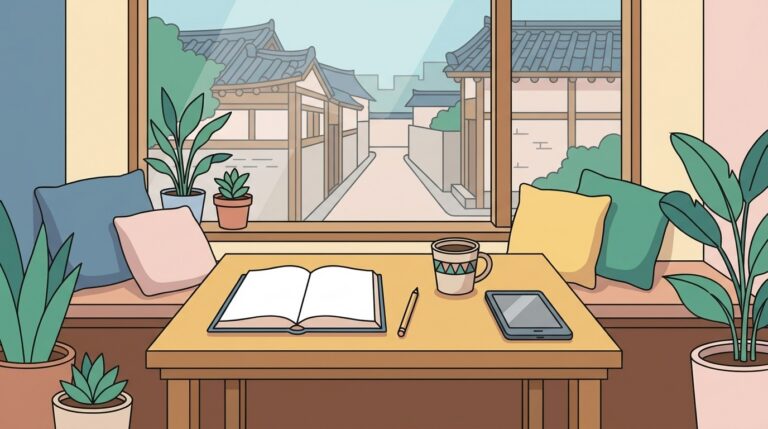
안녕하세요! 매일한글 에디터입니다. (Hello! I’m your Daily Hangul editor.) Imagine sitting in a cozy Yeonnam-dong book cafe on a rainy Seoul afternoon, just like a scene from Romance is a Bonus Book. You pull out a crisp paperback and a wooden pencil, while your Korean friend taps on a sleek e-reader or pops in earbuds for an audiobook. You want to explain why underlining memorable lines in pencil and scribbling thoughts in the margins helps everything stick in your brain—but suddenly, your Korean freezes at ‘I like books.’ Don’t worry! Built from real feedback from intermediate learners, this guide gives you the exact nuances to debate paper books versus digital reading like a true local.
Phase 2: Deep Dive Into 3 Essential Expressions
1. 밑줄을 긋다 (mit-ju-reul geut-da)
- Pronunciation: mit-ju-reul geut-da — Say “mit” like meet cut short, “jul” like jewel without the w, “eul” like uh-l, “geut” like good ending in a soft t, and “da” like dah.
- Meaning: Literally “to draw an underline.” In real life, Koreans also casually say 줄을 치다 (ju-reul chi-da, to strike a line), and it carries the nuance of actively savoring and studying a text rather than just skimming it.
- K-Culture Moment: Picture the book-loving leads in the K-Drama Romance is a Bonus Book (로맨스는 별책부록) sitting at a desk lamp late at night, gently dragging a pencil under a poignant poem.
- Editor’s Insight: Notice the verb 긋다 (geut-da) is an irregular ㅅ verb! When you conjugate it to “while underlining,” it becomes 그으면서 (geu-eu-myeon-seo), dropping the ㅅ. If that trips you up mid-conversation, native speakers often swap in 줄을 치다 (ju-reul chi-da -> 줄 치면서), which never changes irregularly!
- Situation Spectrum: Casual ✅ (밑줄 그어 / 줄 쳐) | Semi-formal ✅ (밑줄을 그어요 / 줄을 쳐요) | Formal ✅ (밑줄을 긋습니다)
- 🤔 Think About It: In English, you might say “I highlighted a quote,” even when using a pen or digital stylus. In Korean, 밑줄을 긋다 specifically evokes the tactile image of drawing a line. Does your native language distinguish between highlighting with color and underlining with a pencil?
2. 여백에 메모하다 (yeo-bae-ge me-mo-ha-da)
- Pronunciation: yeo-bae-ge me-mo-ha-da — Say “yeo” like yuh in young, “bae-ge” like bay-geh, and “me-mo-ha-da” smoothly like meh-mo-ha-dah.
- Meaning: Literally “to make a memo in the blank space.” In everyday Korean, 여백 (yeo-baek) means the margin of a page, and 메모하다 (me-mo-ha-da) sounds lighter and more spontaneous than “taking formal notes” (필기하다, pil-gi-ha-da).
- K-Culture Moment: Think of Korean indie reading vlogs on YouTube where creators show off their well-loved paperbacks filled with tiny pencil thoughts along the edges, sharing 내 생각 (nae saeng-gak, my thoughts) with subscribers.
- Editor’s Insight: Using 메모하다 instead of 필기하다 is a huge intermediate-level upgrade! 필기하다 sounds like copying a professor’s lecture onto a notebook, whereas 여백에 메모하다 feels personal, creative, and reflective.
- Situation Spectrum: Casual ✅ (여백에 메모해) | Semi-formal ✅ (여백에 메모해요) | Formal ✅ (여백에 메모합니다)
- 🤔 Think About It: 여백 (yeo-baek) isn’t just a publishing term—in Korean traditional art, 여백의 미 (yeo-bae-gui mi, the beauty of empty space) is a cherished aesthetic value. How does leaving or filling empty space on a page feel in your culture?
3. 머리에 더 잘 남다 (meo-ri-e deo jal nam-da)
- Pronunciation: meo-ri-e deo jal nam-da — Say “meo-ri-e” like muh-ree-eh, “deo” like duh, “jal” like jahl, and “nam-da” like nahm-dah.
- Meaning: Literally “to remain in the head better.” Naturally, it means “the content sticks better in my memory.” You will also hear 기억에 더 잘 남다 (gi-eo-ge deo jal nam-da, stays in memory better) or the vivid mimetic adverb 머리에 쏙쏙 들어오다 (meo-ri-e ssok-ssok deu-reo-o-da, sinks right into one’s head).
- K-Culture Moment: In Korean variety shows like I Live Alone (나 혼자 산다), celebrities studying for a license or reading late at night often sigh when reading on a phone and say they need paper so it “sticks in their head.”
- Editor’s Insight: Intermediate learners often translate “stick” literally as 붙다 (but-da), which sounds like glue stuck to your hair! Always use 남다 (nam-da, remain) or 들어오다 (deu-reo-o-da, enter) for memories and knowledge.
- Situation Spectrum: Casual ✅ (머리에 더 잘 남아) | Semi-formal ✅ (머리에 더 잘 남아요) | Formal ✅ (머리에 더 잘 남습니다)
- 🤔 Think About It: Koreans use spatial metaphors for learning—things stay (남다) or come inside (들어오다) the head, rather than sticking to it. What physical metaphors does your native language use for remembering?
Phase 3: Textbook Korean vs. Real Korean
Situation 1: Explaining why you prefer paper books over e-readers
- 📖 Textbook Korean (교과서 한국어): 종이책이 전자책보다 기억에 더 많이 남습니다. (Jong-i-chae-gi jeon-ja-chaek-bo-da gi-eo-ge deo ma-ni nam-seum-ni-da. — Paper books remain in memory more than e-books.)
- 🗣️ Real Korean (진짜 한국어): 아무래도 연필로 줄 치면서 읽어야 머리에 쏙쏙 남더라고요. (A-mu-rae-do yeon-pil-lo jul chi-myeon-seo il-geo-ya meo-ri-e ssok-ssok nam-deo-ra-go-yo. — Somehow, I find I have to underline with a pencil while reading for it to really stick in my head.)
- 💡 Why the Difference? Real conversations soften opinions with 아무래도 (a-mu-rae-do, somehow / after all) and the experiential ending -더라고요 (-deo-ra-go-yo, I noticed from experience). Adding 쏙쏙 (ssok-ssok) brings warm, expressive color to your intermediate Korean!
Situation 2: Acknowledging the appeal of e-readers and audiobooks
- 📖 Textbook Korean (교과서 한국어): 전자책과 오디오북은 이동할 때 매우 편리합니다. (Jeon-ja-chaek-gwa o-di-o-bu-geun i-dong-hal ttae mae-u pyeon-ri-ham-ni-da. — E-books and audiobooks are very convenient when traveling.)
- 🗣️ Real Korean (진짜 한국어): 출퇴근길엔 가벼운 이북 리더기나 오디오북이 진짜 편하긴 해요. (Chul-toe-geun-gi-ren ga-byeo-un i-buk ri-deo-gi-na o-di-o-bu-gi jin-jja pyeon-ha-gin hae-yo. — On the commute, a light e-reader or audiobook really is super convenient, though.)
- 💡 Why the Difference? Instead of a stiff 이동할 때 (when moving), locals say 출퇴근길 (chul-toe-geun-gil, commute) and use -긴 해요 (-gin hae-yo, it is indeed…, though) to concede a point before sharing their personal preference.
Phase 4: K-Culture Deep Dive & Non-Verbal Manners
4-1. Nunchi (눈치) & Book Etiquette Gestures
In Korea, books are treated with deep respect—many Koreans won’t even fold a page corner (dog-earing) unless they are fiercely committed to “owning” the book. If you pull out a pencil in a cafe, a Korean friend might jokingly gasp, “우와, 책에 바로 쓰네?” (U-wa, chae-ge ba-ro sseu-ne? — Wow, you write right in the book?). To show good 눈치 (nunchi, social awareness), casually clarify “제 책이라서요” (je chae-gi-ra-seo-yo, because it’s my own book), and never underline in a borrowed or library book! When discussing a favorite quote in a quiet book cafe, Koreans lower their voice and gently trace an imaginary line in the air with one finger to mimic underlining without disturbing nearby readers.
4-2. Culture Code: Korea’s “Text Hip” (텍스트힙) Boom
You might assume hyper-digital Seoul runs purely on smartphones, e-readers, and audiobooks. While apps like Millie’s Library (밀리의 서재) and e-book readers are huge on packed Subway Line 2 commutes, Korea is currently riding a massive 텍스트힙 (tek-seu-teu-hip, “Text Hip”) wave! Among Korean Gen Z and Millennials, carrying a physical paper book, sitting in an independent bookstore in Seongsu-dong or Yeonnam-dong, and photographing pencil-underlined pages for Instagram has become the ultimate cool, mindful lifestyle—echoing the timeless literary romance of dramas like Because This Is My First Life (이번 생은 처음이라).
Phase 5: Real-Life Roleplay Scenario
Setting: A sunlit, wood-scented book cafe in Yeonnam-dong. Jazz plays softly in the background. You are sitting across from your Korean friend Ji-min (지민), who is scrolling on her slim white e-reader while you sharpen a wooden pencil beside your paperback.
- Ji-min: 🎭 (Looks up from her e-reader, amused) 야, 아직도 종이책이랑 연필을 들고 다니네? 무겁지 않아? (Ya, a-jik-do jong-i-chae-gi-rang yeon-pi-reul deul-go da-ni-ne? Mu-geop-ji a-na? — Hey, you still carry around a paper book and a pencil? Isn’t it heavy?)
- You: 🎭 (Smiles and taps your book cover) 조금 무겁긴 한데, 나는 종이책이 더 좋더라고요. (Jo-geum mu-geop-gin han-de, na-neun jong-i-chae-gi deo jo-teo-ra-go-yo. — It is a bit heavy, but I find I like paper books better.)
- Ji-min: 🎭 (Pats her slim e-reader proudly) 이북 리더기 쓰면 가방도 가볍고 밤에 불 끄고 보기도 편한데! (I-buk ri-deo-gi sseu-myeon ga-bang-do ga-byeop-go ba-me bul kkeu-go bo-gi-do pyeon-han-de! — If you use an e-reader, your bag is light and it’s easy to read at night with the lights off!)
- You: 🎭 (Nods in agreement) 맞아요, 출퇴근길엔 이북 리더기나 오디오북이 진짜 편하긴 해요. (Ma-ja-yo, chul-toe-geun-gi-ren i-buk ri-deo-gi-na o-di-o-bu-gi jin-jja pyeon-ha-gin hae-yo. — Right, on the commute, an e-reader or audiobook really is super convenient, though.)
- Ji-min: 🎭 (Tilts her head curiously) 그런데 왜 굳이 종이책을 고집하는 거야? (Geu-reon-de wae gu-ji jong-i-chae-geul go-jip-ha-neun geo-ya? — Then why do you insist on paper books so much?)
- You: 🎭 (Holds up your pencil and points to the page) 인상 깊은 문장에 연필로 밑줄을 긋고 여백에 내 생각을 메모하면서 읽거든요. (In-sang gi-peun mun-jang-e yeon-pil-lo mit-ju-reul geut-go yeo-bae-ge nae saeng-ga-geul me-mo-ha-myeon-seo il-geo-deun-yo. — Because I read while underlining memorable sentences in pencil and jotting my thoughts in the margins, you see.)
- Ji-min: 🎭 (Eyes widen thoughtfully) 아, 하긴 이북으로 하이라이트하는 거랑 느낌이 좀 다르긴 하지. (A, ha-gin i-bu-geu-ro ha-i-ra-i-teu-ha-neun geo-rang neu-kki-mi jom da-reu-gin ha-ji. — Oh, true, highlighting on an e-book does feel a bit different.)
- You: 🎭 (Taps your forehead playfully) 네, 그렇게 손으로 쓰면서 읽을 때 내용이 머리에 더 잘 남더라고요! (Ne, geu-reo-ke so-neu-ro sseu-myeon-seo il-geul ttae nae-yong-i meo-ri-e deo jal nam-deo-ra-go-yo! — Yes, when I read while writing by hand like that, the content sticks in my head much better!)
🔀 Interactive Branching Point: Ji-min offers to lend you her favorite novel!
Ji-min says, “Oh! I have the paper copy of that novel at home too. Do you want to borrow it?” How do you reply if you love taking pencil notes?
- Option A: “고마워! 빌려서 연필로 밑줄 좀 그으면서 읽을게!” (Go-ma-wo! Bil-lyeo-seo yeon-pil-lo mit-jul jom geu-eu-myeon-seo il-geul-ge! — Thanks! I’ll borrow it and read while underlining in pencil!) -> ❌ Bad: Major nunchi fail! Never tell a Korean friend you plan to write in a book you’re borrowing from them.
- Option B: “좋아! 대신 네 책이니까 밑줄은 안 긋고 내 노트에 따로 메모할게.” (Jo-a! Dae-sin ne chae-gi-ni-kka mit-ju-reun an geut-go nae no-teu-e tta-ro me-mo-hal-ge. — Sounds good! Since it’s your book, though, I won’t underline—I’ll take notes in my own notebook.) -> ✅ Best: Respectful, natural, and shows both high Korean fluency and great cultural awareness!
- Option C: “아니, 나는 남의 책 절대 안 빌려. 무조건 사서 봐.” (A-ni, na-neun na-mui chaek jeol-dae an bil-lyeo. Mu-jo-geon sa-seo bwa. — No, I never borrow other people’s books. I always buy them.) -> ⚠️ Risk: Honest, yet a bit too blunt! Softening it with “고맙지만” (Thanks, but…) keeps the warm friendship vibe intact.
Phase 6: 10-Second Emotional Shadowing Drill
Read these lines aloud, pausing at / and matching the emotion cues!
[🤔 Thoughtfully]연필로 밑줄을 긋고 / 여백에 메모하면서 읽으면 / 머리에 더 잘 남아요. (Yeon-pil-lo mit-ju-reul geut-go / yeo-bae-ge me-mo-ha-myeon-seo il-geu-myeon / meo-ri-e deo jal na-ma-yo. — When I underline in pencil / and jot notes in the margins while reading, / it sticks in my head better.)[😊 Warmly conceding]출퇴근길엔 / 오디오북이나 이북 리더기가 / 진짜 편하긴 해요. (Chul-toe-geun-gi-ren / o-di-o-bu-gi-na i-buk ri-deo-gi-ga / jin-jja pyeon-ha-gin hae-yo. — On the commute, / audiobooks or e-readers / really are super convenient, though.)[✨ Excitedly sharing]이 문장 / 너무 좋아서 / 바로 줄 쳤어요! (I mun-jang / neo-mu jo-a-seo / ba-ro jul chyeo-sseo-yo! — This sentence / is so good that / I underlined it right away!)
Phase 7: K-Culture Mini Dictionary
- 1. 종이책 (jong-i-chaek) | 2. Paper book | 3. Daily/Business Usage: Used everywhere from bookstores to podcasts when contrasting physical books with digital formats. Example: 요즘 다시 종이책이 인기예요. (Yo-jeum da-si jong-i-chae-gi in-gi-ye-yo. — Physical books are popular again lately.)
- 1. 전자책 / 이북 리더기 (jeon-ja-chaek / i-buk ri-deo-gi) | 2. E-book / E-reader | 3. Daily/Business Usage: 전자책 refers to the digital file/format, while 이북 리더기 refers to the dedicated device (like Kindle or Crema). In publishing meetings, 전자책 is standard.
- 1. 필사 (pil-sa) | 2. Hand-copying / Transcribing | 3. Daily/Business Usage: A huge K-Culture trend! Copying meaningful sentences from a book into a notebook by hand to savor the prose and boost memory.
- 1. 줄을 치다 (ju-reul chi-da) | 2. To underline / draw a line | 3. Daily/Business Usage: A super natural, idiomatic alternative to 밑줄을 긋다, widely used by students, book clubs, and office workers reviewing reports.
Phase 8: Survival Kit for Travelers
Visiting iconic spots like Kyobo Bookstore in Gwanghwamun or Aladin Used Bookstore? Keep these 3 phrases handy!
- 이 책 재고 있어요? (I chaek jae-go i-sseo-yo? — Do you have this book in stock?) | Pro Tip: Even better, use the self-service search kiosks inside big Korean bookstores to print out the exact shelf map!
- 책에 쓸 연필 하나만 추천해 주세요. (Chae-ge sseul yeon-pil ha-na-man chu-cheon-hae ju-se-yo. — Please recommend a good pencil for writing in books.) | Pro Tip: Kyobo’s stationery section (핫트랙스, Hottracks) is stationery heaven—ask for 사각거리는 연필 (sa-gak-geo-ri-neun yeon-pil, a pencil with a crisp scratching sound).
- 여기 북카페 이용하려면 음료 주문해야 해요? (Yeo-gi buk-ka-pe i-yong-ha-ryeo-myeon eum-ryo ju-mun-hae-ya hae-yo? — Do I need to order a drink to use this book cafe?) | Pro Tip: Most Seoul book cafes operate on a 1-person, 1-drink rule (1인 1음료).
Editor’s Travel Note
Before hopping on the Seoul subway to explore indie bookstores in Yeonnam-dong or Seongsu, install navigation tools via the Naver Map App Download page so you don’t get lost in winding alleys. Want to browse Korean bestsellers or pick up paper copies in person? Check stock ahead of time on the Kyobo Bookstore Official Website using their BaroDream pickup service! Bring a reusable tote bag (에코백, e-ko-baek)—Korean bookstores charge a small fee for paper bags, and your T-money transit card works seamlessly at most major bookstore kiosks and convenience stores nearby.
Phase 9: One Step Deeper
In Korea, learning has long been tied to 정성 (jeong-seong)—wholehearted sincerity poured into small physical actions. From neatly summarizing textbooks with colored pens during fierce school exams to the modern 필사 (pil-sa) trend of transcribing novels by hand, putting pencil to paper is seen as more than a study hack. Underlining a sentence and scribbling a note in the margin turns solitary reading into an intimate, slow dialogue between your thoughts and the author’s voice. Even in the fastest digital society on earth, Koreans still crave that quiet, tactile proof that a book truly lived in their hands.
💬 Your Turn: Are you Team Paper Book (종이책 파), Team E-Reader (전자책 파), or Team Audiobook (오디오북 파)? Tell us in the comments in Korean or English—and share what you love writing in the margins!
Phase 10: FAQ & Myth Busting
Q: Can I use “하이라이트하다” (ha-i-ra-i-teu-ha-da) instead of “밑줄을 긋다” for paper books?
A: Yes, Koreans understand 하이라이트하다, especially when talking about e-readers or digital tablets! However, for a physical pencil on paper, 밑줄을 긋다 or 줄을 치다 sounds much more natural and authentic. If you use a yellow marker on paper, say 형광펜으로 칠하다 (hyeong-gwang-pe-neu-ro chil-ha-da, to color with a highlighter).
Q: What is the difference between “메모하다” (me-mo-ha-da) and “필기하다” (pil-gi-ha-da)?
A: 메모하다 means jotting down brief reminders, personal reactions, or sudden ideas—perfect for book margins! 필기하다 implies structured, formal note-taking, like writing down a teacher’s lecture or minutes in a meeting.
Q: Why do Koreans often say “머리에 들어오다” instead of “머리에 남다”?
A: They describe two moments in the same process! 머리에 (쏙쏙) 들어오다 focuses on understanding while you are reading (“it’s sinking in right now”), while 머리에 더 잘 남다 focuses on retention afterward (“it stays in my memory later”). Both work wonderfully at the intermediate level.
🚨 Common Mistakes Warning Board
- Mistake: Saying 머리에 붙다 (meo-ri-e but-da) for “stick in my head.” -> Correct Action: Say 머리에 남다 (meo-ri-e nam-da) or 기억에 남다 (gi-eo-ge nam-da).
- Mistake: Saying 그으면서 as 긋으면서 (forgetting the ㅅ irregular drop). -> Correct Action: Use 그으면서 (geu-eu-myeon-seo), or comfortably swap in 줄 치면서 (jul chi-myeon-seo).
- Mistake: Underlining inside a friend’s borrowed paper book! -> Correct Action: Always ask first or jot notes in your own notebook (내 노트에 따로 메모하다).
Phase 11: Action Mission & Engagement
- 🥉 Bronze Mission: Read today’s 3 emotional shadowing sentences aloud three times, tracing an invisible line in the air whenever you say 밑줄을 긋고.
- 🥈 Silver Mission: Snap a photo of a book page you underlined (or your favorite e-reader quote) and post it with the Korean caption: 연필로 밑줄 긋고 메모하면 머리에 더 잘 남아요! #매일한글 #텍스트힙
- 🥇 Gold Mission: Strike up a chat with a Korean language partner and ask: 종이책이랑 전자책 중에 뭐가 더 좋아요? (Jong-i-chae-gi-rang jeon-ja-chaek jung-e mwo-ga deo jo-a-yo? — Between paper books and e-books, which do you prefer?), then explain your own habit using today’s phrases!
🎮 K-Culture Mission: Watch an episode of Romance is a Bonus Book or search #텍스트힙 or #필사 on Instagram/YouTube and spot how Korean readers decorate their book margins and notebooks!
Phase 12: Interactive Quiz Challenge
Quiz 1 (Situational Judgment)
Your Korean classmate asks why you always carry a thick paperback instead of using an e-reader app on your phone. Which response sounds the most natural and intermediate-level?
A) 전자책은 나빠요. 연필이 좋아요.
B) 아무래도 밑줄 긋고 여백에 메모하면서 읽어야 머리에 더 잘 남더라고요.
C) 종이책에 필기하면 머리에 붙어요.
Click to reveal Answer & Explanation
Answer: B!
Option A is overly blunt and beginner-level. Option C misuses 필기 (formal lecture notes) and 붙다 (physical glue!). Option B brilliantly combines 아무래도, 밑줄 긋고 여백에 메모하면서, and 머리에 더 잘 남더라고요.
Quiz 2 (Fill in the Blank)
Complete the sentence smoothly using the irregular conjugation of 긋다 (to draw a line):
“인상 깊은 문장에 밑줄을 ( ____ ) 읽었어요.” (I read while underlining memorable sentences.)
Click to reveal Answer & Explanation
Answer: 그으면서 (geu-eu-myeon-seo)!
Because 긋다 is an irregular ㅅ verb, the ㅅ disappears before a vowel ending like -으면서, turning 긋 + 으면서 into 그으면서. (Alternative casual option: 치면서 from 줄을 치다!)
Quiz 3 (True/False Culture Quiz)
True or False: In Korea, because e-books and audiobooks are popular on the subway, paper books are considered completely outdated by young people.
Click to reveal Answer & Explanation
Answer: False!
While e-readers and audiobooks are super popular for commuting, young Koreans are currently leading the 텍스트힙 (Text Hip) trend—celebrating physical books, indie bookstores, and handwritten 필사 (hand-copying) as a cool, mindful lifestyle!
🎬 Watch Our Daily Videos! (Daily Hangul Official Instagram)
Review the expressions you learned in this article with our fun daily short videos! Check out native pronunciation and real-life nuances in action.
- Instagram @dailyhangul_en







