

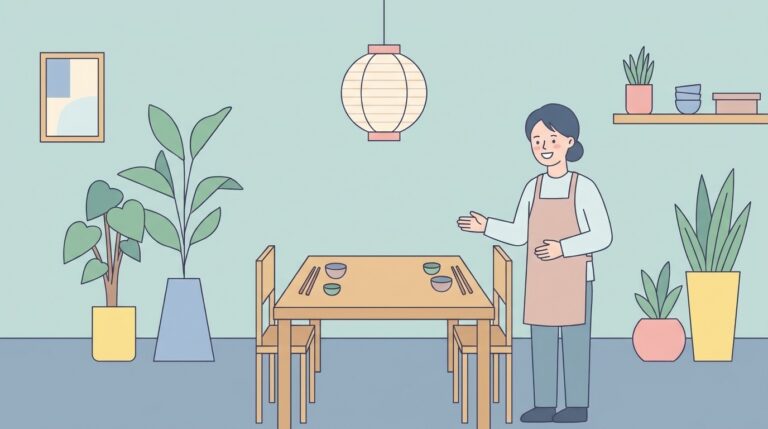
Phase 1: The Doorway Freeze — We’ve All Been There!
Annyeonghaseyo! (안녕하세요!) Hello! I’m your Daily Hangul editor.
Picture this: you just landed in Seoul, starving after watching ten hours of K-Dramas on the plane. You push open the door of a sizzling Korean BBQ spot in Hongdae. The mouthwatering smell of grilled pork belly hits you, and a super busy server looks up, waves toward the back, and says something fast. Instantly, your brain freezes! Are they saying “We are full,” or “Please take a seat this way”? Based on feedback from hundreds of our beginner learners, those first ten seconds at the restaurant door are the biggest travel panic moment. Don’t worry—your Korean bestie is here to rescue your dinner! Master these simple phrases today, and you will walk to your table smoothly like a true Seoul local.
Phase 2: Top 3 Must-Know Expressions for Getting Seated
1. 이쪽 자리로 앉으세요 (Ijjok jariro anjeuseyo)
- Pronunciation: ee-jjok ja-ree-ro an-jeu-se-yo (Say “jjok” like “joke” with a sharp, tight ‘j’ sound, and “eu” like the short “uh” sound you make when you’re mildly puzzled—just keep your lips slightly relaxed and flat!)
- Meaning: Literally “This-side seat-to please sit.” In real life, it warmly means “Please take a seat over here.”
- K-Culture Moment: Picture the friendly imo (auntie) server in Reply 1988 or Hospital Playlist, quickly wiping down a wooden table and waving the hungry crew over to a cozy corner booth.
- Editor’s Insight: Good news—you don’t even have to say this one yourself! You just need your ears to catch two magic clues: 이쪽 (ijjok – this way) and 앉으세요 (anjeuseyo – please sit). The moment you hear anjeuseyo, you know 100% it’s time to sit down and get ready to eat.
- Situation Spectrum: Casual: 🚫 (Too formal for close friends) | Semi-formal: ✅ (Standard polite) | Formal: ✅ (Very natural in customer service)
- 🤔 Think About It: In many English-speaking countries, a host asks, “Would you prefer a booth or a table?” Why do you think Korean restaurants usually guide you directly to a specific seat instead of giving a menu of seating choices?
2. 여기 앉아도 돼요? (Yeogi anjado dwaeyo?)
- Pronunciation: yuh-gee an-ja-do dweh-yo? (“Yeo” sounds just like “yuh” in “yummy,” and “dwae” rhymes smoothly with “way” or the “we” in “wedding.”)
- Meaning: Literally “Here, even if I sit, does it work?” Real nuance: A super polite, gentle “May I sit here?”
- K-Culture Moment: Think of a peaceful scene in Our Beloved Summer, where a character spots a sunny window seat at a quiet café and softly checks with the barista before setting down their bag.
- Editor’s Insight: Even if a table in Korea looks totally empty, it might be reserved or waiting to be wiped down. Asking this quick question before you drop your backpack makes servers smile instantly because it shows thoughtful manners!
- Situation Spectrum: Casual: ⚠️ (With close friends, drop the ‘yo’: 여기 앉아도 돼? / Yeogi anjado dwae?) | Semi-formal: ✅ (Perfect at any café or restaurant) | Formal: ✅ (Polite and respectful everywhere)
- 🤔 Think About It: Korean asks for permission using the pattern -ado dwaeyo? (is it okay if…?). How does framing a request as “is it okay if I…” change the mood compared to saying “I want this seat”?
3. 두 명이에요 (Du myeong-ieyo)
- Pronunciation: doo myuhng-ee-eh-yo (“Myeong” sounds just like “young” with an ‘m’ in front—super easy!)
- Meaning: Literally “Two people-it is.” Real nuance: “Party of two” or “There are two of us.”
- K-Culture Moment: Remember in Itaewon Class when friends burst into the lively pocha (street tent bar) after work, holding up two or three fingers over the music to tell the staff their group size?
- Editor’s Insight: When counting people, always use native Korean numbers (한 han = 1, 두 du = 2, 세 se = 3, 네 ne = 4) with 명 (myeong – people). Dining solo? Say 혼자예요 (honja-yeyo – I’m alone) or 한 명이에요 (han myeong-ieyo – one person)!
- Situation Spectrum: Casual: ⚠️ (Just say 두 명! / Du myeong! with friends) | Semi-formal: ✅ (Your golden ticket at every restaurant door) | Formal: ✅ (Clear and polite)
- 🤔 Think About It: Korean uses special “counter words” like myeong exclusively for people. Does your native language change number words depending on whether you are counting people, cups, or animals?
Phase 3: Textbook Korean vs. Real Korean
Situation 1: When the Server Guides You to Your Table
- 📖 Textbook Korean: 이쪽 자리로 앉으십시오. (Ijjok jariro anjeusipsio.) — “Please take a seat in this direction.”
- 🗣️ Real Korean: 이쪽으로 오세요~ / 여기 앉으세요! (Ijjogeuro oseyo~ / Yeogi anjeuseyo!) — “Come this way~ / Sit right here!”
- 💡 Why the difference? Textbooks love the ultra-formal -sipsio ending, which sounds like a 5-star hotel concierge or an airport announcement. In everyday Korean diners and cafés, staff keep things warm, fast, and approachable using -seyo!
Situation 2: When Staff Ask Your Group Size
- 📖 Textbook Korean: 손님, 몇 분이십니까? (Sonnim, myeot bunisimnikka?) — “Guest, how many esteemed persons are in your party?”
- 🗣️ Real Korean: 몇 분이세요? (Myeot buniseyo?) — “How many people?”
- 💡 Why the difference? 분 (bun) is an honorific word for people used to show respect to customers. Swapping out the stiff -imnikka ending for -iseyo makes the greeting feel cozy and welcoming rather than robotic.
Phase 4: K-Culture Deep Dive & Non-Verbal Manners
4-1. Nunchi (눈치) & Gestures at the Door
In Korea, 눈치 (Nunchi)—the art of reading the room—starts the second you cross the threshold. Instead of rushing straight to a big four-person table if you’re alone or a pair, pause near the entrance for two seconds to catch a staff member’s eye. During busy lunch or dinner hours, solo diners and pairs are often guided to cozy two-seater tables so bigger tables stay open for groups.
When a Korean server says 이쪽 자리로 앉으세요 (Ijjok jariro anjeuseyo), they almost never point with a single index finger (which can feel rude). Instead, they extend an open palm facing upward, gently sweeping their hand toward your table. Give a tiny, friendly head nod (about 15 degrees) and say 네, 감사합니다 (Ne, gamsahamnida – Yes, thank you) as you follow them!
4-2. Cultural Code: No-Host Diners & Shoe-Off Seating
If you’re used to fancy host stands from Western dining, K-Food culture will feel refreshingly casual! Many neighborhood eateries don’t have a formal host stand at all. You simply step inside, hold up your fingers to show your group size, and wait for a nod from someone near the kitchen.
Also, keep an eye out for 좌식 (jwasik – floor seating) at traditional Korean restaurants! If you spot a raised wooden floor with neat rows of shoes lined up on a step below, that’s your cue to take off your shoes before stepping up to your cushion. Pro tip: wear cute, hole-free socks when exploring traditional Korean eateries!
Phase 5: Real-Life Roleplay Scenario
Setting: It’s 7:00 PM on a buzzing Friday in Myeongdong. The restaurant smells like sweet spicy tteokbokki and crispy fried chicken. Neon lights reflect off the shiny metal tables.
Your NPC: Mina (미나), a bright, fast-talking college student working the floor who has a huge smile and moves at 100 mph.
- Mina: 어서 오세요! 몇 분이세요? (Eoseo oseyo! Myeot buniseyo?) — “Welcome! How many people?”
🎭 (Mina wipes her hands on her apron and flashes a big smile while holding up two fingers as a guess.) - You: 안녕하세요! 두 명이에요. (Annyeonghaseyo! Du myeong-ieyo.) — “Hello! Two people.”
🎭 (You smile back and hold up two fingers clearly.) - Mina: 네! 이쪽으로 오세요. 이쪽 자리로 앉으세요! (Ne! Ijjogeuro oseyo. Ijjok jariro anjeuseyo!) — “Yes! Come this way. Please take a seat over here!”
🎭 (She turns and waves with an open palm toward a cozy booth near the window.) - You: 네, 감사합니다! (Ne, gamsahamnida!) — “Yes, thank you!”
🎭 (You give a small polite nod and walk toward the window booth.) - You: 저기요, 여기 창가 자리에 앉아도 돼요? (Jeogiyo, yeogi changga jarie anjado dwaeyo?) — “Excuse me, may I sit in this window seat here?”
🎭 (You notice an even prettier empty two-seater right next to the window view and point gently with an open hand.) - Mina: 아, 그쪽은 예약석이에요. 여기 앉으세요! (A, geujjogeun yeyakseog-ieyo. Yeogi anjeuseyo!) — “Oh, that side is reserved. Please sit here!”
🎭 (She points politely to the clean table next to it that has fresh water bottles ready.) - You: 아, 네! 알겠습니다. (A, ne! Algetseumnida.) — “Ah, yes! Got it.”
🎭 (You nod cheerfully and slide into the seat she offered.) - Mina: 편하게 앉으세요! 메뉴판 드릴게요. (Pyeonhage anjeuseyo! Menyupan deurilgeyo.) — “Please sit comfortably! I’ll bring you the menu.”
🎭 (She sets down two shiny metal cups and dashes toward the counter.)
🔀 Interactive Branching Point: What Do You Do Next?
You’re seated, and Mina said she’ll be right back with menus. Suddenly you realize you want to put your heavy shopping bags on the extra chair—or maybe the table right next to the door is freezing! Choose your move:
* Option A: Put your bag on the chair inside your booth, look for the table bell button, and say 잠시만요! (Jamsimanyo! – Excuse me/Just a moment!) politely when you’re ready to order.
* Option B: Silently get up without asking and move your water bottles to a giant 6-person reserved table because you want more legroom.
* Option C: Shout across the crowded restaurant, 야! 메뉴 주세요! (Ya! Menyu juseyo! – Hey! Give me the menu!)
Editor’s Feedback:
* Option A (Best!): 10/10 Nunchi master! Keeping your bags tidy and using polite words when Mina returns shows amazing Korean dining etiquette.
* Option B (Risk): Careful! Switching to a big table—especially one marked 예약석 (yeyakseok – reserved)—without asking can cause awkward confusion for incoming groups. Always ask 여기 앉아도 돼요? (Yeogi anjado dwaeyo?) first!
* Option C (Bad!): Whoa, abort mission! 야 (ya) is super rude to strangers and servers—it’s only for very close friends or younger siblings. Stick to 저기요 (jeogiyo – excuse me) instead!
Phase 6: 10-Second Emotional Shadowing Drill
Read each phrase out loud! Pause briefly at every / mark and channel the emotion in the brackets:
- [😊 Warm & welcoming] 이쪽 자리로 / 앉으세요! (Ijjok jariro / anjeuseyo!) — “Please take a seat this way!”
- [🥺 Gentle & polite] 여기 / 앉아도 돼요? (Yeogi / anjado dwaeyo?) — “May I sit here?”
- [🙌 Cheerful & hungry] 안녕하세요! / 두 명이에요! (Annyeonghaseyo! / Du myeong-ieyo!) — “Hello! There are two of us!”
- [😌 Friendly & thankful] 네, / 감사합니다! (Ne, / gamsahamnida!) — “Yes, thank you!”
Phase 7: K-Culture Mini Dictionary (4 Essential Keywords)
- 자리 (Jari) | Seat / Spot | Used everywhere! From checking if a restaurant has open seats (자리 있어요? / Jari isseoyo?) to grabbing a spot on the subway or at a café.
- 몇 분 (Myeot bun) | How many people (Polite) | You will hear this at almost every restaurant door. Remember: staff call you bun, and you reply using myeong (e.g., 두 명이에요 / Du myeong-ieyo).
- 예약석 (Yeyakseok) | Reserved seat | Look for this sign on empty tables! If you see it, don’t sit there—check with staff first.
- 혼밥 (Honbap) | Eating alone | A trendy Korean slang word combining 혼자 (honja – alone) + 밥 (bap – meal). Solo travelers, embrace the honbap life!
Phase 8: Traveler’s Survival Kit
Top 3 Survival Phrases
- 자리 있어요? (Jari isseoyo?) — “Do you have a seat available?” Pro Tip: Say this with rising pitch at the end while peeking into a busy café or BBQ spot!
- 잠시만요 (Jamsimanyo) — “Excuse me / Just a moment.” Pro Tip: Use this if you need a second to take off your coat or decide before sitting.
- 웨이팅 있어요? (Weiting isseoyo?) — “Is there a wait?” Pro Tip: Yes, Koreans use the English word “waiting” (weiting)! Super easy to remember at popular Instagram spots.
Editor’s Travel Note
- Must-Have Apps: Before heading out to trendy areas like Seongsu or Hongdae, grab the Download CatchTable Global App for Restaurant Reservations so you can join digital waitlists from your phone instead of standing outside! Also, Google Maps doesn’t give full walking directions in Korea, so be sure to Download Naver Map App for Korean Directions before your trip.
- Payment & Tipping: Korea is a no-tipping culture! Never leave cash on the table as a tip—the staff will chase you down thinking you forgot your money. Almost everywhere accepts international credit cards and Apple Pay/T-money, and you usually pay at the front counter after you finish eating.
Phase 9: One Step Deeper — Why Do We Swap Bun and Myeong?
Have you ever noticed how Korean makes you step outside your own ego? When a server asks you 몇 분이세요? (Myeot buniseyo?), they elevate you with the respectful counter 분 (bun). Yet when you reply 두 명이에요 (Du myeong-ieyo), you deliberately use the neutral, humble counter 명 (myeong) for yourself! In Korean society, politeness isn’t just about fancy vocabulary—it’s a quiet dance of lowering yourself slightly while lifting up the person in front of you. Even a quick five-second chat at a restaurant doorway reflects centuries of mutual respect and Jeong (정, warm human connection).
💬 Your Turn: Have you ever felt nervous walking into a restaurant in a foreign country? Tell us in the comments what Korean dish you are most excited to order once you get seated!
Phase 10: FAQ & Common Mistakes
Q: Can I just walk into a Korean restaurant and pick any empty seat myself?
A: It depends on the vibe! At casual fast-food spots or empty cafés, yes—though asking 여기 앉아도 돼요? (Yeogi anjado dwaeyo?) is always smart. At sit-down restaurants, pause at the door for a moment so staff can guide you to the right table for your group size.
Q: What if I don’t understand what the server says after I tell them “Du myeong-ieyo”?
A: Watch their hands! Korean servers almost always gesture toward the open table with an open palm or point to a waiting area. If they cross their arms in an ‘X’ or say 자리 없어요 (jari eopseoyo), it means all seats are currently full.
Q: Is it okay to dine alone at Korean restaurants?
A: Yes! 혼밥 (honbap – solo dining) is huge in Korea for ramen, kimbap, soup (gukbap), and cafés. Just note that a few traditional Korean BBQ restaurants require a 2-portion minimum order even for one person.
🚨 Common Mistakes TOP 3
- Saying “이 명이에요 (I myeong-ieyo)” for two people: I is a Sino-Korean number (used for phone numbers and prices), not for counting people! Correct Action: Use native Korean numbers: 한 명 (han myeong) for 1, 두 명 (du myeong) for 2, 세 명 (se myeong) for 3.
- Calling yourself “두 분이에요 (Du bun-ieyo)”: Using the honorific bun for yourself sounds funny, like calling yourself “Your Majesty”! Correct Action: Always use 명 (myeong) when talking about yourself and your group.
- Forgetting to check for floor seating (jwasik): Walking onto a raised wooden dining platform with sneakers on is a major faux pas! Correct Action: Look at the floor first—if you see shoes lined up neatly by a step, slip yours off before sitting.
Phase 11: Your Daily Hangul Action Mission
- 🥉 Bronze Mission (Solo Practice): Stand in front of your mirror today, smile, hold up two fingers, and say 안녕하세요! 두 명이에요! (Annyeonghaseyo! Du myeong-ieyo!) out loud three times.
- 🥈 Silver Mission (Share the Vibe): Save this guide or share your favorite Korean seating phrase on your Instagram Story and tag a friend you want to eat Korean BBQ with!
- 🥇 Gold Mission (Real-World Use): Next time you visit a local Korean restaurant in your city, greet the staff at the door with 안녕하세요! 두 명이에요 (Annyeonghaseyo! Du myeong-ieyo) and watch their faces light up!
🎮 K-Culture Mission: Watch any episode of a modern K-Drama (like Business Proposal or Extraordinary Attorney Woo) and spot a restaurant entrance scene! Listen closely—did you catch the server say 몇 분이세요? (Myeot buniseyo?) or 이쪽으로 앉으세요 (Ijjogeuro anjeuseyo)?
Phase 12: Interactive Quiz Challenge
Test your Seoul dining instincts! Click the toggles below to check your answers.
1. Situational Judgment: You walk into a cozy kimchi jjigae (kimchi stew) restaurant with your best friend. The server smiles and waves toward a booth saying, “이쪽 자리로 앉으세요! (Ijjok jariro anjeuseyo!)” What should you do?
* A) Say “안녕히 가세요 (Annyeonghi gaseyo)” and leave.
* B) Nod politely, say “네, 감사합니다 (Ne, gamsahamnida),” and walk to the booth.
* C) Say “이 분이에요 (I bun-ieyo)” and stay standing at the door.
Click to reveal Answer & Explanation
Answer: B! Ijjok jariro anjeuseyo means “Please take a seat this way.” Option A means “Goodbye” when leaving, and Option C mixes up both the wrong number system (i) and the honorific counter (bun)!
2. Fill in the Blank: You enter a quiet café alone and spot a cute seat by the window. You ask the barista: “여기 ______ 돼요? (Yeogi ______ dwaeyo?)” (May I sit here?)
Click to reveal Answer & Explanation
Answer: 앉아도 (anjado)! 여기 앉아도 돼요? (Yeogi anjado dwaeyo?) is your golden phrase for politely asking if a seat is open.
3. True or False Cultural Quiz: In Korea, if a restaurant table is empty, you can always just sit down immediately without checking with anyone, and you should leave a 15% cash tip on the table afterward.
Click to reveal Answer & Explanation
Answer: False! Always pause briefly at the door or ask 여기 앉아도 돼요? (especially to avoid reserved tables or shoe-off zones), and remember that Korea is a no-tipping country!
🎬 Watch Our Daily Videos! (Daily Hangul Official Instagram)
Review the expressions you learned in this article with our fun daily short videos! Check out native pronunciation and real-life nuances in action.
- Instagram @dailyhangul_en






