

How Old Are You? Don’t Ask It Like a Textbook! The Polite Way to Ask Age in Korea
Phase 1: Empathy (안녕하세요! Welcome to Daily Hangul!)
안녕하세요! (An-nyeong-ha-se-yo!) I’m your lead editor and your trusty local cultural navigator from Daily Hangul.
Imagine this: You are watching your favorite K-Drama. The main characters have just met. Within two minutes of a slightly awkward conversation, one of them suddenly asks, “How old are you?”
In many Western cultures, asking someone’s age right off the bat is considered a major social taboo. But in Korea? It is the ultimate icebreaker! Why? Because Korean honorifics (존댓말 – Jon-daet-mal) rely entirely on age hierarchy to determine how people speak to, show respect for, and bond with one another.
If you ask for someone’s age the wrong way, you might accidentally sound rude or childish. But don’t worry! Based on years of teaching global learners, I’ve put together the ultimate friendly guide to asking age in Korean, tailored just for your A2 beginner journey. Let’s dive in!
Phase 2: Core Expressions Deep Dive
1. 연세가 어떻게 되세요? (Yeon-se-ga eo-tteo-ke doe-se-yo?)
- Pronunciation: Yawn-say-gah uh-ttuh-kay dweh-seh-yo? (Softly roll the ‘r’ sound in ‘eo-tteo-ke’)
- Meaning: “May I kindly ask your age?” (Literal: “How is your honorable age?”)
- K-Culture Moment: This is the exact phrase you’ll hear in heartwarming family K-Dramas like Reply 1988 when a younger character meets a friend’s grandmother or a respected neighborhood elder.
- Editor’s Insight: “연세” (Yeon-se) is the high-honorific word for age. Never use “나이” (Na-i) for seniors, grandparents, or anyone who looks over 50. This phrase shows you understand true Korean respect.
- Situation Spectrum: Casual 🚫 / Semi-formal ⚠️ / Formal ✅
- 🤔 Think About It: In your culture, does a grandparent have a different name for their age than a teenager? How does having a special word like Yeon-se change your perspective on aging?
2. 나이가 어떻게 되세요? (Na-i-ga eo-tteo-ke doe-se-yo?)
- Pronunciation: Nah-ee-gah uh-ttuh-kay dweh-seh-yo? (Keep your tone flat and gentle)
- Meaning: “How old are you?” (Literal: “How is your age?”)
- K-Culture Moment: Picture a romantic comedy blind date at a chic Hanok cafe. Two working professionals in their late 20s ask this to figure out who should speak politely first.
- Editor’s Insight: This is your golden, safest, go-to phrase for adults of similar age, colleagues, or strangers around your age.
- Situation Spectrum: Casual 🚫 / Semi-formal ✅ / Formal ✅
- 🤔 Think About It: Why do you think adults on a date want to find out their age hierarchy so quickly?
3. 몇 살이에요? (Myeot sal-i-e-yo?)
- Pronunciation: Myut sahl-ee-eh-yo? (Like “mew” but with a quick “t” stop at the end: myut)
- Meaning: “How old are you?”
- K-Culture Moment: You’ll hear this on university campuses, in schools, or when an adult is talking to a cute child in a show like The Return of Superman.
- Editor’s Insight: Although it ends in the polite “요” (yo), “몇 살” (how many years) can sound a bit too blunt if used with someone older or in a professional setting. Keep it for kids, teenagers, or very casual peer groups.
- Situation Spectrum: Casual ✅ / Semi-formal ✅ / Formal 🚫
Phase 3: Textbook Korean vs. Real Korean
Let’s compare what standard textbooks teach you against how real Koreans actually talk!
Scenario 1: Meeting a lovely elder at a local guesthouse
- 📖 Textbook Korean: 몇 살이에요? (Myeot sal-i-e-yo? – Too blunt for an elder!)
- 🗣️ Real Korean: 연세가 어떻게 되세요? (Yeon-se-ga eo-tteo-ke doe-se-yo? – Beautiful, respectful, and polite.)
- 💡 Why the difference? Textbooks teach you that adding “요” makes everything polite. But culturally, asking “몇 살” to someone older bypasses the honorific vocabulary (Yeon-se) they deserve.
Scenario 2: Chatting with a peer at a trendy Hongdae cafe
- 📖 Textbook Korean: 연세가 어떻게 되세요? (Yeon-se-ga eo-tteo-ke doe-se-yo? – Way too stiff! They will feel like they are 90 years old.)
- 🗣️ Real Korean: 혹시 몇 년생이세요? (Hok-si myeot nyeon-saeng-i-se-yo? – “By any chance, what year were you born?”)
- 💡 Why the difference? Young Koreans find asking “how old are you” directly slightly awkward. Instead, they ask for your birth year (myeot nyeon-saeng) to instantly calculate the age difference smoothly!
Phase 4: K-Culture Deep Dive & Non-verbal Manners
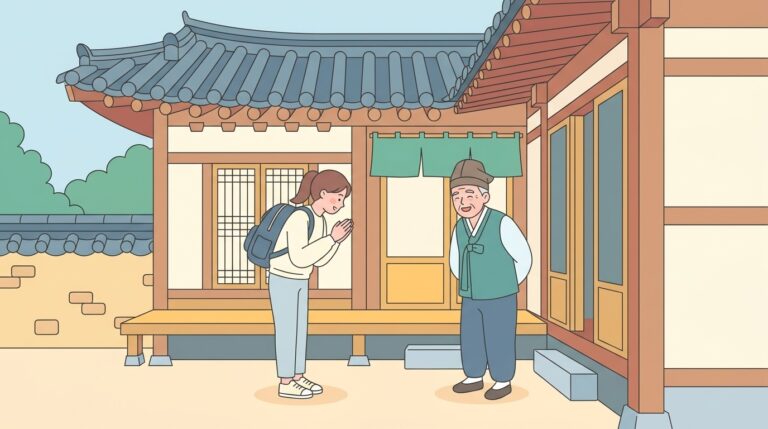
4-1. Nunchi (눈치) & Bowing Gestures
When asking or answering age, your body language is just as important as your words!
* The Soft Bow: Always tilt your head or upper body slightly forward when asking “연세가 어떻게 되세요?”.
* Hand Placement: Gather your hands neatly in front of your waist. Never point, fold your arms, or keep your hands in your pockets.
* Eye Contact: Avoid staring intensely into an elder’s eyes. Keep a gentle, soft gaze slightly downward to show humility.
4-2. The “Korean Age” Cultural Code
You might have heard that Korea recently transitioned to the international age system for official laws. However, culturally, people still calculate their social hierarchy by birth year (년생). Establishing who is the “언니” (Unni – older sister for females), “오빠” (Oppa – older brother for females), “누나” (Noona – older sister for males), or “형” (Hyung – older brother for males) is the foundation of Korean friendship!
Phase 5: Real-World Roleplay Scenario
Background: You are visiting a beautiful, historic tea house in Insadong. The owner, a sweet grandfatherly figure named Mr. Kim, brings you your warm ginger tea.
Mr. Kim (Owner): 🎭 (Smiling warmly, setting down the tea)
어어서 오세요! 따뜻한 생강차입니다.
(Eo-seo o-se-yo! Tta-tteut-han saeng-gang-cha-im-ni-da.)
"Welcome! Here is your warm ginger tea."

You: 🎭 (Bow your head slightly and take the tea with both hands)
감사합니다! 정말 향이 좋아요.
(Gam-sa-ham-ni-da! Jeong-mal hyang-i jo-a-yo.)
"Thank you! It smells wonderful."

Mr. Kim: 🎭 (Chuckles, pleased)
한국말을 아주 예쁘게 잘하시네요!
(Han-guk-mal-eul a-ju ye-ppeu-ge jal-ha-si-neyo!)
"You speak Korean so beautifully!"

You: 🎭 (Blushing slightly, clasping your hands)
아니에요. 아직 많이 부족해요.
(A-ni-e-yo. A-jik man-i bu-jok-hae-yo.)
"No, I am still lacking a lot."

Mr. Kim: 🎭 (Sits down across from you)
젊은 친구가 한국 문화에 관심이 많아 보여서 참 좋네요.
(Jeolm-eun chin-gu-ga Han-guk mun-hwa-e gwan-sim-i man-a bo-yeo-seo cham jon-ne-yo.)
"It's so nice to see a young friend with so much interest in Korean culture."
🔀 Your Interactive Choice! What do you say next to ask his age politely?
- A) “할아버지, 몇 살이에요?” (Hal-a-beo-ji, myeot sal-i-e-yo?)
- B) “할아버지, 연세가 어떻게 되세요?” (Hal-a-beo-ji, yeon-se-ga eo-tteo-ke doe-se-yo?)
- C) “할아버지, 나이가 어떻게 되세요?” (Hal-a-beo-ji, na-i-ga eo-tteo-ke doe-se-yo?)
💡 Feedback on Your Choices:
- Choice A (Bad 🚫): Ouch! Mr. Kim might smile because you are a foreigner, but inside he will feel a bit startled. “몇 살” is much too casual for a grandfather.
- Choice B (Best ✅): Perfect! Perfect! Mr. Kim’s eyes light up with surprise. He is deeply impressed by your cultural manners because you used the highest honorific form, “연세”.
- Choice C (Risk ⚠️): It’s okay and polite, but
Frequently Asked Questions (FAQ)
Q: What does "연세가 어떻게 되세요? (Yeon-se-ga eo-tteo-ke doe-se-yo?)" mean in Korean and how do you pronounce it?
A: In Korean, "연세가 어떻게 되세요? (Yeon-se-ga eo-tteo-ke doe-se-yo?)" is pronounced [Yawn-say-gah uh-ttuh-kay dweh-seh-yo? (Softly roll the 'r' sound in 'eo-tteo-ke'] and means: "May I kindly ask your age?" (Literal: "How is your honorable age?")
Q: What does "나이가 어떻게 되세요? (Na-i-ga eo-tteo-ke doe-se-yo?)" mean in Korean and how do you pronounce it?
A: In Korean, "나이가 어떻게 되세요? (Na-i-ga eo-tteo-ke doe-se-yo?)" is pronounced [Nah-ee-gah uh-ttuh-kay dweh-seh-yo? (Keep your tone flat and gentle] and means: "How old are you?" (Literal: "How is your age?")
Q: What does "몇 살이에요? (Myeot sal-i-e-yo?)" mean in Korean and how do you pronounce it?
A: In Korean, "몇 살이에요? (Myeot sal-i-e-yo?)" is pronounced [Myut sahl-ee-eh-yo? (Like "mew" but with a quick "t" stop at the end: myut] and means: "How old are you?"







