

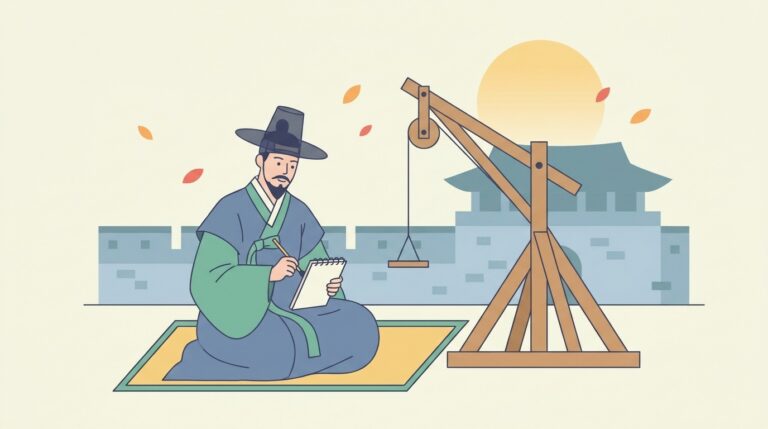
Phase 1: Why Silhak Still Rules Korean Debates Today
Hello! I’m your Daily Hangul Editor (안녕하세요! 매일한글 에디터입니다). Have you ever watched a historical K-drama like Yi San and wondered why scholars in silk robes suddenly argue fiercely about rice fields, silver mines, or pulley cranes? Welcome to Late Joseon Silhak (실학, Practical Learning)! For Level 6 Korean learners, discussing Silhak—especially Dasan Jeong Yak-yong’s statecraft and the split between Gyeongsechiyong (agrarian land reform) and Iyonghusaeng (Northern Learning commerce)—is often a huge stumbling block. Classical Hanja compounds feel intimidating when native Koreans casually drop them into modern economic debates! Based on real feedback from advanced students, mastering these expressions lets you decode Korean news, academic essays, and K-dramas like a true insider.
Phase 2: Top 3 Essential Silhak Expressions (Level 6 Deep Dive)
1. 실사구시 (實事求是) — Seeking Truth from Facts
- Pronunciation: Silsagusi (Sounds like sil-sah-goo-she, where “sil” is crisp like “seal” cut short, and “si” rhymes with “she”)
- Meaning: Literally “based on actual facts, seek what is true.” In real Korean discourse, it means evidence-based pragmatism—ditching empty ideology in favor of verifiable, real-world solutions.
- K-Culture Moment: In historical dramas like Yi San (이산) or modern political thrillers like Chief of Staff (보좌관), a reform-minded official slams a report on the desk and declares, “지금 필요한 건 이념이 아니라 실사구시입니다 (Jigeum pillyohan geon inyeomi anira silsagusi-imnida / What we need right now isn’t ideology, it’s evidence-based pragmatism).”
- Editor’s Insight: Though rooted in Han Dynasty scholarship and championed by Silhak master Kim Jeong-hui (Chusa), modern Koreans use silsagusi constantly in corporate strategy meetings and startup pitch decks. Saying this signals executive-level Korean fluency!
- Situation Spectrum: Casual ⚠️ (Used playfully among grad students) | Semi-formal ✅ (Great in thoughtful discussions) | Formal ✅ (Gold standard in speeches, essays, and business)
- 🤔 Think About It: Western pragmatism often focuses on individual utility or scientific empiricism. Why do you think Korean silsagusi remained tightly bound to moral governance and social harmony? Compare that to how “pragmatism” is framed in your native language!
2. 경세치용 (經世致用) — Statecraft for Practical Benefit
- Pronunciation: Gyeongsechiyong (Sounds like gyung-seh-chee-yong, with “gyung” like “young” with a soft g, and “yong” like “yo” + “ng”)
- Meaning: Literally “governing the world and putting learning to practical use.” It specifically represents the agrarian institutional reform school (led by Yu Hyeong-won, Yi Ik, and Dasan Jeong Yak-yong) focused on land equity and stabilizing farmers’ lives.
- K-Culture Moment: Imagine a scene in a sageuk where Dasan inspects drought-stricken farmland during his exile in Gangjin, clutching his manuscript of Gyeongseyupyo (경세유표), determined to rebuild tax and land systems from the ground up rather than recite Neo-Confucian poetry.
- Editor’s Insight: Koreans distinguish between pure academic theory (순수 학문, sunsu hangmun) and gyeongsechiyong. When a university policy institute or government think tank pitches a housing or tax overhaul, commentators praise it for embodying gyeongsechiyong spirit.
- Situation Spectrum: Casual 🚫 (Too heavy for casual chatting) | Semi-formal ⚠️ (Academic/cultural talks) | Formal ✅ (History, economics, policy editorials)
- 🤔 Think About It: Dasan believed land inequality ruined both morality and the economy. In your home country’s history, did reform start with land/agriculture first, or with trade and technology?
3. 이용후생 (利用厚生) — Utilizing Innovation to Enrich Lives
- Pronunciation: Iyonghusaeng (Sounds like ee-yong-hoo-seng, smooth and flowing, with “seng” rhyming with “sang” in “sang a song” or close to “seng”)
- Meaning: Literally “making convenient use of tools/resources to make people’s livelihoods abundant.” This was the battle cry of the Northern Learning (Bukhakpa, 북학파) mercantilists—scholars like Park Ji-won and Park Je-ga who championed commerce, wheeled carts, brick kilns, and foreign technology.
- K-Culture Moment: Think of the lively market scenes in The Tale of Lady Ok or Mr. Queen, where scholars debate whether opening trade routes and adopting new tools corrupts tradition or actually feeds the starving populace.
- Editor’s Insight: Unlike gyeongsechiyong (which focused on fixing land laws), iyonghusaeng argued you must grow the pie through tech and trade! Today, Korean tech giants and smart-city planners cite iyonghusaeng to explain why technology must serve human comfort.
- Situation Spectrum: Casual ⚠️ (Used ironically when buying a cool gadget: “이게 바로 이용후생이지!”) | Semi-formal ✅ (Great in cultural or tech chats) | Formal ✅ (Business philosophy, innovation panels)
- 🤔 Think About It: The Bukhakpa faced fierce backlash for wanting to learn from Qing China—a dynasty many Joseon elites looked down upon. How difficult is it in your culture to admit you should adopt innovations from a rival?
Phase 3: Textbook Korean vs. Real Korean
At Level 6, your grammar is already solid—now it is all about sounding sharp, nuanced, and effortlessly native when discussing big ideas.
Situation 1: Calling out an impractical, out-of-touch policy
- 📖 Textbook Korean: 현실과 동떨어진 비실용적인 이론에 불과합니다. (Hyeonsilgwa dongtteoreojin bisiryongjeogin irone bulgwahamnida. — It is merely an impractical theory detached from reality.)
- 🗣️ Real Korean: 현장감 제로인 전형적인 탁상공론이네요. (Hyeonjanggam jero-in jeonhyeongjeogin taksanggongnon-ineyo. — That’s classic desk-bound armchair theorizing with zero sense of the field.)
- 💡 Why the difference? Textbook Korean stacks adjectives neatly, whereas native Koreans love the sharp four-character idiom 탁상공론 (taksanggongnon)—literally “empty talk on top of a desk”—the exact opposite of Silhak! Pairing it with English-loanword punch like 현장감 제로 (zero field awareness) sounds 100% like an educated Seoul native.
Situation 2: Praising a policy or tech upgrade that genuinely helps ordinary people
- 📖 Textbook Korean: 백성의 삶을 실질적으로 윤택하게 만드는 정책입니다. (Baekseong-ui salmeul siljiljeogeuro yuntaekhage mandeuneun jeongchaegimnida. — It is a policy that substantively enriches the people’s lives.)
- 🗣️ Real Korean: 말로만 민생이 아니라, 진짜 이용후생의 정석을 보여주네요. (Malloman minsaeng-i anira, jinjja iyonghusaeng-ui jeongseogeul boyeojuneyo. — It’s not just lip service to public welfare; it truly shows the textbook essence of enriching livelihoods.)
- 💡 Why the difference? Koreans are tired of politicians using 민생 (minsaeng, people’s livelihood) as an empty buzzword. By contrasting 말로만 (in words only) with 이용후생의 정석 (the gold standard of practical enrichment), you elevate a casual compliment into bitingly smart commentary.
Phase 4: K-Culture Deep Dive & Non-Verbal Manners
4-1. Nunchi (눈치) & Intellectual Manners
When discussing Silhak, historical reforms, or modern Korean economic inequality with Korean friends or professors, how you disagree matters as much as what you say:
* Softening Critique: Even when Silhak scholars like Dasan criticized rigid Neo-Confucianism, they wrapped radical ideas in respectful deference (존중, jonjung). Avoid pointing a finger or raising your voice during debates. Instead, lean in slightly, nod slowly while saying “그 말씀도 일리가 있지만… (Geu malsseumdo illiga itjiman… / That point makes sense too, however…)”, and place both hands lightly on the table or your notebook.
* Eye Contact: Maintain steady, attentive eye contact when listening, and briefly glance down at your notes or tea when formulating a sharp counterargument—this signals thoughtful deliberation (신중함, sinjungham) rather than hostility.
4-2. Cultural Code Analysis: From Yi San to Suwon Hwaseong
If you want to feel Silhak in your bones, look at Suwon Hwaseong Fortress (수원 화성) and the hit drama Yi San (이산) or The Red Sleeve (옷소매 붉은 끝동). King Jeongjo famously championed both gyeongsechiyong and iyonghusaeng! Using Dasan Jeong Yak-yong’s Geojunggi (거중기)—a multi-pulley crane inspired by Western and Chinese engineering texts—workers built Hwaseong in under three years instead of ten, saving massive labor and paying fair wages instead of relying purely on unpaid corvée labor. That spirit—combining humanitarian care (애민, aemin) with tech efficiency—is literally the DNA behind South Korea’s modern “Miracle on the Han River” and its obsession with practical, ultra-convenient infrastructure.
Phase 5: Interactive Roleplay Scenario
Setting: A breezy autumn afternoon at a traditional hanok café overlooking the stone walls of Suwon Hwaseong Fortress. The smell of roasted barley tea mingles with crisp October air.
NPC: Min-jun (민준), a witty 32-year-old Korean history PhD candidate who loves debating whether agrarian land reform or commerce saved Joseon.
- Min-jun: 저 성곽 좀 보세요. 다산 선생의 거중기가 아니었으면 10년은 족히 걸렸을 거예요. (Jeo seonggwak jom boseyo. Dasan seonsaeng-ui geojunggiga anieosseumyeon simnyeon-eun jokhi geollyeosseul geoyeyo.)
Look at those fortress walls. Without Master Dasan’s Geojunggi crane, it would have easily taken ten years. 🎭 (Points proudly toward the fortress wall, raising his ceramic teacup) - You: 맞아요. 단순히 기술만 도입한 게 아니라, 백성의 노역을 줄였다는 점에서 진정한 이용후생이네요. (Majayo. Dansunhi gisulman doiphan ge anira, baekseong-ui noyeogeul juryeotdaneun jeomeseo jinjeonghan iyonghusaeng-ineyo.)
True. It wasn’t just adopting technology—by reducing the people’s forced labor, it’s genuine Iyonghusaeng. 🎭 (Nods appreciatively while admiring the masonry) - Min-jun: 그렇죠! 그런데 사실 실학파 내부에서도 논쟁이 치열했어요. 북학파는 상공업을 키우자고 했고, 다산 선생은 토지 제도 개혁이 우선이라고 봤죠. (Geureotjyo! Geureonde sasil silhakpa naebueseo-do nonjaeng-i chiyeolhaesseoyo. Bukhakpaneun sanggongeobeul kiujago haetgo, Dasan seonsaeng-eun toji jedo gaehyeogi useonirago bwatjyo.)
Exactly! Yet there was fierce debate within Silhak itself. The Northern Learning school pushed commerce and industry, while Dasan saw land system reform as the top priority. 🎭 (Draws two imaginary circles on the wooden table to contrast the two camps) - You: 경세치용 학파 입장에서는 농민의 삶이 무너지면 상업도 사상누각이라고 본 거군요. (Gyeongsechiyong hakpa ipjang-eseoneun nongmin-ui salmi muneojimyeon sangeopdo sasangnugagirago bon geogunyo.)
From the Gyeongsechiyong perspective, if farmers’ livelihoods collapsed, commerce would be like a castle built on sand. 🎭 (Leans forward, resting elbows lightly on the table) - Min-jun: 와, 사상누각이라는 표현까지! 완벽한 해석이에요. 반면에 박제가 선생은 재물을 우물물에 비유하며 소비와 유통을 강조했죠. (Wa, sasangnugagiranun pyohyeonkkaji! Wanbyeokhan haeseogieyo. Banmyeone Park Je-ga seonsaeng-eun jaemureul umulmure biyuhamyeo sobiwa yutongeul gangjohaetjyo.)
Whoa, even using the idiom “sasangnugak”! Spot-on interpretation. On the other hand, Master Park Je-ga compared wealth to well water, emphasizing consumption and circulation. 🎭 (Eyes light up with genuine surprise at your Level 6 idiom) - You: 우물물을 퍼내지 않으면 마르듯이, 돈도 돌지 않으면 경제가 고인다는 통찰이 정말 현대적이네요. (Umulmureul peonaeji aneumyeon mareudeusi, dondo dolji aneumyeon gyeongjega goindaneun tongchari jeongmal hyeondaejeogineyo.)
Just as well water dries up if you don’t draw it, money stagnates the economy if it doesn’t circulate—that insight is remarkably modern. 🎭 (Traces a slow circle with a finger to illustrate circulation) - Min-jun: 정말 그렇죠. 당시 사대부들이 이런 실사구시 정신을 받아들여 공론만 멈췄더라도 역사가 달라졌을 텐데요. (Jeongmal geureotjyo. Dangsi sadaebudeuri ireon silsagusi jeongsineul badadeuryeo gongnonman meomchweotdeorado yeoksaga dallajyeosseul tendeyo.)
Indeed. If the scholar-officials back then had embraced this Silsagusi spirit and stopped empty theorizing, history might have changed. 🎭 (Sighs wistfully, gazing out the hanok window) - You: 맞아요. 하지만 그 고민들이 목민심서와 경세유표로 남아서, 오늘날 우리에게도 큰 질문을 던지잖아요. (Majayo. Hajiman geu gomindeuri Mokminsimseo-wa Gyeongseyupyo-ro namaseo, oneullal uriegedo keun jilmuneul deonjijanayo.)
True. Still, because those struggles survived in Mokminsimseo and Gyeongseyupyo, they pose huge questions for us even today. 🎭 (Smiles warmly and raises your cup for a gentle toast)
🔀 Interactive Branching: Min-jun asks you a sharp follow-up!
Min-jun grins and asks: “So in modern Korea—with skyrocketing housing prices and AI disruption—do we need Gyeongsechiyong (institutional equity) or Iyonghusaeng (tech-driven growth) more right now?”
* Option A: “둘 다 떼려야 뗄 수 없지만, 주거 안정 없이는 혁신도 지속 불가능하니 경세치용적 제도 보완이 시급하죠.” (Both are inseparable, yet without housing stability innovation isn’t sustainable, so Gyeongsechiyong institutional fixes are urgent.)
* Feedback (Best ✅): Brilliant Level 6 response! Using 떼려야 뗄 수 없다 (inseparable) and 지속 불가능하다 (unsustainable) shows nuanced, balanced reasoning that Koreans deeply respect.
* Option B: “당연히 돈이 최고죠! 그냥 기술 개발해서 수출 많이 하면 장땡 아닌가요?” (Obviously money is best! Just develop tech and export a lot, isn’t that all that matters?)
* Feedback (Bad 🚫): Way too blunt and colloquial (장땡 is slangy here). It misses the moral core (애민) that separates Silhak from pure capitalism.
* Option C: “글쎄요, 조선 시대 이야기는 현대 경제랑 너무 달라서 비교 자체가 무의미한 것 같은데요.” (Well, Joseon-era stories are too different from the modern economy, so comparing them seems pointless.)
* Feedback (Risk ⚠️): Grammatically fine, but dismissing the historical link (무의미하다) shuts down the intellectual rapport you just built with a history PhD candidate!
Phase 6: 10-Second Emotion Shadowing Drill
Read aloud at natural native speed, pausing briefly at / and matching the emotional beat:
- [😤 Passionately, calling out empty bureaucracy]
백성이 굶주리는데 / 성리학 명분만 따지는 건 / 전형적인 탁상공론 아닌가요?
(Baekseongi gumjurineunde / Seongnihak myeongbunman ttajineun geon / jeonhyeongjeogin taksanggongnon aningayo? — While the people are starving, arguing only over Neo-Confucian dogma is classic armchair theorizing, isn’t it?) - [🤩 Inspired and forward-looking]
수레를 보급하고 / 상업을 장려해야 / 나라 전체가 이용후생할 수 있습니다!
(Surereul bogeuphago / sangeobeul jangnyeohaeya / nara jeonchega iyonghusaenghal su itseumnida! — We must distribute wheeled carts and encourage commerce so the entire nation can prosper practically!) - [🧐 Thoughtfully, weighing social justice]
다산의 여전론은 / 일한 만큼 나누자는 / 철저한 경세치용의 산물입니다.
(Dasan-ui Yeojeonnon-eun / ilhan mankeum nanujaneun / cheoljeohan gyeongsechiyong-ui sanmurimnida. — Dasan’s Yeojeonnon is a product of thorough statecraft pragmatism, arguing we share in proportion to our labor.)
Phase 7: K-Culture Mini Dictionary (4 Core Keywords)
- 목민심서 (Mokminsimseo) | Admonitions on Governing the People | Written by Dasan during 18 years of exile in Gangjin, this manual for local magistrates is still gifted to newly appointed Korean mayors, civil servants, and corporate ethics officers as a reminder against corruption (청렴, cheongnyeom).
- 경세유표 (Gyeongseyupyo) | Design for Good Government | Dasan’s grand blueprint to overhaul Joseon’s central tax, land, and military institutions. In Korean news, journalists reference 경세유표 whenever calling for structural, systemic reform rather than quick Band-Aid fixes.
- 북학파 (Bukhapa) | The Northern Learning School | Scholars like Hong Dae-yong, Park Ji-won, and Park Je-ga who visited Qing China and urged Joseon to embrace commerce, currency, and technology. Today, Korean business columns compare open-minded global innovators to 북학파.
- 여전론 (Yeojeonnon) | Communal Land & Cooperative Farming Theory | Dasan’s bold early land-reform model where villages farmed together and split harvests strictly according to labor hours. Korean economics majors cite it alongside modern basic-income and wealth-redistribution debates.
Phase 8: Traveler’s Survival Kit (Silhak Heritage Trail)
Want to walk in Dasan’s footsteps at Suwon Hwaseong or the Dasan Heritage Site (다산유적지) in Namyangju? Keep these 3 Level-6-polite survival phrases handy:
- 문화해설사 동행 투어를 신청할 수 있을까요? (Munhwahaeseolsa donghaeng tueoreul sincheonghal su isseulkkayo? — Could I sign up for a docent-guided cultural tour?)
- Pro Tip: Free Korean—and select English—docent tours run daily at major heritage sites, packed with stories you won’t find on plaques!
- 정약용 선생의 거중기 복원 모형은 어느 전시실에 있나요? (Jeong Yak-yong seonsaeng-ui geojunggi bogwon mohyeong-eun eoneu jeonsisire innayo? — Which exhibition hall displays the restored model of Jeong Yak-yong’s Geojunggi crane?)
- Pro Tip: Asking specifically for the 복원 모형 (restored model) at Suwon Hwaseong Museum instantly impresses museum staff.
- 기념품 샵에서 목민심서 번역본이나 관련 서적을 살 수 있나요? (Ginyeompum syabeseo Mokminsimseo beonyeokbonina gwallyeon seojeogeul sal su innayo? — Can I buy a translated edition of Mokminsimseo or related books at the gift shop?)
- Pro Tip: Museum bookstores often carry gorgeous illustrated Korean-English editions of Silhak texts.
Editor’s Travel Note
- Transit & Navigation: Google Maps struggles with walking routes in Korea, so before departing, Download Naver Map for Korean Public Transit or Install KakaoMap for Real-Time Bus Arrivals. You can reach Suwon Station in ~35 minutes from Seoul Station via ITX-Saemaeul or Mugunghwa trains, then hop on a local bus straight to Hwaseong Haenggung Palace using your T-money card.
- Official Heritage Info: Check seasonal night-opening hours through the Suwon Cultural Foundation Official Hwaseong Guide before you go—seeing the fortress walls lit up at dusk is pure magic.
Phase 9: One Step Deeper — Why Silhak Still Matters
In the West, the Enlightenment championed individual autonomy, natural rights, and breaking free from institutional authority. Late Joseon Silhak, by contrast, asked a deeply relational question: how do we reshape institutions (경세치용) and upgrade tools (이용후생) so that the entire community—especially the vulnerable—can live with dignity? Dasan Jeong Yak-yong didn’t reject Confucian morality; he demanded that morality prove itself in rice bowls, fair tax ledgers, and lighter wooden cranes. Even today, when Koreans rally for social safety nets alongside hyper-fast technological innovation, you are witnessing that same centuries-old Silhak tension playing out in real time.
💬 Your Turn: If you had lived in 18th-century Joseon, would you have joined Dasan’s Gyeongsechiyong camp (fixing land and tax equity first) or Park Je-ga’s Iyonghusaeng camp (boosting trade, cities, and technology first)? Drop your choice and why in the comments!
Phase 10: FAQ & Common Mistakes
Q: Was Silhak an anti-Confucian movement that wanted to overthrow Neo-Confucianism?
A: Not at all! Most Silhak scholars were proud Confucian intellectuals. They didn’t want to destroy Confucianism; they wanted to strip away empty metaphysical word games (공리공담) and return to practical governance (수기치인, cultivating oneself to care for the people).
Q: Why did Dasan write so many famous works like Mokminsimseo and Gyeongseyupyo while in exile?
A: After King Jeongjo—his greatest protector—passed away in 1800, Dasan was banished to Gangjin for 18 years during the Catholic persecution of 1801 (신유박해). Stripped of political office, he poured all his grief and statecraft dreams into writing over 500 volumes with his local disciples.
Q: What is the key difference between Gyeongsechiyong and Iyonghusaeng?
A: Think “Equity vs. Growth.” Gyeongsechiyong (Yi Ik, Dasan) focused on agriculture, land redistribution, and fair taxation to stabilize peasant life. Iyonghusaeng / Bukhakpa (Park Ji-won, Park Je-ga) focused on commerce, currency circulation, transportation, and adopting advanced foreign technology.
🚨 Common Mistakes TOP 3
- Mistake: Confusing 실학 (Silhak) with modern “applied science” (응용과학) and calling Dasan “just an engineer.”
- Correct Action: Remember that Silhak is a holistic philosophy blending institutional reform, ethics, history, and technology—refer to Dasan as a 실학 사상가 (Silhak thinker) or 경세가 (statesman-scholar).
- Mistake: Using 탁상공론 (armchair theory) as a neutral noun for “academic research.”
- Correct Action: 탁상공론 is strictly pejorative! Never say it about a professor’s thesis unless you want to insult it. Use 이론 연구 (theoretical research) neutrally.
- Mistake: Pronouncing 경세치용 with a hard English “g” or dropping the “ng” ending.
- Correct Action: Keep the nasal “ng” resonance clear in Gyeong and yong so it doesn’t blur into unrelated words.
Phase 11: Action Mission & K-Culture Challenge
- 🥉 Bronze Mission (Solo Practice): Record yourself reading the 3 Phase-6 shadowing sentences in 10 seconds each, checking your pauses at
/and hitting the emotional tone. - 🥈 Silver Mission (Community Share): Pick your favorite idiom from Phase 2 (실사구시, 경세치용, or 이용후생) and write one original Level-6 Korean sentence about a modern topic (like AI, remote work, or housing) to share on Instagram or your study group.
- 🥇 Gold Mission (Real-World Use): Next time you chat with a Korean friend or language partner, naturally weave in 탁상공론 or 실사구시 when discussing news or workplace policies—watch their jaw drop!
- 🎮 K-Culture Mission: Watch an episode of Yi San (이산), Tree With Deep Roots (뿌리깊은 나무), or a Korean news documentary on Suwon Hwaseong, and see if you can catch words like 백성 (baekseong, the people), 개혁 (gaehyeok, reform), or 실용 (siryong, practical).
Phase 12: Interactive Quiz Challenge
Q1. (Situational Judgment) Your Korean coworker proposes a flashy app feature that sounds impressive on paper, yet completely ignores how exhausted customers actually use the service. Which idiom best captures this flaw?
A) 이용후생 (Iyonghusaeng) B) 탁상공론 (Taksanggongnon) C) 실사구시 (Silsagusi)
Click to reveal Q1 Answer & Explanation
Answer: B) 탁상공론 (Taksanggongnon)
Explanation: While 이용후생 means tech that genuinely enriches daily comfort and 실사구시 means fact-based pragmatism, 탁상공론 perfectly skewers flashy ideas cooked up at a desk without field reality!
Q2. (Fill-in-the-Blank) Complete the sentence describing the Northern Learning school:
“박제가를 비롯한 북학파 학자들은 상공업과 기술 혁신을 통해 백성의 삶을 풍요롭게 하자는 ( ) 정신을 주창했다.”
Click to reveal Q2 Answer & Explanation
Answer: 이용후생 (利用厚生 / Iyonghusaeng)
Explanation: Agrarian land reformers belonged to 경세치용, whereas Bukhakpa mercantilists championed commerce, consumption, and tech innovation under 이용후생.
Q3. (True / False Cultural Quiz)
True or False: Dasan Jeong Yak-yong wrote Mokminsimseo while serving as King Jeongjo’s prime minister in Hanyang (Seoul).
Click to reveal Q3 Answer & Explanation
Answer: False!
Explanation: Dasan wrote Mokminsimseo (along with Gyeongseyupyo and Heumheumsinseo) during his 18-year political exile in Gangjin, Jeollanam-do, after King Jeongjo’s death!
🎬 Watch Our Daily Videos! (Daily Hangul Official Instagram)
Review the expressions you learned in this article with our fun daily short videos! Check out native pronunciation and real-life nuances in action.
- Instagram @dailyhangul_en







