

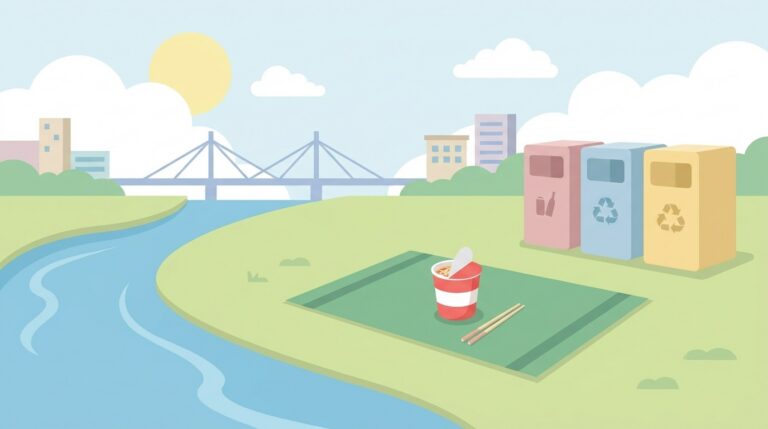
Why Hangang Picnics Come With a Recycling Boss Level
Phase 1: Welcome to Your Hangang Picnic Rescue
안녕하세요! 매일한글 에디터입니다. (Annyeonghaseyo! Maeil Hangeul editeoimnida. – Hello! I am the Daily Hangul Editor.) Picture this: golden sunset over the Han River, cool breeze, and a steaming bowl of Hangang ramen on your picnic mat. Pure K-drama bliss! Then you finish eating and walk to the park bins—suddenly, you freeze. Five separate bins, Korean labels everywhere, and leftover ramen broth in your hand. Where does the soup go? What about the paper cup? Many Daily Hangul learners told us this exact moment made them panic! Based on real learner feedback, this beginner-friendly guide teaches you simple Korean phrases to sort trash like a local and enjoy your picnic worry-free.
Phase 2: Top 3 Essential Expressions
1. 이거 어디에 버려요? (Igeo eodie beoryeoyo?)
- Pronunciation: ee-guh uh-dee-eh buh-ryuh-yo (Think of saying “ee-guh” like “eagle” without the L, and “buh-ryuh-yo” smoothly like “bury-uh-yo” with a soft B.)
- Meaning: Literally “This, where do I throw away?” In real life, it is the polite, friendly way to ask “Which bin does this go in?”
- K-Culture Moment: Just like characters in K-dramas like Hospital Playlist or Hometown Cha-Cha-Cha helping each other clean up after an outdoor meal, locals at Hangang Park often hold up a cup and ask a friend or staff member this exact question.
- Editor’s Insight: At Level 1, you do not need fancy grammar! Pointing gently at your trash and saying 이거 (igeo – this) with 어디에 버려요? (eodie beoryeoyo? – where do I throw it away?) solves 90% of park trash confusion.
- Situation Spectrum:
- Casual: ⚠️ (Use 이거 어디에 버려? (Igeo eodie beoryeo?) with close friends)
- Semi-formal: ✅ (Perfect for park visitors, convenience store staff, and strangers)
- Formal: ⚠️ (Add 저기요 (jeogiyo – excuse me) first when asking an elderly person)
- 🤔 Think About It: In many English-speaking countries, people ask “Where is the trash can?” as one general question. In Korea, people ask where each specific item goes because almost everything has its own bin. How does your hometown handle recycling in public parks?
2. 국물 먼저 버려요. (Gungmul meonjeo beoryeoyo.)
- Pronunciation: goong-mool mun-juh buh-ryuh-yo (Notice 국물 sounds like “goong-mool”—like the “oo” in “moon”—because the K sound changes to an NG sound before M!)
- Meaning: Literally “Broth first, throw away.” Real nuance: “Pour out the leftover ramen soup first (before recycling the container).”
- K-Culture Moment: In Korean travel vlogs and variety shows like 2 Days & 1 Night, you will always see a special sink or funnel next to the Hangang convenience store ramen machine just for pouring out leftover broth.
- Editor’s Insight: This is the number one Hangang Park rule! Never toss a paper ramen bowl with soup still inside into the recycling bin. Even a short reminder like 국물 먼저! (Gungmul meonjeo! – Soup first!) shows instant local know-how.
- Situation Spectrum:
- Casual: ✅ (Use 국물 먼저 버려! (Gungmul meonjeo beoryeo!) with your travel buddy)
- Semi-formal: ✅ (Great for telling someone politely how the station works)
- Formal: ⚠️ (In very formal settings, add -세요 (-seyo) to say 버리세요 (beoriseyo))
- 🤔 Think About It: Korean food culture revolves around hot soups and broths, so public spaces evolved dedicated liquid drains. Does your country have special bins for liquids in parks?
3. 분리수거해요. (Bunrisugeohaeyo.)
- Pronunciation: boon-lee-soo-guh-heh-yo (Imagine saying “boon-lee” fast like “boon-ly,” then “soo-guh” like “sugar” without the R, and “heh-yo.”)
- Meaning: Literally “I do separated collection.” Real nuance: “I sort and recycle the trash.”
- K-Culture Moment: In K-pop reality shows where idols live together in dorms, sorting 분리수거 (bunrisugeo – recycling) is a classic daily chore and even a common penalty for losing a game!
- Editor’s Insight: In English, we just say “recycle,” which covers everything. In Korea, 분리수거 (bunrisugeo) emphasizes the act of separating items cleanly—plastic, cans, paper, and general waste (일반쓰레기 – ilban sseuregi).
- Situation Spectrum:
- Casual: ✅ (Drop 요 (yo) with close friends: 분리수거해 (bunrisugeohae))
- Semi-formal: ✅ (Natural in everyday conversation)
- Formal: ⚠️ (Use 분리수거합니다 (bunrisugeohamnida) in presentations or signs)
- 🤔 Think About It: Why do you think Korean uses a word that literally means “separate and collect” instead of “reuse”? It puts the responsibility directly on the person throwing things away!
Phase 3: Textbook Korean vs. Real Korean
Situation 1: Asking where to throw away your ramen cup
- 📖 Textbook Korean: 실례지만, 쓰레기통이 어디에 있습니까? (Sillyejiman, sseuregitongi eodie itseumnikka?) – Excuse me, where is the trash can?
- 🗣️ Real Korean: 저기요, 이거 어디에 버려요? (Jeogiyo, igeo eodie beoryeoyo?) – Excuse me, where do I throw this away?
- 💡 Why the difference? Textbook Korean uses the super formal -습니까 (-seumnikka) ending, which sounds like a news anchor at a park picnic! In real life, Koreans use friendly -아요/어요 (-ayo/eoyo) endings and point to the specific item because Hangang bins are split into food waste, liquids, plastic, and general trash.
Situation 2: Telling your friend to clean up the picnic mat
- 📖 Textbook Korean: 쓰레기를 깨끗하게 정리하십시오. (Sseuregireul kkaekkeutage jeongnihasipsio.) – Please organize the trash cleanly.
- 🗣️ Real Korean: 우리 깨끗이 치우고 가자! (Uri kkaekkeusi chiugo gaja!) – Let’s clean up neatly and go!
- 💡 Why the difference? 정리하십시오 (jeongnihasipsio) sounds like a military command or a park loudspeaker announcement. Among friends, Koreans love using 우리 (uri – we/us) and 치우다 (chiuda – to clear/clean up) to keep the vibe warm and team-oriented.
Phase 4: K-Culture Deep Dive & Non-Verbal Manners
4-1. Nunchi (눈치) & Gestures at the Park Bins
At Hangang Park, good 눈치 (nunchi – social awareness) starts before you even stand up from your picnic mat:
* Empty & Rinse Mindset: If you have leftover ramen soup or iced Americano, hold the cup slightly away from your body and look for the liquid drain first. Nobody wants broth dripping near the park benches!
* Two-Handed or Gentle Pointing: If you ask a convenience store worker or another visitor 이거 어디에 버려요? (Igeo eodie beoryeoyo?), avoid jabbing your finger directly at them. Instead, hold up the trash item gently with one or two hands, make brief polite eye contact, and give a small nod (고개 숙이기 – gogae sugigi).
* Tying the Bag: If you rented a picnic set, neatly gather all trash into the provided plastic bag and tie the top before walking to the bins.
4-2. Cultural Code Analysis: K-Food Meets K-Travel
Hangang ramen (한강 라면 – Hangang ramyeon) is not just instant noodles—it is a beloved Seoul ritual! You buy a foil-lined paper bowl at a riverside convenience store, pop it onto an induction machine that cooks it in four minutes, and eat it outdoors while watching the river. Because thousands of people do this every evening, Korea’s recycling culture keeps the park spotless. Locals treat leaving a clean picnic spot as basic 매너 (maeneo – manners), just like clearing your own tray at a Korean fast-food café.
Phase 5: Real-Life Roleplay Scenario
Setting: Yeouido Hangang Park at sunset. Fairy lights glow near the convenience store. You just finished spicy Hangang ramen and a canned soda.
NPC: Mina (미나), a cheerful Korean college student sitting on the mat next to yours, who happens to be walking toward the recycling station at the same time.
- You: 🎭 (Holding your empty ramen bowl and soda can, looking confused at the 4 bins) 저기요, 이거 어디에 버려요? (Jeogiyo, igeo eodie beoryeoyo? – Excuse me, where do I throw this away?)
- Mina: 🎭 (Smiling warmly and pointing to the drink drain) 아, 캔은 여기예요! 근데 라면 그릇에 국물 있어요? (A, kaeneun yeogiyeyo! Geunde ramyeon geureuse gungmul isseoyo? – Oh, cans go here! Wait, is there broth in the ramen bowl?)
- You: 🎭 (Looking inside your bowl) 네, 조금 있어요. (Ne, jogeum isseoyo. – Yes, there is a little bit.)
- Mina: 🎭 (Gesturing toward a small sink next to the bins) 그럼 국물 먼저 버려요! (Geureom gungmul meonjeo beoryeoyo! – Then pour out the broth first!)
- You: 🎭 (Walking to the drain and pouring out the leftover soup) 아, 알겠어요! 감사합니다! (A, algesseoyo! Gamsahamnida! – Oh, got it! Thank you!)
- Mina: 🎭 (Pointing to the general waste bin for the wet paper ramen bowl) 이제 그릇은 일반쓰레기에 버리면 돼요. (Ije geureuseun ilbansseuregie beorimyeon dwaeyo. – Now you can throw the bowl in general waste.)
- You: 🎭 (Dropping the bowl into the right bin and wiping your hands) 분리수거가 정말 중요하네요! (Bunrisugeoga jeongmal jungyohaneyo! – Recycling is really important!)
- Mina: 🎭 (Giving a thumbs-up) 맞아요! 우리 깨끗이 치워요! (Majayo! Uri kkaekkeusi chiwoyo! – Right! Let’s clean up neatly!)
🔀 Interactive Branching Point: What happens when you finish your iced coffee cup?
You also have an empty plastic iced coffee cup with a little ice left inside. What should you do next?
* Option A: Toss the plastic cup with the ice straight into the 플라스틱 (peullaseutik – plastic) bin.
* Option B: Pour out the ice into the liquid drain, rinse/shake it dry, and ask 이거 플라스틱이에요? (Igeo peullaseutigieyo? – Is this plastic?) before putting it in the plastic bin.
* Option C: Throw the whole plastic cup into 일반쓰레기 (ilbansseuregi – general waste) because it is faster.
Feedback:
* Option A (Bad): Melting ice makes the recycling bin sticky and ruins paper or clean plastics nearby!
* Option B (Best!): Amazing 눈치 (nunchi)! Emptying liquids first and separating the plastic cup earns you an instant thumbs-up from locals.
* Option C (Risk): Putting recyclable plastic in general waste is discouraged in Korea—and in residential areas, it can even result in a fine!
Phase 6: 10-Second Emotion Shadowing Drill
Read each line out loud! Pause briefly at every / and match the emotion tag:
- [😊 Cheerfully and politely] 저기요, / 이거 / 어디에 버려요? (Jeogiyo, / igeo / eodie beoryeoyo? – Excuse me, / this, / where do I throw it away?)
- [😲 Helpful and alert] 잠깐만요! / 국물 먼저 / 버려요! (Jamkkanmanyo! / Gungmul meonjeo / beoryeoyo! – Wait a second! / Broth first, / pour it out!)
- [😌 Proud and satisfied] 우리 / 분리수거 / 깨끗이 했어요! (Uri / bunrisugeo / kkaekkeusi haesseoyo! – We / did recycling / cleanly!)
Phase 7: K-Culture Mini Dictionary
- 분리수거 (Bunrisugeo) | Recycling / Trash sorting | Used everywhere in Korea—from apartment complexes to Hangang Park—to describe separating waste into paper, plastic, cans, and general trash.
- 일반쓰레기 (Ilban sseuregi) | General waste | Trash that cannot be recycled, such as dirty food-stained paper ramen bowls, tissues, or used wet wipes.
- 음식물 쓰레기 (Eumsingmul sseuregi) | Food waste | Leftover noodles, kimchi, or fruit peels. Never mix this into regular trash!
- 국물 (Gungmul) | Soup / Broth | A key word for Hangang ramen lovers. Always empty 국물 into the liquid drain before tossing your bowl.
Phase 8: Traveler’s Survival Kit
Top 3 Survival Phrases
- 쓰레기통 어디 있어요? (Sseuregitong eodi isseoyo?) – Where is the trash can?
- Pro Tip: Great if you cannot see any bins near your picnic mat.
- 국물 버리는 곳 어디예요? (Gungmul beorineun got eodiyeyo?) – Where is the place to pour out broth?
- Pro Tip: Ask this right next to the convenience store ramen machine!
- 이거 일반쓰레기예요? (Igeo ilbansseuregiyeyo?) – Is this general waste?
- Pro Tip: Super helpful when you are unsure if a dirty ramen bowl counts as paper recycling or general waste (hint: dirty bowls go in general waste!).
Editor’s Travel Note
- Essential Apps: Before heading to Yeouido or Banpo Hangang Park, check out our guide to Download the Naver Map App for Seoul Parks to find the exact convenience stores and subway exits, and use Papago Korean Translation App for Bin Labels to scan Korean recycling signs with your camera.
- Local Payment & Transit Tip: Use your T-money (티머니) card on the subway (Yeouinaru Station Exit 2 is the closest to Yeouido Hangang Park), and bring a credit card or cashless payment for the convenience store ramen machine—most stores sell disposable bowls and chopsticks together as a set!
Phase 9: One Step Deeper — Why Clean Parks Matter in Korea
In Korea, public spaces like Hangang Park are viewed as an extension of everyone’s shared living room—a reflection of 우리 (uri – we/community) culture. Cleaning up your picnic spot is not just about avoiding litter; it is a quiet way of showing care for the next person who will sit on that grass. Because millions of Seoul residents gather along the river every weekend, small personal actions like draining ramen broth and sorting 분리수거 (bunrisugeo) keep the riverfront welcoming for everyone. Learning these phrases helps you step right into that warm, considerate rhythm!
💬 Your Turn: What is your favorite Hangang picnic snack—spicy ramen, fried chicken, or tteokbokki? Tell us in the comments, and try writing one Korean phrase from today’s lesson!
Phase 10: FAQ & Common Mistakes
Q: Can I throw a paper ramen bowl into the paper recycling bin?
A: Usually, no! Once a paper ramen bowl is soaked with spicy red broth and oil, it cannot be recycled as clean paper. Pour out the broth first, put leftover noodles in food waste if available, and throw the dirty bowl into 일반쓰레기 (ilban sseuregi – general waste).
Q: Are there always trash bins right next to the picnic lawns?
A: Recycling stations are usually placed near the convenience stores, park entrances, and public restrooms—not right on the grass. It is normal to carry your tied trash bag for a 2-to-3-minute walk to the nearest station.
Q: How do I say “trash bag” in Korean if I need to buy one at the convenience store?
A: You can ask for a 쓰레기봉투 (sseuregibongtu – trash bag) or simply ask 봉투 있어요? (Bongtu isseoyo? – Do you have a bag?) at the counter.
🚨 Common Mistakes Warning Board
- Mistake: Throwing a full cup of iced drink or ramen soup straight into the bin.
- Correct Action: Look for the liquid funnel or sink first and remember 국물 먼저 버려요 (Gungmul meonjeo beoryeoyo).
- Mistake: Putting wet wipes (물티슈 – multisyu) or tissues into paper recycling.
- Correct Action: Tissues and wet wipes always go into 일반쓰레기 (ilbansseuregi – general waste).
- Mistake: Leaving trash stacked next to an overflowing bin.
- Correct Action: Walk to the next bin station near the park exit or convenience store—Hangang Park has multiple stations!
Phase 11: Action Mission & Engagement
- 🥉 Bronze Mission (Solo Practice): Say 이거 어디에 버려요? (Igeo eodie beoryeoyo?) out loud three times while holding a coffee cup or snack wrapper in your room.
- 🥈 Silver Mission (Share It): Post a photo of your favorite Korean snack or ramen on social media with the caption 깨끗이 치워요! (Kkaekkeusi chiwoyo! – Let’s clean up neatly!) and tag a travel buddy.
- 🥇 Gold Mission (Real-Life Action): On your next trip to Korea (or at a local Korean market), point to a recycling bin and use 분리수거 (bunrisugeo) or 이거 어디에 버려요? (Igeo eodie beoryeoyo?) with a real person!
🎮 K-Culture Mission: Watch a Korean picnic vlog or a variety show camping episode (like Running Man or I Live Alone) and spot the moment the cast cleans up. Can you hear them say 치우다 (chiuda – clean up) or 쓰레기 (sseuregi – trash)?
Phase 12: Interactive Quiz Challenge
Test your Hangang Park recycling skills! Click each toggle below to check your answers.
1. Situational Judgment: You finished your Hangang ramen, and there is still soup in the bowl. Your friend is about to throw the whole bowl into the general waste bin. What should you say?
* A) 이거 먹어요! (Igeo meogeoyo!)
* B) 국물 먼저 버려요! (Gungmul meonjeo beoryeoyo!)
* C) 안녕히 가세요! (Annyeonghi gaseyo!)
Click to reveal Answer 1 & Feedback
Correct Answer: B) 국물 먼저 버려요! (Gungmul meonjeo beoryeoyo!)
Option A means “Eat this!” (definitely not leftover soup!), and Option C means “Goodbye!” Always pour out the broth in the liquid drain first so the bins stay clean.
2. Fill in the Blank: Complete the polite question to ask where to throw an item away:
“저기요, 이거 _______ 버려요?” (Jeogiyo, igeo _______ beoryeoyo? – Excuse me, where do I throw this away?)
Click to reveal Answer 2
Correct Answer: 어디에 (eodie – where)
Full sentence: 저기요, 이거 어디에 버려요? (Jeogiyo, igeo eodie beoryeoyo?)
3. True or False Cultural Quiz: True or False? A ramen-stained paper bowl should be thrown into the clean paper recycling bin.
Click to reveal Answer 3
Correct Answer: False!
Food-stained paper bowls cannot be recycled as clean paper. Drain the broth first, remove leftover noodles, and put the dirty bowl into 일반쓰레기 (ilban sseuregi – general waste).
🎬 Watch Our Daily Videos! (Daily Hangul Official Instagram)
Review the expressions you learned in this article with our fun daily short videos! Check out native pronunciation and real-life nuances in action.
- Instagram @dailyhangul_en







