

Master the Korean Glamping BBQ: Speak Like a Local Around the Campfire
Phase 1: Empathy (스토리 몰입형 오프닝)
안녕하세요! Your local bestie and Daily Hangul Editor-in-Chief here!
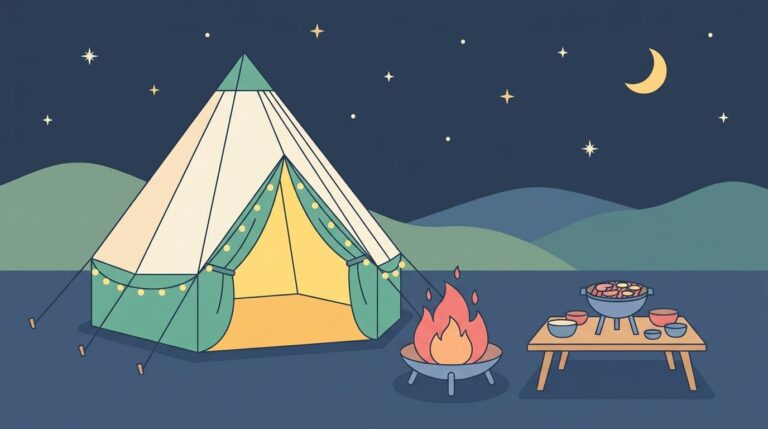
Imagine this: You’ve just arrived at a gorgeous, luxury glamping site in Gapyeong (가평). The fairy lights are glowing, the cool evening breeze is rustling the pine trees, and the charcoal grill is sizzling with premium pork belly (samgyeopsal). Your Korean friends are gathering around, tongs in hand, laughing and preparing the ssam (lettuce wraps).
You want to join the conversation, but you feel stuck. Should you offer to grill? How do you compliment the person cooking without sounding like a formal textbook?
This is a classic C1-level pain point: you know the grammar, but you lack the “social grease”—those culturally loaded, ultra-natural expressions that turn a polite interaction into a warm, bonded friendship. Today, we are cracking the code on Korean Glamping BBQ Culture, giving you the linguistic keys to blending in seamlessly at any Korean campfire!
Phase 2: 3 Core Expressions (핵심 표현 3선 심층 분석)
1. 불멍하다 (bul-meong-hada)
- Pronunciation: [Bul-meong-ha-da] (Think of “Bul” as in bull, and “meong” like the sound of a dazed daydream)
- Meaning: To space out while staring at a campfire (Literal: Fire + Spacing out)
- K-Culture Moment: You will see this constantly on K-dramas and Instagram reels. Characters sit quietly by the fire, holding a warm cup of hot chocolate, saying, “우리 불멍할까?” (Shall we do some fire-gazing?)
- Editor’s Insight: “멍 때리다” (to space out) is a treasured mental-health trend in Korea. “불멍” is its cozy, outdoor cousin. It carries a sense of healing, intimacy, and shared silence.
- Situation Spectrum: Casual (✅) | Semi-formal (✅) | Formal (⚠️ – Use “불을 보며 휴식을 취하다” instead)
- 🤔 Think About It: In your culture, do you have a specific word for the therapeutic act of staring into a fire? Why do you think Koreans created a dedicated slang for this?
2. 고기 굽는 부심 / 고기 부심 (gogi gubneun busim / gogi busim)
- Pronunciation: [Go-gi gup-neun bu-sim] (“Bu-sim” rhymes with choose-him)
- Meaning: Pride/ego in one’s meat-grilling skills (Short for 고기 굽는 자부심)
- K-Culture Moment: During a BBQ, one friend will inevitably grab the tongs and refuse to let anyone else touch them, claiming they know the exact micro-second to flip the pork belly.
- Editor’s Insight: Calling someone’s skill “고기 부심” is a high-level compliment wrapped in playful banter. It acknowledges their expertise while letting them take charge.
- Situation Spectrum: Casual (✅) | Semi-formal (✅) | Formal (🚫)
- 🤔 Think About It: Food is a major social currency in Korea. How does taking pride in cooking for others reflect the collective nature of Korean society?
3. 한 쌈 싸 드릴게요 (han ssam ssa deurilgeyo)
- Pronunciation: [Han ssam ssa deu-ril-ge-yo] (“Ssam” has a tense, sharp ‘ss’ sound, like tsunami without the ‘u’)
- Meaning: Let me make a wrap (ssam) for you.
- K-Culture Moment: Feeding someone a wrap you hand-made is the ultimate sign of affection, friendship, or respect in Korean dining culture.
- Editor’s Insight: Delivering this phrase with a warm smile instantly melts any social awkwardness. It shows you understand “Jeong” (정) – the deep emotional bond of sharing.
- Situation Spectrum: Casual (✅ – “한 쌈 싸 줄게”) | Semi-formal (✅) | Formal (✅)
- 🤔 Think About It: Sharing food directly from your hand can feel overly intimate in some cultures. Why is it considered a peak polite gesture in Korea?
Phase 3: Textbook Korean vs. Real Korean (교과서 한국어 vs 진짜 한국어)
Situation 1: Checking if the charcoal fire is ready
- 📖 Textbook: “숯불이 준비되었습니까?” (Is the charcoal fire prepared?)
- 🗣️ Real Korean: “불 이제 다 올라왔어요?” (Is the fire fully up now?)
- 💡 Why the difference? The textbook version sounds like a hotel manager asking a staff member. “불 올라오다” (the fire rising/getting hot) is the natural, conversational way locals refer to the grill heating up.
Situation 2: Expressing that you are completely full
- 📖 Textbook: “배가 불러서 더 먹을 수 없습니다.” (I am full and cannot eat more.)
- 🗣️ Real Korean: “와, 진짜 배 터질 것 같아요!” (Wow, my stomach is literally about to burst!)
- 💡 Why the difference? At a glamping site, dining is informal and hearty. Using overly rigid textbook language distances you from the group. Saying “배 터질 것 같다” adds a fun, dramatic flair that matches the feast’s vibe.
Phase 4: K-Culture Deep Dive & Non-verbal Manners (K-Culture 딥다이브)
4-1. 눈치 (Nunchi) & BBQ Etiquette
In a Korean glamping environment, Nunchi (tact/social situational awareness) is everything.
* The Griller’s Helper: Never just sit and wait for the meat to be served. If you aren’t the one grilling (the “grill master”), your job is to set up the side dishes (banchan), open the wrapping of the sesame leaves, and place cooked meat onto other people’s plates.
* The Golden Tongs Rule: If someone has strong “고기 부심” (grilling pride), do not try to snatch the tongs. Instead, feed them a wrap (ssam) as a reward for their hard work. This non-verbal gesture creates instant camaraderie!
4-2. The Glamping Aesthetic
Korean glamping isn’t roughing it; it is “감성 캠핑” (aesthetic/emotional camping). It involves string lights, Bluetooth speakers playing indie-folk or soft K-R&B, and “밀키트” (expertly prepared meal kits). It’s a curated escape from high-stress city life, heavily featured in healing reality shows like In the SOOP.
Phase 5: Real-life Roleplay Scenario (실전 롤플레이 시나리오)
Setting: A cozy luxury glamping site in Gapyeong. The aroma of sizzling wood and grilled pork fills the air. Min-ji (민지) is commanding the grill.
- Min-ji (민지): (Holding tongs with high energy) 자, 다들 집중해 주세요! 가평 최고급 목살 들어갑니다!
- You: 우와, 민지 씨 역시 고기 굽는 집게 잡은 포스가 장난이 아니에요! 혹시 고기 부심 있으신가요?
- Min-ji (민지): (Laughs proudly) 당연하죠! 제가 구우면 육즙이 절대 안 빠져나가요. 조금만 기다려요!
- You: 대단해요! 그럼 제가 옆에서 마늘이랑 버섯 세팅할게요. 도와드릴 일 있으면 바로 말씀하세요.
- Min-ji (민지): 아유, 고마워요! 자, 이거 첫 점인데 먼저 드셔보세요. 소금만 살짝 찍어서!
- You: (Chewing happily) 와… 진짜 겉바속촉의 정석이네요! 너무 맛있어요.
- Min-ji (민지): 그렇죠? 자, 이제 본격적으로 먹어봅시다!
- You: 민지 씨 고생하셨으니까 제가 맛있게 한 쌈 싸 드릴게요. 아 하세요!
- Min-ji (민지): (Touched) 헐, 감동이에요! 진짜 센스 대박이시네요!
🔀 Interactive Choice Points
How do you respond to Min-ji’s compliment about your “센스” (social sense)?
- Option A: “아니에요, 그냥 기본이죠.” (No, it’s just the basics.)
- Feedback (Risk): A bit too cold and dry. It might kill the warm, playful glamping vibe.
- Option B: “제가 눈치가 좀 빠르거든요! 다음엔 더 맛있게 싸 드릴게요.” (I have quick Nunchi! Next time I’ll make an even tastier wrap for you.)
- Feedback (Best): Perfect! It shows high social intelligence, acknowledges the cultural concept of Nunchi playfully, and promises future bonding.
- Option C: “네, 제가 한국의 정을 좀 배웠습니다.” (Yes, I learned a bit of Korean ‘Jeong’.)
- Feedback (Bad): Sounds slightly unnatural, like a cultural textbook reciting a thesis statement.
Phase 6: 10-Second Emotion Shadowing Drill (10초 감정 섀도잉 드릴)
Practice these lines out loud with the correct emotional cadence. The slashes (/) indicate short pauses.
[😊 Excited & Grateful]
“와… / 진짜 겉바속촉의 정석이네요! / 최고예요!”
(wa… / jin-ja geot-ba-sok-chok-ui jeong-seok-i-ne-yo! / choi-go-ye-yo!)-
[😎 Playful & Teasing]
“역시 / 민지 씨 고기 부심은 / 인정해 줘야 돼요!”
(yeok-si / min-ji ssi go-gi bu-sim-eun / in-jeong-hae jwo-ya dwae-yo!) -
[🥺 Cozy & Content]
“이게 바로 / 불멍의 매력이죠… / 너무 힐링돼요.”
(i-ge ba-ro / bul-meong-ui mae-ryeok-i-jo… / neo-mu hil-ling-dwae-yo.)
Phase 7: K-Culture Mini Dictionary (K-Culture 미니 사전)
- 불맛 (bul-mat) | Smoky flavor / Fire taste. The highly sought-after charcoal aroma infused in grilled foods.
- 겉바속촉 (geot-ba-sok-chok) | Crispy on the outside, juicy/tender on the inside. (Abbreviation of 겉은 바삭하고 속은 촉촉하다).
- 밀키트 (meal-kit) | Semi-prepared meal kits. An absolute staple for modern Korean glamping—just open, boil/grill, and eat!
- 치팅데이 (cheating day) | Cheat day. Koreans love using this English loanword when indulging in massive amounts of grilled pork belly and ramen at a campsite.
Phase 8: Travel Kit (여행자를 위한 생존 키트)
Survival Expressions TOP 3
- “가위랑 집게 좀 더 주실 수 있나요?”
- Pronunciation: [Ga-wi-rang jip-ge jom deo ju-sil su in-na-yo?]
- Pro Tip: Use this when asking glamping staff for extra scissors and tongs—essential tools for Korean BBQ.
- “혹시 모기향이나 에프킬라 있어요?”
- Pronunciation: [Hok-si mo-gi-hyang-i-na e-peu-kil-ra is-seo-yo?]
- Pro Tip: Glamping in Korean forests means mosquitoes. “에프킬라” (F-Killer) is the generic brand name for bug spray in Korea.
- “장작 추가하려면 얼마예요?”
- Pronunciation: [Jang-jak chu-ga-ha-ryeo-myeon eol-ma-yeo-yo?]
- Pro Tip: To keep the “불멍” going all night, you’ll need to purchase extra firewood (jang-jak).
Editor’s Travel Note
Before heading to Gapyeong or Pocheon for glamping, make sure you have the Naver Map (네이버 지도) app updated. Unlike global maps, Naver Map shows the exact locations of nearby local grocery stores (식자재 마트) where you can buy fresh pork and firewood much cheaper than at the actual glamping site. Note: Store availability and pricing may vary depending on local conditions.
Phase 9: “한 발 더 깊이” (Deep Reflective Thought)
In Western barbecue culture, the griller often stands alone at the grill, cooking for a crowd sitting elsewhere. In Korea, the grill is situated directly in the middle of the table, making cooking a highly cooperative, circular ritual. This layout reflects the deeply rooted collectivism of Korean culture, where eating is not just consumption, but active relationship building. Sharing the warmth of the same fire and eating from the same grill creates an unspoken bond of Jeong (정).
💬 Your Turn: Have you ever experienced a dining setting where cooking was a group activity? How did it change the dynamic of your conversation? Let me know in the comments below!
Phase 10: FAQ & Common Mistakes (FAQ Schema)
Q: Is it okay to use my personal chopsticks to flip the raw meat on the grill?
A: No, this is a hygiene faux pas. Always use the designated communal tongs (집게) to handle raw meat. Using your personal chopsticks might expose others to raw pork bacteria and breaks the clean flow of the table.
Q: What is the correct way to eat a wrap (쌈)?
A: You must eat it in one single bite! Biting a ssam in half is considered messy and slightly impolite as the contents spill out. Make sure to size your wrap according to your mouth’s capacity.
Q: Can I refuse a wrap made by a senior or friend?
A: Unless you have severe allergies, rejecting a hand-wrapped ssam can feel like rejecting their affection. If you must decline, do so politely by saying, “정말 감사한데, 제가 알레르기가 있어서 마음만 받을게요!” (Thank you so much, but I have an allergy, so I will just accept your kind heart!)
🚨 Common Mistakes Alert!
- Mistake: Cutting the pork belly immediately when placed on the grill.
- Correct Action: Wait until the surface is slightly cooked and firm, then cut. Cutting raw pork belly makes it tear and lose its juices.
- Mistake: Sitting silently while the host does all the work.
- Correct Action: Keep your Nunchi active. Pour drinks, pass the salt, or prep the garlic.
- Mistake: Saying “감사합니다” too stiffly to friends.
- Correct Action: Keep it warm! Use “와, 진짜 감동이에요!” (Wow, I’m so touched!) to match the emotional wavelength of the glamping trip.
Phase 11: Action Mission (액션 미션 & 참여 유도)
- 🥉 Bronze Mission: Practice the word “불멍” and “겉바속촉” 3 times in front of the mirror with high emotional expressions.
- 🥈 Silver Mission: Go to Instagram or TikTok, find a video of Korean glamping/BBQ, and write a comment using “고기 부심 대박이네요!” or “불멍하고 싶다!”.
- 🥇 Gold Mission: Book a glamping trip in Korea or host a Korean-style BBQ with friends, and successfully craft a ssam for someone while saying “한 쌈 싸 드릴게요!”
-
🎮 K-Culture Mission: Watch an episode of a Korean reality show (like In the SOOP or Three Meals a Day). Spot the moment they grill meat. Count how many times they use scissors (가위) to cut meat instead of a knife, and share your findings in the comments!
Phase 12: Interactive Quiz Challenge (인터랙티브 퀴즈 챌린지)
Q1. What does the slang “겉바속촉” mean when describing grilled meat?
View Answer & Explanation
Answer: Crispy on the outside, juicy/tender on the inside.
Explanation: It is a portmanteau of 겉(outside)은 바삭하고 속(inside)은 촉촉하다. It is the ultimate compliment for perfectly grilled meat or baked goods!
Q2. True or False: In Korea, cutting meat with scissors at a BBQ table is considered bad table manners.
View Answer & Explanation
Answer: False.
Explanation: Using scissors at the table is incredibly practical and standard practice in Korea. It allows the griller to cut hot meat quickly and evenly without needing a cutting board!
Q3. Fill in the blank: Spacing out while staring quietly at a cozy campfire is called “____”!
View Answer & Explanation
Answer: 불멍 (bul-meong)
Explanation: It combines “불” (fire) and “멍청히/멍하게” (staring blankly). It is a key healing activity of Korean camping culture!






