

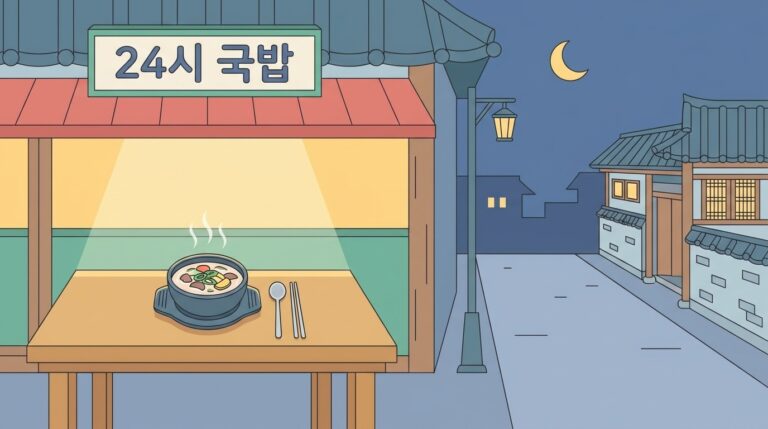
Surviving the 3 AM Hunger: The Ultimate Guide to Korea’s 24-Hour Late-Night Diners
Phase 1: Empathy
Hello! I’m the Lead Editor of Daily Hangul. Have you ever watched a K-drama where the main characters, heartbroken or just exhausted after a long day, end up at a brightly lit, slightly steamy street-side restaurant at 3 AM? They order a boiling pot of something red, clink their green Soju bottles, and suddenly the world is okay again. 자막엔 단순히 ‘Let’s eat’이라고 나오지만 (The subtitles simply say ‘Let’s eat’), the actual cultural weight of that moment is immense.
Welcome to the magic of Korea’s 24-hour restaurant culture (24시간 영업 식당) and late-night snacks (야식, Yashik). For language learners, this is the ultimate testing ground. The textbook Korean you learned in a quiet classroom won’t cut it when a bustling restaurant owner is rushing past you with boiling hot stone bowls. By mastering the advanced nuances of late-night dining, you won’t just survive the 3 AM hunger—you’ll be embraced as a true insider. This guide is based on real questions from advanced learners who wanted to go beyond ‘Hello’ and ‘Thank you’ to truly connect with the locals.
Phase 2: Core Expressions Deep Dive
1. 이모님, 여기 국밥 두 그릇이요!
- Pronunciation: [imonim, yeogi gukbap du geureusiyo!] (ee-moh-nim, yuh-gee gook-bahp doo goo-roo-she-yoh!)
- Meaning: Auntie, two bowls of soup and rice here! (Literal) vs. Excuse me, we’ll take two bowls of soup! (Real nuance)
- K-Culture Moment: It’s 2 AM after a company dinner. Yelling “Jeogiyo” (Excuse me) feels too cold in this cozy, chaotic environment. Calling out “Imonim!” instantly bridges the gap, often resulting in slightly larger portions or a warmer smile.
- Editor’s Insight: As a C1 learner, you know ‘Jeogiyo’ works everywhere. But ‘Imonim’ is about Jeong (정, emotional connection). It shows you understand the familial vibe of Korean comfort food places. Only use it for middle-aged or older female staff.
- Situation Spectrum:
- Casual (친구 사이): ✅
- Semi-formal (직장 동료): ⚠️ (Fine in casual diners, avoid in upscale places)
- Formal (직장 상사·어른): 🚫
- 🤔 Think About It: Why do Koreans use family terms (Aunt, Uncle, Older brother/sister) for strangers in casual service settings? How does this reflect the traditional community mindset?
2. 아, 국물이 진짜 시원하네요.
- Pronunciation: [a, gungmuri jinjja siwonhaneyo.] (ah, goong-moo-ree jin-jja she-won-ha-neh-yoh.)
- Meaning: Ah, the broth is really cold. (Literal) vs. Ah, this hot broth is so incredibly refreshing/hits the spot. (Real nuance)
- K-Culture Moment: You take a sip of boiling hot Gamjatang (pork bone soup) and let out a deep sigh. In Korea, “cool” (시원하다) is used for hot soups to describe the feeling of your stomach relaxing and your fatigue melting away.
- Editor’s Insight: This is the ultimate test of cultural fluency. If you can drink boiling soup and confidently say “시원하다,” Korean uncles at the next table will mentally adopt you.
- Situation Spectrum:
- Casual: ✅
- Semi-formal: ✅
- Formal: ✅ (It’s a universally accepted expression of culinary appreciation!)
- 🤔 Think About It: Can you think of a phrase in your native language that contradicts its literal meaning when describing food?
3. 혹시 영업 끝났나요?
- Pronunciation: [hoksi yeongeop kkeutnannayo?] (hok-she yuhng-up kkut-nan-nah-yoh?)
- Meaning: By any chance, is the business finished? (Literal) vs. Are you closed / Are you closing up soon? (Real nuance)
- K-Culture Moment: You see a 24-hour sign, but the chairs are stacked up and the owner is mopping. Even “24-hour” places have cleaning times or break times (브레이크 타임) post-pandemic.
- Editor’s Insight: Using “혹시” (by any chance) softens the question. It shows high-level politeness and consideration for the exhausted staff.
- Situation Spectrum:
- Casual: ✅
- Semi-formal: ✅
- Formal: ✅
- 🤔 Think About It: Why is “혹시” (by any chance) so frequently used at the beginning of questions in Korean? What does it say about the culture of indirectness?
Phase 3: Textbook vs. Real Korean
[Expressing deep satisfaction with food]
* 📖 Textbook: 음식이 아주 맛있습니다. (The food is very delicious.)
* 🗣️ Real Korean: 와, 속이 다 풀리네. / 이거 제대로다! (Wow, my stomach is completely relieved. / This is the real deal!)
* 💡 Why it’s different: Modern Koreans use vivid, physical sensations to describe deep flavors, especially late at night when the body craves comfort.
[Asking for more side dishes at a diner]
* 📖 Textbook: 반찬 좀 더 주시겠습니까? (Could you please give me more side dishes?)
* 🗣️ Real Korean: 이모님~ 여기 깍두기 좀 더 주세요! (Auntie~ Please give us a bit more radish kimchi here!)
* 💡 Why it’s different: In busy 24-hour joints, hyper-specific requests combined with an affectionate title get faster results than formal textbook sentences.
[Suggesting a late-night bite]
* 📖 Textbook: 밤에 간식을 먹으러 갈까요? (Shall we go eat a snack at night?)
* 🗣️ Real Korean: 야식 땡기지 않아? / 출출한데 뭐 좀 먹을까? (Aren’t you craving late-night food? / I’m a bit peckish, should we eat something?)
* 💡 Why it’s different: “땡기다” (to crave/pull) is the ultimate C1 slang for expressing a sudden desire for food.
Bottom Note: At the C1 level, try incorporating sensory verbs like ‘풀리다’ (to be relieved/untangled) and ‘땡기다’ (to crave) into your daily conversations to sound instantly more fluent.
Phase 4: Cultural Context — K-Culture Deep Dive
4-1. Non-verbal Nuances (눈치 in the Diner)
In a bustling 24-hour restaurant, Nunchi (눈치, situational awareness) is everything. Don’t wait for the server to come to you; raise your hand slightly and make eye contact, or press the call button (벨) on the table. When water arrives, it is customary for the youngest or the host of the table to pour water for everyone else. If the server brings boiling soup, lean back slightly to give them space to place it down safely.
4-2. The “N-cha” (Nth Round) Culture & Haejang
In K-Dramas, you often see coworkers moving from a BBQ place to a karaoke bar, and then ending up at a brightly lit soup restaurant. This is the classic 3rd or 4th round (3차, 4차) of a Korean night out. The ultimate goal here is Haejang (해장)—curing the hangover before you even go to sleep. The rich, spicy broths of Gamjatang (Pork bone soup) or Sunddaeguk (Blood sausage soup) are believed to sweat out the alcohol. Understanding this ritual helps you understand why these restaurants exist and why they are so beloved.
Phase 5: Real-world Roleplay Scenario
Setting: Friday, 2 AM. A brightly lit 24-hour Gamjatang restaurant in Gangnam. Neon lights flash outside. The restaurant is filled with a mix of tired office workers and loud college students. You are here with your Korean colleagues after an intense company dinner.
Characters:
– YOU: An expat manager, navigating Korean corporate culture like a pro.
– Min-su (32): Your friendly Korean coworker who just dragged you here for “one last bowl.”
Dialogue:
Min-su: 와, 벌써 새벽 2시네요. 우리 딱 국밥 한 그릇만 먹고 가요! 🍲
(Wa, beolsseo saebyeok dusineyo. Uri ttak gukbap han geureunman meokgo gayo!)
(Wow, it’s already 2 AM. Let’s just have one bowl of soup and go!)
(🎭 Stage Direction: Min-su enthusiastically points at the 24-hour sign)
YOU: 진짜 징하네요. 내일 출근 안 해요?
(Jinjja jinghaneyo. Naeil chulgeun an haeyo?)
(You’re truly relentless. Aren’t we going to work tomorrow?)
Min-su: 에이, 해장을 해야 내일 출근을 하죠. 이모님! 여기 뼈해장국 두 개요!
(Ei, haejangeul haeya naeil chulgeuneul hajyo. Imonim! Yeogi ppyeohaejangguk du gaeyo!)
(Hey, we need to cure our hangover so we can go to work tomorrow. Auntie! Two bone hangover soups here!)
Server (NPC): 네~ 앞치마 드릴까요?
(Ne~ apchima deurilkkayo?)
(Sure~ Would you like aprons?)
YOU: 네, 부탁드립니다. (Looking at the boiling pot) 와, 진짜 펄펄 끓네요.
(Ne, butakdeurimnida. Wa, jinjja peolpeol kkeulneyo.)
(Yes, please. Wow, it’s really boiling furiously.)
Min-su: 조심하세요, 엄청 뜨거워요. (Takes a loud slurp of the broth) 크으~ 국물이 끝내주네요.
(Josimhaseyo, eomcheong tteugeowoyo. Keueu~ gungmuri kkeutnaejuneyo.)
(Be careful, it’s super hot. Keuu~ the broth is killer.)
Min-su: [Your Name] 님도 빨리 드셔보세요. 속이 확 풀리죠?
([Your Name] nimdo ppalli deusyeoboseyo. Sogi hwak pullijyo?)
([Your Name], hurry up and try it. Your stomach feels completely relieved, right?)
🔀 Your Turn! How should you reply?
– A) “네, 국물이 정말 차갑네요!” (Yes, the broth is really cold!)
– B) “크으~ 진짜 시원하네요. 술이 다 깨는 것 같아요.” (Keuu~ It’s really refreshing. I feel like I’m sobering up completely.)
– C) “너무 매워서 못 먹겠어요. 환불해 주세요!” (It’s too spicy, I can’t eat it. Refund please!)✅ Best Choice: B — Perfect cultural adaptation. You used the sensory “시원하다” (refreshing) and showed you understand the concept of Haejang.
⚠️ Choice A Analysis: A classic foreigner mistake! Translating the English concept of “cool/refreshing” directly without understanding the Korean gastronomic context.
Phase 6: 10-Second Shadowing Drill
Practice this sentence focusing on intonation and pauses to sound like a local regular!
🥺 이모님~! / 여기 깍두기 좀 / 듬~~~뿍 / 주실 수 있나요?
(imonim~! / yeogi kkaktugi jom / deum~~~ppuk / jusil su innayo?)
(Auntie~! / Could you please give us / a looooot / of radish kimchi here?)
Tip: Stretch the “듬~~~뿍” (abundantly/plenty) to add a friendly, slightly pleading tone that Korean servers love.
Phase 7: K-Culture Mini Dictionary
| 한국어 | Romanization | English | Cultural Context |
|---|---|---|---|
| 야식 | yashik | Late-night snack | From fried chicken to Jokbal, Korea’s midnight delivery and dining culture is a national pastime. |
| 해장 | haejang | Hangover cure | The act of soothing an alcohol-irritated stomach, usually with spicy, boiling hot soups. |
| 24시 | ishipsashi | 24 Hours | Look for these numbers on red neon signs; it guarantees a warm meal no matter the time. |
| N차 | N-cha | Nth round | The Korean drinking culture of moving to multiple venues in one night (1st round dinner, 2nd round pub, 3rd round soup). |
| 앞치마 | apchima | Apron | Essential survival gear in Korean restaurants to protect your clothes from bubbling red broths. |
Phase 8: Traveler Survival Kit
Navigating late-night streets requires a few essential phrases, especially when you’re starving at 2 AM.
🆘 Survival Phrases for the Night Owl
– 🇰🇷 “지금 식사 되나요?” (jigeum siksa doenayo?)
– 🗣️ Meaning: Can we eat right now? / Is the kitchen still open?
– 📍 Where to use: Entering a restaurant late at night when you aren’t sure if they are preparing to close.
- 🇰🇷 “포장해 주세요.” (pojanghae juseyo.)
- 🗣️ Meaning: Please pack this to go.
- 📍 Where to use: When you want to take your late-night snack back to your hotel or the Han River.
🇰🇷 “가장 안 매운 걸로 주세요.” (gajang an maeun geollo juseyo.)
- 🗣️ Meaning: Please give me the least spicy one.
- 📍 Where to use: Crucial if your stomach can’t handle 3 AM fire-spicy ramen.
📌 Editor’s Travel Note:
– Map Apps: Google Maps is notoriously unreliable for walking directions and business hours in Korea. Always use Naver Map or KakaoMap to check if a place is truly “영업 중” (Open).
– Payment: Korea is a cashless society. Your Visa/Mastercard will work at 99% of 24-hour diners, even for a $5 bowl of soup.
– Tipping: NO tipping! Leaving money on the table will result in the staff chasing you down the street thinking you forgot your change.
Phase 9: Critical Thinking — “One Step Deeper”
🧠 Think Deeper: Food & Identity
Why does Korea have such an incredibly developed 24-hour dining and delivery culture? It’s deeply tied to the nation’s rapid modernization. The “Pali-Pali” (hurry-hurry) culture and historically intense working/studying hours meant people were awake and hungry at all hours. Furthermore, Korea’s exceptionally low street crime rate allows people to safely wander out at 3 AM for a bowl of noodles. However, this convenience comes on the backs of night-shift workers and delivery riders. The 24-hour diner is a microcosm of modern Korea: highly efficient, fiercely communal (sharing a pot of stew in the dead of night), and relentlessly hardworking.
💬 Your Turn: How does late-night dining look in your culture? Is it fast-food drive-thrus, street kebab carts, or cooking at home? Share your 3 AM food memories in the comments!
Phase 10: FAQ & Avoiding Mistakes
Q: Can I call male staff “삼촌” (Uncle)?
A: While “Imonim” is universally loved for older female staff, “Samchon” (Uncle) for male staff can sometimes sound a bit overly familiar or slightly patronizing depending on the context. It’s safer to use “사장님” (Boss/Owner) for older men, and “저기요” (Excuse me) for younger staff.
Q: Is it okay to stay for 3 hours in a 24-hour cafe or diner?
A: If you keep ordering food/drinks, yes. But sleeping on the table or occupying a busy restaurant for hours after finishing your single bowl of soup is considered rude (진상 – a nuisance customer).
❌ Common Mistake #1: Calling a young, 20-something university student part-timer “이모님” (Auntie).
✅ Do this instead: They will be deeply offended! Reserve “Imonim” for women who are clearly in their late 40s or older. For younger staff, simply say “저기요!” (Excuse me!).❌ Common Mistake #2: Shouting across the room in a quiet restaurant.
✅ Do this instead: 24-hour pubs and soup joints are loud, so shouting is necessary. But do not use this volume or the “Imonim!” tactic in a quiet, upscale daytime restaurant. Read the room (Nunchi!).
Phase 11: Summary & Action Items
One-Liner Summary: Mastering 24-hour restaurant culture means embracing the noise, using affectionate titles like ‘Imonim’, and learning to find hot soup ‘refreshing’.
Action Mission:
– 🥉 Bronze: Say “아~ 국물이 진짜 시원하다!” out loud three times while drinking your morning coffee or tea today.
– 🥈 Silver: Leave a comment below sharing your favorite late-night snack using the word “야식” (Yashik).
– 🥇 Gold (Real-world): Next time you are in Korea (or at your local Koreatown), visit a late-night restaurant and use “이모님” and “혹시 영업 끝났나요?” confidently!
🎬 K-Culture Mission:
Watch an episode of Itaewon Class or Hospital Playlist and spot the scenes where characters are eating at a brightly lit restaurant late at night. Notice how their posture and language change compared to daytime office scenes!
Phase 12: Interactive Quiz
1. Situational Judgment: It’s 1 AM. You enter a small Gukbap restaurant. The owner is wiping tables and the open sign is off, but the door was unlocked. What is the most polite C1-level way to ask if you can eat?
– A) 안 닫았어요? (Not closed?)
– B) 혹시 식사 가능한가요? (By any chance, is it possible to have a meal?)
– C) 밥 주세요! (Give me rice!)
2. True or False — K-Culture Edition:
“If you loved the 3 AM soup, you should leave a 10% tip on the table for the Imonim.”
3. Fill in the blank:
You take a sip of boiling hot, spicy stew. You want to sound like a middle-aged Korean man experiencing pure joy. “아~~ 속이 확 ( ______ )네!”
(Answers: 1. B – ‘혹시’ adds the perfect polite hesitation. 2. False – Tipping is not practiced and will cause confusion. 3. 풀리 – ‘속이 풀리다’ means the stomach is relieved/hangover is cured.)
Frequently Asked Questions (FAQ)
Q: What does "이모님, 여기 국밥 두 그릇이요!" mean in Korean and how do you pronounce it?
A: In Korean, "이모님, 여기 국밥 두 그릇이요!" is pronounced [imonim, yeogi gukbap du geureusiyo!] and means: Auntie, two bowls of soup and rice here! (Literal) vs. Excuse me, we'll take two bowls of soup! (Real nuance)
Q: What does "아, 국물이 진짜 시원하네요." mean in Korean and how do you pronounce it?
A: In Korean, "아, 국물이 진짜 시원하네요." is pronounced [a, gungmuri jinjja siwonhaneyo.] and means: Ah, the broth is really cold. (Literal) vs. Ah, this hot broth is so incredibly refreshing/hits the spot. (Real nuance)
Q: What does "혹시 영업 끝났나요?" mean in Korean and how do you pronounce it?
A: In Korean, "혹시 영업 끝났나요?" is pronounced [hoksi yeongeop kkeutnannayo?] and means: By any chance, is the business finished? (Literal) vs. Are you closed / Are you closing up soon? (Real nuance)






