

Phase 1: Empathy (Immersion Opening)
Hello! I’m your Daily Hangul Editor.
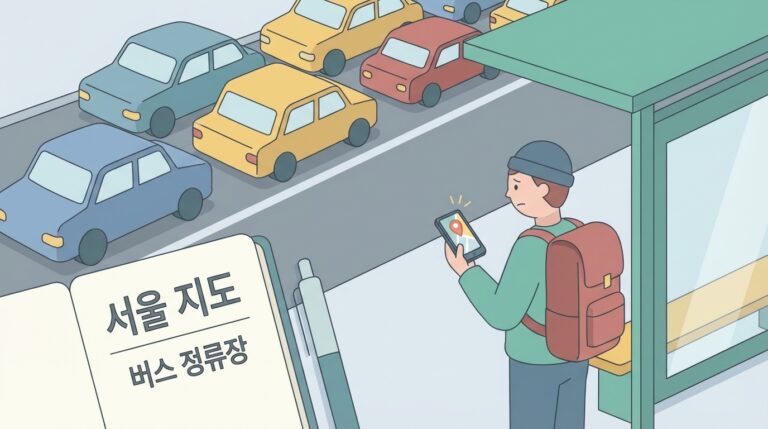
Picture this: It’s 7:00 PM on a Friday—what Koreans call Bulgeum (불금, Fire Friday). You’re standing near Exit 10 or 11 of Gangnam Station, surrounded by a sea of people. You’re waiting for your Korean friend, but they are nowhere to be seen. Suddenly, your phone buzzes. It’s a KakaoTalk message: “차가 너무 막혀서 제시간에 못 올지도 몰라 ㅠㅠ”
If you’ve watched any K-Dramas, you know this scene. The protagonist is stuck in a taxi on a bridge over the Han River, nervously checking their watch, realizing they’re going to miss a crucial moment.
Traffic in Seoul, especially during rush hour, is notoriously unpredictable. Knowing how to express guesses, expectations, and delays isn’t just about grammar; it’s about survival and showing consideration (눈치, nunchi). Today, we’ll decode exactly how Koreans soften the blow of bad news like being late, and how you can do it like a true insider.
(Note: This post is entirely based on real panicked texts from my past students!)
Phase 2: Core Expressions Deep Dive
1. 차가 막혀서 (cha-ga ma-kyeo-seo)
- Pronunciation: cha-ga ma-kyeo-seo [The ‘eo’ sounds like the ‘u’ in ‘uh-oh’]
- Meaning: Literal: Because the cars are blocked / Real nuance: Because traffic is bad
- K-Culture Moment: You’ll hear taxi drivers muttering this under their breath during rush hour. It’s the ultimate, universally accepted excuse in Seoul.
- Editor’s Insight: We don’t say “traffic is heavy.” We say “cars are blocked” (차가 막히다). It paints a vivid picture of a clogged road.
- Situation Spectrum:
- Casual: ✅ (차가 막혀서)
- Semi-formal: ✅ (차가 막혀서요)
- Formal: ✅ (차가 막혀서)
- 🤔 Think About It: Why blame the “cars” instead of saying “I am late”? It shifts the blame to an external factor, saving face for both parties.
2. 제시간에 못 올지도 몰라 (je-si-ga-ne mot ol-ji-do mol-la)
- Pronunciation: je-si-ga-ne / mot ol-ji-do / mol-la [The ‘eu’ in typical Korean sounds like the disgusted sound you make when stepping in gum, but here ‘o’ and ‘a’ are sharp and clear]
- Meaning: Literal: I might not know if I can’t come on time / Real nuance: I might not arrive on time
- K-Culture Moment: This is the classic K-Drama cliffhanger text message. It creates suspense. Will they make it to the airport before their love interest leaves?
- Editor’s Insight: The grammar
-(으)ㄹ지도 모르다(might not know if…) is all about uncertainty. It’s less definitive than saying “I will be late,” which feels too direct and a bit rude.- Situation Spectrum:
- Casual: ✅ (몰라)
- Semi-formal: ⚠️ (몰라요 – use with caution)
- Formal: 🚫 (Do not use this to a boss. See Phase 3!)
- 🤔 Think About It: Why do Koreans prefer saying “I might not know” instead of “I might”? It reflects a culture of humility—avoiding absolute statements just in case you are wrong.
3. 늦을 것 같아 (neu-jeul geot ga-ta)
- Pronunciation: neu-jeul geot ga-ta
- Meaning: Literal: It seems like I will be late / Real nuance: I think I’ll be late
- K-Culture Moment: The most common text sent on Korean group chats for dinner parties (회식, hoesik).
- Editor’s Insight:
-(으)ㄹ 것 같다(It seems like…) is the holy grail of Korean polite guessing. It softens the bad news.- Situation Spectrum:
- Casual: ✅ (늦을 것 같아)
- Semi-formal: ✅ (늦을 것 같아요)
- Formal: ⚠️ (늦을 것 같습니다)
Phase 3: Textbook vs. Real Korean
[Situation 1: Texting a friend that you are stuck in traffic]
* 📖 Textbook Korean: 저는 교통 체증 때문에 늦겠습니다. (I will be late due to traffic congestion.)
* 🗣️ Real Korean: 차 막혀서 늦을 듯 ㅠㅠ (Traffic’s bad, think I’ll be late ㅠㅠ)
* 💡 Why the difference?: “교통 체증” sounds like a news anchor. Real Koreans use “차 막히다” and shorten -(으)ㄹ 것 같다 to -(으)ㄹ 듯 for faster typing on smartphones.
[Situation 2: Guessing another person is going to be late]
* 📖 Textbook Korean: 그 사람은 제시간에 오지 않을 것입니다. (That person will not arrive on time.)
* 🗣️ Real Korean: 그 사람 늦을걸? / 늦을지도 몰라. (They’ll probably be late / They might be late.)
* 💡 Why the difference?: Textbook Korean sounds too definitive. Using -(으)ㄹ걸 or -(으)ㄹ지도 몰라 adds a conversational, speculative tone that leaves room for error.
Bottom Note: For B1 learners, stick to
늦을 것 같아요for coworkers and늦을지도 몰라for friends. They are the safest, most natural choices!
Phase 4: Cultural Context — K-Culture Deep Dive
4-1. Non-Verbal Elements
When delivering the bad news that you’ll be late, words aren’t enough. In Korea, emojis are practically a second language. Adding “ㅠㅠ” (crying eyes) or sending a Kakao Friends sticker of a character bowing deeply on their knees softens the blow. When you finally arrive, don’t just sit down! Do a quick, shallow bow of your head (about 15-30 degrees) and say, “늦어서 미안해!” (Sorry I’m late!). This shows nunchi (눈치)—reading the room and acknowledging the inconvenience you caused.
4-2. K-Culture Connection: K-Travel & Survival
Traffic isn’t just an excuse; it’s a reality in Korea. If you are taking a taxi from Myeongdong to Gangnam on a Friday evening, the GPS map will turn dark red. In Korea, being on time is heavily respected (often called “Korean Time,” meaning arriving 5-10 minutes early). Therefore, if a travel guide, taxi driver, or app tells you “차가 막힐지도 몰라요” (Traffic might be bad), take it seriously and hop on the subway instead!
Phase 5: Real-Life Roleplay Scenario
Setting: Friday, 6:45 PM. You are waiting near a bustling BBQ restaurant in Gangnam. Smoke is billowing out, and the smell of pork belly is everywhere. Your Korean coworker, Min-su (32, friendly and easy-going), is supposed to meet you at 7:00 PM, but he texts you.
Dialogue:
Min-su: (Text) 퇴근길이라서 차가 엄청 막히네 ㅠㅠ
(toe-geun-gi-ri-ra-seo cha-ga eom-cheong ma-ki-ne)
[Because it’s the commute home, traffic is really bad ㅠㅠ]
YOU: (Text) 아, 그래요? 어디쯤이에요?
(a, geu-rae-yo? eo-di-jjeu-mi-e-yo?)
[Ah, really? About where are you?]
Min-su: 한남대교 위인데, 7시 제시간에 못 올지도 몰라요. 미안해요!
(han-nam-dae-gyo wi-in-de, il-gop-si je-si-ga-ne mot ol-ji-do mol-la-yo. mi-an-hae-yo!)
[I’m on Hannam Bridge, I might not arrive on time by 7. Sorry!]
🔀 Your Turn! How should you reply?
– A) “빨리 오세요! 배고파요.” (Come quickly! I’m hungry.)
– B) “괜찮아요! 천천히 조심히 오세요~” (It’s okay! Come slowly and safely~)
– C) “왜 늦었어요?” (Why are you late?)✅ Best Choice: B — In Korea, telling someone to “come slowly and safely” (천천히 조심히 오세요) when they are late is the ultimate sign of good manners and nunchi. It relieves their anxiety.
⚠️ Choice A & C Analysis: Saying “Come quickly” or “Why are you late?” sounds accusatory and lacks empathy for the traffic situation.
(🎭 Stage Direction: Min-su arrives 15 minutes later, slightly panting, and immediately pays for the first round of Soju to apologize.)
Min-su: 늦어서 진짜 미안해요! 오늘 소주는 제가 살게요!
(neu-jeo-seo jin-jja mi-an-hae-yo! o-neul so-ju-neun je-ga sal-ge-yo!)
[I’m really sorry I’m late! I’ll buy the Soju today!]
YOU: 에이, 괜찮아요. 건배!
(e-i, gwaen-cha-na-yo. geon-bae!)
[Hey, it’s okay. Cheers!]
Phase 6: 10-Second Shadowing Drill
Listen to the rhythm, pause where the slashes are, and match the emotion!
😢 아, 어떡하죠? / 차가 너무 막혀서 / 제시간에 / 못 올지도 몰라요.
(a, eo-tteo-ka-jo? / cha-ga neo-mu ma-kyeo-seo / je-si-ga-ne / mot ol-ji-do mol-la-yo)
[Ah, what should I do? / Traffic is so bad / on time / I might not be able to come.]
Phase 7: K-Culture Mini Dictionary
| Korean | Romanization | English | Context |
|---|---|---|---|
| 눈치 | nunchi | Social awareness / Tact | The core Korean social skill of reading the room and knowing what to say to make others comfortable. |
| 불금 | bul-geum | Fire Friday | TGIF! The night when Seoul’s traffic is at its absolute worst because everyone is going out. |
| 퇴근길 | toe-geun-gil | Commute home | The rush hour period (typically 6 PM – 8 PM). |
| 지옥철 | ji-ok-cheol | Hell subway | A crowded subway during rush hour. Often a better alternative than being stuck in a taxi! |
Phase 8: Traveler Survival Kit
If you are traveling in Korea, guessing travel times and dealing with traffic is a daily task.
🆘 Survival Expressions for Getting Around
– 🇰🇷 “여기서 얼마나 걸려요?” (yeo-gi-seo eol-ma-na geol-lyeo-yo?)
– 🗣️ English: “How long does it take from here?”
– 📍 Where to use: Asking a taxi driver or a hotel concierge.
- 🇰🇷 “차가 많이 막혀요?” (cha-ga ma-ni ma-kyeo-yo?)
- 🗣️ English: “Is the traffic bad?”
- 📍 Where to use: Before deciding whether to take a bus/taxi or the subway.
🇰🇷 “지하철 타는 게 나을 것 같아요.” (ji-ha-cheol ta-neun ge na-eul geot ga-ta-yo.)
- 🗣️ English: “I think it would be better to take the subway.”
📌 Editor’s Travel Note
– Useful Apps: Google Maps doesn’t work well for walking/driving in Korea. Download Naver Map or Kakao T (for taxis). They show real-time traffic conditions.
– Rush Hour: Avoid taking taxis between 5:30 PM and 7:30 PM in Seoul. The subway is your best friend!
Phase 9: Critical Thinking Corner — “A Step Deeper”
Language & Power (Politeness and Indirectness)
🧠 Think Deeper:
Have you noticed how Koreans rarely say a direct “No” or “I will be late”? Instead, they use grammar like-(으)ㄹ지도 몰라(might) or-(으)ㄹ 것 같아(I think/it seems). In Korean culture, speaking too directly is often perceived as arrogant or aggressive. By using indirect guesses, you soften the impact of your words, leaving room for the other person’s feelings and maintaining harmony in the relationship. It’s a linguistic reflection of a society that values community harmony over individual bluntness.💬 Your Turn: Does your language have phrases to “soften the blow” when you are late, or do you prefer to be direct? Share your cultural perspective in the comments!
Phase 10: FAQ & Mistake Prevention
- Q: Can I use “못 올지도 몰라요” to my boss or professor?
- A: No!
-(으)ㄹ지도 몰라요sounds a bit too casual or uncertain for strict professional settings. To a boss, it’s better to be apologetic and clearer: “죄송합니다. 차가 막혀서 조금 늦을 것 같습니다.” (I’m sorry. I think I will be a little late due to traffic.)
- A: No!
- Q: Can I use this phrase when writing a fan letter to a K-Pop idol?
- A: Yes! If you are talking about an upcoming event: “이번 콘서트에 못 갈지도 몰라요 ㅠㅠ” (I might not be able to go to this concert ㅠㅠ). It sounds natural and affectionate.
❌ Common Mistake #1: Saying “자동차가 복잡해요” (Cars are complicated).
✅ Do This Instead: Always use “차가 막혀요” (Cars are blocked) to mean “traffic is bad.”
Phase 11: Summary & Action Items
- One-Liner Summary: Soften the blow of being late by blaming the traffic (차가 막혀서) and using the polite guess (제시간에 못 올지도 몰라요).
-
Action Mission 3 Stages:
- 🥉 Bronze (Solo): Read the shadowing sentence out loud 3 times with a dramatic, apologetic face.
- 🥈 Silver (Online): Text a Korean-learning friend: “우리 내일 못 만날지도 몰라” (We might not be able to meet tomorrow) as a joke!
- 🥇 Gold (Real-world): Next time you use Kakao T or a taxi in Korea, ask the driver: “지금 차 많이 막혀요?” (Is traffic bad right now?)
- K-Culture Mission: Open Naver Map (or Kakao Map) at exactly 6:30 PM Korea Standard Time. Look at the roads around Gangnam Station. See all those red lines? That’s when you say: “차가 막혀서 못 올지도 몰라!”
-
Engagement: What is the worst excuse you’ve ever used to explain why you were late? Let me know below! 👇
Phase 12: Quiz — Interactive Challenge
1. Situational Judgment: You are 10 minutes late meeting your Korean language exchange partner at a cafe because the bus was stuck in traffic. What is the BEST text to send?
– A) 버스가 복잡해! (The bus is complicated!)
– B) 차가 막혀서 늦을지도 몰라요 ㅠㅠ (Traffic is bad so I might be late ㅠㅠ)
– C) 왜 아직 안 왔어요? (Why haven’t you come yet?)
(Answer: B. “A” uses the wrong vocabulary for traffic, and “C” is blaming the other person!)
2. True or False – K-Culture Edition:
– If your Korean friend says “천천히 조심히 오세요” (Come slowly and safely) when you are late, it means they genuinely want you to drive at 10 km/h.
(Answer: False. It’s a polite, considerate greeting to tell you not to stress out. You should still hurry up… safely!)
3. Fill in the Blank:
아마 오늘 비가 와서 배달이 _____지도 몰라요.
(Because it’s raining today, the delivery _____ late.)
– A) 늦을
– B) 빠를
(Answer: A. 늦을지도 몰라요 means ‘might be late’.)
Frequently Asked Questions (FAQ)
Q: What does "차가 막혀서 (cha-ga ma-kyeo-seo)" mean in Korean and how do you pronounce it?
A: In Korean, "차가 막혀서 (cha-ga ma-kyeo-seo)" is pronounced [cha-ga ma-kyeo-seo [The 'eo' sounds like the 'u' in 'uh-oh'] and means: Literal: Because the cars are blocked / Real nuance: Because traffic is bad
Q: What does "제시간에 못 올지도 몰라 (je-si-ga-ne mot ol-ji-do mol-la)" mean in Korean and how do you pronounce it?
A: In Korean, "제시간에 못 올지도 몰라 (je-si-ga-ne mot ol-ji-do mol-la)" is pronounced [je-si-ga-ne / mot ol-ji-do / mol-la [The 'eu' in typical Korean sounds like the disgusted sound you make when stepping in gum, but here 'o' and 'a' are sharp and clear] and means: Literal: I might not know if I can't come on time / Real nuance: I might not arrive on time
Q: What does "늦을 것 같아 (neu-jeul geot ga-ta)" mean in Korean and how do you pronounce it?
A: In Korean, "늦을 것 같아 (neu-jeul geot ga-ta)" is pronounced [neu-jeul geot ga-ta] and means: Literal: It seems like I will be late / Real nuance: I think I'll be late







