

Phase 1: Empathy (Welcome to the Han River)
Hello there! It’s your Daily Hangul Editor.
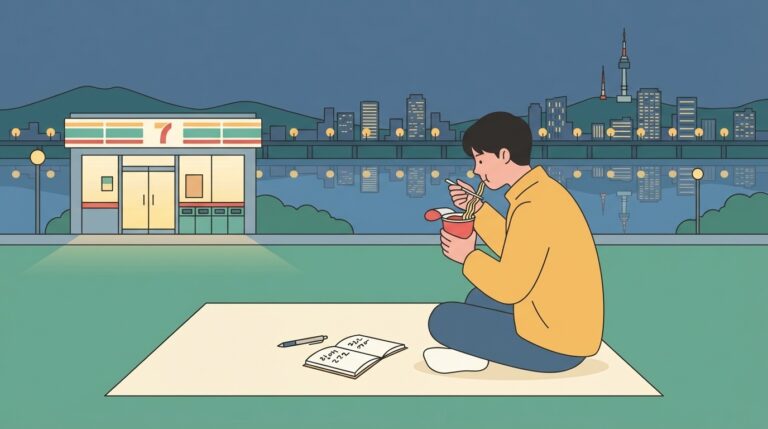
Picture this: It’s a Friday night in Seoul. The cool breeze is blowing off the Han River, the Banpo Bridge Rainbow Fountain is dancing in the background, and you’re sitting on a silver foil mat with your friends. Suddenly, a familiar scent wafts through the air—the spicy, savory, absolutely irresistible smell of Korean instant ramen. It’s a scene straight out of Hospital Playlist or your favorite K-Pop idol’s vlog.
But wait, you didn’t bring a mat. And you have no idea how to operate that futuristic silver ramen-making machine at the convenience store. Panic sets in. Do you just sit on the grass? Do you eat cold sandwiches instead?
Absolutely not! Eating 야식 (Late Night Snacks) at Hangang Park is a sacred ritual for Seoulites. It’s not just about eating; it’s about the vibe, the community, and the healing after a long week. Today, I’m going to share the exact phrases you need to conquer the Hangang Park ramen and picnic experience like a true local.
(Note: This guide is crafted from the real, slightly panicked questions of my B2 students who found themselves hungry and mat-less in Yeouido!)
Phase 2: Deep Dive into Core Expressions
1. 돗자리 하나 빌릴게요.
- Pronunciation: Dotjari hana billilgeyo. [Doat-jah-ree ha-nah beel-leel-ggeh-yo.]
- Meaning: I would like to rent one picnic mat. (Literal: I will borrow one mat.)
- K-Culture Moment: As soon as you exit the subway station near the Han River, you’ll see rows of vendors renting out mats, mood lights, and even mini-tables. You just walk up, point to the size you want, and say this magic phrase.
- Editor’s Insight: The word ‘빌리다’ means to borrow or rent. We rarely say ‘대여하다’ (to rent – formal) in casual, on-the-street transactions. It sounds too much like renting a car!
- Situation Spectrum:
- Convenience Store/Vendor (Casual/Polite): ✅
- Formal business rental: ⚠️
- 🤔 Think About It: Why do Koreans prefer to ‘rent’ mats rather than bring their own? It reflects the ‘Pali-pali’ (hurry) culture and the desire for extreme convenience. Spontaneous hangouts are huge here!
2. 우리 뽀글이 해 먹자!
- Pronunciation: Uri bbogeuri hae meokja! [Oo-ree bbaw-geu-ree heh mawk-jah!]
- Meaning: Let’s make Han River ramen!
- K-Culture Moment: You grab a foil bowl, put your ramen in, and push the button on the machine. The water boils, making a bubbly bbogeul-bbogeul sound. That’s where the cute slang 뽀글이 (Bbogeuli) comes from! It’s the ultimate comfort food phrase among friends.
- Editor’s Insight: If you say “라면 끓여 먹자” (Let’s boil ramen), it sounds like you are at home in your kitchen. If you say “뽀글이 해 먹자,” you instantly sound like you’ve lived in Seoul for five years.
- Situation Spectrum:
- Friends (Casual): ✅
- Close Coworkers (Semi-formal): ✅ (with ‘먹어요’)
- Boss/Elders (Formal): 🚫
- 🤔 Think About It: Ramyeon is technically a cheap, instant meal. But why does cooking it outside on a machine feel like a premium, romanticized experience in Korean media?
3. 배달존 2로 와주세요.
- Pronunciation: Baedal-jon i-ro wa-juseyo. [Bae-dal-joan ee-ro wah-joo-seh-yo.]
- Meaning: Please come to Delivery Zone 2.
- K-Culture Moment: You ordered fried chicken on the app, but Hangang Park is massive. Where does the driver go? Parks have designated 배달존 (Delivery Zones). This is where you meet the driver to claim your precious half-and-half chicken.
- Editor’s Insight: Delivery drivers are always in a rush. Giving them a clear, exact location is the ultimate form of modern Korean etiquette.
- Situation Spectrum:
- Delivery Driver (Polite): ✅
Phase 3: Textbook vs. Real Korean
[Renting a Mat from a Vendor]
* 📖 Textbook Korean: 돗자리를 대여하고 싶습니다. (I would like to rent a mat.)
* 🗣️ Real Korean: 돗자리 2인용 하나 얼마예요? (How much is one mat for two people?)
* 💡 Why the difference?: Street vendors prefer quick, efficient communication. Asking for the size and price directly skips the unnecessary formalities!
[Suggesting Ramen to a Friend]
* 📖 Textbook Korean: 편의점에서 라면을 사서 요리합시다. (Let’s buy ramen at the convenience store and cook it.)
* 🗣️ Real Korean: 한강 라면 국룰인 거 알지? 가자. (You know Han River ramen is an unspoken rule, right? Let’s go.)
* 💡 Why the difference?: 국룰 (Gung-nul) is a very common slang word meaning ‘National Rule’—an unspoken social consensus. Going to Hangang and NOT eating ramen is practically a crime in Seoul!
Bottom Note: For B2 learners, using words like 국룰 (National Rule) or 뽀글이 (Bubble Ramen) shows that you don’t just know the vocabulary; you know the culture.
Phase 4: Cultural Context — K-Culture Deep Dive
4-1. Non-Verbal Cues: The Art of “Mat Nunchi”
When finding a spot for your 돗자리 (mat), 눈치 (Nunchi) is crucial. Don’t place your mat too close to another group—Koreans value their personal “bubble” when relaxing. Also, when taking off your shoes to step onto the mat, leave them neatly aligned on the grass. Stepping on the mat with shoes is a huge cultural faux pas!
4-2. K-Food Connection: The Social Act of Sharing
In K-Dramas, eating ramen by the Han River isn’t just about hunger; it’s a plot device for bonding. When you make Bbogeuli, you usually buy one or two bowls and share them, along with triangle kimbap (삼각김밥) and sausages. Sharing food outdoors breaks down social barriers. Notice how coworkers who were stiff in the office suddenly become chatty older brothers/sisters (형/누나) over a bubbling bowl of spicy soup and some cold beer (치맥 – Chimaek).
Phase 5: Real-Life Roleplay Scenario
Setting: Yeouido Hangang Park, 8 PM on a Friday. The city lights are glittering. You and your friendly Korean coworker, Min-su, just found an empty spot on the grass.
Characters:
– YOU: An expat who has been working in Seoul for a few months. You really want to experience the authentic Hangang vibe.
– Min-su (30): Your fun, outgoing Korean coworker who promised to show you the “real Seoul.”
Dialogue:
민수: 야경 진짜 좋죠? 우리 돗자리부터 빌릴까요?
(Yagyeong jinjja jotjyo? Uri dotjaributeo billilkkayo?)
[The night view is great, right? Shall we rent a mat first?]
YOU: 네! 저기서 돗자리 하나 빌릴게요 하면 되나요?
(Ne! Jeogiseo dotjari hana billilgeyo hamyeon doenayo?)
[Yes! Do I just go over there and say ‘I’ll rent one mat’?]
민수: 맞아요! 센스 있네요. 제가 빌려올게요. 뭐 먹고 싶어요?
(Majayo! Senseu inneyo. Jaega billyeoolgeyo. Mwo meokgo sipeoyo?)
[Exactly! You’ve got sense. I’ll go rent it. What do you want to eat?]
YOU: 음… 한강에 왔으니까 뽀글이 해 먹자고 하고 싶었어요!
(Eum… Hangang-e wasseunikka bbogeuri hae meokjago hago sipeosseoyo!)
[Hmm… Since we are at the Han River, I wanted to say ‘Let’s make Bbogeuli’!]
민수: 하하! 뽀글이요? 한국 사람 다 됐네요! 그럼 제가 돗자리 세팅할 테니까, 편의점 가서 물 올려줄래요?
(Haha! Bbogeuriyo? Hanguk saram da dwaenneyo! Geureom jaega dotjari setinghal tenikka, pyeon-uijeom gaseo mul ollyeojullaeyo?)
[Haha! Bbogeuli? You’re basically Korean now! Then I’ll set up the mat, can you go to the convenience store and start boiling the water?]
🔀 Your Turn! How do you reply?
– A) 라면 기계 어떻게 써요? (How do I use the ramen machine?)
– B) 물을 올린다는 게 무슨 뜻입니까? (What does it mean to boil water?)
– C) 걱정 마세요! 제가 라면 기계 마스터예요. (Don’t worry! I’m a ramen machine master.)✅ Best Choice: A or C.
If you genuinely don’t know, ‘A’ is natural. But if you want to sound confident and fun, ‘C’ is perfect!
⚠️ Choice B Analysis: Way too formal and robotic for a casual night out. ‘물 올리다’ is a common idiom for starting to cook ramen or tea.
Phase 6: 10-Second Shadowing Drill
Let’s practice ordering the delivery. Speak it out loud!
📞 단호하지만 친절하게 (Firm but politely)
기사님 / 저 지금 / 배달존 2번 / 앞에 있어요. / 천천히 오세요!
(Gisanim / jeo jigeum / baedal-jon ibeon / ape isseoyo. / Cheoncheonhi oseyo!)
[Driver / I am currently / in front of Delivery Zone 2. / Please take your time!]
Phase 7: K-Culture Mini Dictionary
| Korean | Romanization | English | Context |
|---|---|---|---|
| 돗자리 | dotjari | Picnic Mat | Usually made of silver foil or colorful waterproof fabric. A must-have for outdoor sitting. |
| 뽀글이 | bbogeuri | Bubble Ramen | The affectionate nickname for convenience store machine-boiled ramen. |
| 치맥 | chimaek | Chicken & Beer | The holy trinity of Hangang: Chicken, Beer, and the river view. |
| 배달존 | baedal-jon | Delivery Zone | Numbered areas in parks where delivery riders drop off food. |
| 국룰 | gung-nul | Unspoken Rule | Slang for ‘National Rule’. Used when something is universally agreed upon. |
Phase 8: Traveler Survival Kit
🆘 Survival Expression #1
– 🇰🇷 “이거 한 시간에 얼마예요?” (Igeo han sigan-e eolmayeyo?)
– 🗣️ Pronunciation Guide: [Ee-gaw hahn shee-gahn-eh awl-mah-yeh-yo?]
– 📍 Where to use: Rental kiosks, bicycle rental spots, mat vendors.
– 💡 Pro Tip: Vendors usually rent mats for a fixed price (e.g., 5,000 KRW) for 3-4 hours, but it’s always good to confirm if there is a time limit!📌 Editor’s Travel Note
– Useful Apps: Yogiyo (요기요) or Baemin (배달의민족) for ordering food. KakaoMap to find the exact location of the ‘Delivery Zones’.
– Trash Etiquette: Hangang Parks have massive recycling stations. DO NOT throw leftover ramen soup in the regular trash. There is a specific bucket labeled “음식물 쓰레기” (Food Waste) or “남은 국물 버리는 곳” (Leftover soup disposal).
– Alcohol: Drinking outside is perfectly legal in Korea! Just grab some canned beer from the convenience store. Just remember to keep it peaceful and clean up afterward.
Phase 9: Critical Thinking Corner — “한 발 더 깊이”
Food & Identity: The Healing Power of Communal Eating
🧠 Think Deeper:
Why do Koreans, who have perfectly good dining tables at home and thousands of fancy restaurants in Seoul, flock to the Han River to eat cheap instant ramen on the floor? It goes deeper than just the taste. In the high-pressure, fast-paced society of Korea, the Han River represents an egalitarian escape.When you sit on a cheap dotjari and share a bubbling foil bowl of bbogeuli, social hierarchies flatten. A CEO and a college student are doing the exact same thing. It is the ultimate manifestation of 정 (Jeong – collective affection). The act of sharing food outdoors is a collective exhale—a moment of democratic healing in a hyper-competitive city.
💬 Your Turn: Does your culture have a specific food or activity that everyone does to “escape” the stress of the city? Let me know in the comments!
Phase 10: FAQ & Avoiding Misunderstandings
Q: “Can I ask a stranger if I can share their mat?”
No! Unlike a crowded pub where sharing tables might happen, a dotjari is considered an extension of personal space. Never step on someone else’s mat or ask to share it unless invited.
Q: “When ordering delivery, how do I explain where I am if I can’t find a Delivery Zone?”
Look around for large landmarks. You can say, “미니스톱 편의점 오른쪽 잔디밭이에요” (I’m on the grass to the right of the Ministop convenience store).
❌ Common Mistake #1: Throwing the ramen container away with the soup still inside.
✅ How to fix it: Always pour the liquid into the designated liquid disposal barrel before recycling the bowl!
Phase 11: Summary & Action Items
One-Liner Summary: Rent a dotjari, boil some bbogeuli, and find the baedal-jon to master the ultimate Hangang Park late-night snack experience!
Action Mission 3단계:
– 🥉 Bronze (Solo): Say “우리 뽀글이 해 먹자!” three times to yourself in the mirror, pretending you are in a K-Drama.
– 🥈 Silver (Online): Go to a K-Pop vlog where idols are at the Han River and try to spot the word 돗자리 or 배달 in the Korean subtitles.
– 🥇 Gold (Real-world): Next time you are in Seoul, go to Banpo or Yeouido Hangang Park, rent a mat in Korean, and make your own machine ramen!
K-Culture Mission:
Open Google Street View, drop yourself in Yeouido Hangang Park, and try to locate a convenience store and a “Delivery Zone” sign. Imagine yourself walking up and ordering your late-night snack!
Did you know about the Hangang ramen machines before this? What’s your favorite ramen flavor? Tell me in the comments below! 👇
Phase 12: Quiz — Interactive Challenge
1. Situational Judgment:
You are at Hangang Park, and you want to sit on the grass with your friends. You walk up to a vendor. What is the most natural thing to say?
– A) 돗자리 하나 빌릴게요.
– B) 돗자리 대여를 허락해 주십시오.
– C) 잔디밭에 앉고 싶습니다.
2. Fill in the Blank:
The slang term for ramen boiled in a foil bowl at the Han River convenience store is called ( _______ ).
3. True or False – K-Culture Edition:
“It is illegal to drink beer outside at Hangang Park.”
4. Roleplay Application:
In Phase 5, if your coworker Min-su says “물 올려줄래요?” (Can you put the water on?), what is he actually asking you to do?
– A) Go swimming in the river.
– B) Pour water on the grass.
– C) Start boiling water for the ramen.
(Answers: 1. A / 2. 뽀글이 (Bbogeuli) / 3. False – it is perfectly legal and popular! / 4. C)
Frequently Asked Questions (FAQ)
Q: What does "돗자리 하나 빌릴게요." mean in Korean and how do you pronounce it?
A: In Korean, "돗자리 하나 빌릴게요." is pronounced [Dotjari hana billilgeyo. [Doat-jah-ree ha-nah beel-leel-ggeh-yo.] and means: I would like to rent one picnic mat. (Literal: I will borrow one mat.)
Q: What does "우리 뽀글이 해 먹자!" mean in Korean and how do you pronounce it?
A: In Korean, "우리 뽀글이 해 먹자!" is pronounced [Uri bbogeuri hae meokja! [Oo-ree bbaw-geu-ree heh mawk-jah!] and means: Let's make Han River ramen!
Q: What does "배달존 2로 와주세요." mean in Korean and how do you pronounce it?
A: In Korean, "배달존 2로 와주세요." is pronounced [Baedal-jon i-ro wa-juseyo. [Bae-dal-joan ee-ro wah-joo-seh-yo.] and means: Please come to Delivery Zone 2.







