

Phase 1: Welcome to the Canvas of K-Culture 🎨
Hello there! I’m your Daily Hangul Editor.
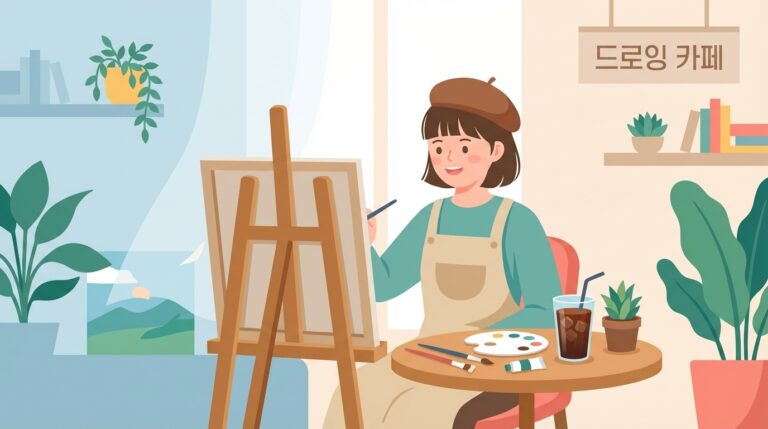
Imagine this: You’re walking down a trendy alley in Seongsu-dong or Hongdae. You peek through a large glass window and see couples and friends wearing cute aprons and berets, holding paintbrushes, and sipping iced Americanos. Wait, is it an art school? No, it’s a ‘Drawing Cafe’ (드로잉 카페)—one of the hottest hangout spots for young Koreans!
Whether you’re recreating a scene from Our Beloved Summer (where the main character is a talented illustrator), reading the latest hit K-Webtoon, or just trying to explain your weekend hobbies to your new Korean language exchange partner, knowing how to talk about drawing (그림 그리기) is a fantastic icebreaker.
But if you just rely on textbooks, you might sound like a robot taking an art exam. Today, I’m going to teach you how to talk about your artistic side like a true Seoulite, complete with the perfect reactions when you see someone else’s masterpiece (or a potato that’s supposed to be a cat).
Let’s grab our brushes and paint some words!
Phase 2: Core Expressions Deep Dive
1. 그림을 그려요 (I draw / I am drawing)
- Pronunciation: [geu-ri-meul / geu-ryeo-yo]
- Sound-alike guide: ‘geu’ sounds like the ‘g’ in ‘good’ followed by the ‘uh’ sound you make when you step in a puddle.
- Meaning: Literally “I draw a picture” or “I am drawing a picture.”
- K-Culture Moment: If someone asks “What did you do this weekend?” (주말에 뭐 했어요?), answering “카페에서 그림을 그렸어요” (I drew pictures at a cafe) instantly makes you sound aesthetic and trendy.
- Editor’s Insight: In English, you can just say “I draw.” But in Korean, we love our object-verb pairs. We almost always say “draw a picture” (그림을 그리다). Just like we say “sleep a sleep” (잠을 자다).
- Situation Spectrum:
- 친구 사이 (Casual): ✅ (그림 그려 – geurim geuryeo)
- 직장 동료 (Semi-formal): ✅ (그림을 그려요)
- 직장 상사·어른 (Formal): ✅ (그림을 그립니다)
- 🤔 Think About It: Why do you think Korean uses so many “Noun + Verb” pairs like “draw a picture” instead of just “draw”? Does your native language have redundant phrases like this?
2. 취미가 그림 그리기예요 (My hobby is drawing)
- Pronunciation: [chwi-mi-ga / geu-rim / geu-ri-gi-ye-yo]
- Meaning: My hobby is drawing.
- K-Culture Moment: You’re on a Sogaeting (소개팅 – blind date) in Korea. The awkward silence hits. You ask about hobbies, and they say this. It’s a very common, gentle hobby to share!
- Editor’s Insight: ‘취미’ (chwimi) means hobby. To turn the verb “draw” (그리다) into the noun “drawing,” we attach ‘기’ (gi) to the end. It’s like adding “-ing” in English!
- Situation Spectrum:
- 친구 사이 (Casual): ✅ (취미가 그림 그리기야)
- 직장 동료 (Semi-formal): ✅ (취미가 그림 그리기예요)
- 직장 상사·어른 (Formal): ⚠️ (취미는 그림 그리기입니다 sounds better here)
- 🤔 Think About It: Sharing hobbies is a key way Koreans build jeong (정 – emotional connection). What hobby would you most want to share with a new Korean friend?
3. 우와, 정말 잘 그렸어요! (Wow, you drew it so well!)
- Pronunciation: [u-wa, / jeong-mal / jal / geu-ryeot-seo-yo!]
- Meaning: Wow, you are really good at drawing! (Literally: You drew it really well!)
- K-Culture Moment: Koreans are the kings and queens of Reaction (리액션). If your friend shows you a quick doodle they made on a napkin, you must gasp softly and say this phrase to hype them up!
- Editor’s Insight: ‘잘’ (jal) means ‘well’. Put it right before the verb. It’s much more natural than saying “You are a good artist” in Korean.
- Situation Spectrum:
- 친구 사이 (Casual): ✅ (진짜 잘 그렸다!)
- 직장 동료 (Semi-formal): ✅ (정말 잘 그렸어요!)
- 직장 상사·어른 (Formal): ⚠️ (그림 솜씨가 좋으시네요 – Your drawing skills are good!)
- 🤔 Think About It: In Korean culture, giving a good, enthusiastic reaction is considered a form of politeness and good social skills. How do people react to compliments in your culture?
Phase 3: Textbook vs. Real Korean
Let’s see how people actually talk when admiring art.
[Situation 1: Complimenting someone’s amazing art skills]
* 📖 Textbook Korean: 당신은 그림을 아주 잘 그립니다. (You draw pictures very well.)
* 🗣️ Real Korean: 와 대박! 완전 금손이네요! (Wa daebak! Wanjeon geumsonineyo! – Wow awesome! You totally have golden hands!)
* 💡 Why the difference?: ‘금손’ (Geumson – Gold hands) is massive internet slang that has crossed into daily life. It means someone is incredibly skilled with their hands (drawing, cooking, makeup). Conversely, ‘똥손’ (Ttongson – Poop hands) means you are terrible at it!
[Situation 2: Responding to a compliment about your drawing]
* 📖 Textbook Korean: 네, 감사합니다. (Yes, thank you.)
* 🗣️ Real Korean: 에이~ 아니에요. 그냥 취미예요. (Ey~ anieyo. Geunyang chwimiyeyo. – Oh no~ It’s nothing. Just a hobby.)
* 💡 Why the difference?: Modesty is a virtue in Korea. Even if you are the next Picasso, you must initially deny the compliment to show humility before accepting it.
Bottom Note: For A2 learners, using “에이~ 아니에요” with a shy smile will make Koreans incredibly impressed by your cultural fluency!
Phase 4: Cultural Context — K-Culture Deep Dive
4-1. The Non-verbal “Modesty Wave”
When someone tells you “정말 잘 그렸어요!” (You drew it so well!), don’t just say “Thank you” and stare blankly. Use the Modesty Wave. Raise your hand in front of your face (palm facing out) and gently wave it side to side while saying “에이~ 아니에요” (No, it’s not). This physical gesture screams, “Oh stop it, I’m not that good!” It’s a crucial part of reading the room (Nunchi).
4-2. The “Drawing Cafe” (드로잉 카페) Date Culture
If you watch K-Dramas, you might notice couples doing activities rather than just sitting and talking. Making perfume, baking, and yes, Drawing Cafes are top-tier dating spots in Seoul.
You pay around 20,000 to 30,000 KRW, get an easel, a canvas, acrylic paints, an aesthetic apron, and a coffee. It’s designed to be Instagram-worthy. It takes the pressure off making constant conversation because you are focused on the art. Next time you travel to Korea, search for “드로잉 카페” on Naver Maps—it’s a perfect rainy-day activity!
Phase 5: Real-life Roleplay Scenario
- Setting: A cozy Drawing Cafe in Yeonnam-dong. You are wearing a beige apron, holding a palette smeared with paint. You are painting a picture of your dog.
- Characters:
- YOU: An A2 Korean learner, trying your best to paint and speak.
- Minji (28): Your Korean language exchange partner. She is very encouraging and loves making big reactions.
Minji: 우와, 그거 강아지예요? 너무 귀여워요! 🐶
(Uwa, geugeo gangajiyeyo? Neomu gwiyeowoyo!)
[Wow, is that a puppy? So cute!]
YOU: 네, 제 강아지 맥스예요.
(Ne, je gangaji maekseuyeyo.)
[Yes, it’s my dog, Max.]
Minji: 그림 진짜 잘 그리네요! 완전 금손!
(Geurim jinjja jal geurineyo! Wanjeon geumson!)
[You draw really well! Total golden hands!]
(🎭 Stage Direction: Minji claps her hands together, looking genuinely impressed.)
🔀 Your Turn! How should you respond to Minji’s compliment?
– A) “네, 저는 그림을 아주 잘 그립니다.” (Yes, I draw pictures very well.)
– B) “에이~ 아니에요. 맥스가 더 예뻐요.” (Oh~ no. Max is prettier.)
– C) “알아요. 감사합니다.” (I know. Thank you.)✅ Best Choice: B — This uses the Korean modesty culture beautifully. You politely deflect the compliment while keeping the conversation warm.
⚠️ Choice A & C Analysis: They sound arrogant in Korean culture. While confidence is good, in everyday Korean social situations, starting with a humble “No, no” makes you much more likable.
YOU (Choosing B): 에이~ 아니에요. 그냥 취미예요.
(Ey~ anieyo. Geunyang chwimiyeyo.)
[Oh~ no. It’s just a hobby.]
Minji: 저도 그림 그리는 거 좋아해요. 근데 저는 똥손이에요 ㅠㅠ
(Jeodo geurim geurineun geo joahaeyo. Geunde jeoneun ttongsonieyoㅠㅠ)
[I like drawing too. But I have poop hands (bad at drawing) ㅠㅠ]
YOU: 하하, 아니에요. 민지 씨 그림도 멋있어요!
(Haha, anieyo. Minji ssi geurimdo meosisseoyo!)
[Haha, no. Your drawing is cool too, Minji!]
Phase 6: 10-Second Shadowing Drill
Let’s practice the perfect compliment. Pay attention to the pauses (/) and the emotion!
😊 우와! / 진짜 / 잘 그렸어요!
(u-wa! / jin-jja / jal geu-ryeot-seo-yo!)
Translation: Wow! You drew it really well!
Tip: Stretch out the “진짜” (jin~jja) slightly to show genuine amazement!
Phase 7: K-Culture Mini Dictionary
| Korean | Romanization | English | Context |
|---|---|---|---|
| 금손 | geumson | Golden hands | Slang for someone who is exceptionally skilled at art, crafting, or even gaming. |
| 똥손 | ttongson | Poop hands | Slang for someone who is clumsy or terrible at drawing/making things. Use it playfully about yourself! |
| 웹툰 | weptun | Webtoon | Korean digital comics optimized for scrolling on smartphones. A massive inspiration for modern artists. |
| 앞치마 | apchima | Apron | Essential vocabulary if you visit a drawing cafe or a Korean BBQ restaurant! |
Phase 8: Traveler’s Survival Kit (Drawing Cafe & Hobbies)
If you visit a Drawing Cafe in Seoul, you’ll need to know how to ask for help when your paint dries out or you need a new brush.
🆘 Survival Phrases for the Cafe
– 🇰🇷 “물감 좀 더 주세요.” (mulgam jom deo juseyo.)
– 🗣️ Pronunciation: [mool-gam johm duh joo-seh-yo]
– 💡 Meaning: Please give me some more paint.
- 🇰🇷 “이거 어떻게 해요?” (igeo eotteoke haeyo?)
- 🗣️ Pronunciation: [ee-guh uh-ttuh-keh hae-yo]
- 💡 Meaning: How do I do this? (Great for asking the staff how to set up the canvas).
📌 Editor’s Travel Note
– Booking: Many popular drawing cafes in Seongsu or Hongdae require reservations via Naver Maps (네이버 지도).
– Time Limit: Usually, you are given 2 hours to complete your painting. They might politely let you know when your time is almost up!
Phase 9: Critical Thinking — “One Step Deeper”
🧠 Think Deeper: Modesty vs. Confidence (언어와 권력 & 정체성)
In Western cultures, when someone says “You’re a great artist,” the standard polite response is to own it: “Thank you so much! I worked hard on it.” However, in Korean culture, language is built around maintaining group harmony and not elevating oneself above others. This is why phrases denying a compliment (아니에요 – It’s not) are so deeply embedded in the language. It’s not that Koreans lack confidence; it’s that humility is the socially agreed-upon script for politeness. By lowering yourself slightly, you elevate the person you are talking to.
💬 Your Turn: How do people in your culture react to compliments about their hobbies or skills? Do you say “Thank you” or do you play it down? Let me know in the comments!
Phase 10: FAQ & Avoiding Common Mistakes
Q: Can I use “금손” (Geumson / Golden hands) to my older boss?
Maybe, but with caution. It’s slang. If your boss is cool and you are close, you can say “부장님, 완전 금손이시네요!” (Manager, you really have golden hands!). But to be safe, use “그림 솜씨가 정말 좋으시네요” (Your drawing skills are really good).
Q: Can I just say “그려요” instead of “그림을 그려요”?
Yes, but… native speakers heavily prefer adding the object “그림” (picture). If you just say “그려요”, they might pause and think, “Draw what?”
❌ Common Mistake #1: Confusing writing and drawing.
– “I write a letter” -> 편지를 써요 (sseoyo).
– “I draw a picture” -> 그림을 그려요 (geuryeoyo).
Please don’t say “글씨를 그려요” (I draw letters) unless you are literally doing calligraphy!
Phase 11: Summary & Action Missions
One-Liner Summary: To sound like a true Korean when talking about art, say “취미가 그림 그리기예요” and always react to others’ work with a humble “우와, 잘 그렸어요!”
Your Action Missions for Today:
* 🥉 Bronze (Solo): Look at a painting or a webtoon on your phone and say “진짜 잘 그렸다!” out loud.
* 🥈 Silver (Online): Leave a comment in Korean on your favorite artist’s Instagram or K-Webtoon: “우와, 그림 너무 예뻐요! 금손이네요!”
* 🥇 Gold (Real Life): Next time you meet a Korean friend, ask them: “취미가 뭐예요? 그림 그리는 거 좋아해요?” (What is your hobby? Do you like drawing?)
🎨 K-Culture Mission: Go to YouTube or Naver and search for “서울 드로잉 카페 브이로그” (Seoul Drawing Cafe Vlog). Watch how Koreans spend their time there, and listen for the words we learned today!
Phase 12: Interactive Quiz
Let’s test your inner artist!
1. You are at a drawing cafe. Your friend shows you a beautiful painting they just finished. What is the most natural Korean reaction?
A) 당신은 그림을 잘 그립니다.
B) 우와, 진짜 잘 그렸어요!
C) 에이~ 아니에요.
2. True or False: If a Korean says they have ‘똥손’ (poop hands), it means their hands are dirty.
True / False
3. Fill in the blank: My hobby is drawing.
취미가 그림 _________예요.
(Answers: 1. B, 2. False – It means they are bad at drawing/crafting, 3. 그리기)
How did you do? Ready to unleash your inner Picasso in Korean? If you have any questions, drop them in the comments below! See you in the next lesson! 🎨☕️
Frequently Asked Questions (FAQ)
Q: What does "그림을 그려요 (I draw / I am drawing)" mean in Korean and how do you pronounce it?
A: In Korean, "그림을 그려요 (I draw / I am drawing)" is pronounced [geu-ri-meul / geu-ryeo-yo] and means: a key conversational Korean expression covered in this lesson.
Q: What does "취미가 그림 그리기예요 (My hobby is drawing)" mean in Korean and how do you pronounce it?
A: In Korean, "취미가 그림 그리기예요 (My hobby is drawing)" is pronounced [chwi-mi-ga / geu-rim / geu-ri-gi-ye-yo] and means: My hobby is drawing.
Q: What does "우와, 정말 잘 그렸어요! (Wow, you drew it so well!)" mean in Korean and how do you pronounce it?
A: In Korean, "우와, 정말 잘 그렸어요! (Wow, you drew it so well!)" is pronounced [u-wa, / jeong-mal / jal / geu-ryeot-seo-yo!] and means: Wow, you are really good at drawing! (Literally: You drew it really well!)







