

Phase 1: Welcome to the “Family” 🇰🇷
Hello there! I’m your lead editor from Daily Hangul.
Picture this: You’re watching your favorite K-Drama. The main character walks into a cozy, rundown traditional soup restaurant (gukbap-jib). She smiles brightly at the elderly woman stirring the massive pot and yells, “Halmeoni! One bowl of soup, please!”
The subtitles say “Grandma.” But wait… is the restaurant owner actually her grandmother?
Spoiler alert: Probably not! In Korea, family terms like Grandfather (할아버지) and Grandmother (할머니) aren’t just for your blood relatives. They are titles, terms of endearment, and sometimes, a cultural minefield!
If you use these words correctly, you’ll instantly unlock the warm, affectionate side of Korean culture. But if you call the wrong person “Grandma,” you might accidentally offend them by making them feel old. Let’s dive into the fascinating world of Korean elderly terms so you can navigate Seoul like a true local!
(Note: This guide is based on real moments my beginner students faced when traveling in Korea or watching K-Dramas!)
Phase 2: Core Expressions Deep Dive
Let’s master the 3 most essential words you need when talking about (or to) elderly people in Korea.
1. 할아버지 (Grandfather)
- Pronunciation: [hal-a-beo-ji] / Sounds like: “hal-ah-buh-jee”
- Meaning: Grandfather (Literal) / Elderly man (Real nuance)
- K-Culture Moment: Think of the classic K-Drama “Chairman” (회장님). The strict but secretly soft-hearted rich grandpa who eventually accepts his grandson’s poor but cheerful girlfriend.
- Editor’s Insight: You use this for your actual grandpa. You can use it for a very elderly man on the street, but be careful—he must look visibly over 70. If he looks 50 or 60, use “Ajeossi” (Middle-aged man) instead!
- Situation Spectrum:
- Your actual family: ✅
- Very elderly man at a park: ✅
- A 55-year-old taxi driver: 🚫 (Major offense!)
- 🤔 Think About It: Why do Koreans use family terms for strangers? Does your native language have a way to make strangers feel like family?
2. 할머니 (Grandmother)
- Pronunciation: [hal-meo-ni] / Sounds like: “hal-muh-nee”
- Meaning: Grandmother (Literal) / Elderly woman (Real nuance)
- K-Culture Moment: The “Neighborhood Grandma” in K-Dramas who always gives the main characters extra food and good life advice.
- Editor’s Insight: This word feels very warm. However, modern Korean women in their 50s and 60s are very stylish and young at heart! Calling them “Halmeoni” might make them glare at you. When in doubt at a restaurant, call them 사장님 (Sa-jang-nim), which means “Boss/Owner.”
- Situation Spectrum:
- Your actual family: ✅
- Very elderly woman at a traditional market: ✅
- A stylish 60-year-old cafe owner: ⚠️ (Use Sajangnim instead!)
- 🤔 Think About It: Is youth highly valued in your culture? How do people react to aging?
3. 어르신 (Elder / Senior)
- Pronunciation: [eo-reu-sin] / Sounds like: “uh-roo-shin”
- Meaning: Respected elder (Literal) / Polite way to address an older stranger (Real nuance)
- K-Culture Moment: When a K-Pop idol is doing a volunteer show or visiting a rural village, they will respectfully address the older locals as “Eoreusin” to show maximum respect and good manners.
- Editor’s Insight: This is your “Get Out of Jail Free” card. If you need to talk to an older person but you’re scared “Halmeoni/Halabeoji” will offend them, use Eoreusin. It sounds incredibly respectful and shows you really know your Korean manners!
- Situation Spectrum:
- Your actual family: 🚫 (Too formal/distant)
- Older stranger on the subway: ✅
- An elderly customer at your store: ✅
- 🤔 Think About It: The word Eoreusin comes from the root “to be grown up/mature.” How does language shape our respect for older generations?
Phase 3: Textbook vs. Real Korean
| Situation | 📖 Textbook Korean | 🗣️ Real Korean | 💡 Why is it different? |
|---|---|---|---|
| Addressing an older male restaurant owner | 할아버지 (Hal-a-beo-ji) | 사장님 (Sa-jang-nim) | “Boss” is safer and more professional. It avoids the age issue entirely! |
| Giving up your seat on the subway to an elder | 할머니, 앉으세요. (Hal-meo-ni, sit down.) | 여기 앉으세요. (Yeo-gi an-jeu-se-yo. – Please sit here.) | Koreans often drop the pronoun/title completely to be polite but indirect. |
| Talking about your grandparents to a friend | 저희 할아버지예요. (Jeo-hui hal-a-beo-ji-ye-yo.) | 우리 할아버지예요. (U-ri hal-a-beo-ji-ye-yo. – Our grandpa) | Koreans use “Our” (Uri) instead of “My” to show collective community spirit! |
Phase 4: Cultural Context — K-Culture Deep Dive
4-1. The Non-Verbal “Nunchi” (눈치)
When interacting with a Halabeoji or Halmeoni in Korea, your body language is just as important as your words:
– The Two-Hand Rule: If an elderly vendor hands you your change or a bag of street food, ALWAYS receive it with both hands (or your right hand supported by your left hand).
– The Bow: A slight head bow (about 15-30 degrees) when greeting or saying thank you is a must.
4-2. K-Food Connection: The “Grandma” Guarantee
If you travel to Korea, you will see countless restaurants with signs like “원조 할머니 국밥” (Original Grandma’s Soup) or “할머니 떡볶이” (Grandma’s Tteokbokki).
Why? In Korea, a grandmother represents Son-mat (손맛 – literal translation: “hand taste”). It means the secret, unwritten recipe and the loving, generous portions that only a grandmother can provide. If a restaurant has “Halmeoni” in the name, Koreans automatically assume the food will be comforting, authentic, and hearty.
Critical View: While “Grandma’s food” is a beloved concept, it also reflects traditional gender roles where women of that generation spent most of their lives in the kitchen. Today, younger generations appreciate this but are shifting toward more balanced family dynamics.
Phase 5: Real-Life Roleplay Scenario
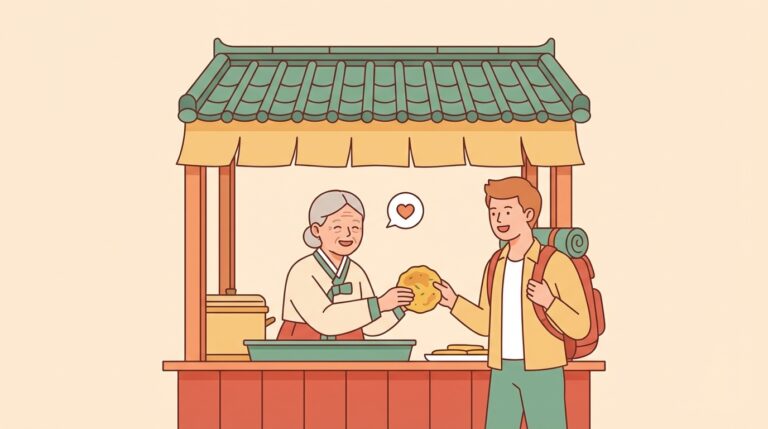
Setting: Gwangjang Market in Seoul, 2:00 PM. The air smells like sizzling oil and savory pancakes. You are sitting on a small wooden bench with your Korean friend, Min-su. Behind the grill is a sweet-looking elderly woman who just gave you an extra piece of Bindaetteok (mung bean pancake) for free!
Characters:
– YOU: A hungry traveler who loves Korean food.
– Min-su (28): Your helpful Korean friend.
– Owner (75): The warm-hearted stall owner.
Dialogue:
Owner: 외국인 친구 예뻐서 하나 더 주는 거야. 많이 먹어~ 🥞
(Oegugin chingu yeppeoseo hana deo juneun geoya. Mani meogeo~)
[English] I’m giving you one more because the foreign friend is pretty/handsome. Eat a lot~
(🎭 Stage Direction: The owner places a huge extra pancake on your plate with a warm smile)
Min-su: 우와! 너 진짜 운 좋다. 빨리 감사하다고 해!
(Uwa! Neo jinjja un jota. Ppalli gamsahadago hae!)
[English] Wow! You’re so lucky. Quickly say thank you!
🔀 Your Turn! How should you respond?
– A) “할머니! 감사합니다!” (Hal-meo-ni! Gam-sa-ham-ni-da!)
– B) “아줌마! 땡큐!” (A-jum-ma! Thank you!)
– C) “사장님! 잘 먹겠습니다!” (Sa-jang-nim! Jal meok-get-seum-ni-da!)✅ Best Choice: C or A.
– Why C is great: “Sajangnim (Boss)” is always polite and safe, and “Jal meok-get-seum-ni-da (I will eat well)” is the perfect phrase before eating.
– Why A is okay here: Because it’s a traditional market and she is visibly elderly and acting affectionately (like a grandma), calling her “Halmeoni” affectionately is totally fine and charming here!
– ⚠️ Choice B Analysis: “Ajumma” can be considered rude to older women nowadays, and combining it with casual English might seem disrespectful to an elder.
Phase 6: 10-Second Shadowing Drill
Let’s practice speaking! Follow the slash (/) for pauses and the emojis for emotion.
😊 우리 / 할머니는 / 요리를 / 정~~~말 / 잘하세요!
(u-ri / hal-meo-ni-neun / yo-ri-reul / jeong~~~mal / jal-ha-se-yo!)
[English] My grandmother is really good at cooking!
🥺 할아버지, / 건강하세요!
(hal-a-beo-ji, / geon-gang-ha-se-yo!)
[English] Grandfather, please stay healthy! (A great phrase for New Year’s or saying goodbye)
Phase 7: K-Culture Mini Dictionary
| Korean | Romanization | English | Context/Explanation |
|---|---|---|---|
| 정 | jeong | Affection/Warmth | The invisible bond of love and connection in Korean society. Grandmas giving extra food is pure jeong. |
| 덤 | deom | Extra / Bonus | When a market vendor gives you a little extra food for free. |
| 효도 | hyo-do | Filial piety | The duty of taking care of your parents and grandparents. It’s a core value in Korean culture. |
| 어르신 | eo-reu-sin | Respected elder | The safest, most polite word for an older stranger. |
Phase 8: Traveler Survival Kit 🧳
If you’re traveling in Korea, you will definitely interact with elderly people—they run many traditional shops, markets, and taxis. Here are your A1 survival phrases!
🆘 Survival Expression #1: Asking the Price
– 🇰🇷 “이거 얼마예요?” (i-geo eol-ma-ye-yo?)
– 🗣️ Sound: “ee-guh uhl-mah-yeh-yo?”
– 📍 Where to use: Traditional markets, street vendors.
– 💡 Pro Tip: Elderly vendors might not speak English numbers. If you don’t understand their Korean reply, politely hand them your phone with the calculator app open!🆘 Survival Expression #2: Polite Refusal
– 🇰🇷 “아니요, 괜찮습니다.” (a-ni-yo, gwaen-chan-seum-ni-da.)
– 🗣️ Sound: “ah-nee-yo, gwen-chan-seum-nee-dah”
– 📍 Where to use: When an elderly vendor offers you something you don’t want to buy, or a taxi driver asks a personal question.
– 💡 Pro Tip: Smile and slightly bow your head while saying this. It softens the “No.”
📌 Editor’s Travel Note:
– Giving up your seat: On Korean subways, the seats at the very ends of the train are strictly reserved for the elderly, pregnant women, and the disabled. Even if the train is packed, young people leave these seats empty for the Halabeoji and Halmeoni!
Phase 9: Critical Thinking Corner — “A Step Deeper”
🧠 Think Deeper: The “We” Culture (Community vs. Individual)
In English, you say “My grandfather” or “My grandmother.” But in Korean, you almost always say “우리 할아버지” (Uri halabeoji – Our grandfather), even if you are an only child speaking to a friend! This reflects Korea’s deep-rooted communal identity. Historically, villages operated like extended families. By calling someone “Our Grandma,” Koreans linguistically bring everyone into their inner circle. It shows that the family unit is the core lens through which Koreans view the entire world.
💬 Your Turn: Does your language use “My” or “Our” when talking about family? How does your culture view the line between “family” and “strangers”? Share in the comments!
Phase 10: FAQ & Avoiding Misunderstandings
Q: My Korean language partner is 10 years older than me. Can I call them Halabeoji/Halmeoni as a joke?
A: NO! Unless you are extremely close and they have a great sense of humor, age is a sensitive topic. Use 오빠/형 (older brother) or 언니/누나 (older sister) instead.
Q: I saw a K-Pop idol call an older lady ‘Eomeoni’ (Mother). Is that okay?
A: Yes! ‘Eomeoni’ (Mother) or ‘Abeojeoni’ (Father) are also used for older adults, usually in their 50s-60s. It’s polite, but as a beginner, stick to Sajangnim (Boss) at shops to be completely safe.
❌ Common Mistake #1: Calling a woman in her 50s “Halmeoni.”
✅ Do this instead: Call her “사장님” (Sajangnim – Boss) if she runs a shop, or “이모님” (Imo-nim – Auntie) if it’s a casual, traditional restaurant.
Phase 11: Summary & Action Items
One-Liner Summary: “Halabeoji” and “Halmeoni” mean Grandpa and Grandma, but use “Sajangnim” or “Eoreusin” for strangers to show respect without mentioning age!
Action Mission 3 Steps:
– 🥉 Bronze (Solo): Say “Uri Halmeoni” (Our Grandma) and “Uri Halabeoji” (Our Grandpa) out loud 3 times right now.
– 🥈 Silver (Online): Find a picture of your favorite K-Drama grandparent character and post it on your study app with the caption “최고의 할아버지/할머니!” (The best Grandpa/Grandma!).
– 🥇 Gold (Real World): Next time you go to a Korean restaurant, use both hands to receive your receipt and say “감사합니다” (Thank you) with a slight bow!
🎬 K-Culture Mission:
Watch one episode of the famous K-Drama “Navillera” or “Reply 1988.” Count how many times you hear the words “Halmeoni” or “Halabeoji”!
Phase 12: Quiz — Interactive Challenge
1. Situational Judgment: You are at a trendy cafe in Seoul. The owner is a stylish woman who looks about 60 years old. You want to order an Iced Americano. How should you get her attention?
– A) “할머니! 아아 주세요!” (Grandma! Iced Americano please!)
– B) “사장님! 아아 주세요!” (Boss! Iced Americano please!)
– C) “어르신! 아아 주세요!” (Elder! Iced Americano please!)
2. True or False – K-Culture Edition:
In Korea, it is completely normal to sit in the reserved elderly seating on the subway as long as no elderly person is around.
– A) True
– B) False
Answers:
1. B is correct. She is working at a trendy cafe, so “Sajangnim” is professional and safe. “Halmeoni” might offend her, and “Eoreusin” is too formal for a cafe setting!
2. False. Even if the train is completely packed, young Koreans will stand and leave the elderly priority seats (usually at the very ends of the train car) completely empty out of respect.
Frequently Asked Questions (FAQ)
Q: What does "할아버지 (Grandfather)" mean in Korean and how do you pronounce it?
A: In Korean, "할아버지 (Grandfather)" is pronounced [hal-a-beo-ji] and means: Grandfather (Literal) / Elderly man (Real nuance)
Q: What does "할머니 (Grandmother)" mean in Korean and how do you pronounce it?
A: In Korean, "할머니 (Grandmother)" is pronounced [hal-meo-ni] and means: Grandmother (Literal) / Elderly woman (Real nuance)
Q: What does "어르신 (Elder / Senior)" mean in Korean and how do you pronounce it?
A: In Korean, "어르신 (Elder / Senior)" is pronounced [eo-reu-sin] and means: Respected elder (Literal) / Polite way to address an older stranger (Real nuance)






