

Phase 1: Empathy (Immersive Opening)
Hello! I’m your Daily Hangul Editor.
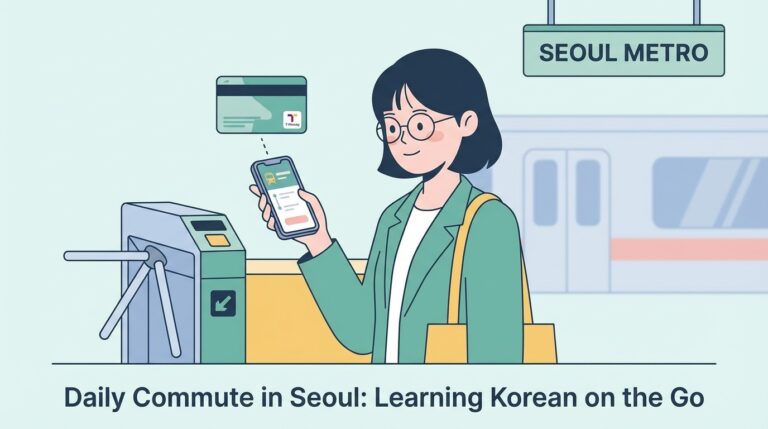
Picture this: It’s 6:30 PM at Gangnam Station. A scene straight out of a K-Drama like My Liberation Notes (나의 해방일지). Office workers are pouring out of high-rises, looking utterly exhausted. But watch closely as they approach the subway turnstile. They don’t just tap their cards; they pull out their smartphones, open a specific app, and click a button that says ‘Departure’ (출발). What are they doing? Are they reporting their location to a strict boss?
Not quite! They are meticulously engaging in the modern Korean art of Jjantech (짠테크)—frugal tech. By tracking their walking distance to the subway station, they accumulate mileage on their Altteul Transportation Card (알뜰교통카드) or the newer K-Pass (K-패스).
For an advanced (C2) Korean learner, simply knowing how to say ‘How much is the bus fare?’ is no longer enough. If you truly want to blend into a Korean office environment or converse with locals navigating the high cost of living in Seoul, you need to speak the language of ‘mileage,’ ‘rebates,’ and ‘financial defense.’ This guide is built on the real, everyday survival conversations of Seoulites. Let’s dive into the highly nuanced vocabulary of the Korean commute!
Phase 2: Deep Dive into Core Expressions
1. 쏠쏠하다 (ssolsolhada)
- Pronunciation: [ssol-ssol-ha-da] (Think of the ‘ss’ as a sharp, hissing sound, and the ‘l’s as soft and bouncy.)
- Meaning: Literal: To be moderately good. / Real Nuance: To be surprisingly lucrative, rewarding, or totally ‘worth it’ (especially regarding small amounts of money adding up).
- K-Culture Moment: You’re having lunch with your Korean coworkers. One of them checks their bank app and smiles because their monthly transit card cashback just came in. They proudly show the screen saying, “This month’s rebate is pretty sweet!”
- Editor’s Insight: This isn’t a word you use for winning the lottery. You use
쏠쏠하다for small, consistent gains—like transit mileage, credit card points, or selling a used item on Karrot (당근마켓). It carries a feeling of cozy, unexpected satisfaction.- Situation Spectrum:
- Casual with friends: ✅
- Semi-formal with coworkers: ✅
- Formal with strict bosses: ⚠️ (A bit too casual for an executive boardroom, but okay in small talk.)
- 🤔 Think About It: Why is there a specific adjective in Korean just for “small but satisfying financial gains”? How does this reflect the modern economic reality of young people?
2. 교통비를 방어하다 (gyotongbireul bangeohada)
- Pronunciation: [gyo-tong-bi-reul bang-eo-ha-da]
- Meaning: Literal: To defend transportation expenses. / Real Nuance: To strategically offset or minimize the impact of rising transit fares.
- K-Culture Moment: When news hits that the Seoul subway fare is going up by 150 won, office group chats explode. Someone shares a link to a new transit card, saying, “We need to defend our wallets!”
- Editor’s Insight: The use of the martial/military term
방어하다(to defend) for personal finances is a brilliant quirk of modern Korean slang. It shows that managing living expenses is literally treated like a defensive battle against inflation.- Situation Spectrum:
- Casual with friends: ✅
- Semi-formal with coworkers: ✅
- Formal with strict bosses: 🚫 (They might find the slang usage weird.)
- 🤔 Think About It: Does your native language use combat or sports metaphors (like ‘defense’) when talking about everyday frugality?
3. 짠테크 (Jjantech)
- Pronunciation: [jjan-te-keu] (The ‘jj’ sounds like the ‘j’ in ‘jump’ but tense, with no breath escaping.)
- Meaning: Portmanteau of 짠돌이/짠순이 (miser/frugal person) + 재테크 (financial technology/investment). Real Nuance: Extreme, smart frugality using apps and systems.
- K-Culture Moment: A popular YouTube vlog titled “Office Worker’s Jjantech Vlog” shows a person walking 3 stops to max out their Altteul transit mileage, taking the company’s instant coffee home, and never taking a taxi.
- Editor’s Insight: Being called “salty” (짠) used to be an insult in Korea (meaning stingy). Today,
짠테크is a badge of honor. It proves you are savvy, smart, and a master of the system.- Situation Spectrum:
- Casual with friends: ✅
- Semi-formal with coworkers: ✅
- Formal with strict bosses: ✅ (Widely recognized social term now.)
- 🤔 Think About It: How has the perception of “being cheap” shifted in Korean society over the last decade?
Phase 3: Textbook vs. Real Korean
| Situation | 📖 Textbook Korean | 🗣️ Real Korean | 💡 Why the difference? |
|---|---|---|---|
| Explaining why you walk so much | 저는 돈을 절약하려고 걷습니다. (I walk to save money.) | 알뜰 마일리지 채우려고요. (I’m trying to max out my Altteul mileage.) | Real Korean focuses on the specific mechanism (filling up mileage) rather than the broad concept of saving. |
| Reacting to getting money back | 환급금을 받아서 기쁩니다. (I am happy to receive my refund.) | 와, 이번 달 캐시백 쏠쏠하네. (Wow, this month’s cashback is sweet.) | “쏠쏠하다” perfectly captures the emotional satisfaction of small financial wins. |
| Complaining about high fares | 교통비가 너무 비쌉니다. (Transit fares are too expensive.) | 요새 교통비 올라서 짠테크 필수예요. (Fares went up recently, Jjantech is a must.) | Emphasizes the collective societal response (Jjantech) rather than just stating a complaint. |
Phase 4: Cultural Context — K-Culture Deep Dive
4-1. The Gamification of the Commute
In Korea, the concept of Nunchi (눈치) applies even to the turnstiles. You must have your card ready; otherwise, the collective sigh of the people behind you will burn a hole in your back. But beyond speed, the Altteul Card (and the recent K-Pass) introduced gamification. You literally had to press ‘Start’ on your app when you left your house, and ‘Arrive’ when you reached your office. It turned the grueling Korean commute into a daily quest for points.
4-2. K-Drama Connection: The Commuter’s Plight
If you’ve watched K-Dramas like My Liberation Notes (나의 해방일지) or My Mister (나의 아저씨), you’ve seen the soul-crushing reality of the “Gyeonggi-do to Seoul” commute. Characters spend 3-4 hours a day on trains and buses. In reality, these long-distance commuters are the biggest power-users of transit mileage systems. When they say, “캐시백이 쏠쏠하다,” it’s not just about money; it’s a small psychological comfort for the physical toll the commute takes on them.
Critical View: While K-Pop idols ride in tinted Kia Carnivals and drama chaebols have personal drivers, the ultimate badge of the “real” Seoulite is knowing exactly which subway car door aligns perfectly with the transfer stairs to save 30 seconds, and checking their transit app for points.
Phase 5: Real-Life Roleplay Scenario
Scenario A: The Office Pantry Frugality Battle
- Setting: 9:00 AM, Tuesday. The office pantry. You are making your morning instant coffee (Maxim Gold, naturally) after a brutal ride on Line 2.
- Characters:
- YOU: An expat professional who has lived in Seoul for 3 years, trying to navigate local financial hacks.
- Ji-eun (30): Your Korean coworker, a self-proclaimed “Jjantech Master” who knows every discount in the city.
Ji-eun: (Sighing while looking at her phone) 아, 이번 달 교통비 진짜 많이 나왔네.
(Ah, ibeon dal gyotongbi jinjja mani nawanne.)
[Ah, my transit expenses came out really high this month.]
YOU: 저도요. 택시 몇 번 탔더니 지출이 장난 아니에요.
(Jeodoyo. Taeksi myeot beon tatdeoni jichuri jangnan anieyo.)
[Me too. I took a taxi a few times and the expenses are no joke.]
Ji-eun: 그러니까요! OO씨는 알뜰교통카드나 K-패스 안 써요? 그거 환급 쏠쏠한데.
(Geureonilkkayo! OO-ssineun altteul-gyotongkadeuna K-paeseu an sseoyo? Geugeo hwanggeup ssolsolhande.)
[Right?! Do you not use the Altteul card or K-Pass? The rebate on that is pretty sweet.]
🔀 Your Turn! How do you respond?
– A) “그게 뭡니까? 설명해 주십시오.” (Too textbook and robotic for a pantry chat.)
– B) “아, 귀찮아서 그냥 신용카드 써요.” (Honest, but kills the conversation and makes you look out of touch.)
– C) “오, 그거 진짜 좋아요? 저도 짠테크 좀 시작해야겠어요!”✅ Best Choice: C — “Oh, is it really that good? I need to start doing some Jjantech too!”
Why? You instantly validate her expertise and use a high-level cultural keyword (짠테크). Ji-eun will now happily adopt you as her frugal apprentice.
(Continuing with Choice C)
Ji-eun: (Eyes lighting up ✨) 맞아요! 한 달에 만 원 넘게 캐시백 들어온다니까요? 제가 앱 설치하는 거 알려줄게요!
(Majayo! Han dare man won neomge kaesibaek deureoondanilkkayo? Jaega aep seolchihaneun geo allyeojulgeyo!)
[Exactly! I get more than 10,000 won in cashback a month! Let me show you how to install the app!]
Scenario B: Bonus – The Confused Tourist
- Setting: A bus stop in Myeongdong. A tourist is staring blankly at the T-Money machine, blocking the entrance.
- YOU: (Tapping your card efficiently) “내리실 때도 태그하셔야 환승 할인돼요!”
(Naerisil ttaedo taegeuhasyeoya hwanseung halindwaeyo!)
[You have to tag when you get off too, to get the transfer discount!]
Phase 6: 10-Second Shadowing Drill
Master the natural intonation of a Seoulite defending their wallet:
😤 저는 / 요즘 / 교통비 방어하려고 / K-패스 / 무.조.건. 써요.
(jeo-neun / yo-jeum / gyo-tong-bi bang-eo-ha-ryeo-go / K-pae-seu / mu.jo.geon. sseo-yo.)
[Lately, to defend against transit costs, I use the K-Pass unconditionally/without fail.]
Tip: Put heavy emphasis on 무조건 (mu-jo-geon), pronouncing each syllable distinctly to show your absolute dedication to the hustle.
Phase 7: K-Culture Mini Dictionary
| Korean | Romanization | English | Contextual Meaning |
|---|---|---|---|
| 짠테크 | jjan-te-keu | Frugal-tech | Combining extreme frugality with tech (apps, points) to save money. |
| 쏠쏠하다 | ssol-ssol-ha-da | Sweet/Lucrative | The feeling of satisfaction from small, steady financial gains. |
| 지옥철 | ji-ok-cheol | Hell Subway | The heavily congested subway during rush hour (specifically Lines 2, 7, and 9). |
| 하차 태그 | ha-cha tae-geu | Alight Tag | Tapping your transit card when getting off the bus (crucial for mileage and transfer discounts). |
| 앱테크 | aep-te-keu | App-tech | Making small amounts of money by doing daily tasks (walking, clicking ads) on smartphone apps. |
Phase 8: Traveler Survival Kit
If you are visiting Seoul, the specific “Altteul Card” might not be available to you (it requires a resident registration number), but the transit culture is still highly relevant!
🆘 Survival Expressions for Public Transport
– 🇰🇷 “이거 환승 되나요?” (igeo hwanseung doenayo?)
– 🗣️ Pronunciation: [i-geo hwan-seung doe-na-yo?]
– 📍 Where to use: Asking bus drivers if a transfer discount applies.
– 💡 Pro Tip: In Seoul, you MUST tap your card when getting off the bus (하차 태그). If you don’t, you lose your transfer privilege and get charged a penalty fee on your next ride!📌 Editor’s Travel Note
– Climate Card (기후동행카드): Good news for tourists! Seoul recently launched the Climate Card, an unlimited transit pass. If you ride the subway/bus more than 3-4 times a day, this is your ultimate tourist Jjantech.
– T-Money: The classic. You can buy it at any convenience store.
– Never fold it: T-Money cards have NFC chips. Bending them will ruin your day at the turnstile.
Phase 9: Critical Thinking — “A Step Deeper”
🧠 Think Deeper: The Socio-economics of ‘Jjantech’ and App-tech
While the sight of millions of Seoulites meticulously tapping their phones to earn 250 won (about 20 cents) per commute might seem quirky, it deeply reflects the current socio-economic climate of South Korea. Amidst stagnant wages and soaring housing prices (the famous real estate bubble), young professionals feel they cannot build wealth through traditional savings. Therefore, Jjantech and transit mileage aren’t just about being cheap; they are psychological coping mechanisms. It provides a sense of control and agency in a tough economy. By gamifying frugality, Koreans turn financial anxiety into a daily, achievable mission.
💬 Your Turn: Does your country have government-subsidized programs or tech apps that gamify saving money? Do young people proudly share their “cheap” hacks, or is frugality hidden? Share your culture’s approach in the comments!
Phase 10: FAQ & Mistake Prevention
- Q: Can I tell my boss “과장님, 캐시백이 쏠쏠하네요”?
- A: Maybe. If you have a friendly, casual relationship with your manager, it’s fine. However, during an official performance review or formal meeting, avoid slang like
쏠쏠하다or짠테크.
- A: Maybe. If you have a friendly, casual relationship with your manager, it’s fine. However, during an official performance review or formal meeting, avoid slang like
- Q: Can tourists get the K-Pass or Altteul Card?
- A: No. These specific mileage cards require a Korean ARC (Alien Registration Card) and a domestic bank account. Tourists should look into the Namane Card, WOWPASS, or the Climate Card (기후동행카드) instead.
❌ Common Mistake #1: Forgetting to tap out on the bus.
✅ Do this instead: The Korean transit system calculates fares by distance. If you don’t tap out, the system assumes you rode to the end of the line and charges you the maximum penalty fare next time. Always listen for the beep!
Phase 11: Summary & Action Items
- One-Liner Summary: Master the art of the Korean commute by speaking the language of Jjantech, where every tap of your transit card is a strategic defense of your wallet!
-
Action Mission:
- 🥉 Bronze (Solo): Look at your own monthly transport expenses and say aloud: “교통비 방어해야겠다!” (I need to defend my transit costs!)
- 🥈 Silver (Online): Go to a Korean language forum and write a sentence using “쏠쏠하다.”
- 🥇 Gold (Real World): Ask a Korean friend or colleague if they use the K-Pass or Climate Card, and ask them how much cashback they get.
- K-Culture Mission: Open Naver Maps or KakaoMap right now. Plot a route from Gangnam Station to Hongdae Station. Look closely at the estimated cost—notice how the app calculates exact transfer discounts. That’s the algorithm powering Korea’s transit Jjantech!
Phase 12: Quiz — Interactive Challenge
1. Situational Judgment: Your friend shows you they made 15,000 won this month just by walking to the bus stop using an app. What is the most natural native-like response?
A) “너는 참 돈이 없구나.” (You really have no money.)
B) “와, 진짜 쏠쏠하다! 나도 알려줘.”
C) “저는 대중교통을 사랑합니다.”
2. Fill in the Blank:
“요즘 물가가 너무 올라서, 저도 오늘부터 앱으로 ___을 시작했어요.”
(Prices have gone up so much lately, I started doing [Frugal-tech] with an app starting today.)
3. True or False – K-Culture Edition:
In Seoul, if you take the subway, get out to buy a coffee, and re-enter the same station 5 minutes later, it counts as a free transfer. (T / F)
(Answers below)
Click here for Answers!
- B – “Wow, that’s pretty sweet! Teach me how.” (A is incredibly rude, and C sounds like a robot.)
- 짠테크 (Jjantech)
- False (Mostly) – Historically, re-entering the same station incurred a new fare. However, as of late 2023, Seoul introduced a 15-minute free re-entry rule for the same station, but only on lines operated by Seoul Metro! But generally, “transfers” only apply when moving from Bus <-> Subway, or Bus <-> Different Bus route.
Frequently Asked Questions (FAQ)
Q: What does "쏠쏠하다 (ssolsolhada)" mean in Korean and how do you pronounce it?
A: In Korean, "쏠쏠하다 (ssolsolhada)" is pronounced [ssol-ssol-ha-da] and means: Literal: To be moderately good. / Real Nuance: To be surprisingly lucrative, rewarding, or totally 'worth it' (especially regarding small amounts of money adding up).
Q: What does "교통비를 방어하다 (gyotongbireul bangeohada)" mean in Korean and how do you pronounce it?
A: In Korean, "교통비를 방어하다 (gyotongbireul bangeohada)" is pronounced [gyo-tong-bi-reul bang-eo-ha-da] and means: Literal: To defend transportation expenses. / Real Nuance: To strategically offset or minimize the impact of rising transit fares.
Q: What does "짠테크 (Jjantech)" mean in Korean and how do you pronounce it?
A: In Korean, "짠테크 (Jjantech)" is pronounced [jjan-te-keu] and means: Portmanteau of 짠돌이/짠순이 (miser/frugal person) + 재테크 (financial technology/investment). Real Nuance: Extreme, smart frugality using apps and systems.







